ACCA Coaching Classes

Approved Gold Learning Partner | Get Free ACCA Registration

Get a Call-Back


    Where Our Students Work

    The top choice for ambitious students, professionals, and leading organizations.

    Master ACCA, Shape Global Accounting & Finance.

    Program Highlights

    Career in Accounting and Finance

    Comprehensive Offline/Online Learning

    Globally Recognized in 180+ Countries

    Professional Growth

    Accredited Certification

    Future-Ready Skills

    20+

    Other Benefits

    Leading the Way in Practical Financial Education

    Students Trained
    0
    Placements
    0
    Hours of Training
    0 +
    Years Of Operations
    0 +

    We're Widely
    Accredited

    ACCA Course Curriculum

    Discover How We Efficiently Cover Every Detail?

    Regular Progress Tests, Mock Exams, One on One Mentoring Support, ACCA Qualified Trainers and Mentors

    Benefits Of Joining ACCA With TWSS

    Scholarship upto Rs 90,000

    ACCA Qualified Faculty & Mentor

    Progress Tests & Mock Exams

    Offline/Online
    Classes Delhi and Mumbai

    No Additional Charges Till You Pass

    Foundation Batch Covering Basics

    1 - 1 Doubt Sessions

    Tailored Mentorship

    Mock Interviews/ ATS Compliant Resume

    Avail upto 9 Exemptions

    WhatsApp study groups

    Trainer Notes

    Watch ACCA Course Related videos on our Youtube Channel

    Watch ACCA Course Related videos on our Youtube Channel

    finance degree

    ACCA Course Overview​

    ACCA (Association of Chartered Certified Accountants) a UK-based global accounting certification, is recognized in 180+ countries. It opens doors to international finance careers, including roles in management, taxation, and forensic accounting. With its global prestige, ACCA is highly sought after. Elevate your accounting career by enrolling in ACCA coaching today!

    Getting the ACCA degree can land you in key roles like management, investment banking, taxation, etc. If you want to expand your accounting career, enroll in the ACCA coaching!

    The Wallstreet School's Placement Assistance Services

    Career Guidance and Counselling

    Comprehensive Assistance for Success

    • Placement Assistance: The Wall Street School offers placement assistance to all its candidates.
    • Assessment Completion: Candidates are added to the TWSS placement pool upon completing the assessments.

    • Success-Based Model: The school operates on a success-based model.
    • Placement Success Fee: For ACCA integrated students, a fee of Rs. 50,000 is charged once a candidate is placed and accepts the offer, facilitated by The Wall Street School.


    ACCA Integrated Program With 100% Placement Assistance

     UndergraduatesCommerce GraduatesCommerce Graduate +CA, CMA
    And BelowAnd AboveCA Inter(5+ Years Experience)
    Exam Prep13 ACCA Exams9 ACCA Exams7 ACCA Exams4 ACCA Exams
    Included
    AdditionalFinancial Modeling & Excel TrainingFinancial Modeling & Excel TrainingFinancial Modeling & Excel TrainingFinancial Modeling & Excel Training
    BenefitsStock Market TrainingStock Market TrainingStock Market TrainingStock Market Training
    Duration2.5 to 3 Years2 to 2.5 Years1.5 to 2 Years1 to 1.5 Years

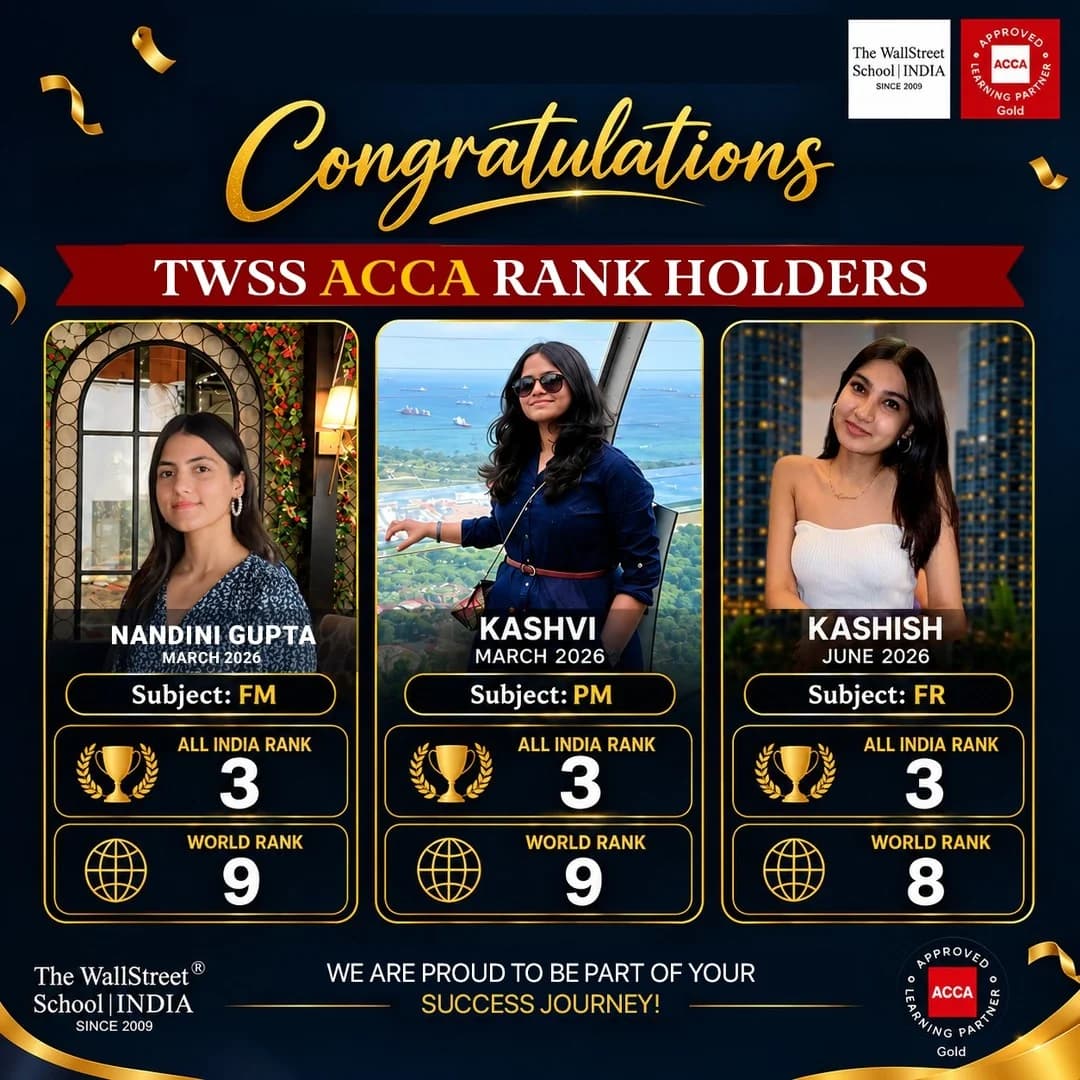
    Celebrating ACCA Achievers

    We are incredibly proud of our ACCA achievers, recognizing their hard work and dedication. We celebrate every milestone, acknowledging the completion of each exam paper as a significant step toward their overall success in the ACCA qualification.

    Student Video Testimonial

    Watch heartfelt testimonials from our students, sharing their firsthand experiences and success stories about their transformative learning journeys at our institution.

    Hear from our students

    Explore firsthand accounts of student experiences. Hear their stories, triumphs, and insights that make our community exceptional. Real voices, real impact.

    NEWS COVERAGE

    Explore the extensive media coverage highlighting innovative approaches and impact in financial education.

    ACCA Course Fee and Admissions

    Given the 3 levels of exams and the flexible exam pattern, the ACCA course duration is usually 2-3 years. During this period, the students can appear for the exams every quarter while continuing their 36 months of mandatory practical training.

    Knowledge Level

    Offline/Live - ₹ 65,000 Inc. GST
    (Recorded - ₹ 45,500 Inc GST)
    • 4 Subjects - LW, BT, MA
      and FA
    • HD Videos, Quizzes, Mock Tests, 3 Progress Test, 3 Mock Exam, Discussion Forum, Doubt Solving, and Revision Classes
    • 100% Job Guarantee ACCA Integrated Program

    Skills Level

    Offline/Live ₹ 1,05,000 Inc. GST
    (Recorded - ₹ 55,000 Inc GST)
    • 6 Subjects - PM, TX, FR, AA,
      FM
    • HD Videos, Quizzes, Mock Tests, 3 Progress Test, 3 Mock Exam, Discussion Forum, Doubt Solving, and Revision Classes
    • 100% Job Guarantee ACCA Integrated Program

    Professional Level

    Live - ₹ 105,000 Inc. GST
    Recorded - ₹ 65,500 Inc GST)
    • 4 Subjects - SBR (INT), SBL, Optional 1 & 2
    • HD Videos, Quizzes, Mock Tests, 3 Progress Test, 3 Mock Exam, Discussion Forum, Doubt Solving, and Revision Classes
    • 100% Job Guarantee ACCA Integrated Program

    Association of Chartered Certified Accountants

    ACCA stands for the Association of Chartered Certified Accountants, a UK based global body for accounting and finance professionals. The ACCA Course is one of the most recognised accounting qualifications in the world, accepted across more than 180 countries.

    So what exactly is the ACCA qualification? It’s a structured program that takes you from foundational accounting concepts all the way to strategic financial management, spread across a series of exams. Once you clear all the required papers and meet the practical experience requirement, you become an ACCA member, which opens doors to accounting and finance roles globally, not just in one country.

    Who should actually go for this? Commerce students, B.Com graduates, working professionals in finance and accounting and anyone who wants a qualification that’s respected internationally rather than in just one market. If your goal involves working with multinational companies, global accounting firms or even relocating abroad someday, the  ACCA Course Duration: How Long Does ACCA Take? make a lot more sense once you see how globally portable this qualification actually is.

    ACCA Course Levels and Structure

    The ACCA Course is broken into three levels and each one takes you a step closer to the full qualification.

    Applied Knowledge is where everyone starts. It covers the basics of accounting and business and it’s meant to build a strong foundation before things get more technical. This level has three papers and is generally considered the most approachable of the three.

    Applied Skills comes next and this is where the syllabus gets meatier. You’re now dealing with subjects like taxation, audit, financial management and financial reporting in more depth. There are six papers at this stage and most candidates spend the bulk of their ACCA journey working through this level.

    Strategic Professional is the final stretch. It’s split into two Essential papers and a choice of two from four Optional papers and it’s designed to test how well you can apply everything you’ve learned to real business and leadership scenarios. This is where ACCA starts feeling less like an exam and more like actual decision making.

    Across all three ACCA Levels, the exam structure moves from objective and short-form questions in Applied Knowledge to longer, case-study style questions by the time you reach Strategic Professional. It’s a gradual climb, not a sudden jump, which makes the whole thing manageable if you take it level by level.

    ACCA Course Syllabus and Subjects

    The ACCA Syllabus covers thirteen papers in total, though exemptions can reduce how many you actually need to sit for (more on that later). Here’s a breakdown of the ACCA Subjects at each level.

    Applied Knowledge:

    • Business and Technology
    • Management Accounting
    • Financial Accounting

    Applied Skills:

    • Corporate and Business Law
    • Performance Management
    • Taxation
    • Financial Reporting
    • Audit and Assurance
    • Financial Management

    Strategic Professional (Essentials):

    • Strategic Business Leader
    • Strategic Business Reporting

    Strategic Professional (Optional, choose two):

    • Advanced Financial Management
    • Advanced Performance Management
    • Advanced Taxation
    • Advanced Audit and Assurance

    At the Applied Knowledge level, students learn the fundamentals, how businesses operate, how to prepare basic financial statements and how management accounting works day to day. Nothing too intimidating here, it’s meant to ease you in.

    Applied Skills builds real technical depth. You’re learning how tax actually works in practice, how audits are conducted, how to read and prepare more complex financial reports and how financial management decisions get made inside a company. This is the level where the ACCA Course starts feeling genuinely professional.

    By Strategic Professional, the focus shifts to leadership and strategy. You’re expected to think like someone advising a business, not just someone recording its numbers. Subjects here connect accounting knowledge to bigger picture business decisions, which is exactly what senior finance roles demand.

    ACCA Course Eligibility

    ACCA Course Eligibility is fairly open, which is part of why so many students from different academic backgrounds end up pursuing it.

    Eligibility after 12th – Students who’ve completed their 12th grade with a minimum aggregate (usually around 65% in Math or Accounts and English and 50% in other subjects, though this can vary) can register directly for ACCA. This is actually one of the most common entry points, since students can start early instead of waiting until after graduation.

    Eligibility after B.Com – B.Com graduates are eligible too and they often qualify for exemptions on some of the foundational papers because of overlapping coursework. This can shave a fair bit of time off the overall journey.

    Graduates – Any graduate, not just commerce backgrounds, can register for ACCA. Non-commerce graduates might not get as many exemptions, but they’re still fully eligible to pursue the qualification.

    Working professionals – Since ACCA exams run across multiple sessions a year and the whole program is self-paced, working professionals in accounting or finance roles can absolutely prepare for it alongside their job. Many actually find that real work experience makes the syllabus click faster.

    ACCA Course Fees, Cost & Price in India

    ACCA Course Fees in India aren’t a single number, there are several components that add up over the course of the qualification. Understanding the full ACCA Course Cost upfront helps avoid surprises later.

    Here’s what typically goes into it:

    • Registration fees – a one-time fee paid to ACCA when you first register for the qualification.
    • Exam fees – charged per paper and these vary depending on how early you book your exam (early bird rates are usually cheaper than late registration).
    • Annual subscription – ACCA charges a yearly subscription fee to keep your registration active, payable each year until you complete the qualification.
    • Exemption fees – if you qualify for exemptions on certain papers, there’s usually a fee attached to claim each one, generally lower than sitting the actual exam.
    • Coaching fees – this depends entirely on which institute you go with and whether you choose live classes, recorded content or a combination.
    • Study material – sometimes bundled with coaching, sometimes purchased separately depending on the provider.

    Since ACCA fees are set in GBP and get converted, along with periodic revisions from ACCA itself, it’s worth checking the official ACCA website for the latest numbers before budgeting. Coaching fees in India also swing quite a bit based on the institute, the number of papers covered and what’s included in the package.

    ACCA Course Duration

    There’s no fixed answer to ACCA Course Duration, it depends heavily on how many papers you’re exempted from and how much time you can dedicate to studying.

    For a student starting fresh with no exemptions, the full ACCA journey typically takes around 2 to 3 years, assuming steady progress through all levels. Here’s roughly how it breaks down:

    • Applied Knowledge – around 6 months to a year, since it’s just three papers and mostly foundational.
    • Applied Skills – around a year to a year and a half, given there are six papers and the content gets more technical.
    • Strategic Professional – roughly a year, covering the two Essentials and two Optional papers.

    Exemptions change this timeline significantly. A B.Com graduate with several papers exempted might finish in under two years, since they’re skipping straight to Applied Skills or even further along.

    For working professionals, the duration often stretches a bit longer, simply because study time is squeezed around a full time job. That said, plenty of working professionals still complete the ACCA Course in the 2 to 3 year range by staying consistent with a study schedule rather than trying to rush through papers.

    ACCA Exemptions

    ACCA Exemptions let you skip certain papers based on your prior education, which can save a meaningful amount of time and money.

    So what are exemptions exactly? If you’ve already studied a subject in depth during your degree, say financial accounting or business law, ACCA may waive the requirement to sit that paper again, recognising that you’ve already demonstrated that knowledge.

    Who actually gets exemptions? It mostly comes down to your academic background:

    • B.Com graduates typically get exemptions on some Applied Knowledge papers and occasionally a couple of Applied Skills papers, depending on the university and syllabus covered.
    • MBA finance graduates sometimes qualify for exemptions too, again depending on subjects studied.
    • CA or CMA qualified professionals often get significant exemptions, sometimes clearing straight through to Strategic Professional.

    How do you actually check what you’re eligible for? ACCA provides an official exemption calculator on their website where you enter your qualification details and it tells you exactly which papers you can skip. It’s worth running this before you register, since it directly affects both your ACCA Course Duration and your ACCA Course Cost.

    ACCA Exam Pattern

    The ACCA Exam Pattern varies across the three levels, both in format and in what’s expected from candidates.

    Exam format – Applied Knowledge exams are computer-based and mostly objective, testing straightforward comprehension. Applied Skills exams mix objective and longer-form questions, requiring more written explanation. Strategic Professional exams lean heavily on case studies and scenario-based questions, closer to how you’d actually analyse a real business problem.

    Question types – Expect multiple choice at the Applied Knowledge level, a blend of calculation and written response at Applied Skills and extended case-based analysis at Strategic Professional, particularly in papers like Strategic Business Leader.

    Exam sessions – ACCA holds exams four times a year (March, June, September and December for most papers), which gives candidates a lot of flexibility compared to certifications with fixed annual windows.

    Passing criteria – Each paper is scored out of 100 and candidates generally need 50 marks to pass. Results are released a few weeks after each exam session.

    Since ACCA updates its exam structure and policies periodically, it’s a good idea to check the official ACCA website for the most current details before you sit for any paper.

    How to Prepare for ACCA Exams

    ACCA Exam Preparation works best with a plan you actually stick to, rather than winging it paper by paper.

    • Build a study plan – map out how many weeks you have before each exam session and divide the syllabus accordingly, so you’re not cramming in the final weeks.
    • Practice questions – work through past papers and practice questions regularly, ACCA’s own exam technique heavily rewards familiarity with question styles.
    • Revision – don’t leave everything for the end, go back to earlier topics periodically so they stay fresh.
    • Mock tests – sit full-length mocks under timed conditions before the real exam, this matters more at Strategic Professional where time pressure is real.
    • Time management – ACCA exams are notorious for being tight on time, especially the longer case-study papers, so practising under a clock is genuinely useful, not optional.

    Whether you go through ACCA Classes or prepare independently, the fundamentals stay the same. Consistent daily effort over weeks tends to beat last-minute intensive study, especially given how application-heavy the later papers get.

    ACCA Classes vs Self-Study

    Whether ACCA Classes or self-study suits you better depends on your background and how you personally learn best.

    Structured ACCA Coaching brings a few clear advantages. You get faculty support to walk through tricky concepts, dedicated doubt solving instead of figuring things out alone, mock tests built into the program and a study schedule someone else has already thought through for you. This tends to help a lot if you’re newer to accounting or find it hard to stay disciplined without external structure.

    ACCA Online Classes specifically have become a popular middle ground too, offering the structure of coaching with the flexibility to study around a job or other commitments, which matters a lot for working professionals.

    ACCA Self-study, on the other hand, works reasonably well if you already have a strong accounting or commerce background, you’re comfortable working through ACCA’s official study material independently and you’re disciplined enough to build and stick to your own schedule without much outside push.

    Neither path is objectively better, it really comes down to whether you learn faster with guided structure or whether you’re someone who thrives working things out on your own.

    ACCA Career Opportunities and Jobs

    An ACCA Course opens up a genuinely wide range of career paths, both in India and internationally. Here’s what some of the common ACCA Jobs actually involve.

    Financial Accountant – handles day to day accounting, prepares financial statements and ensures compliance with accounting standards.

    Financial Analyst – analyses financial data and trends to support business or investment decisions.

    Auditor – examines financial records to check accuracy and compliance, either internally within a company or externally through an audit firm.

    Finance Manager – oversees a company’s financial planning, budgeting and reporting, often managing a small team of accountants or analysts.

    Tax roles – work on tax planning, compliance and advisory, either within a company or at a professional services firm.

    Financial Reporting roles – focus specifically on preparing accurate financial statements in line with international accounting standards, which matters a lot for multinational companies.

    Given how globally recognised the qualification is, ACCA Career paths often extend beyond India into Middle East markets, the UK and other regions where ACCA holds strong recognition, which is a big part of the appeal for many students.

    ACCA Salary in India

    ACCA Salary in India depends a fair bit on experience, role and the type of company you’re working for.

    • Fresher salary – entry level roles for candidates who’ve recently completed or are close to completing ACCA typically start around what’s standard for junior accounting or finance analyst positions.
    • Experienced salary – professionals with a few years of experience post-ACCA, especially in audit, financial reporting or finance management roles, tend to see a solid jump from fresher pay.
    • Role-wise salary – auditors and financial reporting specialists at established firms often command different pay bands compared to financial analysts or tax professionals, largely based on demand and specialisation.

    Factors affecting salary go well beyond just holding the qualification. The hiring company, whether it’s a Big Four firm, an MNC or a smaller domestic company, along with prior work experience, the specific role and even the city you’re working in, all play into what someone actually ends up earning. ACCA opens the door, but the specific path you take after determines a lot of the outcome.

    Is ACCA Worth It?

    Is ACCA worth it? For a lot of students and professionals, the honest answer is yes, particularly if global mobility and accounting depth matter to your career plans.

    The career benefits are fairly clear. It’s recognised across more than 180 countries, which means an ACCA Career doesn’t box you into working in just one market. If you eventually want to work abroad or with multinational firms based in India, that global recognition genuinely counts for something.

    Global opportunities are a real draw too. ACCA members work across auditing firms, MNCs, banks and finance departments worldwide and the qualification is widely respected in markets like the UK, the Middle East and parts of Asia.

    Salary potential improves meaningfully as you gain experience post-qualification, though as mentioned earlier, it’s rarely just about the certificate on its own.

    Time and cost are worth weighing honestly though. The ACCA Course does require a real commitment, both in terms of study hours across multiple papers and the cumulative fees involved. It’s not something to start half-heartedly.

    Who should actually choose ACCA? Commerce students planning a career in accounting, audit or financial reporting, anyone eyeing international finance roles and working professionals who want a globally portable qualification without stepping away from their job to pursue it.

    How to Choose the Best ACCA Classes

    Picking the right ACCA Classes shapes a lot of how smoothly your preparation goes, so it’s worth comparing a few things before signing up.

    • Faculty – do the instructors have real accounting or finance experience, not just teaching experience?
    • Live classes – are live sessions available so you can ask questions in real time?
    • Recorded lectures – can you revisit sessions later or catch up if you miss a live class?
    • Mock tests – does the coaching include full-length mocks that mirror the real exam?
    • Study material – is quality material provided or do you need to source it separately?
    • Doubt support – how easily can you actually get a doubt resolved, live sessions, forums, one-on-one help?
    • Career support – does the institute offer any guidance on internships or job placement once you’re through with ACCA?

    Comparing ACCA Coaching providers on these points gives a much clearer picture than just looking at price or flashy marketing claims.

    Why Choose The WallStreet School for ACCA Classes?

    The WallStreet School structures its ACCA Classes around experienced faculty, consistent live teaching and steady support right through your ACCA journey.

    Faculty bring real accounting and finance backgrounds to their teaching, so lessons connect back to how concepts actually apply in practice, not just textbook definitions. Recorded classes sit alongside the live sessions, which is genuinely useful if you need to revisit a topic or missed a class due to work or other commitments.

    Doubt solving is built into the program rather than left as an afterthought, so you’re not stuck waiting on unanswered questions while trying to move forward with the syllabus. Mock tests and structured study material are part of the preparation too, giving you enough practice before you actually sit for each paper.

    Practical learning gets woven into the ACCA Coaching as well, with real-world examples and case studies that help concepts like financial reporting or audit make a lot more sense than they would from theory alone.

    Beyond exam prep, The WallStreet School also offers career support, helping candidates think through what comes next after ACCA, whether that’s an entry level accounting role, a move into audit or eventually working toward more senior finance positions.

    FAQs

    1. What is an ACCA Course?

    The ACCA Course is a globally recognised accounting qualification from the Association of Chartered Certified Accountants, covering accounting, taxation, audit and financial management across thirteen papers.

    1. What is the full form of ACCA?

    ACCA stands for the Association of Chartered Certified Accountants.

    1. Who is eligible for ACCA?

    Students who’ve completed 12th grade with the required marks, graduates from any stream and working professionals in finance or accounting are all eligible to register for ACCA.

    1. What are ACCA Course Fees in India?

    ACCA course fees include registration fees, per-paper exam fees, an annual subscription, exemption fees if applicable and optional coaching fees, which together make up the total ACCA course cost.

    1. What is the ACCA Course Cost?

    The total cost varies based on how many papers you sit for, how many exemptions you claim and whether you opt for coaching, so it’s best checked against current ACCA and coaching institute rates.

    1. How long does ACCA take?

    Most students complete ACCA in around 2 to 3 years, though this shortens with exemptions and can stretch longer for working professionals studying alongside a job.

    1. What are the ACCA subjects?

    ACCA subjects span thirteen papers across Applied Knowledge, Applied Skills and Strategic Professional, covering areas like financial accounting, taxation, audit, financial management and strategic business leadership.

    1. What is the ACCA syllabus?

    The ACCA syllabus is structured across three levels, moving from foundational business and accounting concepts to advanced strategic and leadership-focused papers.

    1. Can I do ACCA after B.Com?

    Yes, B.Com graduates are eligible for ACCA and often qualify for exemptions on some papers based on their existing coursework.

    1. What are ACCA exemptions?

    ACCA exemptions allow candidates to skip certain papers based on prior qualifications, reducing both the ACCA course duration and the overall cost.

    1. Are ACCA Classes necessary?

    Not strictly necessary, but ACCA classes help with structure, faculty support and doubt resolution, which many candidates find valuable compared to preparing entirely on their own.

    1. What is ACCA Salary in India?

    ACCA salary in India depends on experience, role and company type, with fresher pay typically in line with junior finance roles and experienced professionals earning considerably more.

    1. What are the career options after ACCA?

    Career options include financial accountant, financial analyst, auditor, finance manager and roles in taxation and financial reporting, both in India and internationally.

    1. Is ACCA worth it?

    For students and professionals aiming at accounting, audit or global finance careers, ACCA is generally worth the time and cost given its international recognition and career flexibility.

    To start the ACCA qualification, you typically need a minimum of 10+2 level education (equivalent to A-levels) from a recognized educational board or institution in India. Graduates and postgraduates from any discipline can also join the ACCA qualification directly without the need for additional qualifications.

    The ACCA course consists of a total of 13 exams divided into four levels: Applied Knowledge, Applied Skills, Strategic Professional, and Ethics and Professional Skills. The ACCA 2023 program consists of a total of 13 exams, covering subjects like business and technology, management accounting, financial accounting, corporate and business law, taxation, performance management, financial reporting, audit and assurance, as well as financial management.

    The ACCA duration may vary based on a student’s prior education, dedication, and study pace. On an average, it can take around 2 to 4 years to complete an ACCA course, considering both exams and practical experience requirements.

    Exams for BT, MA, FA and CL are on demand exams of 2 hours each and are 100% objective in nature. Exams for PM, FR, TX, AA and FM are held quarterly (March, June, September, December) and are 70% objective and 30% subjective. These exams are 3 hours long each. All exams at Professional level are also held quarterly (March, June, September, December) and are pre-seen based case study exams. Duration of these exams are 3 hours and 15 minutes.

    All exams are computer based exams.

    Anyone who has cleared 10th standard can start with the FIA (Foundations In Accounting) route. A commerce student can start after 12th standard from Knowledge level under the condition that he/she has scored above 65% in accounting, mathematics and English. If these conditions are not met then the student can still do ACCA via FIA route.

    ACCA qualification is accepted in 180+ countries including India. Demand for ACCA professionals is rapidly increasing in countries like India, Middle East, Canada, Singapore, etc. ACCA professionals are the most ideal employees for any MNC in today’s world. 

    ACCAs can work in Consultancy, Finance, Management Accounting, Accounting and Taxation (UK) profiles primarily.  Fresher ACCAs are hired not only by Multinational Companies like American Express, Bank of America, Genpact, General Electric (GE) but also by all the Big Four Companies (viz. PwC, Deloitte, KPMG and EY).  ACCAs are working for European MNCs and Indian MNCs alike. ACCAs are working in the same profiles and at the same positions as Indian CAs are working

    The total cost of ACCA is between 2 lakhs to 4 lakhs, depending upon the exemptions you avail. 

    Post clearing the ACCA exams, you can be open to choosing the following career options : 

    1. Management accountant
    2. Consultant
    3. Business analyst
    4. Corporate finance expert
    5. Subject matter experts
    6. Financial planner/advisors
    7. Tax consultant

    Besides the above mentioned options, you can also even set up your own firm, consulting and offer finance related solutions to corporates as well as business professionals. This will definitely give you a reputed outlook about yourself as well as your career.

    ACCA qualification is accepted in 180+ countries including India. Demand for ACCA professionals is rapidly increasing in countries like India, Middle East, Canada, Singapore, etc. ACCA professionals are the most ideal employees for any MNC in today’s world. 

    ACCAs can work in Consultancy, Finance, Management Accounting, Accounting, and Taxation (UK) profiles primarily.  Fresher ACCAs are hired not only by Multinational Companies like American Express, Bank of America, Genpact, General Electric (GE) but also by all the Big Four Companies (viz. PwC, Deloitte, KPMG and EY).  ACCAs are working for European MNCs and Indian MNCs alike. ACCAs are working in the same profiles and at the same positions as Indian accountants are working.

    ACCA has three levels to clear and after every level ACCA grants 

    Fresher ACCAs are hired not only by Multinational Companies like American Express, Bank of America, Genpact, General Electric (GE) but also by all the Big Four Companies (viz. PwC, Deloitte, KPMG and EY).

    ACCA affiliate/member’s salaries are at par with CA. Even without any prior experience ACCA candidates can be easily placed at a package of INR 3-6 lakhs per annum. With 3 years’ experience the salary can go up to 7-10 lakhs per annum. ACCA students & members usually earn 50-100% more than their non-qualified peers

    Qualification

    Exempted Papers

    12th Pass | Undergraduate

    No exemptions

    B.com | BAF | BBI

    BT, MA, FA & CL

    BBA | BMS

    BT

    CA Intermediate

    BT, MA, FA, TX & AA

    B.com + CA Intermediate 

    BT, MA, FA, CL, TX & AA

    CA Qualified

    BT, MA, FA, CL, PM, FR, TX, AA & FM

    CMA with 5 years of experience

    BT, MA, FA, CL, PM, FR, TX, AA & FM

    Undoubtedly, ACCA can be the best decision that you would take for your career. A qualification which is at par with CA curriculum, but also gives you a fair chance to clear the qualification with 40% to 50% passing rate is unmatchable. Moreover, by providing exemptions, conducting subject wise exams, being cost effective and by providing best job profiles, ACCA proves to be giving the best value for money.

    Yes. ACCA remains one of the most respected global accounting qualifications, recognized in over 180 countries. In 2027, employers are looking for finance professionals who combine ACCA knowledge with practical skills like Excel, Power BI, financial analysis and AI tools. ACCA opens career opportunities in accounting, audit, taxation, financial reporting, consulting and corporate finance across multinational companies, Big Four firms and Global Capability Centres (GCCs).

    Starting in 2027, ACCA is introducing a redesigned qualification structure to better align with the future of finance. The updated syllabus places greater emphasis on technology, AI, sustainability, data analytics and professional skills, while reducing the number of Strategic Professional exams students need to complete under the new pathway. Existing students will receive transition guidance from ACCA based on their exam progress.

    Yes. ACCA professionals are hired by Big Four firms, multinational corporations, banks, shared service centres, consulting firms and Global Capability Centres. Common roles include Financial Analyst, Auditor, Tax Consultant, Management Accountant, Financial Reporting Analyst, Risk Analyst and Business Finance Analyst. Building practical skills alongside ACCA can further improve your employability.

    No. AI is expected to automate repetitive accounting tasks such as data entry and routine reconciliations, but it cannot replace professional judgment, financial reporting, audit decisions, tax advisory, or strategic business analysis. Employers increasingly value ACCA professionals who know how to use AI effectively alongside their accounting and finance expertise.

    Yes. Students from science, arts, commerce, engineering and other academic backgrounds can pursue ACCA if they meet the eligibility requirements. Many successful ACCA students come from non-commerce backgrounds and build accounting knowledge through structured learning before progressing to advanced subjects.

    Our ACCA Related Blog

    Are You Ready to Get Started?

    We’re here to help. Send us an email or call

    ACCA Direct Connect​