CFA Coaching Classes
190,000+ strong network: Global expertise, practical skills, & ethical leadership.
- Join our CFA program with a 91% success rate and personalized support.
- CFA Level I & CFA Level II Coaching with 100% Placement Support
- 200 + Hours of HD Video Content with explanatory notes
- Solution bank of 2,500+ questions and summarized formula sheet
- Adaptive exam planner with mock tests
- Highly active Discussion Forum for doubt solving
Get a Call-Back
Where Our Students Work
The top choice for ambitious students, professionals, and leading organizations.


Pave Your Road to CFA Excellence, Lead in Finance.
Program Highlights

Career in Finance

In-Depth Learning

Skill Enhancement

Professional Growth

Accredited Certification

Future-Ready Skills
20+
Other Benefits
Leading the Way in Practical Financial Education
We're Widely
Accredited


Karan Singh
Ex-EY, Ex-GT, Ex-Infosys
Know your Mentor
- Chartered Accountant & Chartered Finance Analyst
- 10+ Years Work-Ex in Consulting (Valuations, Financial Modelling, Investment Banking)
- Appeared at Singapore Arbitration Court, Supreme Court in the Expert's Team
- Has led the operational team of RPs at India's biggest bankruptcy cases
- Taught 3000+ students of CFA (across levels)
CFA Course Curriculum
Discover How We Efficiently Cover Every Detail?
AI-driven, comprehensive, concept-focused, and industry-focused curriculum.
Benefits Of Joining CFA training With TWSS

Industry-Leading Experts and Seasoned Faculty

Comprehensive Curriculum

Real-World Case Studies and Practical Exercises

Advanced Tools and Techniques

Personalised Placement Support

Industry Recognition

1 - 1 Doubt Sessions

Tailored Mentorship
CFA® Coaching Classes
The CFA program at The Wall Street School (TWSS) offers a robust blend of theory and hands-on experience, ensuring you’re well-prepared for both exams and the finance job market. With a passing rate exceeding 91%, our students consistently outperform the average. Our experienced faculty, including CFA charterholders and top industry professionals, have trained over a few thousands of students since last 15 years. Since January 2024, the CFA Level 1 and Level 2 programs have incorporated expanded content on ESG factors, updated ethics standards, advanced quantitative methods, and the impact of AI and emerging technologies. Our program emphasizes practical skills through real-world case studies and simulations, equipping you to excel in the exams and thrive in your career.
The Wallstreet School's Placement Assistance Services

Career Guidance and Counselling

Comprehensive Assistance for Success
- Placement Assistance: The Wall Street School offers placement assistance to all its candidates.
- Assessment Completion: Candidates are added to the TWSS placement pool upon completing the assessments.
- Success-Based Model: The school operates on a success-based model.
- Placement Success Fee: A fee of Rs. 50,000 is charged once a candidate is placed and accepts the offer, facilitated by The Wall Street School.
Celebrating CFA Achievers
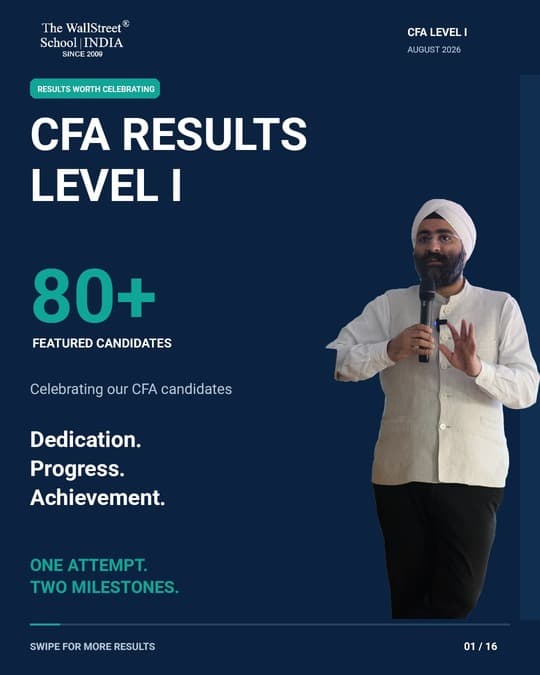
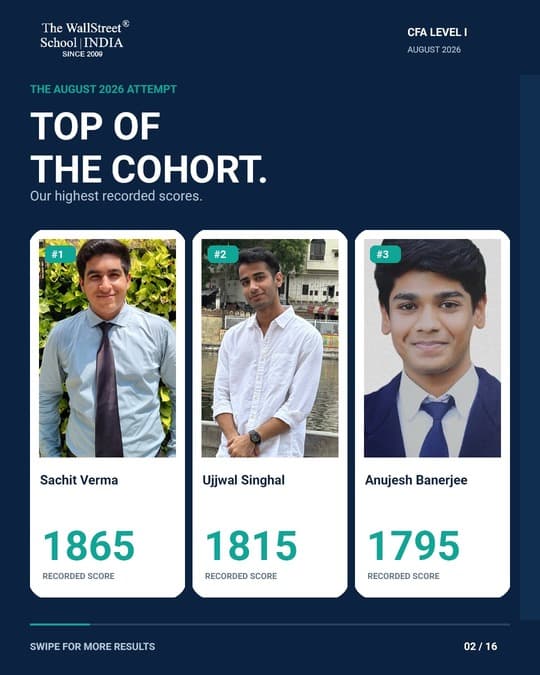
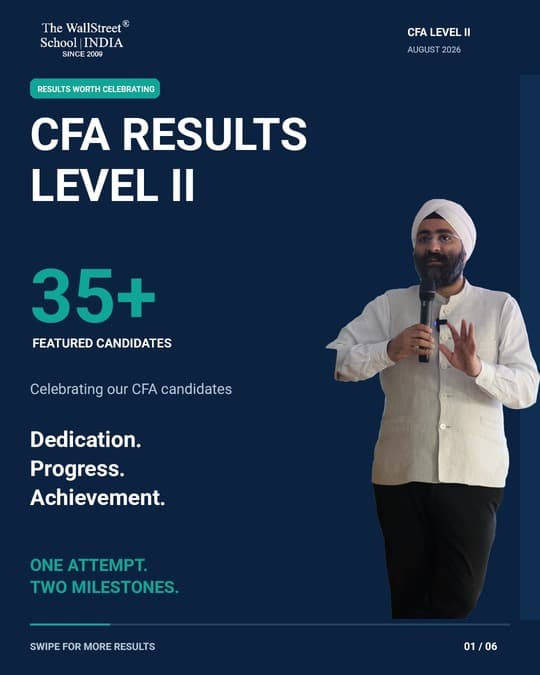
We are incredibly proud of our CFA achievers, recognizing their hard work and dedication. We celebrate every milestone, acknowledging the successful completion of each CFA level as a significant step toward their overall success in earning the CFA designation.
Hear from our students
Explore firsthand accounts of student experiences. Hear their stories, triumphs, and insights that make our community exceptional. Real voices, real impact.
NEWS COVERAGE
Explore the extensive media coverage highlighting innovative approaches and impact in financial education.
CFA Course Fees and Admissions
The CFA program is available to all candidates aiming to advance their knowledge in investment management, corporate finance, equity research, and related finance fields. We celebrate each level of achievement, marking successful completion of each stage with recognition from The Wall Street School. After completing each level, candidates are eligible for placement assistance.
CFA Level I
Classroom / Live Online-
CFA Level 1 classes with mocks, a comprehensive question bank, and personalized doubt solving.
CFA Level II
Classroom / Live Online-
CFA Level 1 classes with mocks, a comprehensive question bank, and personalized doubt solving.
Chartered Financial Analyst
The CFA Course is one of the most recognised finance programs for students and professionals looking to build careers in investment management, equity research, portfolio management and related finance roles. Offered by the CFA Institute, the program covers three levels and subjects including ethics, financial statement analysis, equity, fixed income, derivatives and portfolio management. For candidates who want structured preparation, CFA Classes can provide faculty guidance, study planning, practice questions and exam-focused support throughout the CFA journey.
So what does the CFA Program actually cover? Ethics, financial statement analysis, equity, fixed income, derivatives, portfolio management, the list goes on. It’s built for commerce graduates, working finance professionals and really anyone who wants to get closer to markets and investment decisions on a day to day basis.
You don’t need to wait for the “right time” either. Students take up CFA right after graduation, and plenty of working professionals prepare for it alongside a full time job since the exam windows are fixed throughout the year. Clear a few levels and career doors open up in equity research, investment banking, wealth management and asset management.
Before you enroll though, it helps to actually sit down and understand the CFA course eligibility, the CFA course fees in India, and roughly how long the CFA course duration stretches. A little planning here goes a long way instead of jumping in and figuring things out as you go.
What Is CFA? Understanding the CFA Course and Program
CFA stands for Chartered Financial Analyst. It’s a globally recognised charter given out by the CFA Institute, a US based non-profit that essentially sets the rulebook for the investment management profession.
Here’s something worth clearing up first: the CFA program isn’t a college degree. Think of it more as a self-paced, exam-driven CFA certification that you complete by clearing three levels of exams and putting in the required work experience. Once you’ve cleared all three and met the experience bar, you earn the CFA charter and can officially call yourself a charterholder.
The curriculum itself comes from the CFA Institute, which also runs the exams and hands out the charter at the end. And they don’t let it go stale either, the syllabus gets revised every year to keep pace with how financial markets actually work.
So what do you actually learn along the way? Reading financial statements properly, valuing companies and securities, managing portfolios, understanding fixed income and derivatives, and applying ethical standards when making financial calls. None of this is purely theoretical. It’s built to mirror what analysts and portfolio managers really do once they’re on the job.
Who should even consider this? Anyone aiming for a long career in investment research, portfolio management, equity analysis or asset management. Commerce and finance graduates, MBA finance students, and working professionals already in banking or financial services tend to get the most out of it.
One distinction worth keeping in mind: the CFA Program is the actual certification path, owned entirely by the CFA Institute. CFA coaching is a different thing altogether, it refers to the classes, mentorship and study support that institutes offer to help you prepare for these exams. Coaching doesn’t replace the CFA Program in any way. It just makes the journey through the curriculum a lot less confusing.
CFA Course Levels: Level I, Level II and Level III
The CFA course breaks down into three levels. Each one builds on the last, and honestly, each one tests you in a completely different way.
CFA Level 1 sticks to the basics of finance and investment concepts. Here’s what’s on the table:
- Ethics
- Quantitative Methods
- Economics
- Financial Statement Analysis
- Corporate Issuers
- Equity
- Fixed Income
- Derivatives
- Alternative Investments
- Portfolio Management
At this stage, questions lean toward knowledge and comprehension. You’re expected to know your definitions, your formulas, and be comfortable applying basic concepts across all ten topics.
CFA Level 2 is where things get real. You’re now applying what you learned in Level 1 to actual scenarios, not just recalling facts. The focus shifts to:
- Deeper financial analysis
- Application of concepts
- Valuation of securities
- Financial Statement Analysis
- Equity
- Fixed Income
- Portfolio Management
Questions here are built around case-style item sets, so you’ll need to read a scenario, pull out the relevant data, and stitch together multiple concepts to answer correctly. It’s a different kind of pressure than Level 1.
CFA Level 3, meanwhile, pivots almost entirely toward portfolio management and wealth management. By now you’re expected to bring everything together and apply it to real investment decisions. Expect:
- Portfolio Management
- Asset Allocation
- Wealth Management
- Investment Decisions
- Practical application across asset classes
Here’s a quick side by side to make sense of the three:
Level | Main Focus | Question Style |
Level 1 | Basic concepts across all topics | Multiple choice questions |
Level 2 | Applied financial analysis and valuation | Case based item sets |
Level 3 | Portfolio management and wealth management | Item sets and constructed response |
CFA Course Syllabus and Subjects
The CFA course syllabus rests on ten core subjects. These same ten subjects show up at every level, but how much weight they carry (and how deep you go) changes as you move from Level 1 toward Level 3.
Subject | What You Learn |
Ethics | Professional standards, codes of conduct and how to make ethical calls in investment management |
Quantitative Methods | Statistics, probability, time value of money, and how these show up in financial analysis |
Economics | Micro and macro principles that move markets, interest rates and currencies |
Financial Statement Analysis | Reading balance sheets, income statements and cash flow statements the right way |
Corporate Issuers | Corporate governance, capital structure and how companies actually run their business |
Equity Investments | Stock valuation methods, market structures and how to analyse equities |
Fixed Income | Bond pricing, yield curves, credit risk and everything around fixed income securities |
Derivatives | Options, futures, forwards, swaps, and how they’re used to manage risk |
Alternative Investments | Real estate, private equity, hedge funds, commodities |
Portfolio Management | Asset allocation, risk management, and building portfolios that actually make sense |
Ethics isn’t a one-time chapter, it runs through every single level of the CFA Program and carries real weight in your final score. It’s essentially the professional code of conduct every CFA charterholder is expected to follow for the rest of their career.
Quantitative Methods lays the mathematical groundwork for everything that comes after. Time value of money, probability distributions, hypothesis testing, these ideas keep resurfacing in later subjects, so it pays to get comfortable with them early.
Economics helps connect the dots between interest rates, inflation, currency movements and what they mean for your investment calls. It’s less about theory and more about how macro events trickle down to affect specific businesses and markets.
Financial Statement Analysis teaches you to read a company’s financial health straight from its statements. It’s one of the most heavily tested areas, across all three levels, so don’t rush through it.
Corporate Issuers look at how companies structure and finance themselves, and how they’re governed. Capital budgeting shows up here too.
Equity Investments is all about how stocks get valued and traded, along with the different valuation models analysts actually use.
Fixed Income covers bonds and debt instruments, how they’re priced, and what drives their returns up or down.
Derivatives brings in instruments used for hedging and speculation, plus the mechanics behind how they’re priced.
Alternative Investments steps outside the usual stocks and bonds conversation, which matters more and more given how modern portfolios are built.
Portfolio Management ties the whole syllabus together, teaching you how to build, manage and rebalance a portfolio around a client’s goals and appetite for risk.
CFA Course Eligibility
Compared to a lot of other finance certifications, CFA course eligibility is refreshingly flexible. The CFA Institute doesn’t gatekeep Level 1 registration too tightly.
To register for the CFA Program, you generally need one of these:
- A bachelor’s degree, or
- To be in the final year of your bachelor’s degree, or
- Four years combined of professional work experience and education
Can B.Com students do CFA?
Yes, and honestly it’s one of the most common backgrounds you’ll see among CFA candidates, since B.Com already covers some basic accounting and finance ground.
Can commerce students do CFA?
Yes. Doesn’t matter if you’re from B.Com, BBA or BAF, commerce students across the board are eligible.
Can engineering students do CFA?
Yes, and quite a few engineers actually go this route. That strong quantitative background tends to help with subjects like Quantitative Methods and Derivatives.
Can MBA students do CFA?
Yes. A lot of MBA finance students take up CFA alongside or right after their MBA to sharpen their investment analysis and portfolio management skills further.
Can working professionals do CFA?
Yes. Since the exam windows are fixed and prep is self-paced, plenty of people in banking and financial services study for CFA while still holding down their job.
Can final-year students apply?
Yes, final year students can register for Level 1. Just know you’ll need your degree in hand before moving further into the program.
CFA Course Fees in India
CFA course fees in India aren’t a single lump payment. There are a few moving parts here, since you’re paying the CFA Institute directly for registration and exams, and then separately for whatever coaching or study material you decide to go with.
Here’s roughly what makes up the total:
- CFA Institute fees – a one-time enrollment fee, plus a registration fee for each level’s exam.
- Exam-related costs – things like late registration charges or rescheduling fees if you need to push your exam date.
- CFA classes fees – depends heavily on the institute and whether you’re going live, recorded, or a mix.
- Study material – sometimes bundled into coaching, sometimes billed separately.
- Mock tests – many institutes throw these in as part of the coaching package.
- Other possible costs – travel or accommodation, if your chosen exam center happens to be in another city.
Cost | Paid To | What It Covers |
CFA Institute Fees | CFA Institute | Enrollment and exam registration for each level |
Coaching Fees | Coaching Institute | Live or recorded classes, faculty support, doubt resolution |
Study Material | CFA Institute or Coaching Institute | Curriculum books, question banks, reading material |
Mock Tests | CFA Institute or Coaching Institute | Practice exams that mirror the real test format |
Other Costs | Exam Center or Travel | Rescheduling fees, travel, local exam center charges |
CFA Institute fees do change from time to time, so it’s worth double-checking the official CFA Institute website for the latest CFA course fees before you register. Coaching fees in India swing quite a bit too, based on the institute, the mode of learning, and what’s actually included (mock tests, doubt support, and so on).
CFA Course Duration: How Long Does It Take?
There’s no single answer to CFA course duration, it really comes down to how fast you clear each level and how much time you can realistically put in. Most candidates end up taking around four years for all three levels, though this can stretch shorter or longer depending on the person.
Rough timelines candidates usually work with:
- Level 1 – somewhere around 4 to 6 months of prep
- Level 2 – closer to 5 to 7 months, since the content gets a lot more applied
- Level 3 – roughly 5 to 6 months, with most of the focus on portfolio management
The CFA Institute suggests a minimum of 300 study hours per level, but plenty of candidates need more than that depending on their finance background and how quickly concepts click for them.
Here’s the journey laid out simply:
Level 1 → Level 2 → Level 3 → CFA Charter
Why does completion time differ so much between students? A few reasons really: prior exposure to finance, whether they’re studying full time or juggling it with a job, how many attempts a level takes, and just how consistent their study schedule ends up being.
CFA Exam Pattern and Structure
The CFA exam pattern shifts noticeably as you move up the three levels, both in how questions are asked and how you’re expected to answer.
Level 1
Level 1 sticks to multiple choice questions spread across all ten topics. It’s testing basic knowledge and comprehension, so questions tend to be fairly direct and formula-driven compared to what comes later.
Level 2
Level 2 introduces item sets, essentially case-style questions built around a short scenario called a vignette. Each vignette comes with a handful of questions attached, testing how well you can apply concepts to that specific situation rather than just recall them.
Level 3
Level 3 mixes item sets with constructed response questions, where you’re actually writing short answers instead of picking from options. Naturally, the focus here leans heavily toward portfolio management and how it plays out in real decisions.
Level | Question Format | Testing Focus |
Level 1 | Multiple choice questions | Knowledge and basic application |
Level 2 | Item sets based on vignettes | Applied financial analysis |
Level 3 | Item sets and constructed response | Portfolio management application |
The CFA Institute does tweak exam formats and policies now and then, so it’s a good habit to check their official website for the latest structure before you start planning your prep.
How to Prepare for the CFA Exam
There isn’t one magic formula for CFA prep, but a structured approach definitely helps. Here’s a step by step way to think about it.
- Understand the curriculum – Look at the topic weightage for your level before you even start, so you know where to spend more time.
- Create a study plan – Break the syllabus into weekly targets based on however much time you actually have before the exam.
- Learn concepts – Focus on the logic behind formulas and frameworks rather than just memorising them.
- Practise questions – Solve topic-wise questions right after finishing each section, don’t let it pile up.
- Identify weak areas – Keep track of which topics keep tripping you up and give those extra attention.
- Revise – Circle back to older topics along the way instead of dumping all your revision at the very end.
- Take mock tests – Sit through a few full mocks under real exam conditions to build up your time management.
- Analyse mistakes – After each mock, dig into why you got something wrong, not just what the right answer was.
- Final revision – In the last few weeks, stick to summary notes and formula sheets rather than starting anything new.
Consistency beats intensity here. Two to three focused hours a day, spread over several months, tends to work a lot better than cramming in irregular marathon sessions right before the exam.
CFA Classes vs Self-Study: Which Is Better?
There’s no universal answer between CFA classes and self-study, it really depends on how you learn and how much time you can carve out to build your own structure.
Factor | CFA Coaching | Self-Study |
Study Structure | Structured schedule handed to you by the institute | You build your own plan from scratch |
Faculty Support | Access to experienced faculty for explanations | No direct faculty access |
Doubt Resolution | Resolved through classes or dedicated sessions | You’re relying on forums or your own research |
Mock Tests | Usually bundled into the program | You need to source these separately |
Accountability | Regular classes create built-in accountability | Comes down entirely to self-discipline |
Flexibility | Fixed schedules for live classes, though recorded options exist | Complete flexibility on timing |
Cost | Extra cost on top of CFA Institute fees | No extra cost beyond official material |
CFA classes tend to help candidates who are new to finance, learn better with structure, or just want faculty around to clear doubts quickly. Self-study, on the other hand, works well if you already have a solid finance background and enough discipline to work through the curriculum on your own terms.
Skills You Develop Through a CFA Course
A CFA course builds a fairly wide set of practical finance skills, ones that translate directly into investment and analysis roles.
- Financial Analysis – reading and interpreting company financials to gauge performance
- Investment Analysis – weighing different investment options against risk and return
- Equity Research – analysing stocks and building out investment recommendations
- Financial Statement Analysis – going deep into balance sheets, income statements and cash flow statements
- Valuation – estimating what a company or security is actually worth using different models
- Portfolio Management – building and managing portfolios around a client’s goals
- Fixed Income – understanding bond pricing, yields and credit risk
- Risk Analysis – spotting and measuring financial risk in investment calls
- Quantitative Analysis – applying statistical and mathematical tools to real financial problems
- Investment Decision-Making – blending analysis with judgment to make sound calls
- Professional Ethics – applying ethical standards consistently, not just when it’s convenient
These skills aren’t boxed into a single job title. They show up across research, portfolio management, corporate finance and risk roles, which is a big reason the CFA certification carries weight across so many corners of the finance industry.
CFA Career Opportunities and Jobs
A CFA course opens up quite a few career paths across finance. Here’s a quick look at what some of these roles actually involve.
Financial Analyst – digs into company financials and market trends to back investment or business decisions.
Investment Analyst – researches opportunities across asset classes and puts together recommendations for portfolio calls.
Equity Research Analyst – studies specific stocks or sectors closely to build buy, sell or hold recommendations.
Portfolio Analyst – supports portfolio managers by analysing holdings, performance and risk exposure.
Portfolio Manager – actually makes the investment calls for a fund or client portfolio, balancing risk against return based on the objectives at hand.
Risk Analyst – identifies and measures financial risks tied to an organisation’s investments or day to day operations.
Investment Banking – works on deals like mergers, acquisitions and capital raising for companies.
Wealth Management – advises individual or institutional clients on growing and protecting their wealth.
Corporate Finance – handles financial planning, budgeting and capital structure decisions inside a company.
Asset Management – manages investment funds for clients, aiming to hit specific return targets.
Research – involves continuous analysis of markets, sectors or companies to feed into investment strategy.
The CFA Program gives you the analytical foundation for all of these, but what you actually land depends on things like prior experience, which level you’ve cleared, and whatever extra skills you bring beyond the certification itself.
CFA Salary in India
CFA salary in India swings quite a bit depending on experience, the role, and which part of the industry you’re in.
- Fresher – entry level roles after clearing Level 1 or Level 2 usually fall in line with junior analyst positions on research or finance teams.
- Early career – a couple of years in, along with progress through the CFA Program, and most professionals see a real step up as they move into more analytical work.
- Experienced professionals – CFA charterholders with several years under their belt, especially in equity research or portfolio management, tend to command noticeably higher pay.
- Financial Analyst – salaries here hinge on company size and how complex the analysis actually gets.
- Equity Research – pay often tracks the performance and reputation of the research team, alongside individual experience.
- Investment roles – compensation in investment banking and asset management varies a lot based on the firm and the deal exposure involved.
- Portfolio Management – senior portfolio roles sit among the higher paying options within the CFA path, though they usually come after years of experience, not right out of the gate.
Worth saying plainly: the CFA certification by itself doesn’t determine salary. The hiring company, the specific role, prior work experience and general market conditions all play into what someone actually ends up earning.
Is the CFA Course Worth It?
Whether the CFA course is worth it really comes down to what career you’re aiming for.
It tends to genuinely pay off for careers in:
- Investment Management
- Equity Research
- Portfolio Management
- Investment Analysis
- Wealth Management
- Related finance careers built around analysing markets and securities
For these paths, the CFA curriculum lines up closely with the actual work involved, so the certification stays directly relevant once you’re on the job.
That said, it’s not the right fit for everyone. If you’re aiming for something outside investment management, say pure accounting, taxation or general corporate roles unrelated to markets, other certifications might serve you better. CFA also asks for a serious time commitment stretched across multiple years, so it’s worth being honest with yourself about long term goals before jumping in.
A good gut check: look at what CFA charterholders actually spend their days doing, and see if that lines up with the career you actually want.
Who Should Pursue a CFA Course?
The CFA course fits a fairly wide range of people, including:
- Commerce students aiming to build a career around finance and investments
- Finance students who want to go deeper than what a regular degree covers
- Economics students curious about applying economic theory to real markets and investments
- MBA students specialising in finance who want an added credential focused on investment analysis
- Working professionals in banking or financial services looking to shift into more analytical roles
- Investment professionals already in the field who want formal recognition for their expertise
- Students interested in Equity Research who want structured grounding in valuation and analysis
- Students interested in Portfolio Management who eventually want to manage funds or client money
If your goals involve analysing companies, managing investments, or advising people on financial decisions, the CFA course is genuinely worth a closer look.
How to Choose the Right CFA Classes Institute
Picking the right CFA classes institute actually matters quite a bit, it shapes how well you understand the curriculum and whether you stay consistent through the whole prep journey.
Here’s what’s worth comparing before you commit to one:
- Faculty experience – do the faculty actually have real industry background in what they’re teaching?
- CFA curriculum coverage – does the coaching cover the full syllabus for your level, not just parts of it?
- Live classes – are live sessions available for doubts in real time?
- Recorded lectures – can you go back and revisit classes or catch up on ones you missed?
- Practice questions – is there enough topic-wise practice to actually build confidence?
- Mock exams – are full-length mocks part of the package?
- Doubt support – how do doubts actually get resolved, live sessions, forums, one-on-one help?
- Study planner – is there a structured plan to help you pace things properly?
- Revision support – are dedicated revision sessions offered as the exam gets closer?
- Faculty access – how easy is it to actually reach faculty when you’re stuck?
- Practical examples – does the teaching connect back to real market examples, or is it all textbook theory?
- Career support – is there any guidance on internships or job opportunities once you’re through with CFA?
Running through these points gives you a much clearer picture than just comparing fees or advertised pass rates.
Why Choose The WallStreet School for CFA Classes?
The WallStreet School builds its CFA coaching around structured live classes, faculty with real finance experience, and consistent doubt support all through the CFA course journey.
Classes are taught by faculty who bring practical finance backgrounds to the table, so concepts come with real market context instead of just textbook explanations. Recorded content sits alongside the live classes too, which comes in handy for revision or if you happen to miss a session.
Preparation includes access to mock tests and a structured question bank, so there’s enough practice built in before the actual CFA exam rolls around. A study planner helps pace things out across the syllabus, instead of leaving everything to pile up in the final weeks.
Doubt solving is baked into the program, so you’re not left stuck on a concept with nowhere to turn. Classes also weave in practical case studies that tie CFA concepts back to real financial analysis and decision making.
Beyond just exam prep, The WallStreet School offers career support to help candidates figure out their next move after the CFA course, whether that’s an internship, a job switch, or a shift into a more analytical role.
Practical Learning Alongside CFA Preparation
Practical learning adds real value to CFA prep because it connects textbook concepts to how financial analysis actually plays out in the industry.
Working through real financial examples helps you see how concepts like valuation or financial statement analysis apply to actual companies, not just made-up numbers in a textbook. Case studies built around real market situations make it a lot easier to grasp how portfolio management and investment decisions unfold in practice.
This kind of exposure typically covers:
- Financial analysis using real company data
- Case studies based on actual market events
- Valuation exercises built on live company financials
- Investment decision-making frameworks used by working analysts
- Broader practical finance skills that go beyond just clearing the exam
None of this replaces the CFA curriculum, it just complements it. It gives you a clearer sense of how the concepts you’re studying actually show up in day to day investment work, which also helps things stick better while you’re preparing.
CFA Results and Student Experiences
Every candidate’s CFA journey looks a little different, shaped by their background, the level they’re working through, and the kind of support they lean on along the way.
Here’s a simple way to picture a typical journey:
Student → Background → CFA Level → Learning Experience → Career Outcome
Take a commerce graduate, for instance. They might start CFA Level 1 right after their degree, build a solid foundation through structured coaching and mock tests, and eventually move into a research analyst role once they’ve cleared a few levels. Or take a working professional in banking, prepping for CFA alongside their job using recorded classes and weekend study time, gradually working their way toward a more analytical role within their organisation.
Real outcomes end up varying quite a bit, shaped by individual effort, prior experience, and whichever career path a candidate ends up choosing after the CFA course.
FAQs
- What is a CFA Course?
The CFA Course is a globally recognised finance certification from the CFA Institute, covering ethics, financial analysis, equity, fixed income and portfolio management across three exam levels.
- What is the CFA full form?
CFA stands for Chartered Financial Analyst.
- Who is eligible for CFA?
Anyone with a bachelor’s degree, currently in their final year of graduation, or with four years of combined education and work experience can register for the CFA Program.
- What is the CFA Course fee in India? It includes CFA Institute enrollment and exam fees, plus optional coaching fees, study material and mock test costs, which vary depending on the institute you go with.
- How long does CFA take?
Most candidates take around four years to get through all three levels, though this shifts based on individual pace and how much time goes into prep.
- Is CFA difficult?
It’s a genuinely challenging certification, especially Level 2 and Level 3 with their applied question formats, but steady preparation makes it very doable.
- Can I do CFA after B.Com?
Yes, B.Com graduates are eligible and often start with a bit of an edge given their existing accounting and finance background.
- Can working professionals do CFA?
Yes, since exam windows are fixed and prep is self-paced, it’s entirely possible to study for CFA alongside a full time job.
- What are the CFA career options?
Roles like financial analyst, equity research analyst, portfolio manager, risk analyst, and positions across investment banking, wealth management and asset management.
- What is CFA salary in India?
It varies by role, experience and sector, and comes down to more than just the certification itself, things like the hiring company and prior work experience matter too.
- Is CFA better with coaching or self-study?
Both can work. Coaching helps with structure, faculty support and accountability, while self-study suits candidates who are disciplined and already have a finance background.
- What is the difference between CFA classes and the CFA Program?
The CFA Program is the official certification path run by the CFA Institute. CFA classes are the classes and study support institutes offer to help candidates prepare for those exams.
The Wall Street School CFA coaching is a carefully designed course for the aspirants of Chartered Financial Analyst (CFA) certification. Our course provides extensive and up-to-date coverage of all exam topics by highly experienced and professionally qualified faculty members. We at TWSS pride ourselves on imparting both theoretical and practical knowledge that helps you gain a real-life perspective of the usage of key financial concepts.
The CFA certification is based in the US and is designed keeping in mind the international needs of financial reporting and analysis to aid management decisions. Hence, you can endure a top career as a CFA anywhere in the world. Many Fortune 500 companies are entering India to manufacture and curate a market for their products. On the other hand, corporates in India are also expanding their operations globally. They prefer hiring experienced CFAs to meet international standards on financial reporting and help the management in decision-making. All-in-all the future certainly looks bright if you are a CFA in India.
The CFA course is highly professional and has been traditionally preferred by students who can afford to invest a good amount of money and time in studying. The course being based in the US and requiring extensive preparation has also discouraged students in the past. Hence, only some had the privilege of appearing for the exams. However, the TWSS CFA course aims to make learning available to every aspiring student. If you are a graduate and aspire to become a CFA, join the TWSS CFA coaching Now!
CFA consists of 3 levels of exams spanning over 36 months including requirements for working experience in the field of finance and accounts. It tests you for thorough knowledge in subjects like Financial Reporting, analysis, corporate finance, valuation, economics, qualitative techniques, etc. The TWSS CFA course provides approx. 150+ hours of live and recorded training for the preparation of each level including extensive notes, question bank, summary sheets, mock tests, and much more. Join now to prepare for the CFA exams!
As a CFA, you can have a career in various roles. Here’s the scope of the CFA course in India along with the average annual salaries:
- Market Research Analyst: 7-10 L
- Portfolio Manager: 7-17 L
- Investment Banker: 9-18 L
- Business Analyst: 7-12 L
- Equity Analyst: 6-10 L
- Risk Manager: 9-15 L
- Finance Manager: 10-17 L
With growing experience, you can expect challenging roles and higher-paying jobs.
Both CA and CFA are professional courses in the field of finance and accounting. But, it is difficult to say whether one is harder than the other. Although, CFA is certainly more widely accepted around the world. Here’s why:
- The course is based in the USA and students from across the globe apply for the course.
- While CA is focused on the preparation of accounts and auditing, the CFA course focuses on making use of the accounting data, analyzing it, and aiding management decisions.
- CFA has a global outlook and focuses on learning about the International standards unlike CA which is more India-centric.
MBAs in general cover all aspects of management and hence have a broader outlook on how a business functions, CFA is a specialized certification in the field of finance. Usually, the role of a CFA is to analyze historical data and draw financial models for the business that will help the management make correct decisions. On the other hand, MBAs are a part of the management and use this analysis to make decisions and work on their implementation.
One of the reasons students are reluctant to apply for the CFA course is because of the high tuition fees, exam fees at each level, etc. As the exam is conducted by the CFA Institute, USA, it costs more to appear for the exams from India. The components of the fees include:
- Standard Registration Fee
- One-time Enrollment Fee
- Exam Fees
- Exam Rescheduling Fees
But, it is our mission at TWSS to make learning affordable for the students. Hence, our CFA course tuition charges are only Rs. 29,500 for each level which is much lesser compared to the exam fees.
One-time enrolment fee of $350 when you register with CFA Institute. For each level, you have to exam fee. Early exam fee $900 and Standard exam fee $1,200.
Additionally, candidates have to pay 18% GST on above fees.
CFA (Chartered Financial Analyst Course) is a US-based certification for students who want to build a successful career in the field of finance. At the same time, CFA is an expensive exam and every aspirant wants to clear it in their first attempt. For this, you should choose to learn from the best. The Wall Street School CFA course is a carefully curated curriculum by our expert faculties with immense experience. It helps you clear all the exams in the minimum possible time.
What do you get by choosing the TWSS CFA coaching? Here are some features of our course:
- 120+ hours of recorded video classes
- 150+ hours of live training from our highly experienced trainers
- Explanatory notes and Summary Sheets including important formulas
- 2500+ solved exam questions
- Mock Tests and Study Planners
- Flagship courses for Financial Modeling and Python
Apart from the elaborate details about the TWSS CFA course, what makes it better and why should you choose it to prepare for the CFA exams? Here are some key pointers about TWSS that you should reflect on before making your decision:
- Focus on Learning: We live in times where under exam pressure, learning takes the back seat. But, the TWSS CFA coaching is designed to promote both practical and theoretical learning to make you both exam-ready & job-ready.
- High Passing Rate: The passing rate for our students in the CFA course is over 91% which is approx. 2.5 times the average pass rate of the CFA exams.
- Experienced Faculty: We have a full-time highly experienced faculty for the CFA coaching. We have trained more than 25,000 successful students over the last 15 years with TWSS. Our faculty members for the course are either CFA charter holders or CAs with top management experience in consulting and investment banking.
- Up-to-date Course syllabus: With our learning-based approach, we do not compromise on any aspect of the CFA course. Hence, the syllabus is always kept updated. We have already added topics like Financial Modeling and Python as these topics have been introduced in the CFA level 1 exams from 2024.
- Extensive Practical Training: Unlike other educators who focus on classroom teaching and theory alone, the TWSS CFA course is studded with sessions based on real-world case studies, scenarios, simulations, etc. This helps you understand the practical uses of the concepts that you learn. Hence, the focus is not only on clearing the exams but also on making you skilled enough to land a job as soon as you are qualified.
Know More About CFA Course
The CFA exam has three levels. You should prepare for at least six months for each level. So, if you pass all three levels one after another, you could complete the CFA exam in 18 months. But it’s a bit challenging to pass all three levels in a row because most students have other things to do besides studying for the CFA, like work or other responsibilities. On average, it takes candidates around 3 to 4 years to finish all the levels.
- CFA Level I exam pass rate close to 41%
- CFA Level II exam pass rate close to 45%
- CFA Level III exam pass rate close to 52%
(Based on 10-year average pass rate)
The CFA Institute doesn’t reveal the exact minimum passing score. Instead, the MPS (Minimum Passing Score) for each attempt is determined by the CFA Institute Board of Governors. From what we’ve observed, scoring around 70% is generally needed to successfully pass the exam.
- For CFA Level I, there will be 180 multiple-choice questions (MCQs) with three options: one right and two wrong.
- For CFA Level II, there will be 22 case-study MCQs. Each case study will have 4 MCQs.
- In CFA Level III, there will be 11 case-study MCQs and 11 sets of essay questions.
Each level of the CFA exam takes place in one day and lasts for 4 hours and 30 minutes.
- For CFA Level I and II: Within 5-7 weeks of taking the exam
- For CFA Level III: Within 6-8 weeks of taking the exam
Meet any of the following enrolment requirements:
- Bachelor’s degree
- Undergraduate student (while they are in their second last year of graduation)
- Professional work experience including internships (4,000 hours of work experience acquired over minimum of three years). Professional work experience does not need to be investment related.
CFA Related Blogs
Are You Ready to Get Started?
We’re here to help. Send us an email or call