So, you have looked at your bank account, looked at the soaring sky-risers in Mumbai, Gurgaon, or Bengaluru and decided that a plain old college degree is not going to cut it anymore. You want to break into the big leagues of corporate finance. But right at the starting line, you are hit with the ultimate finance certifications comparison: should you choose ACCA or FRM?
Choosing between these two is not just about picking a set of alphabet soup titles to stick next to your name on LinkedIn. It is about deciding how you want to spend your Mondays for the next thirty years.
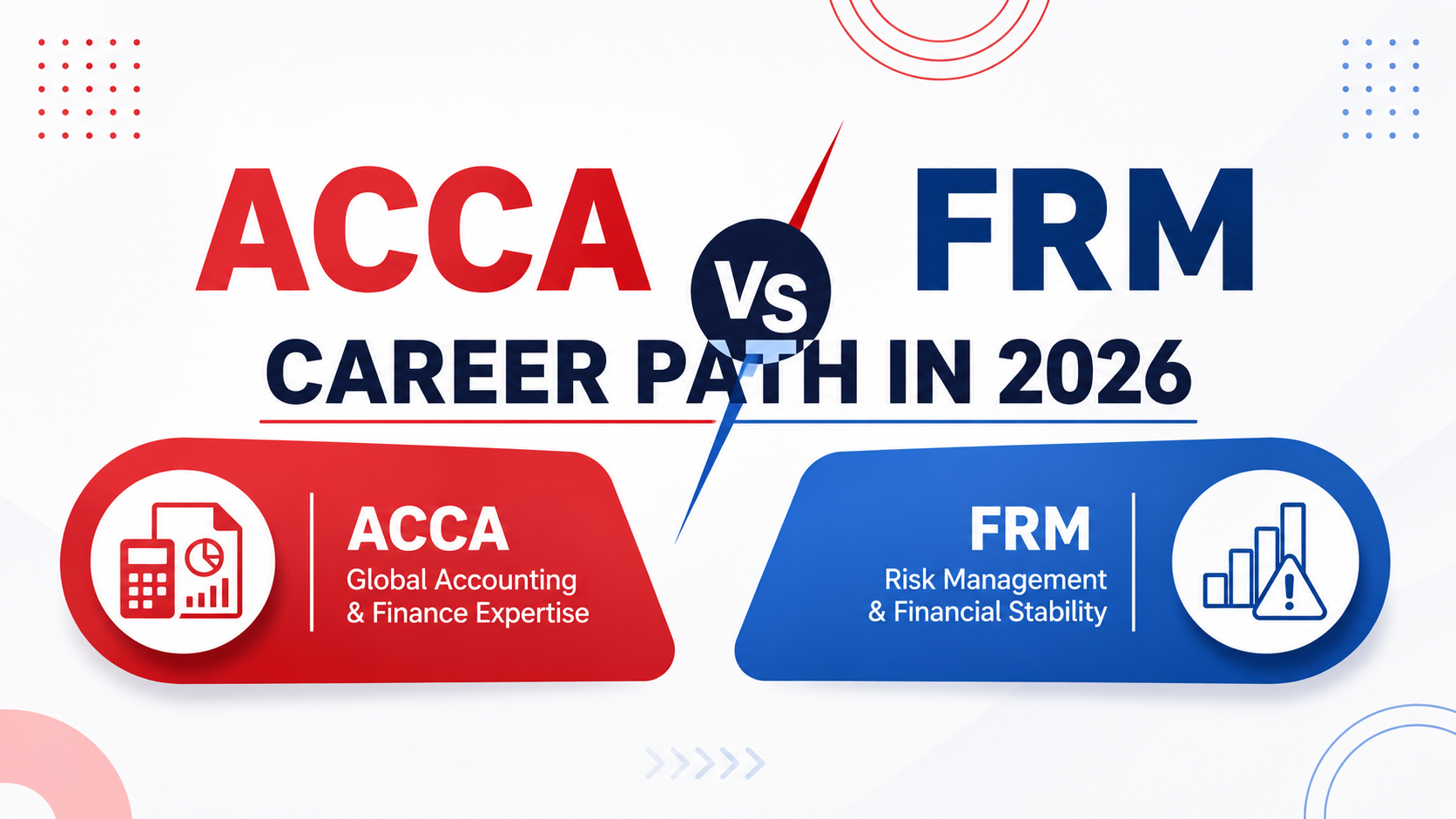
Do you want to be the sharp corporate strategist steering global MNCs through massive financial expansions, or do you want to be the financial wizard protecting Wall Street investment banks from catastrophic market crashes? Let’s strip away the marketing fluff and look at the ground reality of the ACCA vs FRM career path in 2026.
1. Demystifying the Core: What Are They Anyway?
Before we look at the money, we need to understand what these qualifications actually train your brain to do. They operate in completely different hemispheres of the financial universe.
The Finance Spectrum
ACCA- Broad Corporate Finance, IFRS & Business Management
FRM- Niche Tech, Risk Models, Market Analytics
ACCA: The Global Corporate Swiss Army Knife
The Association of Chartered Certified Accountants (UK) is essentially your passport to global business management. Think of it as a Chartered Accountancy degree but with a British passport and an intense focus on International Financial Reporting Standards (IFRS). It does not just drill you on numbers, but also teaches you how businesses run, how corporate laws function globally and how to audit massive multinational operations. If a company exists, it needs someone with the skills of an ACCA to keep it profitable, compliant and structured.
FRM: The Financial Shield
The Financial Risk Manager certification, awarded by GARP (USA), is an entirely different beast. FRMs are not accountants; they are quantitative risk specialist professionals. They spend their time studying market volatility, stress-testing credit portfolios and writing algorithms to ensure a sudden economic black swan event doesn’t bankrupt an investment bank overnight. It is deeply technical, heavily math-oriented and intensely focused on the banking, hedge fund and fintech ecosystems.
2. Curriculum, Passing Rates and the “Pain Factor”
Let’s talk about the actual grind, as neither of these courses is a walk in the park, but the type of pain they inflict on your social life is quite different.
| Feature | ACCA (UK) | FRM (USA) |
| Total Papers | 13 Papers (with up to 9 exemptions for B.Com/CA grads) | 2 Parts (Part I and Part II) |
| Exam Schedule | 4 Windows a year (March, June, September, December) | Multiple Windows (typically May, August, November) |
| Pass Rates | Comfortably ranges from 40% to 50% globally. | Historically hovers around 40% to 45%. |
| Average Duration | 2 to 3 years (highly flexible pacing) | 1 to 1.5 years (fast paced but intense) |
The ACCA Exam Journey
The beauty of ACCA lies in its structural flexibility. You do not have to write a massive group of exams all at once and risk failing the entire batch because of one bad paper. You can take things one exam at a time. The curriculum is split into three progressive tiers: Applied Knowledge, Applied Skills, and Strategic Professional. It transitions smoothly from basic bookkeeping concepts to complex international tax planning and corporate governance, allowing your brain to adapt to the professional rigor gradually.
The TWSS Advantage: As an Approved ACCA Gold Learning Partner, The WallStreet School (TWSS) turns this theoretical grind into an interactive boot camp. Led by veteran corporate mentors, TWSS combines core ACCA preparation with intensive practical skill training in Financial Modeling, Advanced Excel and Stock Valuation. This means you don’t just clear the 13 papers, you enter your first interview knowing exactly how corporate desks operate in real-time.
The FRM Exam Journey
FRM is a short, sharp sprint that will test your mathematical limits. It is divided into just two parts, but each part is an absolute mountain of information. Part I dives deep into quantitative analysis, financial markets, and foundational valuation models. Part II throws you into the deep end of practical risk management—specifically market risk, credit risk, operational risk, and investment management strategy. If statistical distributions, calculus, and financial engineering models give you nightmares, FRM will feel like a thriller movie.
The TWSS Advantage: You cannot crack FRM by just memorizing definitions. At TWSS, our FRM coaching programs are engineered by certified risk practitioners and investment bankers who have managed multi-million dollar corporate transactions. With access to over 2,500 structured questions, extensive mock databases, and dedicated 1-on-1 doubt clearing, we strip away the intimidating math jargon and map the curriculum directly to corporate application.
3. The Money Talk: ACCA Salary vs FRM
Let’s be honest– this is why you are here. When comparing ACCA salary vs FRM, you are looking at two highly lucrative, yet completely different corporate compensation structures in the Indian market.
The ACCA Compensation Trajectory
Because ACCA positions you for roles across mainstream corporate finance, auditing, and financial planning & analysis (FP&A), your salary scales predictably with corporate titles.
- Freshers (0–2 Years): At the entry level, freshers stepping into Big 4 assurance or shared service roles pull in a starting package of Rs 4 to Rs 8 LPA. If you have internships under your belt, reaching the higher end of that bracket is highly achievable.
- Mid-Level (3–6 Years): Once you move into Senior Consultant, Assistant Manager, or FP&A Specialist positions, the salary numbers scale rapidly to Rs 8 to Rs 18 LPA.
- Leadership (7+ Years): For seasoned professionals stepping into corporate roles like Finance Controller, Director of Finance, or elite global consulting partners, compensation routinely sits between Rs 20 to Rs 45 LPA, scaling well beyond Rs 60 LPA at the absolute C-suite (CFO) level.
The FRM Compensation Trajectory
FRM salaries operate on a slightly higher starting curve because risk management is a specialized, high-stakes niche. Banks are willing to pay a premium to professionals who protect their capital from market volatility.
- Freshers (0–2 Years): A fresher who has cleared both parts of the FRM exam can command an impressive Rs 6 to Rs 12 LPA, especially if they secure a slot within the global capability centers (GCCs) or quantitative risk divisions of investment banking giants in Mumbai or Bengaluru.
- Mid-Level (3–6 Years): As a Senior Risk Analyst or Market Risk Manager, your specialized knowledge commands a premium, driving compensation packages into the Rs 12 to Rs 25 LPA bracket.
- Leadership (7+ Years): Senior Risk Managers, AVPs and Chief Risk CROs routinely clear Rs 30 to Rs 60 LPA, with top-tier international hedge funds and investment banks pushing total compensation past the Rs 1 Crore mark when performance bonuses are factored in.
4. Career Scope: Where Will You Actually Work?
The workspace environment is another massive differentiator in this finance certifications comparison. Choosing your path determines the kind of companies that will be calling you for interviews.
Where Do They Land Jobs
| ACCA EMPLOYERS | FRM EMPLOYERS |
| Big 4 (EY, PwC, KPMG, Deloitte) | Global Investment |
| Fortune 500 Corporate Finance | Commercial Banks |
| Tech Multinationals | Fintech Startups |
| Global Shared Services | Credit Rating Firms |
Career Tracks for ACCA Professionals
An ACCA qualification opens doors across the entire standard corporate world. Your employment opportunities are vast because every mid-to-large business requires structural financial oversight.
- The Big 4 Consulting Ecosystem: Working with EY, PwC, Deloitte, or KPMG within their global assurance, international taxation and corporate advisory wings.
- Financial Planning & Analysis (FP&A): Sitting at the corporate headquarters of tech giants or manufacturing firms, handling corporate budgets, assessing project feasibility and designing corporate growth strategies.
- IFRS & Group Reporting: Managing complex consolidation projects for multinational conglomerates that need their Indian accounts translated flawlessly into international standards.
Career Tracks for FRM Professionals
The scope for FRMs is highly concentrated within specialized financial institutions where market exposure and credit vulnerability are daily operational challenges.
- Global Investment Banks & Hedge Funds: Landing positions at firms like JP Morgan, Goldman Sachs, or Morgan Stanley, working directly on model validation, algorithmic stress-testing and quantitative asset pricing.
- Commercial Banking & Credit Risk: Analyzing massive corporate loan portfolios for major private sector institutions (like HDFC or ICICI Bank) to ensure default risks are kept within safe thresholds.
- Fintech & Trading Desks: Designing predictive risk frameworks and anti-fraud systems for fast-growing fintech platforms, neo-banks and active algorithmic trading firms.
Why Top Corporate Recruits Choose The WallStreet School
No matter how many exams you clear, a certificate on its own doesn’t build a resume– placements do. This is exactly where The WallStreet School (TWSS) bridges the massive gap between academic training and corporate recruitment.
We don’t just hand you study materials and wish you luck. TWSS operates an end-to-end, ultra-transparent Placement Assistance Service (PAS) that has successfully launched over 11,000+ graduates into the elite finance landscape.
- 100% Transparent Placement Records: We take pride in being the only institute in the country that openly shares verifiable contact details of previously placed alumni. Our students routinely transition directly into global financial heavyweights like Deutsche Bank, ICICI Bank, Gallagher & Mohan and the Big 4.
- Rigorous Corporate Grooming: Before you face global talent recruiters, we subject you to comprehensive resume-drafting workshops and intensive “stress” mock interviews. We dismantle academic bad habits and train you to think, speak and solve problems like a seasoned analyst.
- End-to-End Selection Management: From initial company shortlisting to organizing final selection interviews across our deep network of 740+ corporate partners, our placement cell works right beside you until you land your offer letter.
5. The Verdict: ACCA or FRM?
When you are standing at the crossroads trying to decide between ACCA or FRM, the right choice comes down to your personal career aspirations, your comfort level with high-level mathematics and your long-term workplace preferences.
Choose ACCA if: You love the idea of versatile corporate leadership, want a clear and highly flexible path to global business management, prefer a step-by-step examination format and want the freedom to work across virtually any industry, from entertainment giants to tech multinationals.
Choose FRM if: You have a genuine passion for numbers, statistics and financial modeling, you are explicitly aiming for a specialized career track within global banking, fintech, or market analytics and you want a short, intense sprint that rewards niche technical skills with premium early-career compensation.
Whichever path you choose, make sure you don’t just chase the titles– build the practical skills, focus on real-world financial applications and start networking early to turn that professional credential into a phenomenal global career.
Don’t let the fear of complex syllabus guidelines or intense exam schedules stall your career growth. Tap into the practical training ecosystems at The WallStreet School (TWSS), build your technical toolkit and turn that professional aspiration into an elite global reality.
The corporate landscape is moving fast, so pick your weapon and go conquer it.
FAQs
Q1. Can I pursue ACCA and FRM together at the same time?
While it is technically possible to register for both, attempting them simultaneously is generally not recommended due to the massive divergence in their course materials. ACCA demands a deep understanding of corporate compliance, audit structures and financial reporting standards, while FRM requires intense, quantitative focus on statistical modeling and data-driven risk dynamics.
Q2. Which qualification has a higher starting salary in India: ACCA or FRM?
On average, freshers who have cleared both parts of the FRM exam command a slightly higher starting package, typically ranging between Rs 6 to Rs 12 LPA, due to the highly specialized and quantitative nature of risk desks in investment banking operations. Entry-level ACCA professionals generally step into corporate finance, accounting, or Big 4 audit tracks with initial packages between Rs 4 to Rs 8 LPA.
Q3. Does ACCA offer any exam exemptions for commerce graduates or CAs?
Yes, one of the biggest advantages of the ACCA pathway is its generous exemption policy for students with previous academic finance backgrounds. Standard BCom graduates can claim up to 4 paper exemptions, while qualified Chartered Accountants can receive up to 9 paper exemptions out of the total 13 required exams. To maximize this advantage.
4. Is the FRM certification useful for landing front end Investment Banking jobs?
The FRM designation is primarily engineered for risk architecture, model validation and asset protection, making it highly valuable for mid-office or risk management roles within elite investment firms like Goldman Sachs or JP Morgan. While it provides incredible resume credibility regarding valuation models, a front-end investment banking desk usually prioritizes core corporate financial modeling, deal structuring and portfolio management. Combining your qualification with practical financial modeling masterclasses is often the winning strategy to pivot into core banking roles.
5. Why should I choose The WallStreet School (TWSS) for my finance training?
As an Approved ACCA Gold Learning Partner, TWSS bridges the gap between textbooks and boardrooms by combining elite faculty mentorship with hands-on training in Financial Modeling, Advanced Excel and corporate analytics. Furthermore, our dedicated Placement Assistance Service works directly with a robust network of 740+ corporate partners to ensure your resume ends up on the desks of top-tier global recruiters.