The finance job market in India just changed. Private equity funds and corporate finance teams aren’t asking for textbook knowledge anymore. They’re handing candidates a raw PDF annual report, a blank Excel sheet and 90 minutes to prove they can actually build a three-statement model under pressure.
If that’s the practical skill gap you need to bridge, this guide breaks down the five real options in 2026 based on verified placement outcomes, pricing and what actually works.
What Actually Matters Right Now?
Here’s what changed:
- Interview questions became way more practical
- Generic online courses stopped mattering
- Placement infrastructure became the differentiator
- Speed in Excel became table stakes
- Ability to build models from scratch beats memorizing formulas
In 2026, the Ai Era, the question isn’t about which course looks best on LinkedIn? It’s “which one gets results for what I actually need?”
Here are the best 5 financial modeling and valuation courses in India that can help you bridge that skill gap:
1: The WallStreet School (TWSS) – Best for Immediate Placements
Fee Structure: 50,000 rupees base + 75,000 on job offer
Time Commitment: 6-12 weeks
Class Format: Live online and in-person (Delhi, Mumbai)
Best For: Freshers wanting core finance jobs NOW
What Makes TWSS Different
TWSS has been placing finance freshers since 2009. Over 51,000 alumni. Here’s what actually matters: they built the program to work like an investment banking desk, not a classroom.
Instructors are charterholders and ex-bankers from Goldman Sachs, PwC, McKinsey. They teach execution, not theory.
The payment model backs this up. You pay 50,000 upfront for curriculum and infrastructure. You pay 75,000 only after you sign a job offer. That’s risk-sharing. They’re betting their own money on your placement.
Real Career Transition Stories (TWSS Students)
The IT Engineer to Finance Analyst
Mohit Khatri was finishing his engineering degree at VIT. Deep learning research, software internship, the whole thing. His friends thought he was insane when he decided to learn financial modeling and valuation courses instead.
Read Mohit’s complete career transition story here – https://www.thewallstreetschool.com/blog/it-engineer-to-investment-analyst-story/
What changed:
- Built institutional pitchbooks from scratch (no templates)
- Learned to read balance sheets like actual bankers read them
- Skipped the MBA entirely
- Moved into a core corporate finance role
He went from “I can code” to “I can value companies” in 12 weeks.
The Finance Student to Valuation Specialist
Arihant Jain had finance fundamentals. His problem: he was slow. In technical interviews, you get 20 minutes to solve an accretion-dilution problem. Slow doesn’t work.
His course was timed repetition. Same valuation framework. Over and over under pressure until it became instinct.
Result: Investment Analyst at AR Venture Capital. Not because he got smarter. Because he got fast by acquiring a financial modeling certification.
Read Arihant’s complete success story here – https://www.thewallstreetschool.com/blog/ca-final-to-finance-analyst/
What Actually Makes TWSS Different
The WallStreet School’s placement team works full-time to support students throughout the hiring process. Instead of simply sharing job board links, the team helps match student profiles with relevant openings, connects them with hiring managers, prepares them for technical interviews, and guides them through recruitment processes. This is one of the reasons the institute is confident enough to align a significant portion of its fee structure with employment outcomes.
The program is led by CA Manoj Goel and CA Himanshu Jain, professionals who have worked directly in the finance industry. Their experience includes working with firms such as Goldman Sachs, PwC, and McKinsey, as well as participating in real transactions. As a result, the curriculum focuses on practical execution and industry expectations rather than purely academic concepts.
The WallStreet School’s risk-sharing fee model reflects this commitment. Students pay a portion of the fee at admission, while the remaining amount becomes payable only after securing a job offer. This structure aligns the institute’s success with the student’s success and creates a strong incentive to focus on outcomes.
Many students secure roles within 2–4 months of completing the program, making it one of the faster pathways for those looking to enter core finance roles.
The placement focus is primarily on front-end finance careers such as investment banking, equity research, valuation, corporate finance, and advisory roles rather than generic back-office positions.
At the same time, prospective students should understand the trade-offs. The admission fee of ₹50,000 plus GST is a meaningful investment and the program is designed to be intensive. Students typically need to dedicate significant time to training, assignments, interview preparation and placement activities, making it challenging to balance alongside a demanding full-time job.
For classroom learning, offline batches are currently available in Delhi and Mumbai, while students from other cities can attend through the live online format.
2: CFI Education – Best for Working Professionals
Fee Structure: 30,000 to 45,000 rupees (one-time)
Time Commitment: 8-12 weeks
Class Format: Live online, instructor-led, hybrid options
Best For: People working in finance who want to level up
What CFI Does Well
CFI focuses on structural accounting and valuation analysis. If you work in back-office processing or corporate treasury and want to move into a better finance role, this actually works.
The curriculum is solid. Instructors know what they’re doing. The platform is stable and the content is well-organized.
CFI: The Real Trade-Offs
Cost-wise, you’re looking at 30-45K. That’s genuinely reasonable. A lot of people get their employers to pay for it, which is nice. You pay upfront, once, and that’s it. No “pay again after you get hired” stuff.
The schedule actually works if you have a job. They offer flexible timing. Live sessions, but at times that don’t completely destroy your work schedule. Some people do self-paced modules. You’re not forced into an 8am-6pm bootcamp format.
The curriculum is solid. They focus on structural accounting and valuation, which is what you actually need if you’re moving from back-office to something better. It’s not flashy but it works.
The downside is their corporate network isn’t as thick as TWSS. They have relationships, sure, but it’s not the same volume. The placement support is moderate – they’ll help, but they’re not full-time pushing your profile around like TWSS does. You’ll do more of your own networking.
This is really a skill-upgrade course, not a career-pivot course. If you already work in finance and want to move up or sideways, great. If you’re a random person trying to break in from scratch, you might struggle more than you would at TWSS.
Also, the instructors aren’t necessarily ex-bankers with 10 years at Goldman. They’re solid educators who know finance well. Different vibe. You learn the mechanics, not the “here’s how we actually did this on a real deal” stories.
3: Coursera – Best for Global Credentials
Fee Structure: Monthly subscription (varies by course)
Time Commitment: Self-paced, usually 3-6 months
Class Format: 100% pre-recorded video modules
Best For: People who want a prestigious university credential
What Coursera Offers
Access to elite university courses from Wharton, Macquarie and other prestigious institutions. If your goal is a credential that looks pristine on LinkedIn, this does that.
You get a theory. You get structure. You get a university name attached to your profile.
The Coursera Reality
Coursera specializes in connecting you to university-level finance courses from Wharton and Macquarie. If your goal is a credential that looks amazing on LinkedIn, this is genuinely it. The branding is excellent. You’ll learn solid finance theory. It looks prestigious.
Here’s the catch though. Everything is pre-recorded. Your Excel breaks at 11pm on a Friday and there’s no one to help. The platform has zero placement connections in India. You’re learning theory, not practical execution. Best case: you look impressive on paper. Worst case: you struggle through your first real modeling project.
If you’re thinking “I want to strengthen my resume with a global credential but I’m cool with teaching myself the actual practice?” Coursera. It’s cheap, it’s prestigious, it’s just not a job delivery system.
4: IB Institute – Best for Budget-Conscious Learners
Fee Structure: 25,000 to 40,000 rupees (one-time)
Time Commitment: 6-10 weeks
Class Format: Online portals, hybrid options
Best For: Students who need Excel skills on a tight budget
What IB Institute Does
IB Institute teaches fundamental valuation templates and Excel shortcuts. Gets you from “I don’t know what a DCF is” to “I can build one.”
The cost is low. The curriculum covers the basics. If you’re self-disciplined, you can learn a lot.
The budget is tight and you’re self-disciplined? IB Institute isn’t going to hold your hand, but you’ll learn the fundamentals and you’ll pay way less. Then you do your own networking, which actually teaches you something valuable anyway.
Here’s what you get:
- Fundamental modeling skills
- Practical Excel-focused approach
- Flexible scheduling
What you don’t get:
- A big corporate hiring network
- Limited placement support
- You’re mostly on your own for getting interviews
- Requires high self-discipline to actually get in front of hiring managers
- Smaller instructor pool means less mentoring
5: IMS Proschool – Best for Undergrads Building Foundation Skills
Fee Structure: 20,000 to 55,000 rupees (varies by package)
Time Commitment: 8-16 weeks (parallel with studies)
Class Format: Classroom, hybrid networks
Best For: B.Com/BBA students preparing for careers
What IMS Proschool Does
Designed to run parallel with your college degree. Build spreadsheet fundamentals while you’re still in school. Great if you’re preparing for MBA entrance or early-career roles.
Strong history in test preparation, so their structure is systematic and repeatable.
In college right now and you’ve got time? IMS Proschool. It’s built for your situation. You graduate already knowing how to model. Gives you a head start. Affordable entry point. Runs alongside college, no time conflict. Structured curriculum. Moderate placement network for undergrads. Good for CFA/FRM prep foundation.
The downside is it’s not designed for immediate job placement. Better for awareness-building than execution. Slower placement timeline. Doesn’t prepare you for premium finance roles. Less practical deal experience.
The Quick Comparison
So here’s the quick breakdown. Don’t just skim this – the differences matter more than the prices.
TWSS costs 125K total (50K upfront, 75K after you get a job). They’re the fastest, typically 2-4 months. If you need placement support actually pushing your profile around, they’re it. Live classes in Delhi and Mumbai, or online.
CFI sits at 30-45K. Takes longer, maybe 8-12 weeks. But way more flexible. A lot of working professionals go this route because they can’t commit to intensive live sessions.
Coursera is cheap (month to month) but nobody’s actually placing you. If you just want the credential without the pressure, fine. Takes however long you want because it’s self-paced.
IB Institute is in the 25-40K range. Budget option. You move faster than Coursera (6-10 weeks) but you’re mostly on your own for getting interviews. Online only.
IMS Proschool runs 20-55K depending on what package you pick. They’re good if you’re still in college because it doesn’t disrupt your schedule. But it’s not designed to land you a job immediately after.
The Real Money Question: What Gets You Hired
Here’s the truth: all five programs teach you how to build financial models.
The difference is what happens after you complete the course.
TWSS has 50+ active corporate relationships. They match your profile to open roles. They push your resume to hiring managers. They prepare you for technical interviews. They negotiate your offer.
CFI has moderate relationships. Good for career switchers who already know some people in finance.
Coursera has zero hiring relationships in India. You’re on your own for interviews.
IB Institute has a small network. You’re mostly on your own.
IMS Proschool has moderate relationships, but focused on entry-level roles, not premium finance jobs.
This is why TWSS charges more. They’re not just teaching you. They’re placing you.
Entry-Level Finance Salary Reality
Once you land a job, here’s what you make:
Entry level (analyst): 5 to 12 lakhs per year
Depends on:
- Boutique advisory vs bank vs corporate treasury desk
- Your city (Mumbai, Bangalore, Delhi-NCR pay different rates)
- Global vs domestic company focus
If you move into equity research or a better firm after 2 years: 12 to 18 lakhs.
After 5 years at analyst/associate level: 25 to 50 lakhs.
That 125,000 course fee recovers in 2-3 months of entry-level salary. The math is clear.
Can You Actually Get Hired Without a Finance Degree
Yes. Companies care about this order:
- Can you execute (can you actually build models)?
- Can you think (do you ask smart questions)?
- What’s your degree (this is last).
An engineer with exceptional Excel skills and clear thinking beats a finance grad who’s slow every single time.
The bottleneck isn’t your degree. It’s the confidence that comes from being tested repeatedly under pressure.
The Skills You Actually Need
1. Financial Statement Reading
Glance at a balance sheet. Understand the cash position, working capital, debt, equity story instantly. In 30 seconds, not 5 minutes.
2. Valuation Model Building
DCF, comps, accretion-dilution. Build from a blank Excel sheet without templates. Under pressure. In 20 minutes max.
3. Deal Intuition
Why would someone pay 100 million for a company generating 10 million EBITDA? What’s the story? Why does math work? Your instructors need to have actually done deals to teach this.
Most courses teach 1 and 2. Only programs with ex-banker instructors teach 3.
The Placement Guarantee Truth
Any program promising 100% placement is lying.
Hiring decisions happen between you and the company, not between you and the course.
What good programs actually guarantee:
- We’ll prepare you technically
- We’ll put you in front of real companies
- We’ll help you negotiate
If a course says “100% placement,” ask:
- How many students placed in the last 90 days?
- Can I talk to those students?
- What companies hired them?
Transparency shows real operators from marketing plays.
How to Actually Choose?
Let me be practical about how to actually choose.
If You Need a Job Fast
First question: how badly do you need a job and how soon? If you’re thinking “I need an offer in 90 days, I’m serious about this, money isn’t my main problem,” then TWSS. They’ve built their entire operation around speed. Every system they have is designed to move you from enrolled to employed as fast as possible. You pay more upfront, but you get it back fast.
If You’re Already Working
If you’re already working and just want to move departments or companies, CFI makes sense. They get it – you can’t disappear for 12 weeks of intense classes. The curriculum is strong enough and you don’t need someone babysitting you through interviews because you already have professional relationships.
If You Want a Global Credential
Now if you’re the type who wants to build a Wharton or Macquarie credential, genuinely just want that on your resume, and you’re not in a rush for placements? Coursera. You’ll learn solid theory. It looks amazing on LinkedIn. You’ll spend a few months on it. Just know upfront that you’re hunting your own interviews.
If Budget Is the Constraint
Budget is the constraint? IB Institute. Seriously. 25-40K and you’ll learn the mechanics. You won’t have placement staff on your side, which means you need to be disciplined about networking and reaching out to people. But if you’re willing to do that work, you get real skills at a low price.
If You’re Still in College
Last one: you’re in college. Still got time. Not desperate yet. IMS Proschool fits here. It runs alongside your degree, it’s affordable, and you build real skills before you graduate. By the time you’re job hunting, you already know how to read a balance sheet and build a basic model.
Questions Everyone Actually Asks
Can I Do Financial Modeling Without a Finance Background?
People worry they don’t have a finance background. Honestly, that barely matters. You need to be able to think logically and actually sit down and focus for 8 hours straight. If you’re B.Com or engineering, great, you’ll pick things up faster. But I’ve seen people with completely random degrees crack this because they were analytical. The programs care way more about how you think than what your degree says.
Are Engineers Good at Financial Modeling?
The other thing I get is from tech people. Engineers especially worry they won’t fit. But actually, if you can code, you have a massive advantage. You debug systematically. You break problems into parts. That’s literally what financial modeling is – logic applied to numbers. One of the biggest success stories I know was an IT guy from VIT who just couldn’t shake the feeling that he’d switched into the wrong field. Three months in, he was building pitchbooks. Now he’s at a top advisory firm.
How Long Does It Take to Get a Job?
What about the timeline? That’s the one where it actually depends. TWSS moves fast – 2 to 4 months if you commit fully. CFI is more like 2 to 6 months because you’re slower without their placement team pushing you. Coursera has no timeline because you decide when you’re done (which is also when you decide you’re ready for interviews, which is never for a lot of people). IB Institute usually runs 3-6 months depending on how much you network yourself. IMS Proschool runs parallel with your college, so it stretches across a semester or two.
What Salary Can I Expect?
The salary bump. Entry level is 5 to 12 lakhs depending on whether you land boutique advisory or corporate treasury or some random back-office finance role. Jump forward two years and you’re at 12-18 lakhs if you moved somewhere better. Five years in, if you’re senior analyst or associate level, you’re looking at 25-50 lakhs. The math works out quickly.
Should I Do This or an MBA?
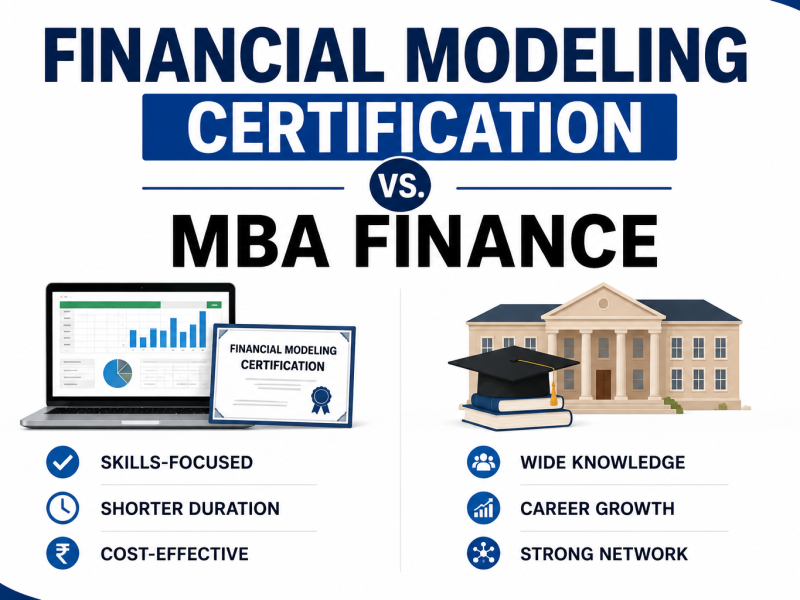
One thing people ask: should I do this or an MBA? Real answer: they serve different things. If you need a job in the next 90 days, the course wins. If you want to network with 200 people and build long-term relationships for a 20-year career, MBA still wins. Ideal path is probably: take the course, work for 2-3 years, then go to a good MBA.
The Real Takeaway
The biggest mistake students make is assuming that financial modeling is just another certificate.
It isn’t. In today’s finance hiring market, a financial modeling course has become a practical screening tool. Employers are no longer interested in whether a candidate has watched a few video lectures or completed an online course. They want proof that the candidate can analyze financial statements, build models from scratch, think through valuation assumptions and work under pressure.
That is why the real question is not “Which course is the cheapest?” or “Which certificate looks best on LinkedIn?”
The real question is whether the program helps you develop skills that employers are willing to pay for.
Every course in this comparison can teach you some level of financial modeling. The difference lies in the depth of training, industry exposure, mentorship and career support that comes with it.
For some people, a flexible self-paced course is enough. For others, direct mentorship, interview preparation and placement support can dramatically shorten the path to a finance role.
Ultimately, the best course is the one that matches your career stage, learning style, budget and timeline.
The finance industry will continue to evolve, but one thing is unlikely to change: professionals who can understand businesses, build valuation models, and make informed financial decisions will remain in demand.
The sooner you build those skills, the more opportunities you create for yourself.