Two FRM Part 1 candidates with almost the same scores can still lead to very different careers. That isn’t an error, you heard it right. Part 1 tests whether candidates understand the tools, while Part 2 measures whether they can actually utilize them on real desks, mixing up what belongs where is often what makes people spend hours studying the wrong chapter for too long.
So here’s the FRM syllabus in simple terms, part by part and topic by topic, along with the official weightage for each section. This makes it easier to see what you actually need to study, how important each topic is, and where you should spend most of your time.
FRM Curriculum: The Logic Behind Splitting It Into Two Parts
Part 1 hands you the raw toolkit, the maths, the statistics, an understanding of how financial products behave and how you’d go about valuing them. Then Part 2 puts you in front of an actual mess, a borrower who’s about to default, a company that’s burning through cash faster than anyone budgeted for, a risk model that’s quietly drifted so far from reality nobody trusts its output anymore. Whether you can use the toolkit properly is what gets tested.
You physically can’t register for Part 2 before clearing Part 1 and honestly, that makes sense once you think about it for a second. Handing someone application-level questions before they’ve learned the underlying tools would just be setting them up to fail.
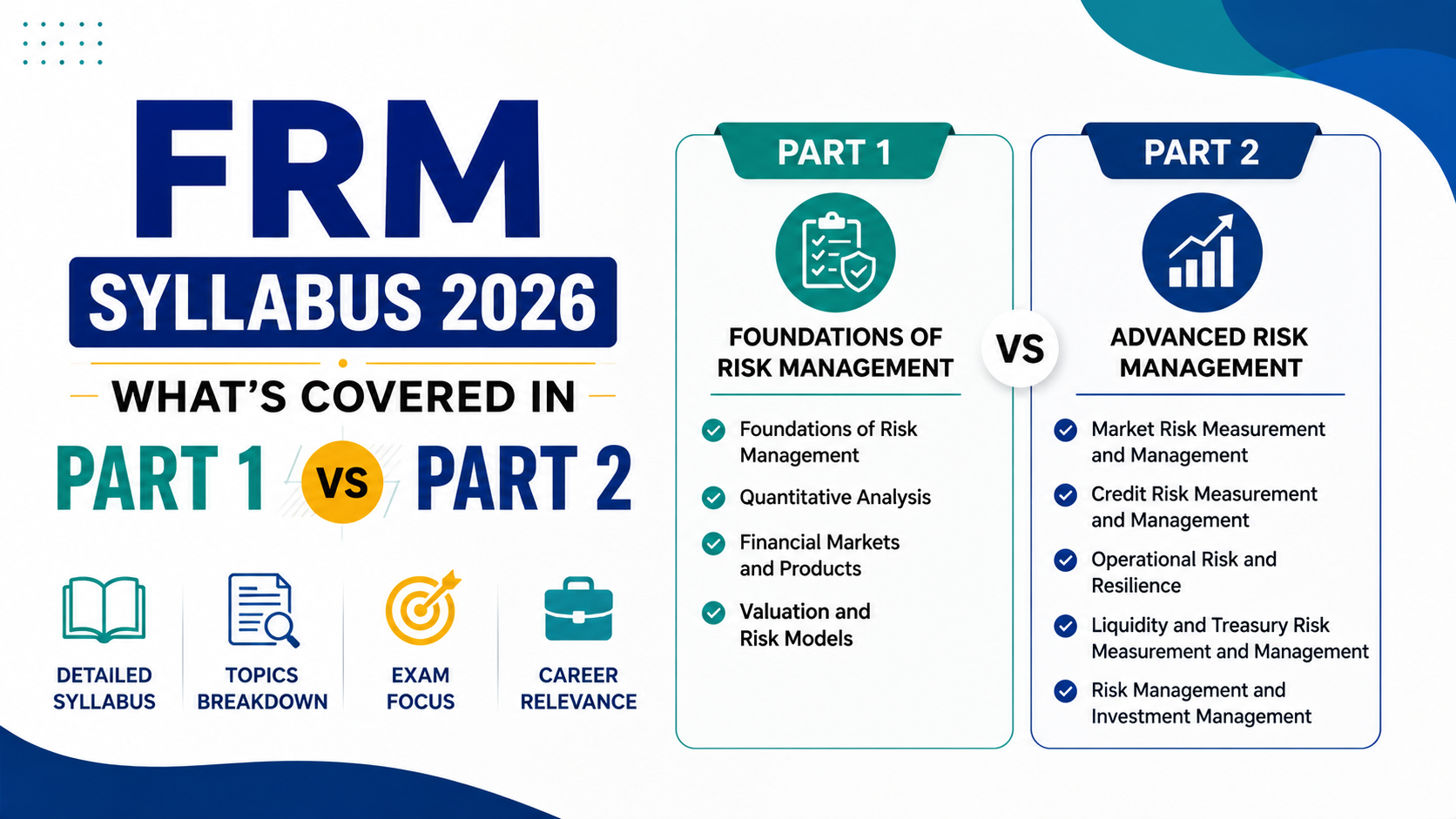
FRM Part 1 Syllabus: The Four Topics That Build Your Toolkit
FRM Part 1 runs 100 multiple-choice questions across four hours. Every question carries equal weight toward your score, which candidates often forget mid-exam when they’re panicking over one hard question and burning time they’ll need later.
| Topic | Weight |
| Foundations of Risk Management | 20% |
| Quantitative Analysis | 20% |
| Financial Markets & Products | 30% |
| Valuation & Risk Models | 30% |
Foundations of Risk Management is where people get lazy, and it costs them. This section pulls case studies from real financial collapses, LTCM, Barings Bank, the 2008 crisis, and expects you to explain what went wrong in the underlying risk process itself, not just retell the story like it’s a history lesson. Candidates treat this as the “soft” topic and skim it. Then the exam asks a governance question that requires actual reasoning, and they’re stuck.
Quantitative Analysis covers probability, working with data, drawing real conclusions rather than guessing. For 2026 it’s gotten noticeably more calculation-heavy than in past years, so if your prep material is a year or two old, this is exactly where you’ll feel the gap.
The two biggest sections, Financial Markets & Products and Valuation & Risk Models, sit at 30% each and together make up more than half the exam. Financial Markets & Products is about how futures, options, swaps, bonds and similar instruments actually behave in practice. Valuation & Risk Models is where something called Value at Risk, a way of estimating potential losses on an investment, moves from being a formula you’ve memorised to something you’re actually calculating under time pressure.
If you’re splitting study hours evenly across all four topics because that feels fair, you’re already behind before you’ve opened a single practice question.
FRM Part 2 Syllabus: Six Topics, Same Toolkit, Real Institutions
The FRM Part 2 exam drops to 80 questions but keeps the same four-hour window, which means more time per question and considerably more scenario-based reasoning than Part 1 ever asks for.
| Topic | Weight |
| Market Risk Measurement and Management | 20% |
| Credit Risk Measurement and Management | 20% |
| Operational Risk and Resilience | 20% |
| Liquidity and Treasury Risk Measurement and Management | 15% |
| Risk and Investment Management | 15% |
| Current Issues in Financial Markets | 10% |
Market Risk, Credit Risk and Operational Risk together make up 60% of Part 2 and that’s not a coincidence, these are the three risk categories that show up on an actual risk desk daily. Market Risk asks you to stress-test VaR models against conditions they weren’t originally built for. Credit Risk moves into default modelling and how the finalised Basel III framework now factors into it. Operational Risk & Resilience got renamed for 2026 and while the weight stayed at 20%, the certified body folded in noticeably more emphasis on cyber risk and third-party vendor exposure, which tells you exactly where the field is heading.
Liquidity & Treasury Risk and Risk & Investment Management split 15% each, covering how institutions manage funding gaps and how portfolio risk gets integrated into investment decisions. Current Issues in Financial Markets sits at just 10%, but don’t write it off, this section changes almost every year and catches candidates studying from outdated material.
FRM Part 1 vs FRM Part 2: The Difference That Actually Matters
Here’s the distinction most guides gloss over. FRM Part 1 tests whether you know what a tool does. FRM Part 2 tests whether you know when to reach for it and whether you can defend that choice to a regulator who’s asking hard questions. A Part 1 question might ask you to calculate a VaR figure. A Part 2 question hands you a portfolio, tells you the model hasn’t been recalibrated in eighteen months and asks what your actual exposure looks like today.
This is also why Part 1 tends to feel more like an advanced finance course and Part 2 tends to feel more like a job simulation. If you enjoyed Part 1’s math but found it disconnected from anything real, Part 2 is usually where the FRM syllabus finally clicks.
FRM Exam Format: A Quick Side-by-Side
| FRM Part 1 | FRM Part 2 | |
| Questions | 100 MCQs | 80 MCQs |
| Duration | 4 hours | 4 hours |
| Topics | 4 | 6 |
| Focus | Foundational tools | Applied, scenario-based |
| Prerequisite | None | Must have passed Part 1 |
Both parts run across the same three annual windows, May, August and November, so your prep timeline should work backward from whichever window you’re targeting, not the other way around.
FRM Preparation: Building a Study Plan Around the Actual Weights
Good FRM preparation starts with the weight table, not a textbook’s table of contents. For Part 1, that means Financial Markets & Products and Valuation & Risk Models should eat the largest share of your study hours, since together they’re worth as much as the other two topics combined. For Part 2, Market Risk, Credit Risk and Operational Risk deserve that same priority, since they carry 60% of the paper between them.
the certified body recommends roughly 240-300 hours of study per part and that number holds up reasonably well against what most candidates actually report. Working professionals typically stretch that across evenings and weekends over several months. Full-time students who can dedicate daylight hours to it often compress the same material into far less calendar time. Either way, the FRM syllabus rewards a plan built around weightings over one built around personal interest in a topic. It’s tempting to over-study Foundations because the case studies are genuinely interesting and under-study Valuation because it’s harder. Resist that instinct.
The Syllabus You Study Is the Career You End Up Building
Everything in the FRM Part 1 syllabus and FRM Part 2 syllabus maps directly onto a job somewhere, market risk to a trading desk, credit risk to a lending decision, operational risk to the fraud and cyber incidents that make headlines every quarter. Study it properly and you’re not just clearing an exam, you’re building the exact vocabulary a risk manager uses in a real meeting.
If you want that mapped out further, our detailed breakdown of the FRM course, its eligibility, fees, duration and full career path picks up exactly where this syllabus guide leaves off. And if getting the weightings right on your own feels like a lot to manage alone, that’s precisely what TWSS’s FRM course is structured to fix, a study plan built around the certified body’s actual topic weights, not a generic chapter-by-chapter crawl through the curriculum.
FAQs on FRM Syllabus 2026
1. What topics are covered in the FRM Part 1 syllabus?
The FRM Part 1 syllabus covers four topics, Foundations of Risk Management (20%), Quantitative Analysis (20%), Financial Markets & Products (30%) and Valuation & Risk Models (30%).
2. What topics are covered in the FRM Part 2 syllabus?
The FRM Part 2 syllabus covers six topics, Market Risk (20%), Credit Risk (20%), Operational Risk & Resilience (20%), Liquidity & Treasury Risk (15%), Risk & Investment Management (15%) and Current Issues in Financial Markets (10%).
3. What is the main difference between FRM Part 1 and FRM Part 2?
FRM Part 1 tests foundational tools and theory across 100 questions, while FRM Part 2 tests how those tools apply to real institutional risk scenarios across 80 questions, with noticeably more scenario-based reasoning.
4. What changed in the FRM syllabus for 2026?
The main 2026 change sits in Part 1’s Quantitative Analysis section, which now leans more heavily toward calculation-based hypothesis testing and stationary time series questions rather than conceptual recall, alongside Part 2’s Operational Risk section adding more emphasis on cyber and third-party risk.
5. How should I plan FRM preparation around the syllabus weights?
Prioritise study hours by topic weight, not personal preference, focus Part 1 preparation on Financial Markets & Products and Valuation & Risk Models since they make up 60% of that exam and focus Part 2 preparation on Market Risk, Credit Risk and Operational Risk for the same reason.