
Project finance modelling is a specialised type of financial analysis used to evaluate large, long-term projects such as power plants, highways, airports, renewable energy facilities, metro rail systems, oil and gas developments. These projects usually require heavy upfront investment and generate cash slowly over many years.
Unlike normal business models, project finance modelling focuses on one single project and studies whether that project can survive financially on its own. The goal is simple. To check if the project can generate enough cash to pay its costs, repay debt on time and still provide reasonable returns to investors.
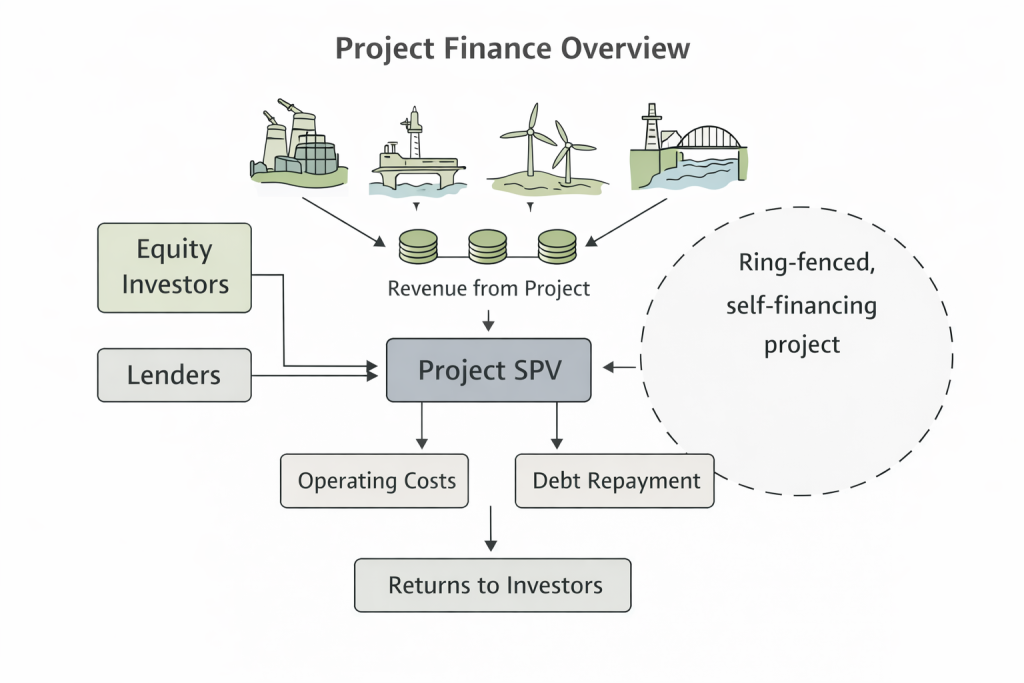
Figure 1: Project finance modelling overview showing how a single project generates cash flows, repays debt and delivers returns through a ring-fenced structure.
Because of this clear focus on cash flows, project finance modelling has become a core skill in infrastructure finance, investment banking, renewable energy and public-private partnership advisory.
What is project finance modelling?
Project finance modelling is the process of building a detailed Excel finance model to forecast the future cash flows of a project and assess its financial viability. The model is built from scratch using project-specific assumptions related to construction costs, operating performance, financing structure and risk factors.
In project finance modelling, lenders and investors do not depend on the financial strength of the parent company.
| Aspect | Project Finance Modelling | Corporate Financial Modelling |
| Focus | Single project | Entire company |
| Repayment source | Project cash flows | Company-wide cash flows |
| Risk | Ring-fenced | Shared across the business |
| Typical users | Banks, infra funds | Management, investors |
Instead, they rely entirely on the project’s future cash flows. This is why the model must be realistic, conservative and logically structured.
Typical projects analysed through project finance modelling include infrastructure assets that operate for 10 to 30 years. Since these assets are capital-intensive and exposed to multiple risks, a well-built model becomes the foundation of every financing decision.
The core idea behind project finance
The central principle of project finance modelling is that the project is ring-fenced. This means the cash flows of the project are separated from the sponsor’s other businesses. Banks lend money only if the project itself can repay the loan.
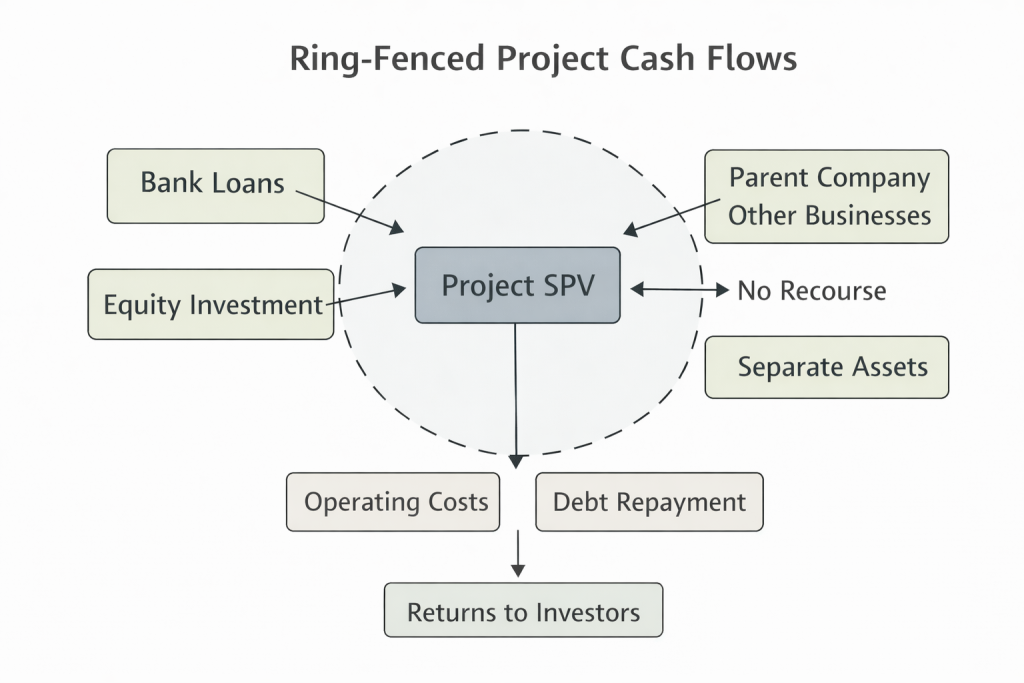
Figure 2: Ring-fenced structure in project finance modelling illustrating how project cash flows are separated from the sponsor’s other businesses.
This approach protects lenders and clearly defines risk sharing between lenders and equity investors. Lenders get priority access to cash flows, while equity investors earn returns only after all obligations are met.
Because of this structure, project finance modelling is heavily focused on timing, cash flow stability and downside protection rather than accounting profits.
Why is project finance modelling important?
Large infrastructure projects involve billions of dollars and long payback periods. Even small mistakes in assumptions can lead to major losses. Project finance modelling helps decision makers answer critical questions before committing capital.
It helps banks decide how much debt the project can safely support. It helps investors understand expected returns and risks. It helps governments and regulators evaluate the long-term sustainability of infrastructure investments.
In short, project finance modelling turns complex projects into measurable financial outcomes.
What is a project finance model designed to answer?
A properly built project finance modelling framework answers five key questions.
| Key Question | What the Model Tests |
| Project cost | Total CapEx and contingencies |
| Funding mix | Equity vs debt structure |
| Cash generation | Revenue and operating cash flows |
| Debt safety | DSCR and cash flow waterfall |
| Investor return | IRR, NPV, payback |
- First, how much money is required to build the project? This includes land, equipment, construction, engineering, permits and contingency costs.
- Second, how will the project be funded? This covers the mix of equity and debt, the timing of funding and any grants or subsidies.
- Third, how much cash does the project generate during operations? This depends on demand, pricing, efficiency and operating performance.
- Fourth, whether the project can comfortably repay its debt? This is tested through coverage ratios and the cash flow waterfall.
- Fifth, whether the project offers attractive returns for equity investors after considering all risks?
Each of these questions is answered directly through project finance modelling outputs.
Structure of a project finance model
Most project finance modelling exercises follow a logical structure to ensure transparency and accuracy.
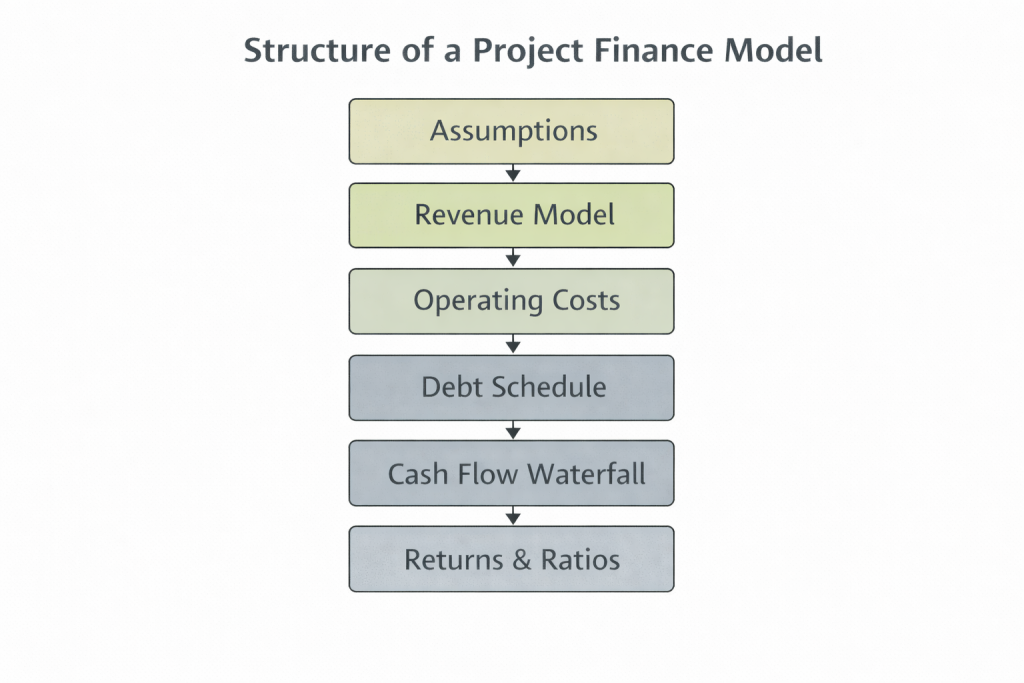
Figure 3: Structure of a project finance modelling Excel model showing assumptions, revenue, costs, debt schedule, cash flow waterfall and returns.
The model starts with an assumptions section. This includes the construction timeline, inflation rates, tax rates, interest rates, tariff escalation and operating life of the project. These assumptions drive the entire Excel finance model.
Next comes the revenue model. Revenue is forecast using physical drivers such as capacity, utilisation and price.

For example, a solar project calculates revenue using installed capacity, plant load factor and tariff rates. This approach ensures realism.
Operating costs are modelled after revenues. Costs are usually split into fixed and variable components. Inflation is applied to reflect rising expenses over time.
Capital expenditure is then modelled across the construction period. In many infrastructure projects, CapEx is spread over several years based on construction milestones.
After this, the funding structure is built. Equity injections are scheduled, debt drawdowns are timed and interest during construction is calculated.
The debt schedule follows next. This includes loan tenor, grace period, interest calculation and principal repayment profile. Debt covenants are also tested here.
At the centre of the model sits the cash flow waterfall.
Understanding the cash flow waterfall
The cash flow waterfall defines the priority in which cash generated by the project is used. It is one of the most important elements in project finance modelling.
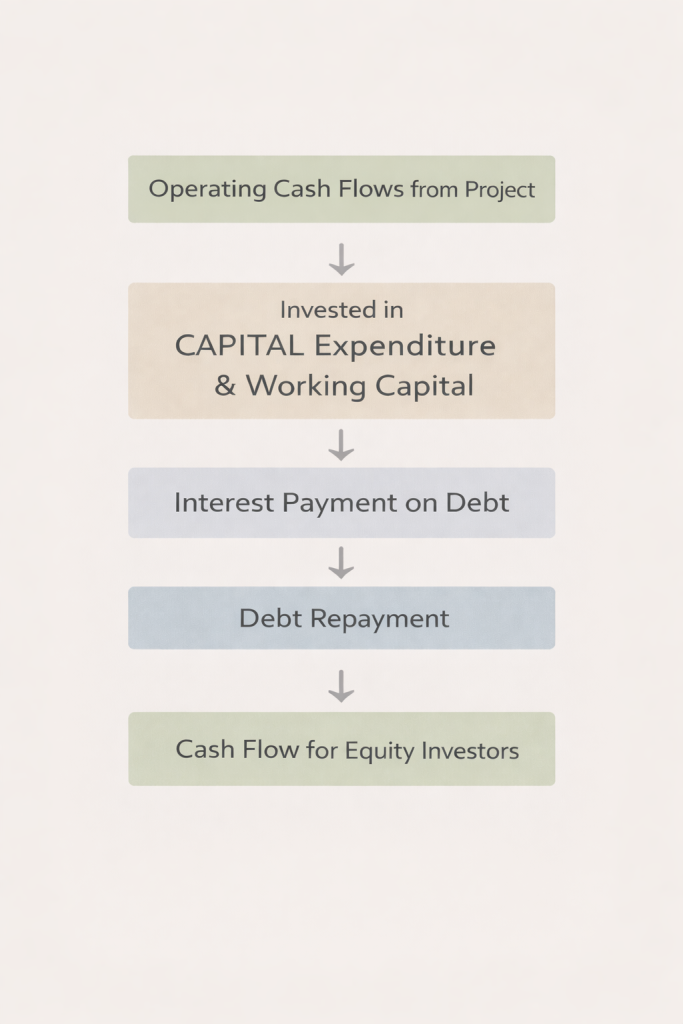
Figure 3: Cash flow allocation in project finance showing how operating cash flows are invested, debt is serviced and residual cash flows go to equity investors.
The typical order of the cash flow waterfall is simple.
- Operating cash flows are generated from the project.
- Cash is invested in capital expenditure and working capital.
- Interest payment on debt is made.
- Debt repayment is completed.
- The remaining cash flow is distributed to equity investors.
This structure ensures that lenders are protected and paid before equity investors. Equity investors accept higher risk in exchange for higher potential returns.
In every infrastructure finance model, the cash flow waterfall must be clearly defined and logically consistent.
Key financial metrics in project finance modelling
Project finance modelling produces several metrics that lenders and investors rely on.
For lenders, the most critical metric is the Debt Service Coverage Ratio (DSCR).

This measures how many times the project’s cash flow covers its debt obligations in a given period. A DSCR above one indicates sufficient cash flow.
| Metric | Used By | What It Shows |
| DSCR | Lenders | Ability to service debt |
| LLCR | Lenders | Long-term debt safety |
| IRR | Investors | Return on equity |
| NPV | Investors | Value created today |
Other lender-focused metrics include minimum DSCR, average DSCR and loan life coverage ratio.
For equity investors, the focus is on Internal Rate of Return, Net Present Value and payback period. These metrics help investors evaluate whether the project justifies the capital and risk involved.
All these outputs are generated directly from the Excel finance model and depend heavily on the quality of assumptions.
How project finance modelling differs from corporate modelling?
Many beginners confuse project finance modelling with normal financial modelling. The two are very different.
| Corporate Financial Models | Project Finance Modelling |
| Focus on entire companies with multiple products and revenue streams | Focus on a single project or asset |
| Cash can move freely across departments | Cash is restricted within the project |
| Funding is flexible | Debt is structured |
| Risks are spread across the company | Risks are isolated within the project |
This is why an infrastructure finance model requires more discipline, stronger assumptions and tighter controls than a standard corporate model.
Preparing before building the model
Good project finance modelling starts before Excel is opened.
The project scope must be clearly defined. This includes project type, location, capacity, construction timeline and operating strategy.
Reliable data must be collected. This includes CapEx estimates, market demand forecasts, tariff structures, operating cost benchmarks and financing terms.
The timeline must be planned carefully. Most Excel finance models use monthly periods during construction and early operations, followed by annual summaries.
A clean structure, clear labels and consistent formulas are essential for credibility.
Revenue and cost forecasting in practice
Revenue forecasting in project finance modelling is driven by real-world drivers rather than assumptions pulled from the air. Capacity, utilisation, efficiency and pricing define revenue.
Costs are forecast based on operational reality. Variable costs move with output, while fixed costs remain relatively stable. Inflation and escalation are applied carefully.
This disciplined approach makes the infrastructure finance model reliable and bankable.
Debt structure and funding logic
Debt is central to project finance modelling. Loans usually have long tenors, structured repayments and strict covenants.
Debt capacity is often calculated dynamically based on available cash flow rather than fixed limits. This ensures the project does not take excessive leverage.
The Excel finance model tests whether debt can be serviced under different scenarios, protecting lenders from downside risks.
Outputs, sensitivity and decision making
Once the model is complete, the results are summarised on output sheets. Monthly data is annualised and key metrics are highlighted.
Sensitivity analysis is often added to test changes in tariffs, costs, delays or demand. This helps stakeholders understand risk.
These outputs form the basis of investment decisions, loan approvals and negotiations.
Why project finance modelling matters today?
Infrastructure investment is growing across energy, transport and digital sectors. Governments rely more on private capital. Lenders demand stronger analysis.
As a result, professionals who understand project finance modelling, cash flow waterfall logic and Excel finance models are in high demand.
This skill is no longer limited to bankers. Consultants, developers and analysts all benefit from understanding how projects are financed.
If you want to learn project finance modelling in Excel with real infrastructure examples, a structured The WallStreet School’s Financial Modelling and Valuation course can help you build these skills practically.
People Also Ask about project finance modelling
- What is project finance modelling?
Project finance modelling estimates a project’s future cash flows to check if it can repay debt and deliver returns using only project-level finances. - What are the 4 components of financial modelling?
Assumptions, revenue forecasting, cost and cash flow analysis and valuation or returns assessment form the core components of financial modelling. - What does a project finance model look like?
A project finance model is an Excel-based structure showing assumptions, revenues, costs, debt schedules, cash flow waterfall and investor returns over time. - Is a DCF model used in project finance?
Yes, DCF is used in project finance to value future project cash flows and assess project viability, equity returns and investment attractiveness.
Final thoughts
Project finance modelling is not about complex math. It is about understanding how a project earns cash, how that cash is used and how risks are managed over time.
A clear, logical and well-structured model builds confidence among lenders and investors. With practice, project finance modelling becomes a practical and powerful tool.
For anyone working with large projects or infrastructure assets, mastering this skill is a smart long-term investment.

