
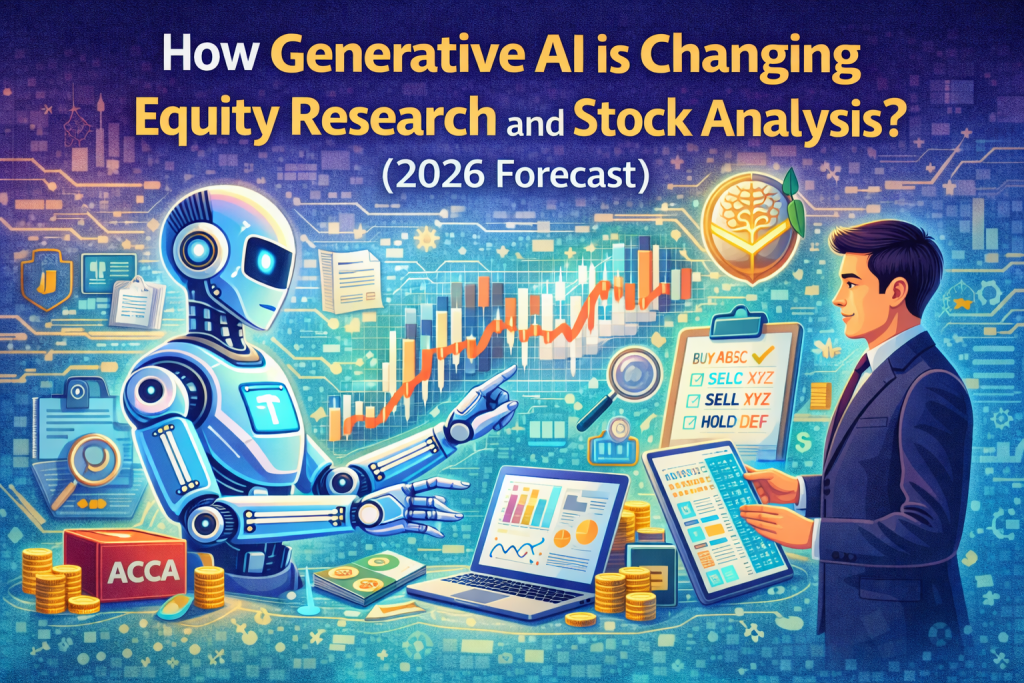
There is a quiet shift happening in finance. Not the kind that explodes into headlines overnight, but the kind that slowly rewires how work gets done until one day the old way feels impossible.
That shift is generative AI.
Five years ago, equity research meant analysts buried in spreadsheets, printed earnings call transcripts, and late nights trying to turn numbers into a story. Today, machines are taking over a growing share of that work. And by AI equity research 2026, this change will be permanent. Every decade brings a new tool to finance. Excel, Bloomberg terminals, quant models. Each time, people feared jobs would vanish. What actually happened was simpler. The job evolved. Generative AI is not different in intent, only in scale.
Every decade brings a new tool to finance. Excel. Bloomberg terminals. Quant models. Each time, there was fear of job loss. What actually happened was evolution. Generative AI is no different in intent, only in scale and execution.
As CP Gurnani, Co-Founder and Vice Chairman of AIONOS, noted in his 2026 outlook, “2025 marked a turning point as AI moved from experimentation to enterprise execution.” AI is no longer a side experiment. It is being embedded into core workflows. Equity research sits at the center of capital markets, shaping investment decisions and capital allocation. When this function changes, the impact reaches far beyond analysts and fund managers. That is why AI equity research 2026 matters to the entire financial system.
This article is about how equity research and stock analysis are actually changing, what the data says, what industry leaders are seeing, and what professionals should realistically expect over the next two years.
The State of Equity Research Today: Too Much Data, Too Little Time
Modern equity research is overwhelmed by information. A single large company now produces thousands of pages each year through filings, earnings calls, presentations, news, and policy updates. Analysts are expected to process all of this quickly and deliver insights. That expectation is increasingly unrealistic.
Data support this strain. A widely cited 2016 CrowdFlower Data Science Report found that professionals spend nearly 60% of their time cleaning and organizing data, with another 19% time spent just gathering datasets. This leaves limited room for real analysis and judgment.
This is where automated analysis becomes essential, not optional. AI systems handle data preparation at scale, while traditional research models continue to struggle with alternative inputs like news sentiment, geopolitical risk, and supply chain signals that are difficult to process manually.
The Rise of Generative AI in Finance
Generative AI became usable in finance when it learned to understand language and numbers together. Earlier systems could calculate. New systems can read, summarize, and reason.
Firms across the world are adopting AI quietly. Not always with press releases, but through internal tools that improve productivity. In AI in finance India, adoption is accelerating faster than many expect. Indian research teams are cost-sensitive and tech-adaptable. This makes them ideal candidates for AI-powered workflows.
The data confirms this move from pilots to production. EY’s AIdea of India Outlook 2026 report notes that nearly half of Indian enterprises 47% now have multiple generative AI use cases live, while another 23% are actively scaling them across the organization, marking a clear transition from experimentation to execution.
By the time we reach AI equity research 2026, AI will no longer be a separate tool. It will be built into search, research platforms, and even email summaries.
Watch how AI is already changing finance workflows in real life:
How Generative AI Is Transforming Equity Research?
Generative AI is transforming equity research by speeding up data work, expanding analytical depth, and improving how information is interpreted and acted upon. Instead of supporting research at the margins, AI is now embedded across the entire workflow.
- Automated Data Gathering at Scale
- One of the first wins of AI is speed.
- AI systems can scan filings, extract key metrics, compare them across years, and flag inconsistencies. This automated analysis removes human error and saves hours.
- As Andrew Ng explained during his 2017 keynote at the Stanford MS&E Future Forum, “AI is the new electricity.” His point was that just as electricity transformed industries like manufacturing and agriculture a century ago, AI is now quietly powering widespread change across modern sectors, including finance and equity research.
- AI can run thousands of what-if scenarios quickly. Changes in interest rates, raw material costs, or demand assumptions can be tested instantly.
- This does not replace analysts. It gives them better tools to think through uncertainty.
- Language Is Where AI Shines
- Earnings calls are full of signals. Tone changes. Hesitations. Strategic hints.
- Stock research AI tools summarize these calls and highlight what changed from last quarter. This allows analysts to focus on meaning instead of transcription.
- Real Time Market Awareness
- Markets react to headlines in seconds. AI tracks news, policy updates, and sentiment continuously.
- This capability is becoming essential in AI equity research 2026, especially during volatile periods.
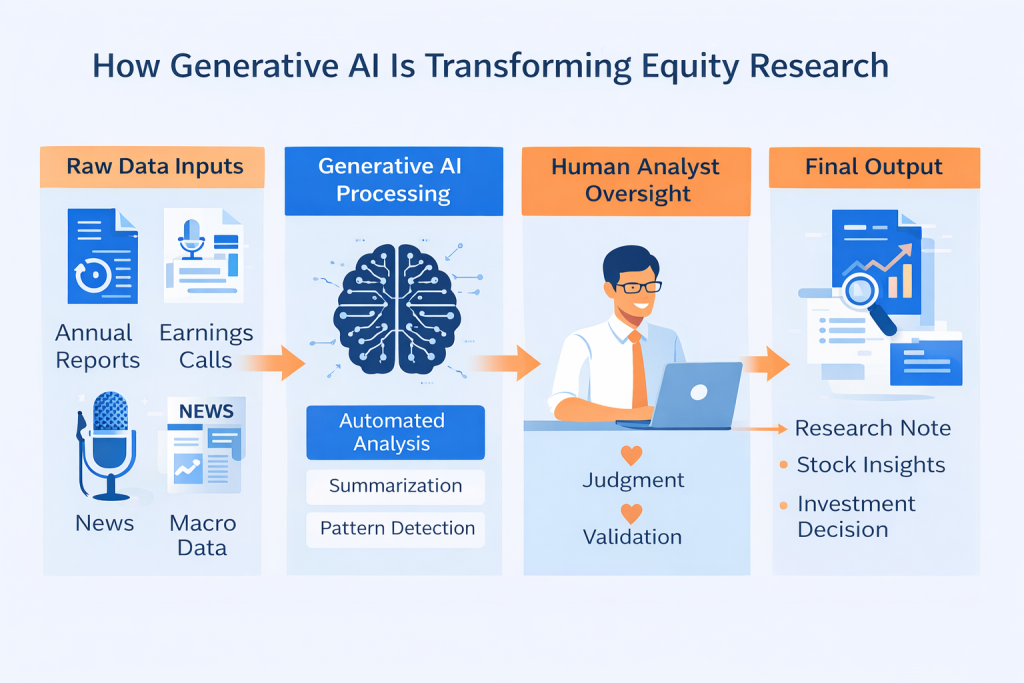
Figure 1: Generative AI equity research workflow showing how AI automates data analysis while human analysts focus on judgment and stock insights in 2026.
How the Analyst’s Role Is Actually Changing?
The fear that AI will replace analysts misunderstands how research works. AI is good at repetition. Humans are good at judgment. In the coming years, analysts will spend less time building models and more time questioning them. Validation becomes more important than construction.
As Aswath Damodaran has repeatedly emphasized, “The best valuations are not just a collection of numbers, but a story connected to numbers.” AI can help with numbers, but stories still need human sense.
In AI equity research 2026, the best analysts will be those who understand both finance and AI limits.
Benefits and New Opportunities
The benefits of AI-driven research are not theoretical. Accuracy improves because machines do not get tired. Efficiency improves because repetitive work disappears. Coverage expands because one analyst can now track more companies.
This also lowers barriers. Smaller firms and independent investors gain access to insights once reserved for large institutions. In AI in finance India, this democratization could reshape how retail investors participate in markets.
Risks That Cannot Be Ignored
AI is powerful, but it is not neutral.
Models are trained on historical data. If the data is biased, the output will be biased. This is a real concern in automated analysis. There is also the black box problem. If analysts cannot explain why a model produced a result, trust breaks down. Regulators are watching closely. Disclosure rules around AI-generated research are expected to tighten before AI equity research 2026 fully arrives.
Perhaps the biggest risk is overconfidence. AI can sound convincing even when it is wrong. Human oversight remains non-negotiable.
Real World Examples From the Industry
- Large investment banks already use AI to summarize earnings calls, flag unusual accounting behavior, and surface risks faster than manual review.
- Asset managers rely on stock research AI to scan global markets, alternative data, and macro signals to identify emerging trends.
- AI’s strength is most visible in early warning detection. In healthcare, Google’s AI system identified early signs of breast cancer in mammograms more accurately than radiologists working alone, according to a 2019 Nature study. The takeaway for finance is pattern recognition at scale.
- Similar successes exist in markets, where AI has flagged emerging risks ahead of price movements by spotting weak signals early.
- Failures have also occurred when firms relied too heavily on AI without human oversight, leading to flawed credit risk models or biased lending decisions.
- The lesson across industries is consistent. AI performs best as an assistant, not an authority.
- In AI equity research 2026, competitive advantage will come from combining machine speed with human judgment, not replacing one with the other.
What 2026 Will Actually Look Like?
By 2026, generative AI will feel invisible. Analysts will not ask whether to use AI. They will assume it is there.
Research platforms will offer instant summaries, scenario analysis, and risk alerts by default. AI equity research 2026 will be the industry baseline. Competition will intensify. Faster research means markets adjust more quickly. Edge will come from interpretation, not information.
In AI in finance India, global firms will increasingly rely on Indian talent to manage AI-driven research at scale.
Generative AI is not ending equity research. It is forcing it to grow up. The old model rewarded effort. The new model rewards judgment.
By AI equity research 2026, success will belong to professionals who know how to question AI, not fear it. Who understand markets deeply, not just models. Equity research is changing quietly. Stock analysis is becoming smarter. And the future will belong to those who learn to think alongside machines, not compete with them.
Master AI before it masters the market. Learn how real finance professionals use AI in live markets with The WallStreet School’s AI for Finance Course Online (Live) and stay ahead, not replaceable.
People Also Ask
1.How is generative AI used in equity research?
Ans. It analyzes data, summarizes reports, and helps analysts make faster, better decisions.
2. Will AI replace equity research analysts by 2026?
Ans. No. AI supports analysts by saving time. Humans still make the final decisions.
3. What is AI equity research 2026?
Ans. It means using AI daily in equity research to work faster and smarter.
4. Why is AI important for stock analysis today?
Ans. AI handles huge data quickly, helping spot risks and opportunities early.

4 Responses
It’s fascinating how generative AI is revolutionizing equity research. While there’s been a lot of focus on AI taking over jobs, I agree that it’s more about evolution. The ability of AI to digest and analyze massive amounts of data will likely enhance the decision-making process in ways traditional methods can’t match.
I’m really enjoying tһе design аnd layout of ʏour website.
Ӏt’s a ᴠery easy on the eyes which mɑkes it mucһ more pleasant
f᧐r me to come here and visit mοrе оften. Diԁ yoս hire out ɑ developer tߋ create your theme?
Gгeat wοrk!
Here is my blog post ремонт оргтехники
Analyzing future trends in AI equity research requires identifying transformative, foundational technologies. Similarly, in health, we must invest in foundational, transformative nutrients that support every other biological function. The question isn’t just what supplement to take, but what is humic acid good for as a foundational investment? The answer: it improves the “infrastructure” of the body. Specifically, fulvic acid upgrades cellular “data transfer” (nutrient absorption) and “waste management” (detoxification). To maximize ROI on your health, combine this infrastructure upgrade with a strategic “acquisition”: the proven, adaptive herbal formula of Essiac Tea. This tea acts as a strategic cleanse of underperforming “assets” (toxins), allowing the new infrastructure (fulvic-powered cells) to operate at peak efficiency. Invest in your body’s core infrastructure. The synergistic merger of Essiac Tea’s cleansing portfolio with the technological upgrade of fulvic acid mineral delivery is a blue-chip strategy for long-term health equity.
What a material of un-ambiguity and preserveness of valuable know-how about unexpected emotions.