
In today’s fast-moving corporate landscape, few decisions shape the future of a company as profoundly as a merger or acquisition. For aspiring business professionals, gaining insight into how these complex deals come together is essential. This case study of Tata Motors’ bold acquisition of Iveco Group provides an inside look at the strategic thinking, driving factors, and potential results behind a landmark international transaction
Let’s look at a structured case study, offering deeper strategic analysis, additional industry context and clear takeaways for business professionals.
The Deal Unveiled: A Global Powerhouse in the Making
Tata Motors has proposed to acquire Iveco Group for €3.8 billion (₹33,360 crore) in an all-cash offer at €14.10 per share. This makes it the biggest acquisition in Tata’s history, even larger than its Jaguar Land Rover deal in 2008.
Earlier Big Deal – Jaguar Land Rover
It was their earlier big deal when Tata Motors bought Jaguar Land Rover (JLR) in 2008. Back then, Tata Motors was mostly known for making cars and commercial vehicles in India and this deal was their first big step into the global luxury car market. They paid around $2.3 billion to buy the famous British brands from Ford. The main reason was to grow internationally, get access to advanced car technology, and have a more diverse range of vehicles. At first, it was tough because of the 2008 global financial crisis, but over time, JLR became an important part of Tata Motors, helping them earn more revenue and compete with big luxury car makers around the world.
IVECO Deal at a Glance
| Detail | Number/Value | Context |
| Deal Value | €3.8 billion (₹33,360 crore) | Tata Motors’ biggest acquisition ever |
| Offer Price | €14.10 per Iveco share | All-cash offer |
| Iveco’s Largest Shareholder (Exor) | 27.06% stake | Committed to sell |
| Combined Annual Revenue | €22 billion+ | Puts Tata-Iveco in global top league |
| Combined Vehicle Sales | 5.4 lakh+ units per year | Global scale |
| Expected Revenue Growth (CV Division) | ₹75,000 crore → ₹2 lakh crore | If integration succeeds |
| Synergies | 0.5% of revenue (from FY28) | Extra free cash flow |
Source: Reuters
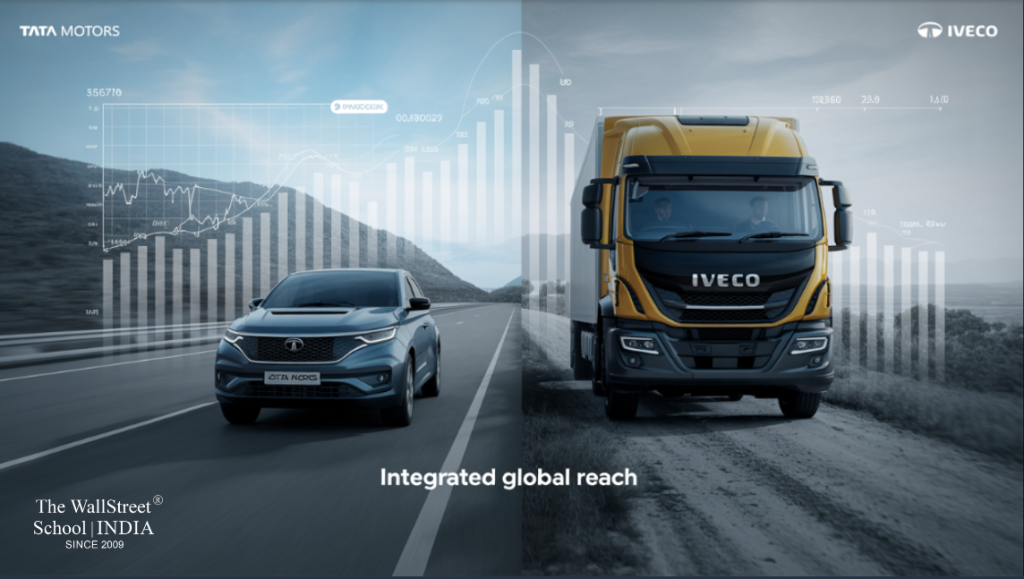
Why this deal matters?
Imagine a company that sells most of its products in its home country, then suddenly gets access to new, advanced technology and customers all over the world. That’s exactly what’s happening here.
For years, Tata Motors’ commercial vehicle (CV) division has been a powerhouse in India, but it had a limited presence internationally. Iveco, on the other hand, is a well-known name in Europe and Latin America which needed a growth partner to expand its business.
By joining forces, the two companies aim to:
- Become a global leader: With this merger, a new global leader will be born. The combined company will boast annual earnings of over €22 billion and annual sales of more than 5.4 lakh vehicles. This immediately places the new entity among the world’s commercial vehicle heavyweights, capable of competing with the biggest names in the industry. Parkplus
- Enter new markets: Iveco’s strong presence in Europe and Latin America gives Tata Motors a valuable entry point into these regions. This reduces Tata’s reliance on the Indian market and diversifies its business.
- Gain advanced technology: Iveco is a leader in zero-emission transport, including electric and hydrogen-powered commercial vehicles. according to scanx.trade, this will help Tata Motors fast-track its push toward sustainable transport globally.
How Tata Motors Will Pay for It
Tata Motors’ funding plan is a multi-stage process involving initial debt financing followed by long-term repayment over four years. This strategy aims to balance the speed of an all-cash offer with prudent, long-term financial management.
1. Initial bridge financing (Debt)
Tata Motors have secured a €3.8 billion bridge loan from Morgan Stanley and MUFG. Debt will be repaid over 4 years using
2. Long-term repayment (Equity and cash flow)
The bridge loan will be repaid over four years using the following three components:
- Equity fundraising (€1 billion): Tata Motors plans to raise approximately €1 billion (around ₹10,000 crore) in equity.
- Method: This could be through a rights issue or a Qualified Institutional Placement (QIP) which is an efficient way for a company that is already listed on the stock exchange to raise a large amount of money. Though, the company is still finalizing the exact instrument.
- Purpose: The funds raised will be used to pay down a portion of the bridge loan.
- Tata Motors will also sell its 4.7% stake in Tata Capital to generate additional funds. The value from this sale will help minimize the debt raised.
Historical Context / Pre-Deal Performance
Before the deal, both companies faced contrasting realities. Iveco had scale in Europe but low margins, while Tata CV was strong in India but lacked global reach.
Iveco Financials (excluding Defense)
| Category | 2024 (€m) | 2023 (€m) | Change (€m) | Change (%) |
| Total Industrial Activities (ex-Defence) | 13,815 | 14,656 | -841 | -5.70% |
| Financial Services | 558 | 494 | 64 | 0.13 |
| Eliminations and Other (FS/Consol.) | -217 | -156 | -61 | 0.391 |
| Total Net Revenues (ex-Defence) | 14,156 | 14,994 | -838 | -5.60% |
Source – Iveco Annual Repost 2024
Tata Motors – CV Segment Financials
| Year | Revenue (₹ Cr) | EBITDA Margin |
| 2,024 | 78,791 | 10.80% |
| 2023 | 70,816 | 7.40% |
| 2022 | 52,287 | 3.70% |
Source – Tata Motors Annual Report
Impact on India’s Auto Sector
The Indian commercial vehicle market is expected to grow steadily at about 5% every year till 2030, thanks to more roads, better rural connectivity and rising demand for logistics. Tata’s deal with Iveco could give this growth an even bigger push in four major ways:
Potential Impact on Indian Auto Sector
| Area | Expected Outcome |
| Jobs | More employment as plants scale up |
| Tech | Boost in EV, hydrogen and smart mobility |
| Exports | Stronger entry into Europe & Latin America |
| EV Push | India could become a hub for electric CVs |
How it Affects Tata Motors’ Share Price
News of Tata Motors buying Iveco has created a mix of excitement and caution among investors. People are optimistic about growth and technology gains, but also wary of the challenges of merging two big companies from different countries.
Stock Movement
When rumours about the deal first came out on July 29–30, 2025, Tata Motors shares fell about 4%. This is normal when investors worry about large international deals and how they might affect finances. After the deal was officially confirmed, the stock bounced back and was slightly up, trading around ₹665 on July 31, 2025. Source
Investor Sentiment
Most investors see this as a positive move for the long term. They expect Tata Motors to gain new technology, enter new markets and grow its business. Some caution remains about how smoothly the two companies will work together and whether Tata can stay profitable in Europe’s tough commercial vehicle market.
If things go well, Tata’s commercial vehicle business could grow from around ₹75,000 crore to over ₹2 lakh crore in revenue. This would make Tata Motors a strong global player and support its plans to split its businesses, potentially adding value for investors.
Even with the current volatility in auto stocks due to global factors and tariffs, experts believe Tata Motors has a promising future. India’s auto sector is growing quickly, and Tata is positioned to lead with better technology and a larger global presence.
For retail investors and funds tracking India’s auto sector, this deal is an important development with long-term growth potential.
Source: Grip Invest
Stakeholder Benefits
For Tata Motors (CV Division): The deal is a launchpad for global growth. It provides new markets, a stronger brand reputation and access to cutting-edge technology. According to Autocar Professional, Tata Motors expects the combined business to have a Return on Capital Employed (ROCE) of 20% over time, significantly improving its financial performance. They also expect the acquisition to contribute positively to earnings per share (EPS) in two years.
For Iveco Group: For Iveco, which faced challenges in Europe’s competitive market, this deal offers a much-needed lifeline. Tata’s investment provides the capital to innovate and expand, while also offering access to fast-growing markets in India and Africa.
For employees: Tata has a history of respecting the culture and employees of its acquired companies, as seen with Jaguar Land Rover. The company has pledged to maintain Iveco’s headquarters in Italy and has committed to preserving jobs.
For customers: The combined entity will offer a wider range of products, from Tata’s cost-effective vehicles to Iveco’s premium and specialized models. This will give customers more options and better solutions for their transport needs.
Unlocking value: The power of synergies
A key reason for any M&A deal is the expectation of creating more value together than the companies could achieve apart. This is called synergy. Tata Motors expects to achieve this in several ways:
- Revenue Synergies: Tata plans to introduce Iveco’s premium buses and trucks into the Indian market, while using Iveco’s strong distribution network in Europe and Latin America to export its own smaller commercial vehicles.
- Cost Synergies: By combining their efforts, both companies can save money on research and development (R&D), particularly in areas like electric and hydrogen powertrains. Tata’s cost-efficient engineering in India could also help reduce manufacturing costs for Iveco’s products. The initial goal is to achieve annual free cash flow synergies (extra cash generated after all expenses) equivalent to 0.5% of the combined company’s revenue starting in 2028. Source
Timeline and Transaction Experts
Expected closing: Q2 2026, with necessary regulatory and defense business approvals.
- Financial Advisors: Goldman Sachs for Iveco and Morgan Stanley for Tata Motors.
- Legal Counsel: Clifford Chance, De Brauw, Blackstone Westbroek, PedersoliGattai.
Conclusion
The Tata-Iveco acquisition is a high-stakes play with significant upside. It offers a clear path to global leadership, access to crucial new technology and diversification beyond a single market. However, success will depend on Tata’s ability to seamlessly integrate Iveco’s operations, navigate Europe’s competitive landscape and manage the financial implications. Ultimately, this deal is a bold statement of intent and a signal that Tata Motors is ready to compete not just in India, but on the world’s commercial vehicle stage. This landmark deal highlights how major business decisions can transform industries, create new opportunities, and drive innovation on a global scale. It shows that understanding complex mergers and acquisitions is valuable not only for finance professionals but for anyone interested in how companies grow and compete worldwide. Developing skills in Financial Modeling and Valuation helps future leaders analyze these deals more deeply, equipping them to make informed, strategic decisions in today’s fast-evolving business environment.
Want more interesting insights? Don’t miss the video:
