The complexity of financial markets and the changing industrial and business landscape globally is fuelling the need for professionals with cutting-edge technological skills and specialised finance knowledge. The CFA program is one of the most popular courses finance professionals pursue globally.
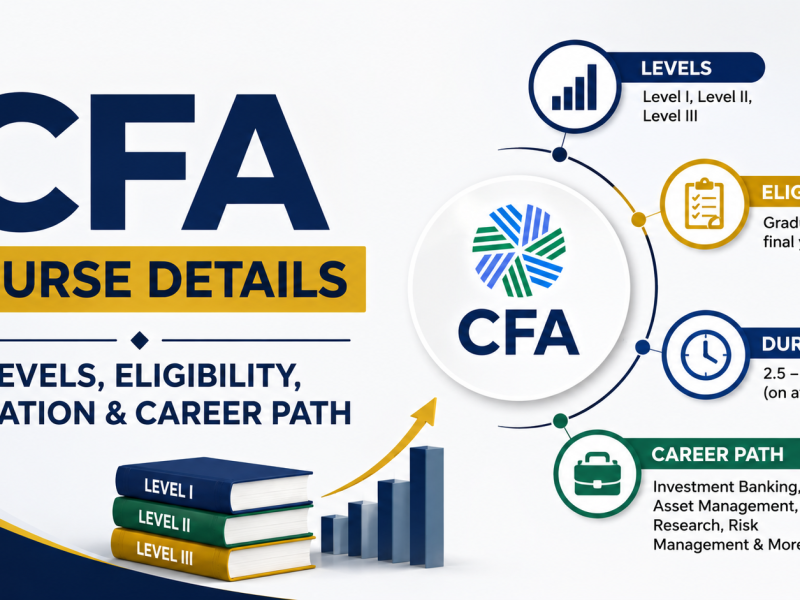
The CFA course in India is highly demanded by Indian finance and investment job aspirants looking to impact the finance industry. To obtain the CFA charter, candidates must clear three rigorous CFA exam levels and have at least 4,000 hours of professional work experience.
Keeping the dynamic nature of the investment industry in mind, the CFA Institute has brought changes to the curriculum of the CFA program, covering current investment trends and related aspects. In this blog, let us quickly look at some of the investment trends finance professionals must know of in 2024.
Top Investment Trends CFA Aspirants Must Know
Sustainable finance, asset digitisation and similar topics are hot topics in finance. Awareness of the latest investment trends gives CFA aspirants a significant advantage. Here are the top trends to watch out for:
-
Rising popularity of digital assets
If you examine the finance and investment industry closely, you will notice a high demand for digital assets. Young investors are more interested in digital assets and tokenisation than in conventional assets.
One of the best examples is cryptocurrency. With keen observation, you will notice that the cryptocurrency market is rapidly expanding. As a CFA professional, you should have solid knowledge and expertise in digital assets and tokenisation to serve your client’s investment needs well.
In addition to the usual study materials for the CFA course in India, try reading more about digital asset management to gain a good placement in the investment industry.
-
The sustainability factor
Whatever industry you work in, you cannot ignore the sustainability factor. Investors nowadays have become conscious of the environment. They aim to make investments that positively impact environmental sustainability.
The CFA is responsible for practising sustainable finance to meet client expectations. The CFA course in India covers the sustainability factor and its use and benefits in the finance and investment industry in detail.
-
Focus on alternative investments
If you check out the “Alternative Investment” section of the CFA course in India 2024, you will see that new content has been added to the segment. This proves that alternative investments are gaining prominence with investors. CFA and investment professionals must have in-depth knowledge of various alternative investments.
As the CFA curriculum now covers alternative investments more intensively, professionals can handle alternative investments with more confidence. This addition to the curriculum also improves their wealth management portfolio.
As the prospects of alternative investments are getting better and more diverse, professionals can get lucrative jobs in the wealth management sector.
-
Emerging technologies paving the way for new investment goals
The investment industry is embracing new technologies like big data, artificial intelligence (AI), and machine learning (ML). Remaining updated with the latest technological trends and innovations in the investment and finance industry makes you a valuable investment professional.
A CFA must know these new technologies and techniques to have a competitive edge over peers. For instance, Artificial Intelligence efficiently reduces the pressure of regular data mining work. AI also plays a pivotal role in extensive investment analysis.
CFA and other finance professionals must know how to implement AI, ML, and other advanced technologies to accelerate and smoothen tasks and operations.

CFA Course in India: Exam Topics and Curriculum
Along with thorough knowledge of the top investment trends, CFA aspirants must be aware of their curriculum and exam topics. The CFA Institute regularly updates the curriculum to reflect modern financial practices.
Mentioned below are the main topics and their weightage according to the exam level:
-
Ethical and Professional Standards
This topic deals with the role of professionalism and ethics in the investment industry, ethics, and the challenges of ethical behaviour.
| Level I | Level II | Level III |
| 15-20 | 10-15 | 10-15 |
-
Quantitative Methods
This section covers quantitative techniques and concepts in investment decision-making and financial analysis. It also includes probability theory and its applications for quantifying investment risks.
| Level I | Level II | Level III |
| 6-9 | 5-10 | 0 |
-
Economics
This part of the CFA course in India introduces primary concepts of demand and supply for business firms and individual consumers. It also includes various market structures along with various microeconomic concepts.
| Level I | Level II | Level III |
| 6-9 | 5-10 | 5-10 |
-
Financial Statement Analysis
This section covers financial reporting standards and procedures that govern disclosures. It also provides a framework for financial statement analysis.
| Level I | Level II | Level III |
| 11-14 | 10-15 | 0 |
-
Corporate Issuers (previously known as Corporate Finance)
This segment offers an introduction to corporate governance, financing and investing decisions.
| Level I | Level II | Level III |
| 6-9 | 5-10 | 0 |
-
Equity Investments
This segment focuses on the various aspects of security markets, equity investments and indexes. It also explains the ways of analysing companies, industries and equity securities using basic equity valuation models.
| Level I | Level II | Level III |
| 11-14 | 10-15 | 10-15 |
-
Fixed Income
The section describes fixed-income securities and their markets, yields, risk factors, and drivers.
| Level I | Level II | Level III |
| 11-14 | 10-15 | 15-20 |
-
Derivatives
This section builds a conceptual framework for basic derivatives and the derivatives markets and covers the concept of arbitrage.
| Level I | Level II | Level III |
| 5-8 | 5-10 | 5-10 |
-
Alternative Investments
This segment of the CFA course in India covers alternative investments, including real estate, hedge funds, commodities, private equity and infrastructure.
| Level I | Level II | Level III |
| 7-10 | 5-10 | 5-10 |
-
Portfolio Management and Wealth Planning
This section covers the basics of portfolio and risk management and includes portfolio planning, construction, and return and risk measurement.
| Level I | Level II | Level III |
| 8-12 | 10-15 | 35-40 |
Conclusion
Pursuing a CFA course in India is an excellent option if you want to make a career in the finance and investment industry. The CFA certification opens up excellent job opportunities for aspirants in the country and abroad with lucrative earning potential.
Enrol for the CFA course right now and boost your career in finance and investment!
Whether you’re looking for online CFA or classroom learning, sign up today!
For more details, visit The WallStreet School or contact us via email or phone: .
Frequently Asked Questions
- Is the CFA program recognised in India?
The CFA program is recognised and accredited globally and is significant in India. It is considered an excellent credential for investment and finance professionals.
- How much time does it take to complete CFA?
There are three levels of CFA exams. Each exam level of the CFA course in India requires a minimum of 6-9 months of preparation. You also need to have 4,000 hours of working experience. It takes approximately 2-5 years to become a CFA charter holder.
- What is the best time to enrol in the CFA course in India?
You can start preparing for the CFA course after you clear your grade 12 examinations. This will give you ample time to clear all three levels of the CFA exams and the required 4,000 hours of work experience.