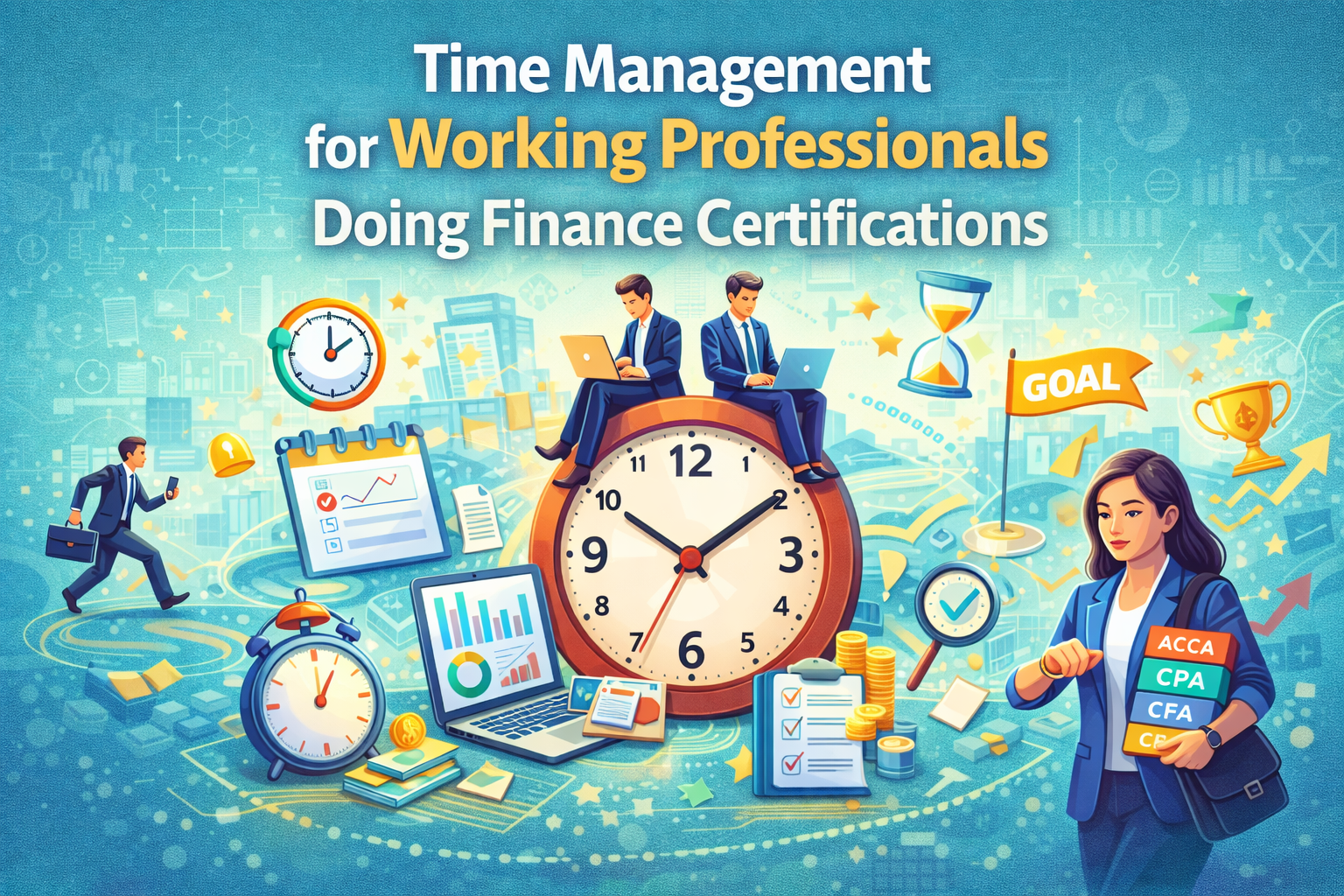
If you are a working professional trying to manage long work hours, unpredictable schedules, and exam pressure at the same time, this guide is written for you. It focuses on realistic systems for balancing work and study and practical exam planning India professionals can actually follow without burning out.
These time management principles apply across most finance certifications, whether it is CFA, ACCA, CMA, FRM, or similar long-term finance and accounting programs pursued alongside a full-time job. Before talking about books, hours, or strategies, it is important to understand how working professionals should actually think about managing time for such finance certifications.
Why Time Management Is the Real Exam?
A working professional plans to study every night after office hours. One project runs late. Then another. By weekday, nothing gets studied. The weekend is spent recovering. The exam syllabus stays untouched.
Most people fail finance certifications not because the syllabus is too tough. They fail because life gets in the way. You plan to study after work, work runs late, you feel tired, days slip into weeks, weeks turn into months, and suddenly the exam window is gone.
That is why studying time management certifications is a real skill. Not memorizing formulas. Not watching lectures at 2x speed. But learning how to fit study into a messy adult life. And yes, balancing work and study is possible. Thousands do it every year. They are not superheroes. They just follow boring systems consistently.
Accept This First: You Cannot Study Like a Student Anymore
A college-style plan says “study 4 hours daily.” A working professional follows it for 5 days, feels exhausted, misses one day, then drops the plan completely.
If you are working, stop copying college-style study plans.
- No 5-hour daily study marathons.
- No last-minute cramming dreams.
- No waiting for “free time”.
Working professionals succeed when they respect reality.
Reality looks like this:
- 10 to 15 focused study hours per week is enough
- Short sessions work better than long ones
- Consistency beats motivation every single time
This is the foundation of study time management certifications. Everything else builds on this.
The 10 to 15 Hour Weekly Rule Actually Works
For example, an analyst studies 1 hour after dinner on weekdays and 3 hours on Sunday morning. No late nights. No stress. Clears CMA Part 1 in 7 months.
You do not need 30 hours per week. Most working professionals who clear CMA, ACCA, CFA, or FRM manage with:
- 1 to 1.5 hours on weekdays
- 3 to 4 hours on weekends
That adds up to 10 to 15 hours weekly. This approach makes balancing work and study sustainable for months, not just weeks.
If you try to do more, burnout says hello very fast.
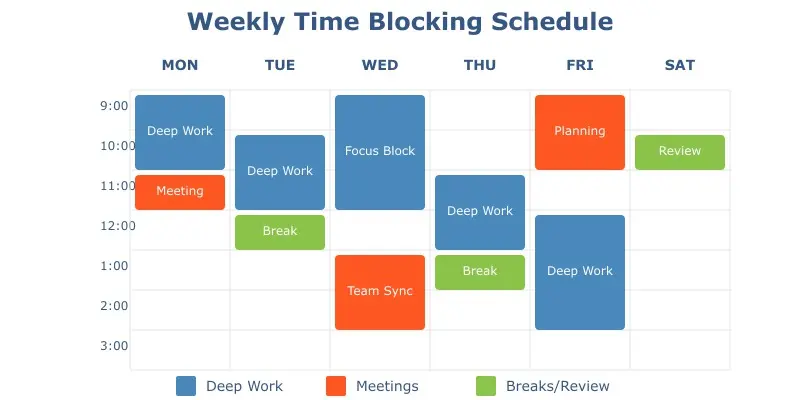
Time Blocking: Treat Study Like a Work Meeting
A professional blocks 7 am to 8 am on the calendar every weekday. Family knows. Phone stays away. Even on busy days, one hour gets done because it is “scheduled.”
One of the most effective tools for study time management certifications is time blocking.
Time blocking means you decide in advance when you will study. And you treat that time like a meeting with your boss.
No rescheduling unless it is an emergency.
Examples:
- 6:30 am to 7:30 am on weekdays
- 9 pm to 10 pm on lighter workdays
- Saturday morning fixed revision slot
The key idea is simple. Study is not optional. It is booked.
This single habit improves balancing work and study more than any app or motivation video.
Early Morning vs Late Night Study: Choose Your Weapon
There is no perfect time. There is only your time.
| Study Time | Works Best If |
| Early Morning | Your office drains your mental energy |
| You want zero distractions | |
| You prefer calm and silence | |
| Late Night | Your mornings are chaotic |
| Your job has flexible hours | |
| You need time to unwind before studying |
Pick one. Stick to it for at least 3 weeks.
Do not keep switching. That kills study time management certifications faster than laziness.
The Pomodoro Method Is Made for Tired Brains
After the office, your brain is not fresh. Accept it.
That is where the Pomodoro technique shines. This technique breaks the study into short 25-minute focused sessions followed by 5-minute breaks, making it easier to study even when you are tired.
For example, a working professional who feels exhausted after office hours starts with just 25 minutes of studying, takes a 5-minute break, and repeats this 3 to 4 times, finishing nearly two chapters in focused hours without burnout.
You will be shocked at how much you can finish. This method is extremely effective for balancing work and study, especially on weekdays. Short sessions feel doable. And doable habits survive long term.
Use Micro Time
Let’s talk about hidden time.
- Lunch breaks.
- Commute.
- Waiting time.
- Before sleep.
These are not study hours. These are revision moments.
Use them for:
- Flashcards
- Formula revision
- Short concept videos
- Audio notes
This is how working professionals win at study time management certifications without extra effort.
10 minutes here. 15 minutes there. It adds up quietly.
Example of a Sample Working Professional’s Week
Let’s take a simple example of a working professional with a 9 to 6 job preparing for a finance certification.
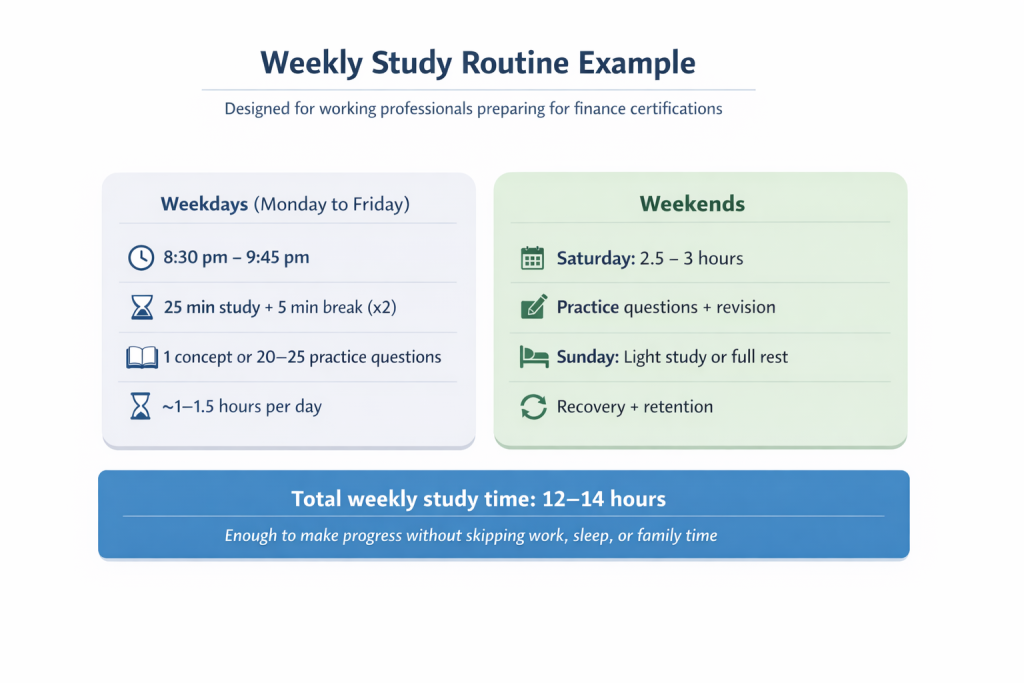
This is not aggressive. This is realistic. And this is exactly how most working professionals actually clear exams.
This example directly supports study time management certifications, balancing work and study, and exam planning India in one shot.
Stop Overplanning and Start Tracking
Many professionals plan beautifully but execute poorly.
Instead of fancy planners, track just three things:
- Hours studied this week
- Topics completed
- Mock scores
Tracking builds awareness and awareness improves study time management certifications naturally.
If you are falling behind, you adjust early. Not after failing.
Use Active Study Methods
Most working professionals rely on passive study without realizing it. Passive study means reading notes, watching lectures, or highlighting pages and feeling busy, but not actually testing understanding. It feels productive, but very little sticks.
Active study is the opposite. It forces your brain to think, recall, and apply concepts instead of just consuming information. This is especially important when balancing work and study, because time is limited.
Replace passive study with:
- Active recall
- Practice questions
- Teaching concepts aloud
- Spaced repetition
These methods reduce total study time. That is gold for balancing work and study.
Burnout Is Not a Badge of Honor
Working professionals often push too hard. Late nights. No breaks. Zero rest days. Like for an example, a professional studies late every night for one month, then stops completely due to exhaustion. Another studies calmly for six months and cleared comfortably.
That is not discipline. That is poor exam planning India. Do this instead:
- Schedule rest.
- Inform the family that it is a temporary phase.
- Protect sleep.
Consistency beats heroic effort. Always.
Simulate Exam Conditions Gradually
Do not wait till the last month to attempt full mocks.
Start early with:
- Timed sections
- Partial mock tests
- Gradual increase in duration
This builds exam stamina without an overwhelming daily routine. This is another underrated part of study time management certifications.
Time Management Mistakes & Better Study Approaches for Working Professionals
| Mistake | Better Approach |
| Studying only when motivated | Fix a daily study slot |
| Ignoring weak topics | Practice weak areas early |
| Weekend-only studying | Add short weekday sessions |
| No regular revision | Schedule frequent revision |
| Copying toppers | Build a personal routine |
Avoid these and balancing work and study becomes much smoother.
Verdict
If there is one takeaway, it is this. Make your study routine boring. Predictable. Repetitive.
That is how habits stick. That is how balancing work and study becomes a normal life.
That is how exam planning India turns from stress to structure. You do not need perfect conditions. You need a system that survives imperfect days. Build that system. Protect it. And let time work in your favor, not against you.
That is how working professionals win.
If you are working full-time and preparing for finance certifications, The WallStreet School helps you study smart without quitting your job or burning out.
People Also Ask
1. How many hours should working professionals study daily for finance certifications?
Ans. Most working professionals need 1 to 1.5 focused hours daily with a consistent weekly routine.
2. Is it possible to balance work and finance exam preparation?
Ans. Yes, balancing work and study is possible with time blocking, short sessions, and realistic weekly planning.
3. What is the best study schedule for working professionals in India?
Ans. A weekday short-study and weekend practice model works best for exam planning India professionals.
4. Are weekends enough to prepare for finance certifications?
Ans. No, relying only on weekends causes stress; small weekday study sessions are essential for steady progress.
5. What is the biggest mistake working professionals make during exam preparation?
Ans. Studying without a system and depending on motivation instead of consistent time management routines.