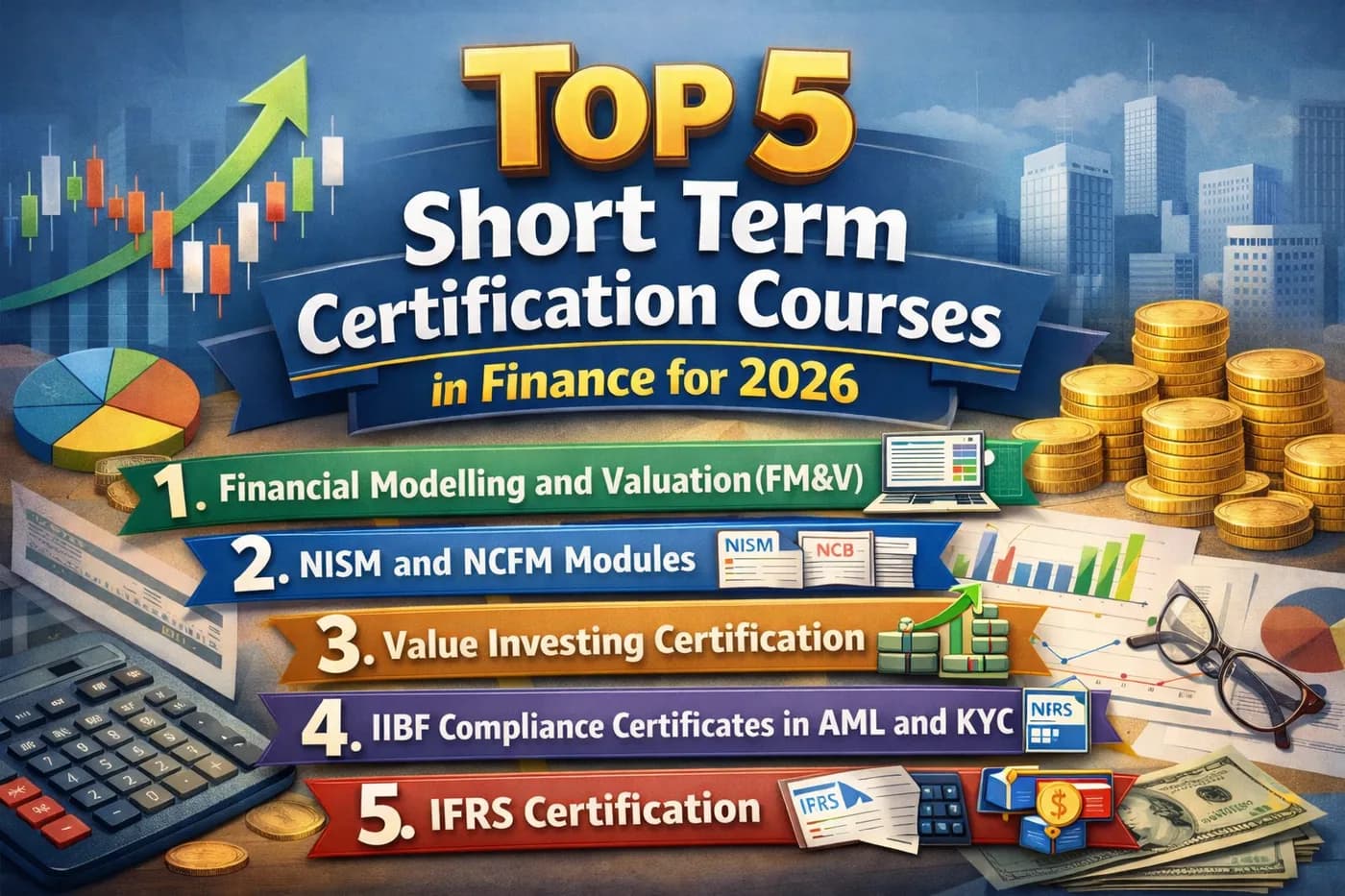
Top 5 Short Term Certification Courses in Finance for 2026
Finance careers in 2027 are moving fast. Companies no longer wait for long degrees or years of exams. They want people who can understand numbers, work with data and support decisions immediately. That is why short term certification courses in finance are becoming the first step for many professionals.
But not every popular finance course is short term. Many people confuse long programs with short ones and lose time. This article focuses only on true short term finance courses, all of which can be completed in six months or less and are known for strong job impact. Many of these are now available as short term certification courses in finance online, so you don’t need a classroom to get started.
If your goal is faster growth, better roles, or a salary jump without committing years, these certification courses in finance are the right place to start.
Why Need Short Term Certification Courses in Finance 2027?
The finance job market has changed. Degrees alone are no longer enough. Employers want people who can support teams from day one.
Here is why short term finance courses are so valuable today:
- They help professionals move faster.
- They cost less than long programs.
- They teach skills used daily at work.
- They fit well with jobs or degrees.
- They reduce career switch risk.
Most are also offered as short term certification courses in finance online, making them accessible from anywhere in India.
That is why finance certification courses with short duration are now seen as smart career moves not shortcuts.
Top 5 Short Term Certification Courses in Finance
Based on duration, demand and salary impact, these are the top five short term certification courses in finance for 2027.
All of them are practical and are known to improve job outcomes.
1. Financial Modelling and Valuation (FM&V)
Among all short term certification courses in finance, Financial Modelling and Valuation stands at the top for one simple reason. It teaches how finance actually happens inside companies.
This course focuses on building financial models using Excel. You learn how a company’s income statement, balance sheet and cash flow statement are connected. More importantly, you learn how to project future performance and understand whether a business is worth investing in or not.
During the course, you work with real company numbers instead of textbook examples. You learn how analysts forecast revenue, estimate costs, calculate cash flows and arrive at business valuations using methods like discounted cash flow.
This finance certification is highly practical. It remains one of the most in-demand short term finance courses for 2027. It prepares you for roles where decision-making depends on numbers, such as corporate finance, investment analysis and equity research support. That is why it offers one of the highest returns among all certification courses in finance. Most learners complete it within 2 to 4 months, making it ideal for quick career upgrades without long exam cycles.
Duration: 2 to 4 months
What You Learn
- Excel for finance
- Financial statement modelling
- Discounted cash flow analysis
- Forecasting and valuation basics
Career Impact
This short term finance certification is widely used in:
- Investment banking support roles
- Equity research
- Corporate finance
- Financial analyst positions
Starting salaries often range from 6 to 15 LPA, depending on the role, your college, city and prior experience — pure freshers from average colleges may start lower.
This is why Financial Modelling and Valuation is considered the highest ROI option among all certification courses in finance.
Many learners prefer structured FM&V programs with practical case studies. Courses offered by The WallStreet School are often chosen for this reason.
2. NISM and NCFM Modules
NISM and NCFM modules (now often called NSE Academy) are some of the most focused short term finance courses available for capital markets and compliance roles.
Each module is designed to cover one specific area of the financial markets. For example, some modules focus on mutual funds, others on derivatives and some on securities regulations. This modular structure allows learners to choose only what is relevant to their career goals. Many candidates now prepare through short term certification courses in finance online before appearing for the exam.
These certification courses in finance explain how financial markets operate in real life. You learn the rules, processes and responsibilities involved in trading, investing and compliance. The content is practical and aligned with regulatory expectations.
Because each module can be completed in 1 to 3 months, NISM and NCFM are true examples of short term finance certification. Among short term finance courses, these modules continue to be a preferred entry point into capital markets roles. They are widely used by banks, brokerage firms and financial service companies for entry-level and support roles. These courses are especially useful for beginners who want structured exposure to markets without getting overwhelmed.
Duration: 1 to 3 months per module
What You Learn?
- Securities markets basics
- Mutual funds and derivatives
- Market regulations
- Compliance fundamentals
Career Impact
These certification courses in finance are useful for:
- Trading support roles
- Compliance teams
- Market operations roles
Typical salary outcomes range from 3 to 18 LPA (entry roles often 3–6 LPA; higher salaries need experience and multiple modules). Because of their short duration and low cost, NISM and NCFM are often chosen as entry points into finance careers.
3. Value Investing Certification
Value investing certification courses focus on analysing companies for long term potential rather than short term price movements. These courses teach how to study a business using financial data and judge whether it is fairly valued.
Among short term certification courses in finance, value investing programs are popular with learners who want to understand how professional investors and equity research teams evaluate companies.
Duration
Most value investing certification courses can be completed within 1 to 3 months. They are usually self paced, which allows learners to manage the course alongside work or studies. Since these are typically short term certification courses in finance online, you can learn at your own pace. Even if access is provided for a longer period, the actual learning effort fits well within the short term finance certification timeframe.
What You Learn?
In value investing courses, learners typically study:
- How to read and analyse financial statements?
- How to assess profits, cash flows, and balance sheet strength?
- How to estimate intrinsic value using basic valuation methods?
- How to understand business models and competitive advantages?
- How to take a long term and disciplined approach to investing?
The focus is on building clarity and judgement rather than memorising theory.
Career Impact
Value investing skills are commonly used in:
- Equity research support roles
- Wealth management and advisory profiles
- Investment analysis teams
- Finance roles involving portfolio evaluation
Typical salary outcomes range from 4 to 15 LPA (entry roles often 3–6 LPA, higher salaries need experience and strong analytical skills)
As a short term finance certification, value investing works best when combined with other certification courses in finance such as financial modelling or accounting-based programs. Together, they help professionals make better data-driven decisions. Among short term finance courses, value investing certifications stand out for their flexible, self-paced format.
Learners looking for a guided and beginner-friendly format often choose structured value investing courses from The WallStreet School, where pre-recorded videos allow the course to be completed at a comfortable pace within a short time frame.
4. IIBF Compliance Certificates in AML and KYC
Compliance is a critical part of the financial system and its importance continues to grow. IIBF compliance certificates focus on the basics of risk control, customer verification and regulatory processes.
These short term finance courses explain how banks and financial institutions prevent fraud and ensure legal compliance. You learn how anti-money laundering rules work, why customer verification is important and how compliance teams operate internally. The content is practical and process-oriented. IIBF AML and KYC modules are also offered as short term certification courses in finance online for working professionals. It helps learners understand how finance operations function behind the scenes. This makes it a useful short term finance certification for people targeting stable roles in banking, operations and compliance support.
Most IIBF certificates can be completed within 1 to 3 months. They are commonly used as stepping stones into banking roles where risk awareness and process knowledge are essential.
Duration: 1 to 3 months
What You Learn?
- Anti-money laundering basics
- Know your customer processes
- Risk and compliance frameworks
- Banking operations support
Career Impact
These finance certification courses are useful for:
- Banking operations roles
- Compliance analyst positions
- Risk support teams
Salary outcomes typically range from 3 to 18 LPA (entry roles usually 3-6 LPA, senior/compliance roles can go higher).
These courses are known for stability and consistent demand.
5. IFRS Certification
IFRS Certification focuses on the International Financial Reporting Standards used by companies across the world.
These certification courses in finance explain how financial statements are prepared and interpreted under global standards. You learn how reporting rules differ from local accounting practices and why these differences matter for multinational companies.
The workshops are usually practical and concise. IFRS workshops are increasingly delivered as short term certification courses in finance online for global finance teams. They focus on understanding standards rather than memorising rules. This makes IFRS a useful finance certification for professionals working with global clients, shared service centres, or international finance teams. For finance professionals eyeing global roles, IFRS remains one of the most practical short term finance courses to pick up in 2027.
Most workshops last between 1 to 3 months. While IFRS alone may not create a career shift, it significantly strengthens profiles in accounting, reporting and finance support roles.
Duration: 1 to 3 months
What You Learn?
- International financial reporting standards
- Financial statement interpretation
- Global reporting requirements
Career Impact
These certification courses in finance support roles such as:
- Reporting analyst
- Accounting roles
- Global finance support
Salary outcomes often range between 4 and 24 LPA. Freshers typically start around 4–8 LPA; higher salaries come with experience and MNC/GCC roles.
IFRS works well as a skill upgrade rather than a standalone career switch tool.
Quick Comparison of Short Term Certification Courses in Finance
Here is a simple overview to help with decision-making. All five options below are available as short term certification courses in finance online.
| Rank | Course | Duration | Cost Range (approx) | Best Use |
| 1 | Financial Modelling and Valuation | 2 to 4 months | 20k to 60k | Corporate finance and modelling roles |
| 2 | NISM or NCFM | 1 to 3 months | 1.5k to 5k | Market and compliance roles |
| 3 | Value Investing Certification | 1 to 3 months | 5k to 10k | Equity research and investment analysis |
| 4 | IIBF AML and KYC | 1 to 3 months | 2k to 10k | Banking risk and compliance foundation |
| 5 | IFRS Workshops | 1 to 3 months | 5k to 1,00,000 (5k–20k for short workshops, 20k–1L for full IFRS certificate/diploma) | Reporting and global finance roles |
Which Short Term Finance Certification Should You Start With?
- Want faster growth and better pay? – start with Financial Modelling and Valuation
- Interested in markets or compliance? – NISM or NCFM modules work better
- Like analysing companies and investments? – go for a Value Investing certification
- Prefer stable banking or operations roles? – IIBF AML and KYC certifications fit well
- Working with global reporting or MNCs? – IFRS certifications are a useful add-on
Simple rule: pick the course that helps with your next job move, not the one with the fanciest name.
Note: If you prefer learning from home, look for short term certification courses in finance online in each category.
Common Mistakes Learners Make
Many people do not benefit fully because they:
- Choose long programs, thinking they are short term
- Collect certificates without applying skills
- Ignore job role alignment
- Follow trends instead of needs
Avoiding these mistakes is what makes short term finance courses effective.
People Also Ask about short term certification courses in finance
Q1. Which short term course is best for finance?
Financial Modelling and Valuation is best for finance due to high demand, practical skills and strong career impact.
Q2. Are short term certification courses in finance worth it?
Yes, they build job-ready skills quickly and help faster career growth without long study commitments.
Q3. Can I do short term finance courses while working?
Yes, most short term finance courses are flexible and many now run as online, so they can be completed alongside a job or college.
Final Thoughts
There is no single course that works for everyone. What matters more is choosing something that actually fits your current situation.
If you want faster growth, Financial Modelling and Valuation usually gives the strongest push. If markets or compliance interest you, NISM or NCFM make sense. Value investing helps if you enjoy analysing companies and thinking long term. IIBF suits people aiming for stable banking roles, while IFRS works best as a reporting skill upgrade.
The mistake most people make is trying to do too much at once. One well chosen short term certification course in finance, done properly, is often enough to open the next door. Focus on skills you will actually use, and the career progress usually follows on its own.
*Salary figures are indicative ranges based on 2025–26 data for metro cities. Actual offers depend on college, experience, skills and company.
Interested in Learning Finance Professionally?
Our courses take you from fundamentals to expert level — with live mentors and placement support.
Explore Our Courses