Most students start CIMA thinking it is just a series of exams. Then halfway through, they realise the structure, exemptions and subscription model are more complex than they expected. The truth is, the CIMA Course Roadmap is not one-size-fits-all. A college student, an MBA graduate and a working professional will all follow different paths within the qualification structure. The levels and exams you attempt, the exemptions you receive and even your CIMA Classes Fee depend entirely on your background.
This Complete CIMA course guide explains the course details clearly so you can plan your journey with confidence and build a strong career and salary foundation.
Prefer a quick video explanation? Watch the full breakdown of the CIMA Student Journey below:
What Is CIMA?
Chartered Institute of Management Accountants, known as CIMA, is a global professional body for management accountants. It focuses on finance, business strategy, risk management and leadership.
Unlike traditional accounting qualifications that focus mainly on tax and audit, CIMA trains you to work inside businesses and help management take decisions. That is why the CIMA journey is built around business performance, strategy and leadership.
If your goal is to move into finance leadership roles in multinational companies, CIMA makes strong sense.
Understanding the CIMA Qualification Structure
Before choosing a route, you must understand the CIMA qualification structure.
There are two main pathways:
- Traditional Route
- Finance Leadership Program route or FLP
Both lead to the same qualification but the structure of CIMA levels and exams differs.
Traditional Route
In the traditional pathway, students appear for individual objective tests and case study exams. In total, around 16 papers are involved across different levels.
This route suits students who prefer a classic exam-based structure and want to clear each paper one by one.
Finance Leadership Program Route
The FLP route is a subscription-based learning model. Instead of paying per exam, you pay an annual subscription. You prepare through structured modules and attempt case study exams at each level.
This model is popular among students pursuing graduation or working professionals because it is flexible and focused. When people search for CIMA Course Details today, they mostly want clarity about FLP. So let us understand it step by step.
CIMA Levels and Exams Explained
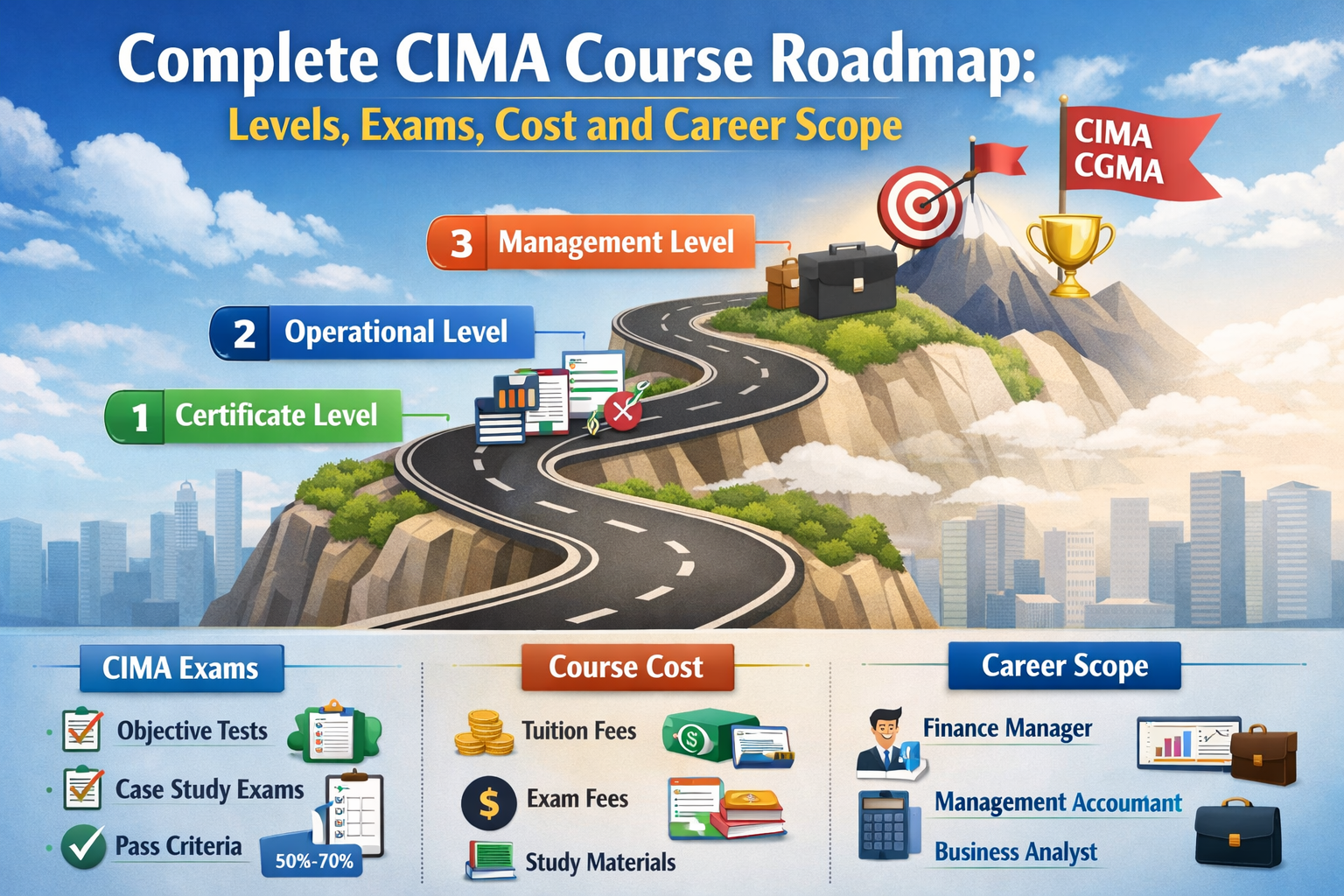
The CIMA Course Roadmap is divided into four broad levels under the FLP route:
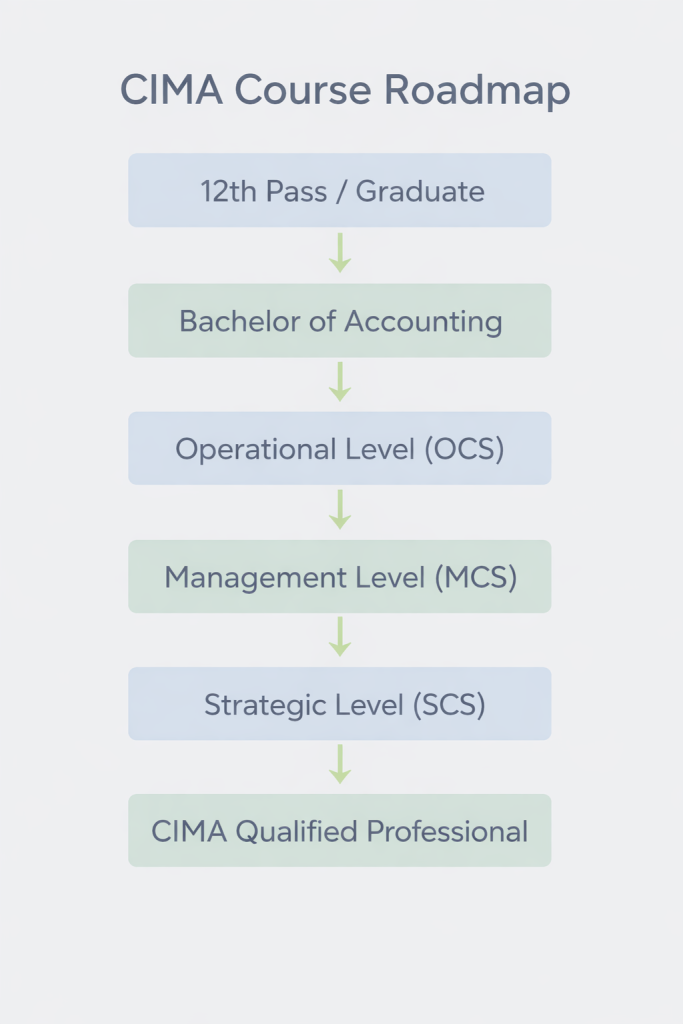
Figure 1: Overview of the CIMA Course Roadmap from entry level to qualification
At each level, you study three subject areas and then attempt one case study exam.
1. Bachelor of Accounting
This is the foundation stage. Students learn core accounting and business basics.
If you are an undergraduate student, you usually start here unless you qualify for exemptions.
2. Operational Level
At this level, the focus shifts to how finance supports day-to-day business operations. You study costing, performance management and basic financial reporting.
You then appear for the Operational Case Study exam or OCS.
3. Management Level
This level builds decision-making skills. Topics include project appraisal, advanced performance management and financial strategy.
You appear for the Management Case Study exam or MCS.
4. Strategic Level
This is the final level of the CIMA qualification structure. Here the focus is on long-term strategy, risk management and leadership.
You appear for the Strategic Case Study exam or SCS.
In the FLP route, you prepare three papers’ worth of content at each level and then attempt one live case study exam. Exams are conducted quarterly. You can attempt up to four times per year, depending on your readiness.
The CIMA exam pattern 2026 continues to focus heavily on case study-based assessment. This means practical application matters more than memorisation.
CIMA Course Roadmap Based on Your Background
Not every student follows the same journey. Your entry point depends on your education and experience.
1. If You Are 12th Pass or Pursuing Graduation
- If you are in college or have just completed 12th, the FLP route is usually the most efficient option.
- You can study alongside your degree through college tie-ups. In many cases, the CIMA Classes Fee is subsidised through such partnerships.
- Undergraduates typically complete the full CIMA Course Roadmap in 1.5 to 2 years if they stay consistent.
This is one of the biggest advantages of starting early. You finish your graduation and CIMA almost together.
2. If You Are Pursuing or Have Completed Masters
Postgraduate students often receive exemptions from the Bachelor of Accounting level. In such cases, you move directly to Operational, Management and Strategic levels. The timeline reduces to around 1 to 1.5 years if preparation is focused.
This makes the CIMA Course Roadmap much faster for students with a finance or accounting background.
3. If You Have Around 6 Years of Relevant Experience
Professionals with about six years of relevant work experience or an MBA may receive exemptions from the Operational level. In such cases, you only need to clear the Management and Strategic Case Study exams. Completion time under the FLP route can be as short as 6 to 12 months.
This flexibility in the CIMA qualification structure is one reason many mid-career professionals choose it.
4. If You Are a Senior Professional With 15 Years of Experience
- Senior leaders with around 15 years of relevant experience may need to appear only for the Strategic Case Study exam.
- Chartered Accountants and Cost Accountants also receive major exemptions. Many of them only need to complete the Management and Strategic levels. For such professionals, the CIMA Course Roadmap can be completed within one year.
CIMA Classes Fee and Cost Structure Explained
One of the most common questions about CIMA Course Details is cost. The FLP route works on a subscription model.
Below is a clear breakdown of the CIMA Classes Fee under different situations.
| Category | Annual Cost | Duration | What You Get |
| College Students with a Tie Up | Around 718 pounds per year | Typically 2 years | Subsidised access through a college partnership |
| General FLP Subscription | Around 2400 pounds per year | 1-year subscription | Full portal access, study material, videos, mock tests, pre-seen material, competency framework and exam eligibility |
The FLP route works on a yearly subscription model instead of charging you for each paper separately. Once you pay the annual fee, you get full access to the learning portal, study material, mock tests and the right to sit for exams during that year. Everything is bundled into that one subscription.
But here is what many students miss. The subscription lasts for one year only. If you do not attempt your exams within that time, it simply expires. No extensions.
That is why planning your CIMA Course Roadmap before paying the CIMA Classes Fee really matters. If you register at the right time, you can use the full year wisely and avoid wasting money on re-subscriptions or rushed attempts.
Start your CIMA journey with The WallStreet School and move from student to strategic finance professional with expert mentorship, structured guidance and exam-focused preparation.
CIMA Exam Pattern 2026 and Attempt Strategy
The CIMA exam pattern 2026 continues to focus on case study-based evaluation at each level.
Case studies test your ability to:
- Analyze business scenarios
- Apply financial knowledge
- Make recommendations
- Write structured answers under time pressure
There are four exam windows per year. Students can attempt exams quarterly.
Since the subscription is time-bound, disciplined preparation is essential. Many students waste attempts because they register too early without completing preparation. The smart approach is simple. Finish your preparation for a level. Then activate or align your subscription so your one-year window is fully utilised.
This approach improves pass rates and protects your CIMA Classes Fee investment.
CIMA Career and Salary Scope
Now let us talk about the outcome.
The CIMA Course Roadmap is designed to produce finance leaders, not just accountants.
After qualification, common roles include:
- Management Accountant
- Financial Analyst
- Business Partner
- Finance Manager
- Risk Manager
- Strategy Analyst
Globally, CIMA qualified professionals work in multinational companies, consulting firms and large corporate groups.
CIMA career and salary potential depend on geography and experience. In many markets, qualified members command strong mid to senior-level salaries due to their business-oriented skill set. Since the CIMA qualification structure builds analytical and strategic skills, many professionals move into CFO track roles over time.
Traditional Route vs FLP Route
When comparing CIMA Course Details, students often ask which route is better.
The traditional route suits those who prefer structured paper wise exams and do not want subscription pressure.
The FLP route suits students who:
- Want flexibility
- Prefer case study-driven learning
- Are pursuing graduation
- Are working professionals
- Want faster completion with exemptions
Currently, the FLP route is widely recommended due to its integrated structure and practical focus.
People Also Ask about CIMA Course Roadmap
- What is the course pattern of CIMA?
CIMA follows three professional levels. Each level has three subjects and one case-study exam that tests real-world business application not just theoretical knowledge. - What are the 4 levels of CIMA?
The four levels are Bachelor of Accounting, Operational, Management and Strategic. Each level builds business, financial and leadership skills progressively. - Is CIMA harder than CA?
CIMA focuses on business strategy and management accounting, while CA is technical and compliance-heavy. Difficulty depends on your strengths and career goals. - What are the 12 CIMA exams?
CIMA has 12 objective test papers across Operational, Management and Strategic levels, plus three case study exams that test practical decision making. - Is CIMA very difficult?
CIMA is challenging but manageable with consistent study. Success depends on understanding concepts and practising case studies regularly. - Do Big 4 hire CIMA?
Yes, Big 4 firms hire CIMA professionals mainly for advisory, consulting, financial planning and corporate finance roles rather than pure audit positions.
Final Thoughts on Planning Your CIMA Course Roadmap
CIMA is not only about passing exams and collecting certificates. It is about shaping how you think as a finance professional. The real difference comes from knowing where you fit in the CIMA qualification structure, understanding your exemptions, timing your subscription smartly, and preparing properly for the case study exams without wasting your CIMA Classes Fee. When you plan your CIMA Course Roadmap with clarity, the journey feels much more manageable. Whether you are a student or an experienced professional, the path is there. What matters is committing to it and staying consistent until you finish.