
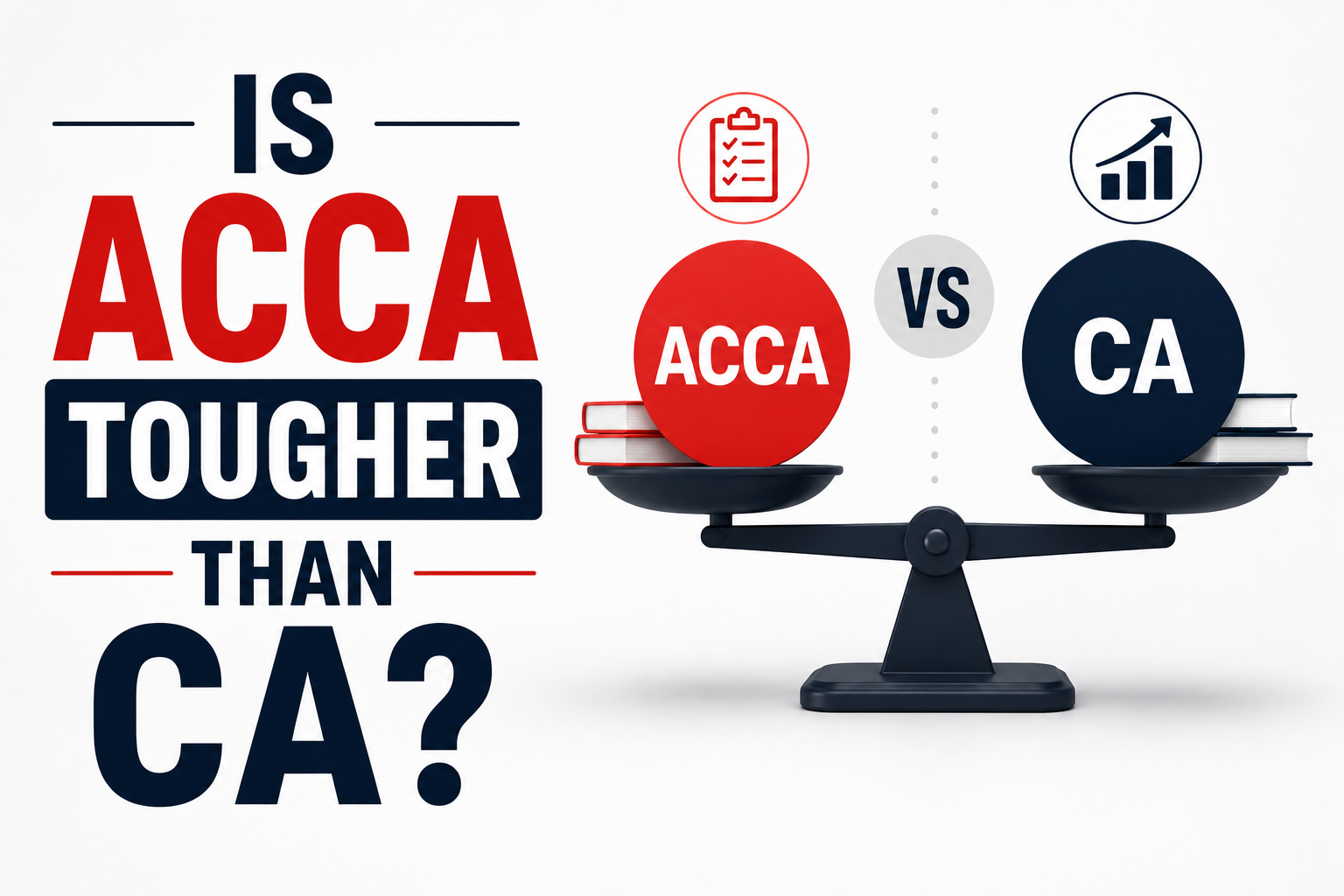
CA is harder — not because it tests more intelligent people, but because the system itself is designed in a way that makes the journey unnecessarily brutal. ACCA is challenging too, but it is challenging in a way that feels fair. There is a difference between being tested and being exhausted.
Let me break this down properly. Because this is a question that deserves a real answer, not a marketing one.
The CA journey — let us be honest about what it actually involves
CA in India is one of the most difficult professional qualifications in the world. And I say that with genuine respect for the people who complete it. But respect for the difficulty does not mean we should not talk honestly about what that difficulty looks like in practice.
The CA curriculum spans three levels — Foundation, Intermediate, and Final — across subjects that include financial reporting, taxation, auditing, law, and strategic management. The syllabus is vast. The depth required at each level is significant. And crucially, the pass rates are brutal. CA Final pass rates routinely sit between 10 and 20 percent. Read that again. Eight out of ten people who sit the exam do not pass it.
But the pass rate alone is not the full story. What makes CA genuinely gruelling for many people is the combination of factors happening at the same time. You are studying a curriculum that is wide and deep. You are simultaneously doing a three-year articleship — often 35 to 50 hours a week of actual work. And you are doing all of this under a rank-based system where your success depends not just on how well you do, but on how well you do relative to everyone else sitting that day. The threshold shifts. You can score the same marks in two different sittings and pass one and fail the other.
A lot of CA students are not failing because they are not smart enough. They are failing because the system is structured in a way that would exhaust almost anyone.
I have spoken to CA students who took four or five attempts at the Final. Intelligent, hardworking people who spent the better part of a decade trying to cross a finish line that kept moving. That is not a test of ability. That is, for many of them, a test of how much punishment they can absorb.
How ACCA approaches things differently
ACCA has 13 papers spread across three levels — Applied Knowledge, Applied Skills, and Strategic Professional. It is not easy. The Strategic Professional papers have pass rates that drop to around 38 to 50 percent. Some papers genuinely challenge you. But the way the system is set up around those papers is fundamentally different from CA.
The first and most important difference is how you are assessed. ACCA is competency-based. You need to score 50 percent to pass. If you score 50, you pass. It does not matter how everyone else does that day. Your result is about your performance against a fixed standard — not about how you rank in a cohort. That one structural difference changes the entire psychological experience of studying.
| ACCA | CA (India) | |
|---|---|---|
| Pass mark | 50% — fixed, competency-based standard | Rank-based — threshold varies by cohort performance |
| Pass rates | 40–55% across most papers; up to 88% at entry level | 10–20% at Final level — among the lowest of any qualification |
| Exam sittings/year | 4 sittings — March, June, September, December | 2 sittings per year — May and November |
| Exam on-demand | Yes — Applied Knowledge papers available on-demand | No — fixed windows only |
| Retake policy | Retake individual papers as needed | Must clear all papers in a group together |
| Work requirement | Flexible — practical experience logged alongside study | Mandatory 3-year articleship running concurrently with exams |
| Time to complete | Typically 3 to 4 years working full-time | Often 5 to 7 years including attempts and articleship |
The flexibility difference — and why it matters more than people realise
One of the things I point out to people considering this choice is that ACCA gives you control in a way that CA simply does not.
You can take one paper at a time. You can take four in a sitting if you are ambitious and well-prepared. If life gets complicated — a job change, a family situation, a difficult few months — you can slow down without losing everything you have already done. Each paper you pass stays passed. There is no group-clearing requirement hanging over you.
In CA, if you pass some papers in a group but not all of them, you clear nothing. You come back and sit the whole group again. That policy alone has cost thousands of capable people years of their life.
ACCA also offers four exam sittings a year, with Applied Knowledge papers available on-demand. That is not just convenient — it means you can study at a pace that matches your life, not a schedule imposed on you twice a year regardless of your circumstances.
The practical reality: ACCA saves most candidates between three and four years compared to the average CA journey when you account for the number of attempts, the articleship structure, and the group-clearing requirement. That is not a small difference. That is years of your career.
Marking — the question of fairness
This is a point that does not get enough airtime. In CA, the marking system is relative. How many people you beat matters as much as how well you actually did. That means on a particularly strong sitting, good candidates fail — not because they did not know the material, but because the cohort was unusually well-prepared that day.
ACCA does not work like that. The 50 percent pass mark is fixed and independent. Every examiner is trained to the same global standard. The marking is moderated. You are being assessed on what you know and what you can do — not on where you land in a distribution.
Is ACCA marking easy? No. The Strategic Business Leader paper, for example, requires integrated thinking, professional judgment, and the ability to construct a coherent argument under time pressure. That is genuinely hard. But when you fail, you know why — and you know exactly what you need to work on. That kind of clarity is something CA students often do not get.
Career progression — where does each one actually take you?
This is ultimately what most people care about. And the honest answer is that both qualifications can lead to strong careers — but they lead to different careers, and the journey there is very different.
CA remains the gold standard within India. If you want to build a career in Indian domestic audit, Indian taxation, or work closely with Indian regulatory frameworks, CA carries weight that ACCA simply does not have in that specific context. That is a real advantage worth acknowledging.
But outside of India? The picture changes significantly. ACCA is recognised in over 180 countries. The qualification is based on IFRS — the global accounting standard. Employers in the UAE, UK, Singapore, and across Africa actively seek ACCA professionals. The career paths ACCA opens — Financial Controller, Finance Director, CFO in an MNC — are genuinely global in a way that CA is not designed to be.
| Career factor | ACCA | CA (India) |
|---|---|---|
| Global mobility | Works across 180+ countries — strong in UAE, UK, Singapore | Primarily recognised within India |
| Senior roles | CFO, Finance Director, Financial Controller in MNCs | CFO, Partner, Tax Director — strong in Indian firms |
| Big 4 access | Active preference across Big 4 globally | Strong preference within Indian Big 4 offices |
| Industry flexibility | Audit, tax, consulting, industry, financial services | Audit and tax-heavy — less breadth across sectors |
| Time to first senior role | Often faster due to shorter qualification timeline | Longer — articleship + multiple attempts typical |
So which one is actually tougher?
CA is harder by almost every measurable metric — pass rates, time to complete, the volume of material, the articleship pressure, and the psychological toll of a system that can make you feel like you are running on a treadmill that keeps speeding up.
ACCA is genuinely challenging — especially at the Strategic Professional level. Do not let anyone tell you it is a soft option. But it is designed to be completed. The support systems are better, the structure is more humane, and when you put in the work, the system meets you fairly.
The more important question for most people is not which one is harder. It is which one is right for where you want to go. If the answer to that question is an international finance career — ACCA is not the easier path. It is the smarter one.
Difficulty for its own sake is not a virtue. What matters is whether the qualification actually prepares you for the career you want — and whether the system gives you a fair shot at earning it.
This is a fantastic bit of analysis, concise, precise, lucid. The CA exam system is designed to respond to the market demand, by keeping the supply somewhat lowering than the probable demand from the employers.
The 10-20% success rate is not, in my opinion, perhaps a true measure of the overall success rate. Let us consider, if we had the data, how many students enrolled for the CA in (e.g.) in the year 2020, and how many of them have qualified as CAs as of now.
As a wild guess, I’d say that out of every 1000 students that enrolled themselves in 2020 into the CA program, maybe some 20 of them are fully qualified at this time.