A straight answer — for everyone who is genuinely unsure.
What do you actually want?
Before I answer the ACCA question, I need to ask you one thing: where do you want your career to go?
Because the answer to that question determines everything else. ACCA and CA are both serious qualifications. Neither is a shortcut. But they are built for different destinations — and choosing the wrong one for your goals is a real cost, not just an inconvenience.
If you want to build a career entirely within India — Indian statutory audit, Indian tax practice, working in a CA firm, advising Indian businesses on compliance — CA is the more relevant choice. It gives you signing authority that ACCA simply does not in the Indian regulatory system. That matters for a specific type of career and you should not ignore it.
But if you want anything beyond that — an MNC finance role, a move to Dubai or Singapore, a position in a Big 4 global team, or just the option to keep those doors open — then ACCA deserves a serious look.
Is ACCA actually recognised in India in 2026?
Yes and more than most people realise. There are over 60,000 ACCA students and members in India right now. The Big 4 firms – Deloitte, PwC, EY, KPMG are actively hire ACCA-qualified professionals in their Indian offices, particularly for roles in global reporting, financial advisory, and shared services. MNC finance teams based in India increasingly prefer ACCA because the qualification is built on IFRS, the same reporting framework their global operations use.
India is also home to a growing number of Global Capability Centres — GCCs — run by international companies. These are not traditional Indian firms. They are finance hubs supporting global operations, and they hire ACCA professionals at a meaningful rate because the qualification aligns with how they work.
GIFT City in Gujarat is another development worth paying attention to. As India builds out its international financial services centre, the demand for professionals with globally recognised qualifications will only grow. ACCA positions you well for that.
The reality on salaries in India: ACCA freshers in India earn between Rs 6 to 10 LPA in 2026, primarily at Big 4 firms, MNCs, and KPOs. At mid-career level, that moves to Rs 15 to 28 LPA. This is comparable to CA at similar stages — the gap narrows significantly once you are in an MNC environment.
How does ACCA compare to other options available in India?
| Qualification | Best for | India recognition | Global reach | Typical time |
|---|---|---|---|---|
| CA (ICAI) | Indian audit, tax, domestic compliance, CA practice | Highest — statutory audit rights | Limited outside India | 5–7 years avg with attempts |
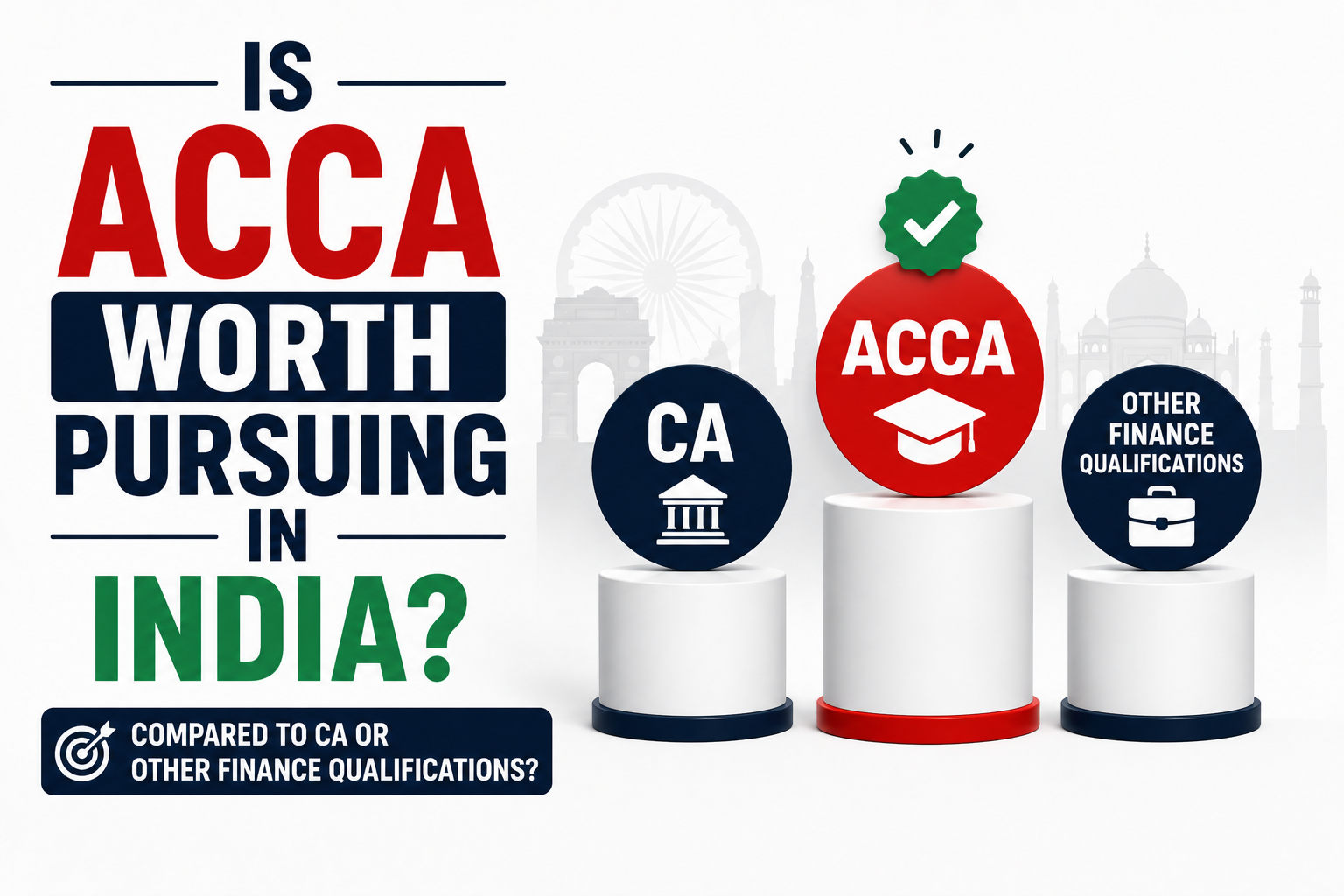
| ACCA | MNCs, Big 4 global teams, international finance roles | Strong and growing — 60,000+ in India | 180+ countries | 3–4 years working full-time |
| CFA | Investment management, equity research, portfolio roles | Respected in investment circles | Global — investment-specific | 3–5 years, very demanding |
| CMA (India) | Cost accounting, manufacturing, internal finance roles | Recognised in India — niche | Limited | 3–4 years |
| CS | Company law, compliance, corporate secretarial work | Recognised in India — very niche | Limited | 3–4 years |
What ACCA gives you that CA does not
The most obvious thing is time. The average CA candidate in India takes five to seven years to qualify when you account for multiple attempts and the articleship structure. ACCA, done alongside a full-time job, typically takes three to four years. That is years of your career spent earning, building experience, and progressing — not re-sitting exams.
The second thing is flexibility. In CA, if you fail one paper in a group, you re-sit the whole group. In ACCA, you clear one paper at a time. Each pass stays passed. That structural difference alone removes an enormous amount of unnecessary pressure and wasted time.
The third thing is the global option. I speak to a lot of professionals in their late twenties and early thirties who qualified as CAs and are now trying to move internationally. Several of them are looking at ACCA to add that global credential. The smarter move — if international work is even a possibility in your future — is to build that in from the start rather than come back for it later.
You do not have to be planning to move abroad today for global recognition to matter. Career paths are rarely straight lines. ACCA keeps more options open.
What CA gives you that ACCA does not
This matters too and I am not going to skip it.
CA gives you statutory audit signing authority in India — something ACCA does not. If you want to run your own CA practice, sign statutory audit reports, or work in a specifically Indian regulatory role, CA is the right path and there is no equivalent through ACCA.
CA also carries significant brand recognition within traditional Indian firms and among Indian corporates that have not internationalised heavily. In those environments, CA still carries more weight than ACCA does.
Worth knowing: If you already hold CA, you can get up to 9 paper exemptions from ACCA — meaning you would only need to clear 4 Strategic Professional papers to become ACCA qualified. Some professionals pursue both for exactly this reason.
Who should seriously consider ACCA in India?
Based on what I see in the market and the conversations I have, ACCA makes the most sense for you if:
You are targeting MNC finance roles, Big 4 advisory, or shared services work — especially anything involving IFRS reporting or global finance teams. You want international mobility at some point in your career, even if not immediately. You are already working and need a qualification that fits around your job rather than demanding you drop everything. You tried CA, found the system genuinely punishing, and are looking for something that challenges you fairly rather than just exhausting you.
It makes less sense if your goal is traditional Indian practice, statutory audit, or you are set on building a CA firm. In that case, CA is not just the conventional choice — it is genuinely the right one.
One more thing: ACCA study materials and exams are in English, and the qualification is designed for working professionals from the ground up. If you are in an English-medium environment already, the transition into ACCA is more natural than many people expect.
The straight answer
ACCA is absolutely worth pursuing in India in 2026 — if your goals align with what it is built for. It is not a second-best option to CA. It is a different option, with different strengths, built for a different kind of career.
If you want to stay in India and build a practice — do CA. If you want global options, MNC exposure, and a qualification that travels with you wherever your career takes you — ACCA is a genuinely smart investment. Just be clear on what you are building before you decide how to build it.
FAQs
Ques 1) Can I get a job in India with just ACCA and no CA?
Yes — especially in MNCs, Big 4 advisory teams, shared services, and KPOs. These employers actively hire ACCA professionals. Where ACCA struggles in India is traditional CA firms and roles requiring statutory audit sign-off. Outside of that specific area, ACCA opens doors just fine.
Ques 2) Is ACCA fees worth it compared to CA which is much cheaper?
CA is cheaper to register for — that is true. But factor in the real cost: multiple re-attempts, years of low-stipend articleship, and a longer timeline before you are earning properly. ACCA costs more upfront but most candidates complete it faster and start earning at a competitive level sooner. Over a five-year horizon, the return often balances out.
Ques 3) I am a BCom graduate. Should I do ACCA or just go for an MBA in Finance?
Different tools for different goals. An MBA in Finance is broad, builds networks, and suits people moving into management or consulting. ACCA is a technical professional qualification — it makes you a credible finance specialist, not just a manager. If you want depth in accounting and global finance, ACCA. If you want a generalist leadership track, MBA. Some people eventually do both, but pick one first based on where you want to be in five years.