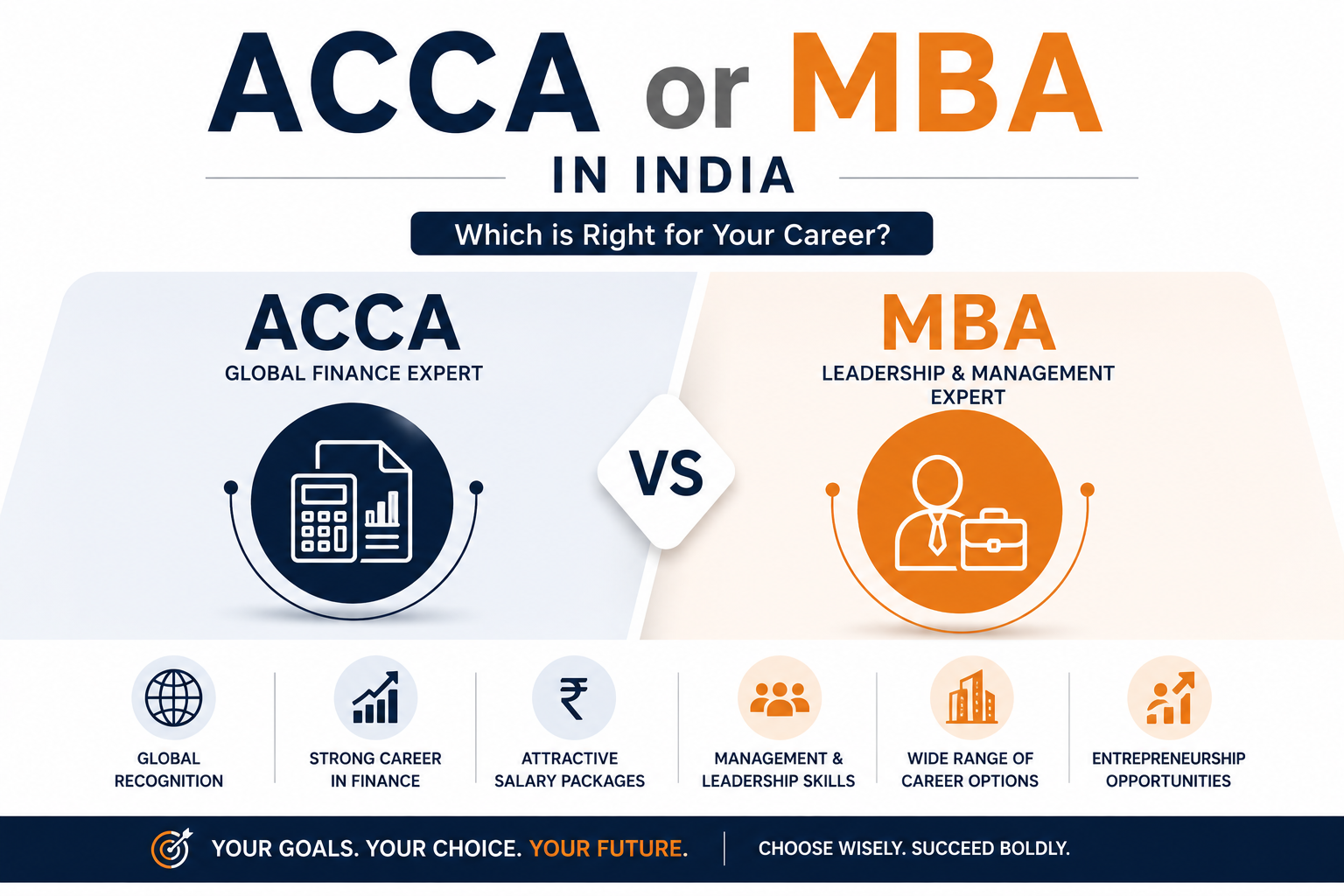
Every commerce student hits this question at some point: ACCA vs MBA, which one actually pays off? Here’s the honest version, with real numbers, not the version coaching institutes sell you.
What ACCA Actually Costs
An ACCA course doesn’t hit you with one big bill. You pay as you go, paper by paper, over two or three years. Fees to ACCA itself (registration, subscription, all thirteen exams) come to about ₹2.2 to ₹3 lakh. Add coaching, which most people take, and you’re looking at ₹3.5 to ₹4.5 lakh total. Skip coaching and go fully self study, and you can bring it closer to ₹3 lakh, though the written Strategic Professional papers get genuinely hard to crack without guidance.
If you’ve got a B.Com or CA Inter behind you, exemptions will cut both your fees and your timeline. Book your exams early instead of at the last window and you’ll save more too.
What an MBA in Finance Actually Costs
MBA finance is a different beast. You’re not paying for a syllabus, you’re paying for a brand, and the brand determines almost everything else. Top IIMs (Ahmedabad, Bangalore, Calcutta) run ₹24 to ₹27.5 lakh for the two year programme. The newer IIMs (Kashipur, Raipur, Ranchi and the rest) come in cheaper, around ₹17 to ₹22 lakh. One year executive programmes like ISB go even higher, ₹35 to ₹40 lakh, but those are built for people already several years into their career.
Outside the IIM system, private B-school finance courses range from ₹10 to ₹25 lakh depending on reputation. Point being: “MBA cost” isn’t one number the way ACCA’s roughly is. It swings wildly based on where you get in.
ACCA Salary: The Real Numbers
ACCA salary in India tracks experience more than pedigree, since the qualification itself does the talking. Freshers start around ₹4 to ₹8 lakh, Big 4 firms and metro cities at the top of that band, Tier 2 cities closer to ₹3 to ₹5 lakh. Three to five years in, most people land ₹10 to ₹17 lakh, often as financial analysts, audit managers, or management accountants at MNCs and GCCs. Eight plus years and you’re typically at ₹20 to ₹30 lakh, with CFO and Finance Director roles going past ₹50 lakh at bigger companies.
One honest flag: ACCA fresher salaries haven’t jumped much lately, partly because more candidates are qualifying every year. It’s still a solid credential. Just don’t walk in expecting the inflated figures some coaching ads throw around.
MBA Salary: The Real Numbers
MBA salary depends far more on institute than ACCA salary does. Top three IIMs reported average packages between ₹26 and ₹47 lakh for 2026 batches, with the best individual offers crossing ₹1 crore. Newer IIMs average lower, ₹20 to ₹30 lakh. Strong private B-schools outside the IIM system land ₹18 to ₹22 lakh. But zoom out to the national average across all MBA colleges, and it’s closer to ₹7 to ₹12 lakh for freshers, dragged down by hundreds of lower ranked colleges.
This is the real story behind MBA vs ACCA salary: MBA outcomes have a huge spread. A top IIM grad will almost certainly out earn an ACCA fresher. An MBA from a mid tier college often won’t beat an ACCA professional with a few years of experience.
Time Is Part of the Cost Too
Money isn’t the only thing you’re spending. ACCA usually takes two to three years, and you can do it while working, since exams are spread across the year and most coaching runs evenings or weekends. That means you’re earning a salary the whole time you’re qualifying, not just paying tuition and hoping for a payoff later.
An MBA is the opposite. A full time programme takes two years out of your working life entirely, and during that window you’re not earning, you’re spending, on top of the fee itself. That’s fine if the placement package at the other end justifies it, which is exactly why institute matters so much for MBA. At a top IIM, two years without a salary plus ₹27 lakh in fees still pays back fast against a ₹35 to ₹47 lakh package. At a weaker college, that same gap in earnings and spending is much harder to close.
So Which One Fits You
Pick ACCA if you want a globally recognised accounting certification without draining your savings upfront, you’re fine paying in instalments over a couple of years, you want to build depth in accounting, audit, or corporate reporting, and you don’t want to pause working to study full time.
Pick MBA Finance if you can genuinely get into a top tier institute, since the whole return on investment hinges on that, not on the degree itself. Go this route if you want a broader management skill set beyond pure finance, you’re aiming at investment banking, private equity, or general management rather than technical accounting, and you can afford or finance the much bigger cost, or you’re confident about getting a strong scholarship or loan.
A lot of people end up doing both. ACCA first, for the technical grounding and global portability, MBA later once they’ve got a few years of real work experience to bring into the room, which also makes them stronger MBA applicants.
Bottom Line
ACCA vs MBA finance really comes down to three things: how much you can spend, what you actually want to do for work, and whether you can get into an institute where the MBA brand justifies the price tag. ACCA gets you into finance and accounting cheaper and faster, with a qualification that travels well internationally and lets you keep earning while you study. A good MBA gets you a wider ceiling and broader career options, but only pays off at the top end, and costs you two years of income along the way. Figure out where you want to land in five years, then pick the path that actually gets you there.
The WallStreet School is here to guide you every step of the way from choosing the right qualification to building a career you’ll be proud of.
Frequently Asked Questions
Ques 1) Is ACCA cheaper than an MBA in India?
By a wide margin. Even with coaching, ACCA runs ₹3.5 to ₹4.5 lakh total. The cheapest IIM MBA alone starts at ₹17 lakh.
Ques 2) Does an MBA always pay more than ACCA?
No. A top IIM grad will likely out earn most ACCA professionals early on. An MBA from a weaker college can pay less than an experienced ACCA holder, especially once you factor in two years of lost income and a much bigger loan to repay.
Ques 3) Can I do ACCA and an MBA?
Yes, and plenty of people do exactly that. ACCA first for the technical base, MBA later with real experience behind you.
Ques 4) Which is better specifically for accounting?
ACCA, no contest. It’s built entirely around accounting, audit, and reporting. An MBA is a management degree that happens to have a finance track.