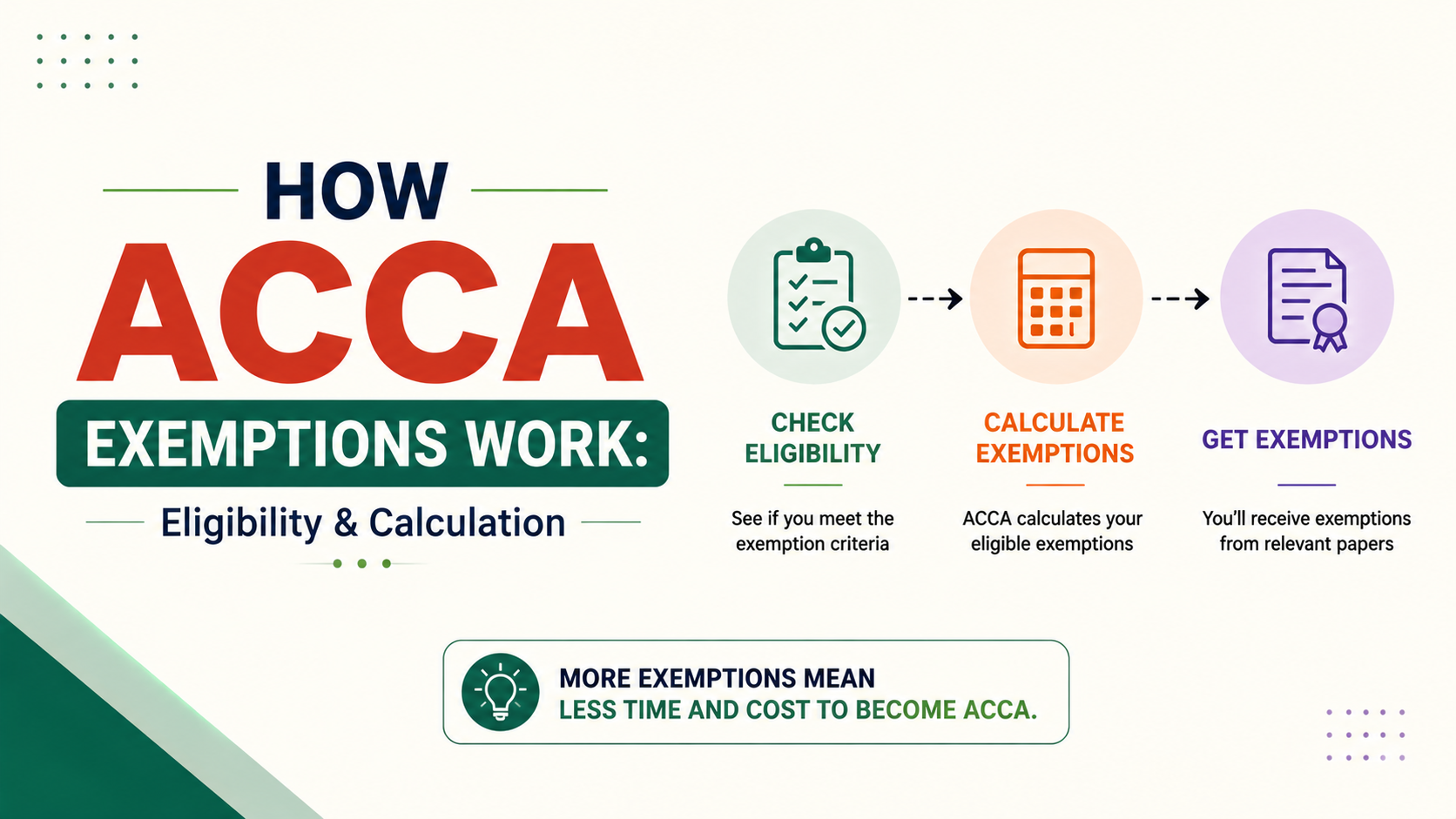
Every ACCA aspirant with a degree asks the same question: how many papers can I skip? But before chasing the highest possible number, it helps to understand what an exemption actually is, how it gets calculated, and when it genuinely helps versus when it quietly sets you up to struggle later at the tougher levels.
What an ACCA Exemption Really Is
ACCA Exemptions are official recognition that your prior degree or professional qualification already covered a paper’s syllabus. Instead of re-sitting that exam, ACCA marks it as cleared on your record. It is a formal process tied to your transcripts, part of how the ACCA Course treats students who arrive with relevant academic background.
Out of 13 ACCA Papers, spread across Applied Knowledge, Applied Skills, and Strategic Professional, exemptions can only touch the first two levels. That is a ceiling of 9 papers: 3 in Applied Knowledge, 6 in Applied Skills. Strategic Professional stays untouched no matter what qualifications you bring.
Working Out Your ACCA Eligibility
ACCA Eligibility for exemptions is based purely on your academic transcript, not your college’s reputation or your final grade. A standard B.Com degree usually clears three to four papers: Business and Technology, Management Accounting, Financial Accounting, sometimes Corporate and Business Law. An ACCA accredited university can push that up to six, since accredited programs map their courses directly against the ACCA syllabus.
CA Intermediate holders typically get six exemptions. A fully qualified ICAI Chartered Accountant, or someone with five plus years through ICMAI, can claim all nine and walk directly into Strategic Professional, skipping the entire foundation stage entirely.
Here is the part people miss: two students with the same degree name can get different exemptions if they studied at different universities or in different years. The syllabus your college actually taught decides this, not the label printed on your certificate.
How the ACCA Exemption Calculator Works
The ACCA Exemption Calculator, a free tool on ACCA’s official website, gives you a quick read on this. Enter your country, institution, and qualification, and it estimates your exemptions in under two minutes.
Treat that number as a starting estimate, not a guarantee. ACCA only locks in your exemptions after you register and submit transcripts for formal review. If you are still studying under an ACCA accredited program, you might see a conditional exemption, meaning it becomes real only once you graduate and prove you completed the required modules.
Why Exemptions Are Not Automatically a Good Idea
This is the part most articles skip, and it matters more than the calculator result. ACCA Exemption Rules allow you to skip a paper, but they cannot hand you the knowledge that paper was meant to build. Applied Knowledge and Applied Skills are the foundation Strategic Professional is built on. Skip too much of that foundation, and Strategic Business Leader or Strategic Business Reporting can hit you hard, because those exams assume you already think like someone who cleared the earlier papers properly.
If your college taught the syllabus well and you genuinely retained it, claiming the exemption makes sense. But if you barely remember what you studied, or you know your foundation is shaky, sitting the paper again, even if you technically qualify to skip it, can be the smarter call. This decision should depend on how confident you are in self study and how solid your basics actually are, not just on what the calculator tells you that you are allowed to skip.
Coaching institutes and blogs often push exemptions hard because a shorter timeline sounds attractive. It is only genuinely attractive for students who can rebuild any gaps on their own through self study. For everyone else, an exemption you did not really earn in substance just becomes a weak spot waiting to surface at Strategic Professional. This is exactly the kind of call worth making with proper guidance rather than a calculator screen alone.
Mentors at The WallStreet School, for instance, actually assess a student’s grasp of the subject before recommending whether to claim or skip an exemption, instead of defaulting to whatever the calculator allows.
ACCA After BCom: A Realistic Look
ACCA After BCom usually means starting with three papers cleared, Business and Technology, Management Accounting, and Financial Accounting, leaving 10 papers ahead, starting with Corporate and Business Law. If your college is accredited, a few more Applied Skills papers might drop off that list too.
Before accepting any of these exemptions blindly, it is worth asking yourself honestly whether you actually understood those subjects in college or just passed them. That answer should guide your decision more than the exemption count itself.
What Exemptions Cost
Exemptions are not free. In 2026, an ACCA Exemption at the Applied Knowledge level costs around £86 per paper, roughly Rs 11,000. Applied Skills exemptions run higher, around £114 per paper, close to Rs 14,700. That is the fee for having ACCA formally record the exemption on your account, separate from the exam entry fees you avoid by skipping it.
Registering and Making the Right Call
ACCA Registration is where you submit your transcripts and let ACCA confirm what you are eligible to skip. But eligibility on paper and readiness in practice are two different things. Before locking in every exemption available to you, be honest about your own foundation. A slightly longer path through the ACCA Qualification with solid basics usually beats a shorter one built on gaps you will have to patch under exam pressure later.
Final Thoughts
Exemptions exist to save time for students who already know the material, not to shrink your syllabus regardless of how well you actually learned it. Run the calculator, check your accreditation status, but make your final call based on your own confidence in self study and how strong your foundation genuinely is. That decision matters more than the number of papers you get to skip.
Frequently Asked Questions
Can I get exemptions on all 13 papers?
No. The maximum is nine, covering Applied Knowledge and Applied Skills only. Strategic Professional has zero exemptions for anyone.
Does a regular B.Com degree qualify for exemptions?
Yes, typically three to four papers. Accredited universities can offer more, depending on their syllabus.
Is the exemption calculator result final?
No. It is an estimate. ACCA confirms exemptions only after reviewing your submitted transcripts during registration.
Should I always claim every exemption I am eligible for?
Not necessarily. If your foundation in a subject is weak, sitting that paper again can serve you better than skipping it.
Do exemptions cost money?
Yes, each exempted paper carries a fee, though it is usually lower than what you would spend preparing for and sitting the exam.