AI Ethics Finance in 2026: A Simple Guide to Staying Safe Smart & Ahead
The world of money is changing very fast. Banks, fintech apps, investment firms and even small lenders are now using artificial intelligence in daily work. From loan approvals to fraud alerts to trading decisions, AI is everywhere. This change feels exciting but also a little scary. That is exactly why AI Ethics Finance matters so much in 2026.
AI Ethics Finance is about using AI in a fair, safe and responsible way in finance. It makes sure technology helps people instead of hurting them.
This guide explains everything in very simple words. You will learn how AI is used in finance today, what risks exist, what AI regulations India and other countries are planning, what banks should do in the next 90 days and how the future of finance technology is shaping up.
Let us go step by step.
What changed from 2018 to 2026
Around 2018, AI in finance was mostly an experiment. Some banks tested chatbots. Some tried basic fraud systems. It was new and exciting but not critical.
Fast forward to 2026 and things look very different. AI now runs core systems. Credit scoring, fraud detection, customer onboarding risk models and trading systems all depend on AI. This is where AI Ethics Finance becomes important. When AI decisions scale up, mistakes also scale up.
In India, this change happened even faster. Digital payments exploded. Online lending grew quickly. Fintech companies started using AI to approve loans in minutes. Banks adopted AI to cut costs and improve speed. But soon, people noticed problems too. Some users were rejected for loans without clear reasons. Some fraud systems blocked genuine transactions. Old data created hidden bias. That is when regulators and companies realized one thing clearly. AI is powerful but without AI Ethics Finance it can go wrong in silent ways.
According to research published by ebo.ai, AI in financial services is no longer just point solutions such as chatbots and simple automation. The report explains that by 2026 AI will be deeply embedded in core financial workflows, transforming how credit risk, fraud, and operations are handled and increasing both efficiency and complexity in financial systems. (Source: Emerging AI Trends in Financial Services for 2026)
This shift from experimentation to core dependence is easier to understand when you see it visually.
Why AI ethics matters to everyday people?
This is not just a bank problem. It affects real people.
Imagine applying for a loan and getting rejected instantly with no explanation. Imagine an AI system marking your transaction as fraud again and again. Imagine markets crashing for a few minutes because an algorithm reacted badly.
This is why AI Ethics Finance matters to everyone. AI decisions affect access to money, trust in banks and stability of markets. When ethics are missing, people lose confidence.
Good AI helps people. Bad AI quietly creates unfair outcomes. No one wants a black box deciding their financial future.
How AI is used in finance today?
Before talking about risks, let us understand how AI is actually used.
- AI is used for credit scoring and loan approvals.
- AI detects fraud by tracking unusual patterns.
- AI helps banks understand customer behavior.
- AI supports trading and portfolio decisions.
- AI improves compliance and risk monitoring.
These uses are part of modern finance AI trends. They save time, reduce cost and improve accuracy. But they also increase responsibility. This is where AI Ethics Finance must guide design and use.
The biggest ethical risks in finance AI
These are the real problems banks and fintechs face today. Let us keep this very simple.
- Bias in lending
AI learns from old data. Old data may carry social and income bias. This can lead to unfair loan rejections. This is one of the biggest AI risk in banking issues today.
- Lack of transparency
Many AI models cannot explain decisions clearly. In finance this is dangerous. People deserve reasons especially when money is involved.
- Data privacy
Banks use huge amounts of personal data. If data is misused or leaked trust breaks instantly. Ethics demand careful handling.
- Automation bias
Humans often trust AI blindly. Even when results feel wrong people follow the machine. This creates silent risk.
- Market instability
Fast trading algorithms can react too quickly. Small mistakes can create big market swings.
Every issue above connects directly to AI Ethics Finance. Ethics keeps these risks under control.
AI regulations India & why they matter?
Rules around AI in finance are getting stricter in India. Regulators are clear that AI is no longer just a support tool. It is now part of core banking and must be handled with care.
Role of the Reserve Bank of India
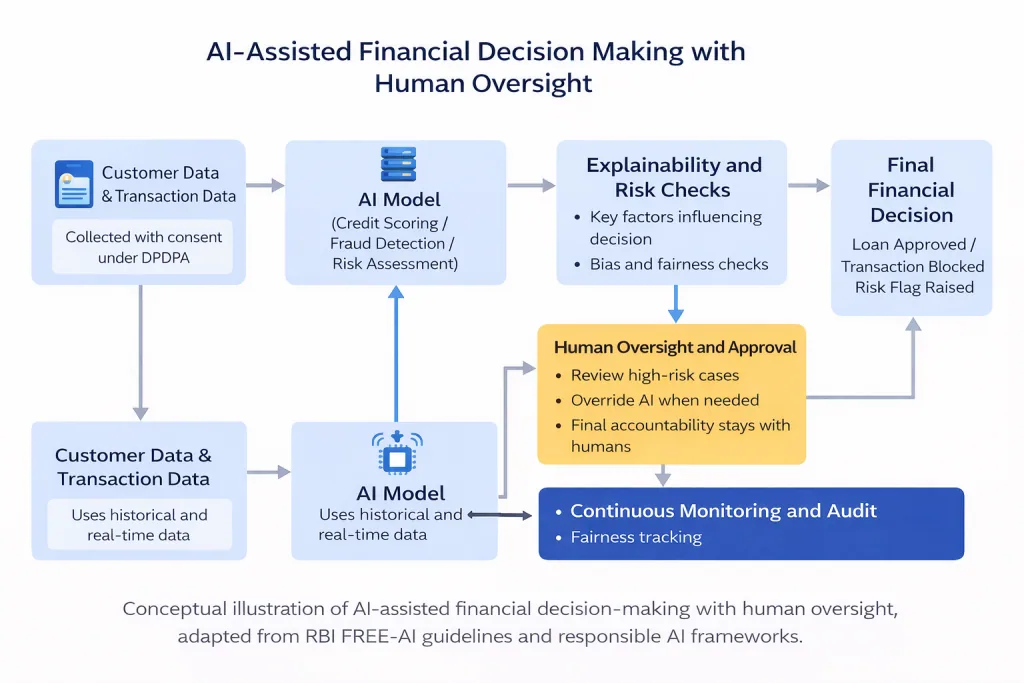
The Reserve Bank of India expects banks to treat AI systems like high-risk financial models. AI used for credit scoring fraud detection, onboarding or risk assessment must be transparent, explainable and properly monitored.
RBI expects:
- Strong governance and senior oversight
- Clear documentation of AI models
- Regular testing and monitoring
- Human involvement in key decisions
As highlighted in a KPMG analysis of RBI’s FREE-AI framework:
“The framework is anchored in seven sutras which serve as the foundational principles… operationalised through twenty-six targeted recommendations under six strategic pillars: Infrastructure, Policy, Capacity, Governance, Protection, and Assurance.” This covers governance, oversight, documentation, testing, monitoring, and human accountability for AI in credit scoring, fraud detection, and risk assessment—treating AI as high-risk core systems.”
(Source: KPMG analysis on RBI FREE-AI Framework)
Simply put, AI can assist but humans remain responsible.
Digital Personal Data Protection Act and AI
India’s Digital Personal Data Protection Act adds strict rules on data use. Financial institutions must use customer data only with clear consent and a defined purpose.
This means:
- AI training data must be legally collected
- Personal data cannot be reused freely
- Customers must be protected and informed
As Legal500 analysis around the Act clearly states:
“With the Digital Personal Data Protection Act, 2023… Institutions must adopt stricter protocols around how data is collected, used, retained, and deleted, with explicit safeguards on consent and quality. Data availability does not mean data permission.”
(Source: Legal500 analysis on RBI FREE-AI Framework)
Data availability does not mean data permission.
Why this matters for banks?
AI is no longer treated as an experiment. Regulators expect it to follow the same discipline as any financial risk system. Poorly governed AI can lead to unfair outcomes and regulatory trouble.
That is why AI Ethics Finance is now essential in India. Ethics is not optional. It is part of compliance trust and long-term stability.
The real toolkit firms need in 2026
People talk about ethics as if it were philosophy. In real life, firms need tools. Simple and practical tools.
- Model inventory
A single list of all AI models used. It shows the purpose owner risk level and usage. Without this list chaos starts.
- Model cards
A simple profile for each model. It explains what the model does, what data it uses, how accurate it is and where it can fail. This supports AI Ethics Finance in daily operations.
- Audit logs
These logs record model changes, decisions and updates. When something goes wrong, the trail is clear.
- Vendor checklist
Most banks use third-party AI tools. A checklist helps assess vendor safety compliance and reliability. Vendor risk is a hidden AI risk in banking.
Together, these tools form the foundation of ethical AI.
Monitoring and MLOps that actually work
Building AI is not enough. Monitoring is everything.
Good teams in 2026 do this:
- They track data drift regularly.
- They test data quality weekly.
- They set alerts for unusual behavior.
- They retrain models on schedule.
- They maintain simple dashboards for visibility.
Ignoring monitoring increases AI risk in banking. Small drift can flip decisions silently.
Crisis moments firms must prepare for
Every finance company should expect these situations.
- Bias crisis
If a model unfairly rejects a group pause it. Fix data review past decisions and communicate clearly.
- Trading error
If an AI trading system behaves strangely stop it. Review logic and inform regulators.
- Fraud spike
If fraud detection misses patterns switch to manual review and retrain models.
Preparedness is part of AI Ethics Finance maturity.
Vendor and cloud risk
Many firms rely on one AI vendor. This is dangerous.
Safe setup includes backup vendors, exit plan,s performance reviews and risk scoring. Vendor dependency is a major AI risk in banking that often gets ignored.
The Dashboard that Proves Ethics is Real
Banks do not rely on promises to show ethical AI. They use AI governance dashboards that align with real regulatory expectations.
According to the RBI’s FREE-AI framework, financial institutions must implement “AI audit and monitoring frameworks” with real-time governance covering fairness, drift, and compliance. (Source: RBI FREE-AI PDF)
These dashboards help teams track key signals such as:
- Fairness scores across groups
- Data drift and model drift alerts
- Explainability and decision insights
- Accuracy and stability trends
- Privacy and consent compliance checks
- Vendor performance and risk
- Customer complaints linked to AI decisions
Risk and compliance teams review these dashboards regularly and act when something looks wrong. This is how AI Ethics Finance becomes real in daily operations, not just a policy statement.
Finance AI trends and future skills
Finance AI trends are clear. AI will drive lending, trading, and risk decisions, while regulations in India tighten.
Global industry bodies, including the World Economic Forum and the Bank for International Settlements, have consistently highlighted that as AI becomes central to financial decision-making, future finance professionals must combine technical skills with regulatory awareness, risk management, and ethical judgment.
Human oversight will increase, and roles focused on AI ethics and AI risk will become more common across financial institutions.
To succeed, finance professionals must understand AI regulations India, manage AI risk in banking, build explainable models, and apply AI Ethics Finance in real systems. This skill mix will shape the future of finance technology.
Sources:
World Economic Forum reports on AI in Financial Services.
Bank for International Settlements publications on AI and financial stability)
The Verdict
AI is not the problem. Using AI without responsibility is. As finance becomes more automated, success will not come from the most advanced tools, but from using them the right way. AI Ethics Finance is no longer optional. It is the base of trust, compliance, and long-term stability in modern finance.
The future of finance technology belongs to professionals who understand how AI works, where it can fail, how regulators think, and how to balance speed with accountability. These skills are in short supply, and demand is only growing.
If you want to build real, job-ready skills at the intersection of AI, finance, risk, and ethics, The WallStreet School’s AI for Finance Course Online (Live) is designed for that reality. It focuses on practical use cases, regulatory awareness, and decision-making, not just theory. This is how you stay relevant, trusted, and ahead in the future of finance.
People Also Asked
1. What is the ethics of AI in finance?
Ans. Using AI fairly safely and transparently so financial decisions stay unbiased, explainable and trustworthy.
2. How is AI being used in finance?
Ans. AI improves fraud detection, credit scoring, reporting, analysis, risk checks and decision support.
3. What is the future of AI ethics?
Ans. Clearer rules, stronger oversight, better data protection and more human control over AI systems.
4. What are the 5 principles of AI ethics?
Ans. Fairness, transparency, accountability, privacy and human oversight in AI systems.
Interested in Learning Finance Professionally?
Our courses take you from fundamentals to expert level — with live mentors and placement support.
Explore Our Courses