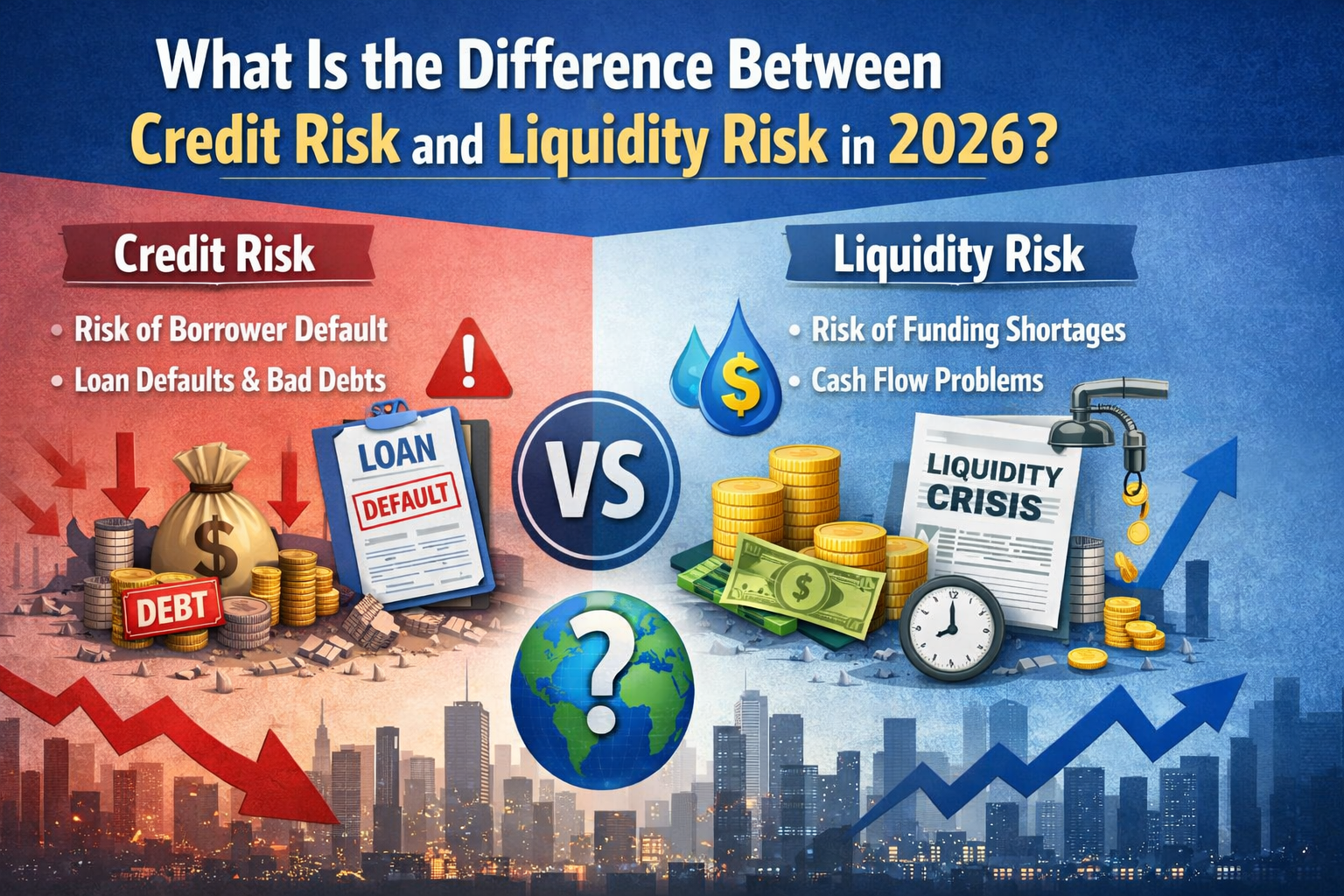
Credit risk vs liquidity risk 2026 sits at the core of how banks operate, yet it is often misunderstood even by people working in finance.
Credit risk is about whether borrowers repay what they owe. Liquidity risk is about whether a bank has cash when it is needed. They sound similar, but they create very different problems. One affects profits slowly, the other can shut a bank down overnight. In real life, these risks do not stay separate. They interact, spread, and often trigger each other.
Understanding credit vs liquidity risk 2026 is essential to see how banks fail, how crises begin, and why managing both risks together matters.
What Is Credit Risk?
Credit risk means there is a chance that a borrower will not repay money as promised, which can cause a loss for the lender. This risk exists whenever money is given today with the expectation that it will be paid back later.
In simple terms, credit risk appears when a lender gives money and the borrower does not return it fully or on time. The borrower can be an individual, a business, another bank, or even a government. In credit vs liquidity risk 2026, credit risk is mainly about financial loss. These losses reduce profits, weaken capital, and affect the long-term health of financial institutions.
How Credit Risk Affects Banks in Real Life?
- Loan defaults
- Rising NPAs
- Credit rating downgrades
- Higher provisions eating profits
Credit risk is the backbone of risk management basics. If a bank ignores it, it slowly bleeds to death.
What Is Liquidity Risk?
Liquidity risk means there is a chance that a financial institution will not have enough cash when it needs to meet its immediate obligations. This risk exists even when the institution is financially sound and owns valuable assets.
In simple terms, liquidity risk appears when money is needed right now, but cash is not available at that moment. Assets may exist, but they cannot be converted into cash quickly without a loss. In credit vs liquidity risk 2026, liquidity risk is mainly about timing rather than direct financial loss. If not managed properly, it can quickly turn into a serious threat to day-to-day operations and overall stability.
Common Liquidity Risk Situations in Banks
- Sudden deposit withdrawals
- Funding markets freezing
- Assets that cannot be sold fast
- Emergency borrowing from central banks
Liquidity risk kills fast. Many banks fail not because they are insolvent, but because they run out of cash at the worst moment. That is why this bank risk type scares regulators the most.
Credit Risk vs Liquidity Risk 2026
| Area of Comparison | Credit Risk | Liquidity Risk |
| Basic question | Will the borrower repay the money | Is enough cash available right now |
| Main concern | Financial loss from non-payment | Ability to meet short-term obligations |
| Impact on the bank | Reduces profits and capital over time | Threatens day-to-day survival |
| Speed of impact | Develops gradually | Can escalate very quickly |
| Visibility | Seen in loan performance and financial statements | Seen in cash flow and funding stress |
| Nature of risk | Long-term and structural | Short-term and operational |
In credit vs liquidity risk 2026, one burns slowly. The other explodes. This difference is exactly why interviews, exams, and board discussions keep coming back to these two bank risk types.
How Do Credit Risk and Liquidity Risk Interact Inside a Bank?
Figure1: Diagram explaining credit vs liquidity risk 2026, showing how rising credit risk in banks can trigger liquidity risk, cash shortages, and a full liquidity crisis over time.
Banks do not face credit risk and liquidity risk in isolation. In real operations, these risks interact and often trigger each other. A problem that begins in the loan book can slowly affect confidence, funding, and cash flows, while a sudden liquidity shock can damage credit quality across the portfolio. In credit vs liquidity risk 2026, understanding this internal flow is critical because most bank failures occur when risks spread from one area to another. The framework below explains how these risks typically move through a bank and why early warning signs matter.
How Credit Risk Turns Into Liquidity Risk?
- Loan defaults increase
- Profits fall
- Market confidence drops
- Depositors panic
- Withdrawals rise
- Liquidity dries up
A credit problem quietly becomes a liquidity crisis. In credit vs liquidity risk 2026, this chain reaction happens faster than ever because information spreads instantly.
How Liquidity Risk Creates Credit Risk?
When liquidity starts tightening, banks usually react defensively. They slow down new lending and become extra cautious about who gets credit. For many businesses, this means refinancing becomes difficult and fresh funding dries up. To manage cash needs, banks may also sell assets quickly, often at prices they would normally avoid. This combination puts pressure on borrowers, cash flows weaken, and repayments get delayed. Over time, what began as a liquidity issue shows up as higher defaults and credit losses. This is why risk teams today do not look at credit risk and liquidity risk separately anymore.
How Do Banks Identify Credit Risk and Liquidity Risk Early?
Risk professionals are not paid to define risks. They are paid to spot them early.
| Area | Credit Risk Indicators | Liquidity Risk Indicators |
| Borrower or funding quality | Weak borrower financials | Rising dependence on short-term funding |
| Concentration risk | High exposure to specific sectors | High concentration of deposits |
| Growth patterns | Rapid loan growth without controls | Fast growth in unstable funding sources |
| Structural issues | Poor underwriting standards | Asset and liability maturity mismatches |
| Market dependence | Higher reliance on risky borrowers | Over-reliance on wholesale or market funding |
In credit vs liquidity risk 2026, early signals matter more than perfect models.
What Tools Are Used to Measure Credit Risk and Liquidity Risk?
As an FRM or working professional, you are expected to speak tools, not buzzwords.
| Credit Risk Tools | Liquidity Risk Tools |
| Probability of Default | Liquidity Coverage Ratio |
| Loss Given Default | Net Stable Funding Ratio |
| Exposure at Default | Cash flow gap analysis |
| Credit scoring and rating models | Survival horizon analysis |
| Loan portfolio stress testing | Liquidity stress testing |
These tools are core to understanding bank risk types in real institutions.
How Do Banks Manage Credit Risk and Liquidity Risk?
Managing risk is not about killing growth. It is about surviving growth.
| Credit Risk Management | Liquidity Risk Management |
| Strong credit appraisal | High-quality liquid asset buffers |
| Continuous borrower monitoring | Diversified funding sources |
| Diversification across sectors | Clear contingency funding plans |
| Realistic provisioning | Daily liquidity monitoring |
In credit vs liquidity risk 2026, banks that manage both together sleep better at night.
What Can We Learn from Past Banking Crises?
History makes one thing very clear. Credit risk and liquidity risk fail differently, but both can destroy institutions when ignored.
A classic credit-driven failure was Lehman Brothers. Years of poor-quality lending and excessive risk-taking weakened its balance sheet. The problems built up slowly and were visible in hindsight. When confidence finally broke, funding disappeared overnight and a credit problem turned into a full liquidity collapse. (source: Investopedia)
On the liquidity side, Silicon Valley Bank showed how fast things can fall apart. The bank was not facing immediate loan defaults, but a sudden loss of depositor confidence triggered massive withdrawals. Within days, a liquidity problem forced the bank to shut down, even though many assets were still performing. (source: GARP)
Closer to home, Yes Bank reflected a dangerous mix of both risks. Weak credit decisions led to rising bad loans, which slowly eroded trust. Once confidence dropped, liquidity pressure followed, requiring regulatory intervention to stabilize the bank. (source: IFSA Network)
The lesson is simple and repeated across countries. Credit-driven failures often look slow until they suddenly explode. Liquidity-driven failures are fast, visible, and chaotic. Ignoring one bank risk type just because the other appears under control is not a strategy. It is professional negligence.
How Regulation Is Changing Credit and Liquidity Risk Management in 2026?
Regulators now assume stress is normal.
| Credit risk | Liquidity risk |
| They push forward looking at loss models and stricter provisioning. | They demand stronger buffers and faster reporting. |
AI regulations India are also entering risk management. Credit models, early warning systems, and monitoring tools now use AI, but regulators expect explainability. Black box thinking is out.
This changes how risk professionals work and how risk management basics are taught.
People Also Ask About Credit Risk and Liquidity Risk
- What is a liquidity risk?
means there is a chance that a financial institution will not have enough cash when it needs to meet its immediate obligations. This risk exists even when the institution is financially sound and owns valuable assets. - What is a credit risk?
Credit risk means there is a chance that a borrower will not repay money as promised, which can cause a loss for the lender. This risk exists whenever money is given today with the expectation that it will be paid back later. - What is the main difference between credit risk and liquidity risk?
Credit risk affects profits over time, while liquidity risk affects immediate survival by limiting access to cash. - Why do banks fail due to liquidity risk?
Banks fail when sudden withdrawals and funding stress drain cash faster than assets can be sold or financed.
Common Mistakes Banks Still Make With Credit and Liquidity Risk
These are the common mistakes:
- Thinking liquidity risk only happens in crises
- Assuming profits mean safety
- Ignoring depositor behavior
- Treating models as truth
In credit vs liquidity risk 2026, bad assumptions are more dangerous than bad data.
Final Thoughts
Credit risk and liquidity risk are often taught as separate ideas, but that is not how banks experience them in real life. Problems usually start quietly in the loan book and only show up later in funding and cash flows. By the time liquidity becomes an issue, the damage is often already done. Many banks fail this way, not because the risks were hidden, but because they were looked at separately. Credit teams focus on loans, treasury watches cash, and the connection gets missed until it is too late.
In credit vs liquidity risk 2026, the real skill is seeing how one problem quietly triggers the other and acting before it shows up as a crisis.For those preparing for FRM or already working in risk roles, spending time on real bank cases and practical discussion, such as in Wallstreet School’s FRM coaching classes, helps build that judgement in a way theory alone never does.