Finance Jobs AI Might Replace: What Every Finance Professional Needs to Know
When was the last time your job required you to make a real judgment call, not just follow a process? If you are struggling to
When was the last time your job required you to make a real judgment call, not just follow a process? If you are struggling to answer this, keep reading.
Because that one question is the cleanest way to understand which finance jobs AI might replace and which ones it cannot touch. It is not about your title, your degree, or how many years you have put in. It is about what your day actually looks like. If most of it is rule-based, step-by-step and process-driven, the risk is real and it is already here.
AI is not coming for all of finance. But it is coming for a specific kind of finance work and it is moving faster than most people are comfortable admitting.
Watch this quick breakdown before we dive deeper:
Here is exactly where the line is drawn:
The Jobs That Are Actually at Risk
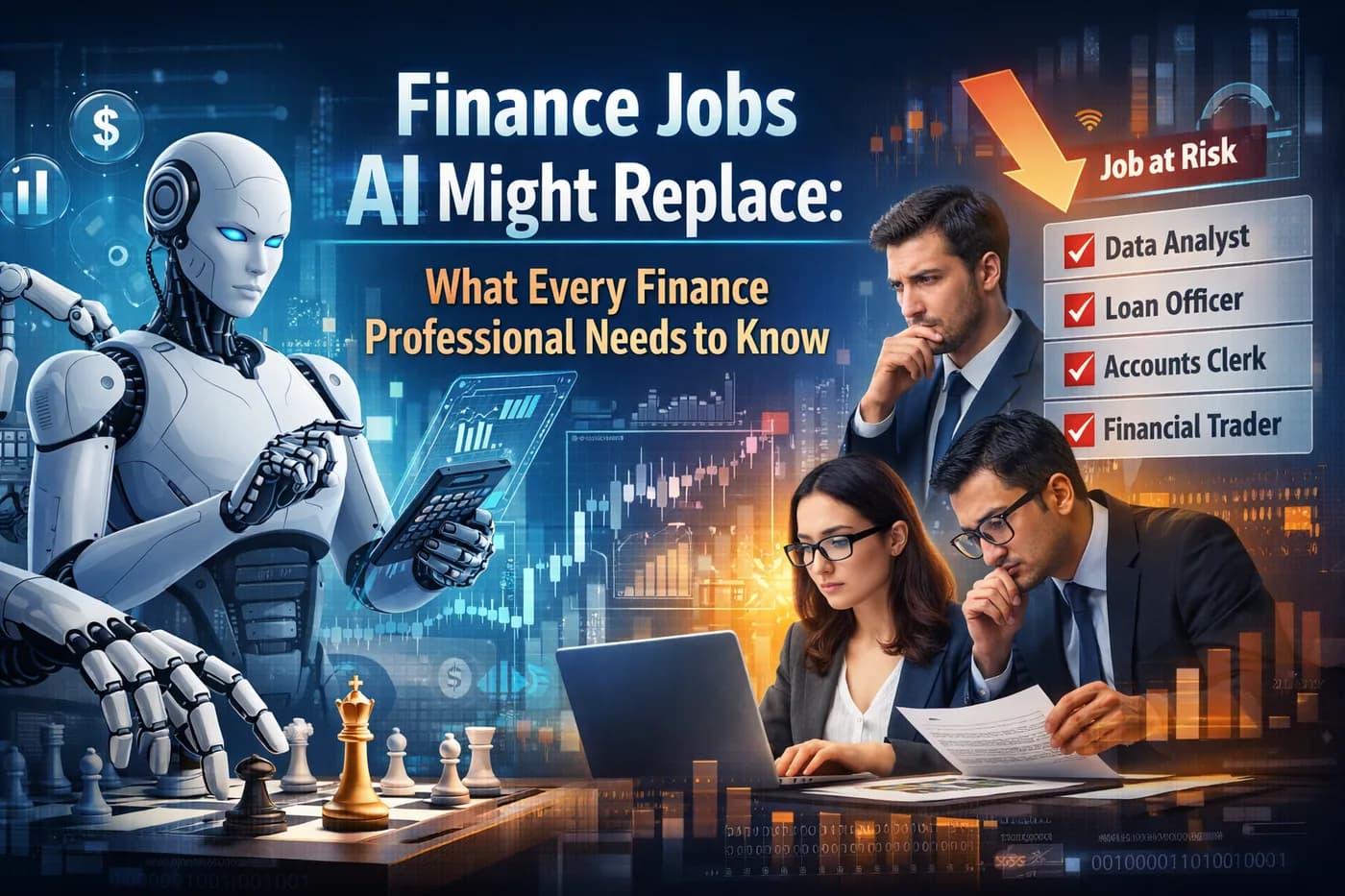
When you look at finance jobs AI might replace, the pattern is clear. The roles most exposed to automation are the ones that are process-oriented and rule-based. These are jobs where you follow a set of steps, apply a fixed rule and arrive at an output. There is not much interpretation involved. The work is repetitive by design.
1. Accounting and Bookkeeping
This is one of the most obvious cases of AI replacing finance jobs. Tools like SAP automation and QuickBooks AI can already read invoices, post entries into books of accounts and manage accounts receivable and payable without a human doing it step by step. The profit and loss statement, the balance sheet and the routine recordings are all of this is increasingly being handled by software. The demand for people doing basic bookkeeping will shrink over time.
2. Credit Analysis
Many people wonder will AI replace finance jobs in banking and credit analysis is a strong example of where it already is. Fintech companies are using AI to read a client’s transaction history, assess their creditworthiness and approve loans instantly. The basic process of reviewing financials before lending, which used to require a junior analyst spending hours on it, is now being automated. Those doing the most routine parts of credit analysis face real risk.
3. Tax Filing and Basic Taxation
For routine tax filing, like submitting income tax returns or doing basic tax calculations, automation is already well advanced. Even more interesting is that when it comes to drafting appeals and replies in taxation matters, professionals are increasingly using tools like ChatGPT and other AI platforms to do the heavy lifting. The effort required from a human has dropped substantially. This is a clear case of jobs in finance being replaced by AI at the process level.
4. Trading
Manual order placement is largely a thing of the past. This is one of the clearest examples of finance jobs AI might replace, becoming a reality. Algorithmic trading platforms can recognize patterns and execute trades on a client’s behalf without any human involvement. The basic role of a trader putting orders into a system manually is now mostly irrelevant.
5. Audit
Traditional auditing involved putting people on the job of sampling transactions, checking invoices and vouchers and looking for anything unusual. The limitation was always that auditors could only check a sample. Now, AI tools can scan 100% of transactions and 100% of invoices. That changes the workload entirely. The number of people needed for routine audit work has come down and this trend will continue.
The Jobs That Are Safe
Now here is where things get more encouraging for people building careers in finance. When people ask will AI replace finance jobs entirely, the answer is no and the reason is clear: AI cannot replace judgment, context or human relationships.
1. Financial Analysts and Bankers
A financial analyst or a banker who advises companies on their financial needs is not at risk. The reason is simple: this work requires understanding a business, not just running numbers. Take acquisition advisory as an example. Advising a company on whether to acquire another one means understanding why the company wants to do it, what the synergies are and what cultural mismatches might exist between the two organizations. These are not things AI can assess comprehensively. This is where AI replacing finance jobs has a hard limit.
2. Client-Facing Roles
Any role where you sit across from a client and advise them is safe. The ability to build trust, read a situation and offer guidance that fits a specific person’s needs is not something software can replicate. These roles depend on emotional intelligence and relationship management and they remain among the most secure in the industry.
3. Strategy and Senior Management
At the senior level, the work is about understanding the broader environment, making decisions under uncertainty and leading people through change. Jobs in finance replaced by AI simply do not include these roles, because strategy requires human judgment in a way that is difficult to define but easy to recognize. AI can process data. It cannot provide wisdom.
4. Investment Advisory and Private Equity
Understanding a business model, assessing a market and making investment decisions involves interpretation that goes far beyond numbers. In private equity especially, the valuation of a company is as much about business understanding as it is about financial modeling. This is another area where AI replacing finance jobs runs into a real wall.
What You Should Do Now?
Knowing which finance jobs AI might replace is only useful if it changes how you prepare yourself. Here is what makes sense based on where things are headed.
- Build strong analytical skills. Focus on understanding what numbers mean, not just how to calculate them. The ability to interpret financial data and connect it to a business situation is what separates a professional who will thrive from one who will be replaced.
- Learn AI tools. This is not a contradiction. Using AI tools well is itself a skill and finance professionals who know how to work with these tools will get more done in less time. Staying current with what is available in the finance domain is part of being relevant.
- Focus on business understanding. The more you understand how businesses work, what their challenges are and how financial decisions connect to real outcomes, the less replaceable you become. This kind of knowledge cannot be automated.
The Bottom Line
AI is already replacing parts of finance work, specifically the parts that are repetitive, process-driven and rule-based. Accounting entries, credit scoring, tax filings, trade execution and routine audits are all seeing reduced demand for human labor.
But the roles that require judgment, business understanding, client relationships and strategic thinking are not going away. Finance jobs AI might replace are a specific category not the whole profession.
The professionals who will do best are the ones who understand this clearly, move toward the work that requires interpretation and relationships and use AI as a tool rather than fear it as a threat.
Interested in Learning Finance Professionally?
Our courses take you from fundamentals to expert level — with live mentors and placement support.
Explore Our Courses