
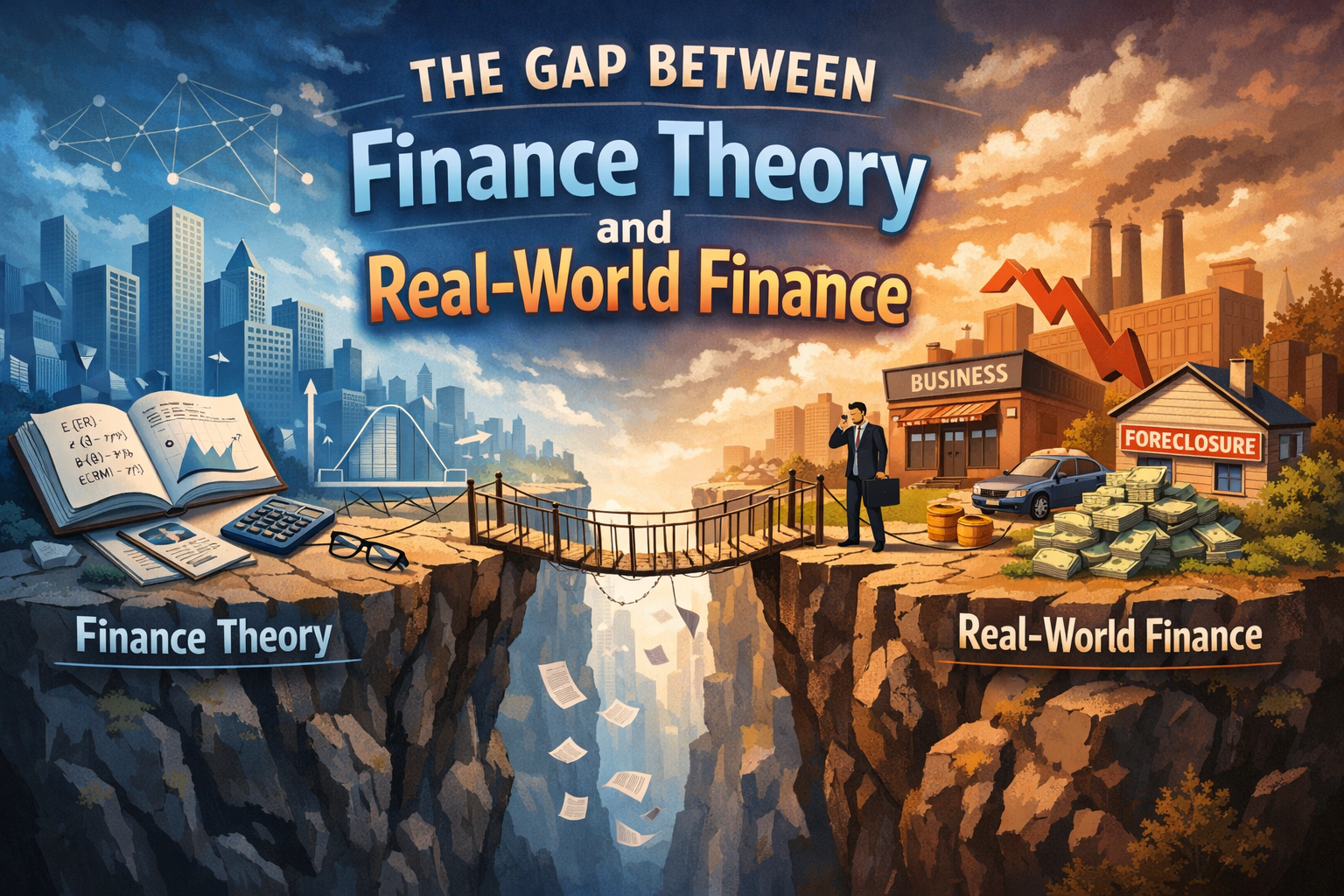
Some of the smartest economists in history have gone broke in real markets. Not because their theories were completely wrong, but because real world finance does not care about theories. It cares about cash, timing, human panic and the next crisis no one saw coming.
Finance school promises neat answers. A finance career gives you something messier and if you are honest, far more interesting. Every professional remembers that first week on the job when their textbook portfolio could not survive ten minutes of actual market conditions. You came for math. You stayed for the chaos. Long-Term Capital Management had two Nobel laureates on its team. It still lost $4.6 billion in under four months.
The gap between finance theory and practice is stubborn and well known. The only real question is what you plan to do about it.

Figure 1: Finance theory vs practice: what financial modeling skills teach you and what real world finance actually demands.
Why Finance Theory Looks So Good in the Classroom?
Theories in finance are built on assumptions, rational investors, perfect information, no transaction costs, liquid markets and stable correlations between assets. These assumptions exist because they make the math work. They allow economists to build clean models and derive conclusions that hold up in controlled conditions.
Modern Portfolio Theory tells you that diversification lowers risk. Add enough uncorrelated assets to a portfolio and your exposure to any single risk shrinks. The idea is elegant. It won a Nobel Prize. And it fails at the exact moment you need it most.
Think of any balanced mutual fund in India in February 2020. Equity for growth, debt for safety, gold for protection. A perfect mix on paper. By March 2020, equity funds had fallen 30 to 35%, debt funds were shaken by credit fears and panic withdrawals, and even gold dipped before bouncing back. For several weeks, almost nothing behaved the way it was supposed to. Investors who thought they had covered all their bases found out they had not.
During the 2008 financial crisis, stocks, bonds and commodities that normally move independently started falling together at the same time, something MPT never prepared for. Everything fell together. The diversification MPT had promised essentially disappeared under stress. This is the central problem with finance theory vs practice: the models are not entirely wrong. They just collapse in the tails and the tails are precisely where real world finance is decided.
Where Real World Finance Gets Complicated?
The gap between theory and practice shows up in 3 consistent places.
- Data limitations. Financial modeling skills built entirely on historical data assume the future resembles the past, It often does not. The 2020 COVID crash, the 2022 crypto collapse that erased close to 70% of valuations and the 2021 Archegos blowup were not caught by most standard risk models that relied on historical data. In real world finance, historical data is a starting point for thinking, not a substitute for it.
- Human behavior. Finance theory assumes rational agents. Finance industry skills in the real world require understanding that investors are not rational. They panic when prices fall and chase momentum when prices rise. They follow crowds at the wrong time and exit positions at the worst moments. This is not a weakness unique to retail investors. Institutional managers do it too. Behavioral finance has spent decades documenting it. Yet most financial modeling skills curricula still treat it as a footnote.
- Friction. Transaction costs, taxes, bid-ask spreads, regulatory constraints, liquidity mismatches. These are not edge cases in real world finance. They are the daily operating conditions. A portfolio that looks theoretically optimal before costs can perform mediocre after them. Finance industry skills that ignore friction are like driving directions that ignore traffic.
The Finance Theory vs Practice Problem in Corporate Finance
Surveys of CFOs across industries show that many firms avoid theoretically optimal techniques because the data required does not exist in usable form or because their companies operate under conditions the models do not account for. The weighted average cost of capital, one of the most widely taught tools in corporate finance, involves enough subjective inputs around beta, market risk premium and debt cost that two analysts can produce dramatically different valuations for the same company.
Fund managers consistently report that neoclassical theory is contradicted by real market data. Most practitioners still use discounted cash flow models, Value at Risk frameworks and scenario analysis. But they use them as inputs to judgment, not as replacements for it. Financial modeling skills are table stakes for getting the job. Practical finance skills are what determine whether you keep it.
AI Is Narrowing the Gap, But Not Closing It
One of the most significant shifts in real world finance in recent years is the growing role of machine learning and agentic AI in quantitative work. At leading institutions, AI tools are increasingly being used to run thousands of scenario simulations in the time it would take an entire team of analysts to finish just one. They identify non-linear relationships in data that CAPM cannot even attempt to model. They process earnings call transcripts, satellite data and ESG disclosures as structured inputs.
This matters because AI is doing something static theory never could. It adapts dynamically to shifting market conditions rather than applying fixed assumptions. A discounted cash flow model that updates with real-time macroeconomic data is meaningfully closer to real world finance than one built on five-year historical averages.
But AI does not solve the judgment problem. It optimizes within constraints but cannot define what the right constraints are. It finds patterns but cannot tell you when those patterns will stop holding.
Finance theory vs practice in the age of AI is not a solved equation. Practical finance skills still require a human who understands when to trust the output and when to override it.
How to Build Practical Finance Skills That Actually Transfer?
The practitioners who bridge this gap most effectively tend to share a few consistent habits worth studying.

Figure 2: Four practical finance skills every real world finance professional needs to bridge the finance theory vs practice gap.
Know your tools
- SQL for pulling and cleaning data, Python for building models, Excel for communicating results and Power BI for visualization
- These are not optional extras anymore. They are core finance industry skills for anyone working with real data in a real organization
- A finance professional who cannot query a database or run a sensitivity analysis in Python is falling behind fast
Work on real problems
- Modeling the actual capital structure of a company, building a live Value at Risk calculation on a real portfolio or stress testing a loan book under different rate scenarios
- This kind of work does more for your practical finance skills than any number of textbook exercises
- Capstone projects and live case work are not just resume fillers. They are how financial modeling skills turn into actual judgment
Read practitioners, not just academics
- Investor letters, risk management post-mortems and analyst reports from real market cycles carry more usable insight into finance theory vs practice than most academic papers
- The LTCM collapse, the Archegos margin call and the 2008 mortgage crisis are not just history. They are case studies in what happens when financial modeling skills are applied without accountability or common sense
Study what went wrong
- Finance industry skills are not just about knowing the frameworks. They are about knowing exactly where the frameworks break
- The professionals with the sharpest understanding of finance theory vs practice are usually the ones who watched a model fail in real time and had to explain it to a room full of people
At The WallStreet School, we teach exactly the skills this article talks about. Check out our courses and see what fits you.
What This Means for Your Career in Finance?
The gap between theory and real world finance is not an argument for skipping the theory. Finance industry skills without a theoretical grounding are fragile. You will not understand why models break if you never understood how they work in the first place.
But theory alone is a dead end in real world finance. The professionals who command strong positions in risk management, investment banking and asset management are those who translate fluently between both worlds. They understand CAPM well enough to know when to ignore it. They have sharp enough financial modeling skills to build the model and enough practical finance skills to know when the model is wrong.
The gap between finance theory and practice has existed for decades. It will probably never fully close. The 2026 version of real world finance, shaped by AI tools, India-specific regulatory constraints and new asset classes, is wider in some ways and narrower in others.
What you control is how wide that gap is in your own work. Start closing it.
People Also Ask about Finance Theory vs Practice
- Does an FRM certification help bridge the gap between theory and real world finance?
Yes. FRM focuses on applied risk measurement, stress testing and regulatory frameworks, which are closer to finance industry skills than most academic programs.
- Can AI replace financial modeling skills entirely?
No. AI improves the efficiency and range of financial modeling skills, but human judgment about model assumptions and failure conditions remains essential in real world finance.
- What practical finance skills matter most in 2026?
Python, SQL, scenario modeling, behavioral finance awareness and the ability to communicate model outputs clearly.
What This All Comes Down To-
You came for the math. The clean models, the elegant formulas, the feeling that finance was a puzzle you could actually solve. Then real world finance showed up and laughed at your spreadsheet.
That is not a failure of education. That is just how this industry works. The theory gives you a starting point. Experience teaches you when to trust it and when to throw it out.
The gap between finance theory and practice has existed for decades and it will outlast all of us. The only thing worth controlling is how wide that gap is in your own work. Start there.


I completely agree that textbooks can’t prepare you for the chaos of real markets. Developing intuition and staying alert to market signals seems just as important as understanding theory, and often makes the difference between success and failure.