

Investment banking is the field that connects finance with high stakes, long hours, and often, substantial rewards. It is an entire ecosystem of roles, skills, and pathways for those looking to reach this world.
From fresh analysts to managing directors, each position is a piece of the complex puzzle that makes up investment banking. Let us break down the investment banking jobs, structure, skills, and growth paths that make a career in it both challenging and, for many, gratifying.
The right education for investment banking jobs
Before we delve into investment banking job roles, let us talk about education. Most investment banking professionals start with a foundation in finance, economics, or business. However, simply holding a degree is not enough in this ultra-competitive field.
So, how can you start?
- Undergraduate degree: Start with a degree in finance, accounting, economics, or related fields. These subjects lay the groundwork for understanding financial markets and business principles.
- Advanced degrees and certifications:
-
- MBA: An MBA with a finance focus adds a layer of management skills to your portfolio, often fast-tracking career progression.
- CFA certification: Highly respected, the CFA certification showcases a high level of expertise and dedication to the field. It’s a strong alternative to an MBA, focusing solely on finance and investment.
Investment banking job roles
Investment banking opens the way to many roles with specific responsibilities, offering a variety of career paths: Here is a list of some investment banking jobs:
- Financial analyst: An entry-level role where analysts conduct research, evaluate financial data, and develop models. They provide crucial support for investment decisions. Progression usually moves from analyst to associate, and then to higher roles as they gain experience. In this role, your salary ranges between INR 2-4 LPA at the entry level which rises to INR 13 LPA with experience.

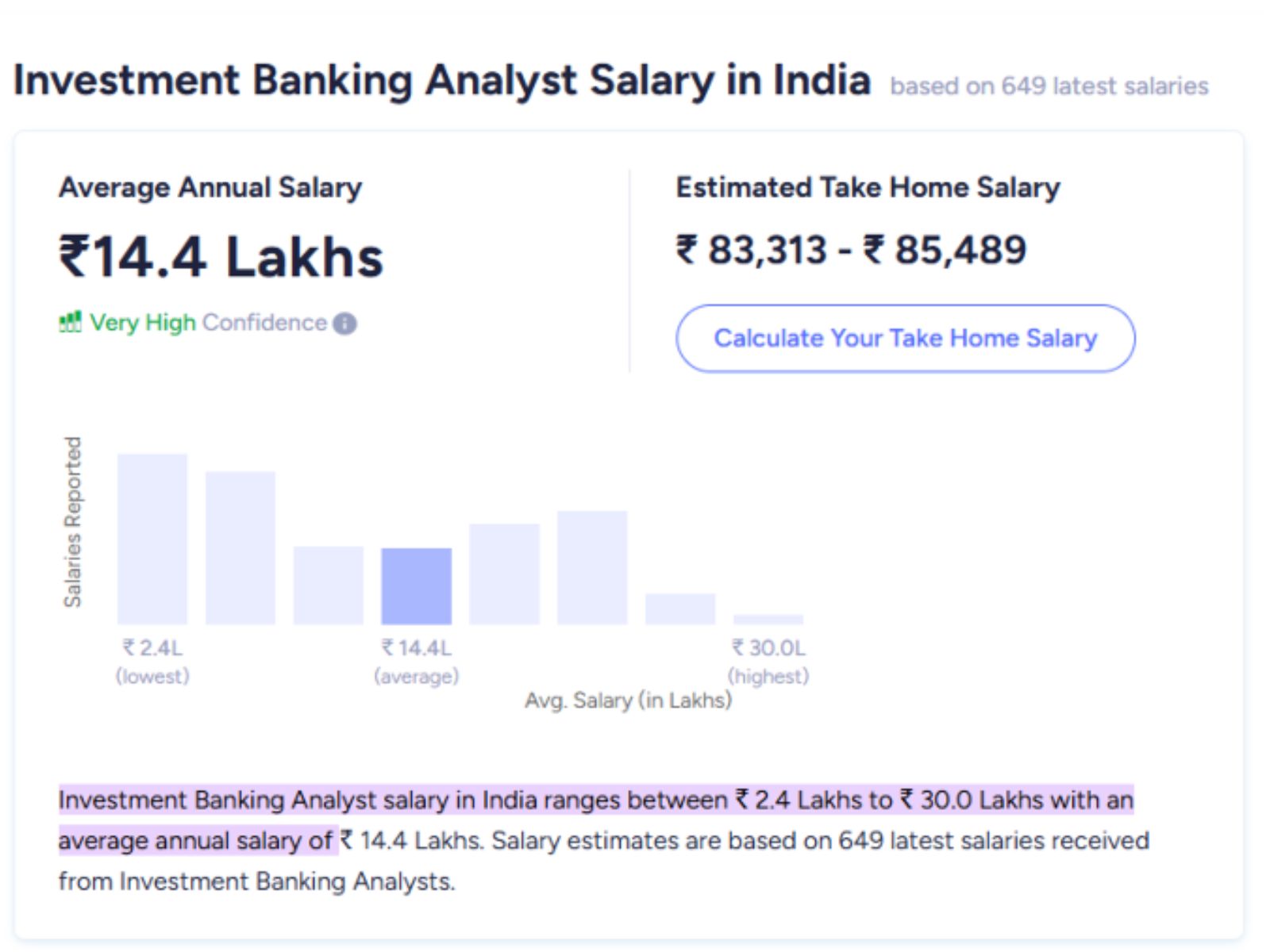
2. Investment banking analyst: These analysts work on high-profile transactions, such as mergers and acquisitions (M&A), initial public offerings (IPOs), and debt issuance. They are deeply involved in due diligence, industry research, and preparing presentations. From here, the career path can lead to associate, vice president, and eventually, managing director. The salary averages around INR 14.4 LPA, with senior-level roles reaching INR 30 LPA.
3. Portfolio manager: Overseeing client portfolios, portfolio managers craft investment strategies to align with goals and risk tolerances. Success in this role can lead to senior positions, such as head of investments or chief investment officer. Entry-level portfolio managers can expect INR 3-6 LPA, with senior positions going up to INR 30 LPA.

4. Private equity analyst: Here, the focus shifts to analysing private companies for potential investment. Private equity analysts conduct due diligence, valuation, and negotiate deals. Those who excel might become partners or directors within private equity firms. The salary average here is INR 10.9 LPA, with the potential to reach up to INR 35 LPA as they advance.

5. Corporate finance analyst: These analysts support companies in raising capital, strategic planning, and acquisitions. The corporate finance path can lead to senior finance roles, including CFO positions. In these roles, entry-level positions range from INR 6.4 LPA, with senior roles reaching INR 17 LPA.

6. Risk analyst: A crucial role, risk analysts develop strategies to manage market, credit, and operational risks. Their work involves evaluating exposure and conducting stress tests. The role offers a clear path to senior positions in risk management. The starting salaries are around INR 16.2 LPA, moving up to INR 34.5 with experience.

7. Quantitative analyst: The quants develop mathematical models for trading, asset pricing, and risk management. With roles ranging from junior to head of research, quants often work alongside traders to optimise strategies. For quants, the salary ranges between INR 8.3 LPA to INR 98 LPA, while the average salary is INR 33.9 LPA.

Internships and networking
Breaking into investment banking jobs often requires more than just qualifications. Internships and networking can open doors and offer hands-on experience in the industry.
- Internships: An internship at a reputable firm provides exposure to real-world investment banking work, often leading to full-time offers. Interns are typically involved in tasks such as financial modelling, research, and presentations, giving them a taste of the industry’s demands.
- Networking: In investment banking jobs, who you know can be as valuable as what you know. Building professional connections through industry events, conferences, or online platforms can open doors to job opportunities and provide invaluable mentorship.
Opportunities for growth and development
The growth potential within investment banking jobs is immense, with ample room for career advancement:
- Promotions: Move from analyst to associate to managing director, gaining responsibilities and influence along the way.
- Specialisation: Focus on areas like M&A, debt issuance, or capital markets to become an industry expert.
- International opportunities: Global investment banking jobs offer opportunities to work in different financial hubs, gaining exposure to international markets.
- Entrepreneurship: Many senior bankers eventually set up boutique advisory firms, capitalising on their network and industry experience.
Prospects in investment banking
The outlook for investment banking jobs is promising. Despite economic volatility, this field remains robust, thanks to increasing capital flows, liberalisation efforts, and an upsurge in M&A activity.
Emerging technologies like AI, blockchain, and big data analytics are revolutionising the industry. Investment banks are leveraging these innovations to improve decision-making, reduce risks, and improve client experiences.
For new entrants, tech skills are becoming a valuable addition to traditional financial knowledge.
Wrapping it up
Investment banking jobs are not for the faint-hearted, but if you thrive in high-pressure environments, it could be the career for you. The road to success might seem steep, but with the right qualifications, skills, and a bit of networking, you can carve out a rewarding career in this field.
Remember, whether you are drawn to the analytical rigour of valuation or the high-stakes environment of deal-making, investment banking has something for every financial enthusiast.
So, brace yourself up and look around for some investment banking jobs today!
FAQs
- What are the ethical challenges faced in investment banking jobs?
Investment bankers navigate ethical challenges in transparency, client confidentiality, and responsible decision-making amid high-stakes financial pressures.
- What role does technology play in modern investment banking careers?
Technology streamlines processes, aids in predictive analytics, and enhances transaction efficiency, helping bankers deliver quicker, data-driven solutions.
- Can investment bankers transition into impact investing?
Yes, investment bankers with financial analysis expertise can pivot into impact investing, focusing on socially responsible and sustainable investments.

