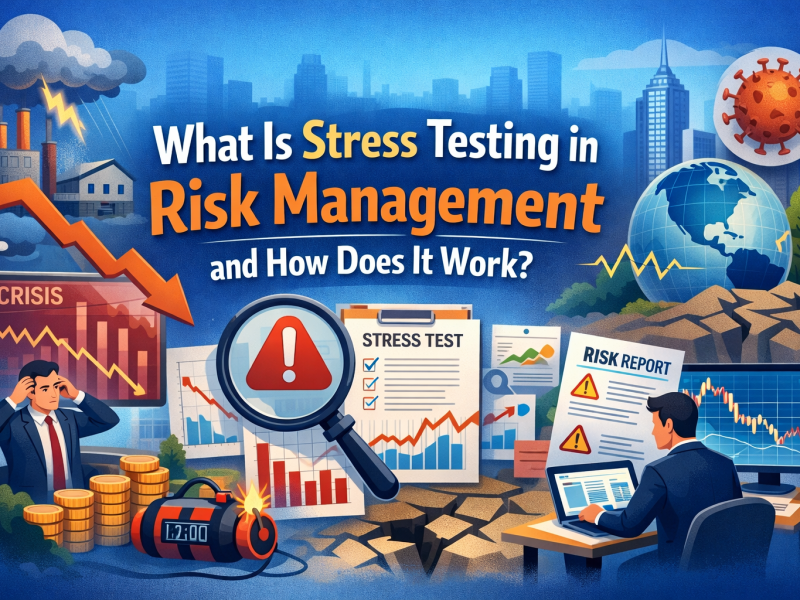
Imagine a bank sitting comfortably with healthy numbers on paper. Then interest rates jump, oil prices crash, or inflation shoots up. Suddenly, the numbers do not look so healthy anymore. Stress testing FRM helps you see these situations before they happen.
Stress Testing is all about asking the tough what if questions. What if market prices fall? What if borrowers stop paying? What if liquidity dries up? It shows how your portfolio reacts when things get messy, so you can stay prepared instead of panicking.
It is also a key global rule now. Regulators want proof that banks can survive rough markets. In the US, CCAR checks if big banks keep strong capital after severe shocks. In Europe, the EBA runs system-wide tests. Many countries use ICAAP and ILAAP to make banks include stress tests in their own capital and liquidity plans. FRM candidates should know how all these link to capital planning, risk appetite, and recovery planning. Most banking risk models look fine in calm markets, but calm periods do not reveal much. The real test appears when conditions turn rough, which is why stress testing is central to financial risk 2026.
Now, let us get into the 5 stress testing models you must know.
1. Scenario-Based Stress Testing FRM
Scenario-based stress testing is the classic model that most people think of when they hear the word stress test. In this approach, you pick a situation and test how your portfolio reacts. It could be a real event from history or a made-up event that feels realistic.
How it works
You take a scenario like
- a fall in GDP
- a sudden jump in unemployment
- Interest rates rising
- equity markets dropping
Then you apply the scenario to your bank or portfolio. You see how cash flows, valuations, capital, or liquidity change.
For example, say your bank wants to test a housing market crash. You pick a scenario where
- House prices fall 20 percent
- Interest rates rise 1.5 percent
After applying this, you see higher loan defaults and lower collateral value. This helps the bank understand how much loss it may face if the housing market suddenly drops.
Why FRM candidates should know it
Scenario-based stress testing FRM is used everywhere from banking risk models to investment firms to insurance companies. You will see many questions in the exam that ask how a chosen scenario affects a portfolio.
Strengths
- Easy to explain
- Good for big picture thinking
- Works for most asset classes
Limitations
- You only get the answer for the scenarios you choose
- You might miss hidden risks if your scenario is too simple
For stress analysis in FRM, this is your starting point. It helps you think about real-world shocks and how they ripple through a system.
2. Sensitivity Testing or Factor Shock Testing
Sensitivity testing is a lighter version of scenario testing. Instead of building a full event, you shock one factor at a time and watch how things move.
It is like checking how a house reacts if you push one wall instead of shaking the whole foundation.
How it works
Pick one driver:
- interest rate movement
- credit spread widening
- exchange rate swing
- commodity price change
Then shock it up or down. All other variables stay the same.
For example, if you hold a bond portfolio, you can shock interest rates by plus 1 percent. After the shock, you check how much the value of your bonds drops. This tells you how sensitive your portfolio is to interest rate moves.
Why FRM candidates must know it
The FRM exam often gives you a single input change and asks how it affects risk numbers. Sensitivity testing is the answer to this type of question. It helps you understand which variables matter and which ones do not.
Strengths
- Quick and easy
- Great for identifying the most risky factors
- Good for day-to-day trading or risk desk checks
Limitations
- Does not show the combined effects of multiple factors
- May underestimate risk in connected markets
When you think of simple banking risk models used by trading desks, this one is always there.
3. Reverse Stress Testing
Reverse stress testing flips the usual process. Instead of starting with a scenario, you start with a failure point. You ask, what would need to go wrong for us to fall below our capital or liquidity limits? Then you figure out the scenarios that could cause that failure.
How it works
Step 1. Identify the point where your bank or portfolio breaks.
Step 2. Work backward to find out what conditions would cause it.
Step 3. Test whether these conditions are realistic or not.
For example, a bank wants to know what could push its capital ratio below the minimum. It finds that this would happen only if loan defaults double and funding costs rise at the same time. This helps the bank see its weakest spot and plan ahead.
Why FRM candidates should know it
Regulators love reverse stress testing because it forces firms to think about vulnerabilities they never consider in normal testing. The FRM exam wants you to understand this because it ties directly to risk governance.
Strengths
- Reveals weak spots you do not normally see
- Helps in strategic planning and risk appetite setting
Limitations
- Hard to quantify
- Sometimes leads to unrealistic or very broad scenarios
Reverse stress testing is one of the most future-focused methods in stress analysis in FRM.
4. Stressed VaR and Stressed Expected Shortfall
This is where VaR testing meets stress testing. Normally, VaR tells you the possible loss over a period under normal market behavior. But normal markets do not tell the full story. That is why regulators introduced stressed VaR.
How it works
You calculate VaR using market data from a stressed time period. For example, a financial crisis year or a crash period. This shows how the portfolio behaves when volatility is high.
Expected shortfall is another risk measure. With stressed ES you use the same idea. You take losses under tough conditions and average the worst outcomes.
If you normally calculate VaR using the last year of data, you can redo the same calculation using data from a crisis period like 2008. The loss number will usually be much higher. This helps you see how your portfolio reacts when markets are stressed.
Why FRM candidates must know it
VaR testing and ES are major parts of FRM. Stressed versions are part of the regulatory framework, so they show up in exam questions.
Strengths
- Captures tail risk better than normal VaR
- Connects market risk metrics with real-world crises
Limitations
- Depends on the selected stress window
- If the real next crisis is different, results may not match reality
For anyone studying financial risk in 2026, stressed VaR and ES will be standard tools for market risk teams.
5. Systemic or Network-Based Stress Models
This model is more advanced and looks at the financial system as a connected network. It tests how problems spread from one bank or firm to another. If one bank fails, its counterparties take a hit. If many sell assets at the same time, fire sale risk appears. All these connections can create a chain reaction.
How it works
You map relationships like
- loans between banks
- counterparty exposures
- liquidity flows
- common asset holdings
Then you shock one part of the system and see how the stress spreads.
For example, if one large bank is hit with big losses and cannot pay its counterparties, those counterparties may face losses too. They may then sell assets quickly to raise cash. This pushes prices down and affects other banks as well. This example shows how one shock can spread through the system.
Why FRM candidates should know it
Even though the exam will not ask you to build one of these models, it wants you to understand the concept. Global regulators use systemic stress testing to check the stability of whole markets.
Strengths
- Shows second and third-order effects
- Helps capture hidden systemic risks
- Very useful for enterprise-wide stress testing
Limitations
- Needs a lot of data
- Hard to build
- Results can vary a lot based on assumptions
With markets becoming more connected, network-based stress testing will be an important part of banking risk models in the future.
Comparing the Five Models
Let us look at how these five models work in different situations.
| Stress Testing Model | Best Use Case | What It Helps You Understand |
| Scenario-Based Testing | Big real-world events | How your portfolio reacts to large economic or market shocks |
| Sensitivity or Factor Shock Testing | Quick factor level checks | Which variables have the strongest impact on your portfolio |
| Reverse Stress Testing | Finding weak points | The conditions that can push your bank or portfolio to failure |
| Stressed VaR and Stressed ES | Tough market periods | How losses look during high volatility and crises |
| Systemic or Network-Based Testing | System-wide risk checks | How stress spreads across banks and financial institutions |
No single model is perfect. The best practice is to use a mix of these based on the risk problem you want to solve. This is also the approach exam questions expect you to think about.
Study Tips for FRM Candidates
Here are some easy ways to learn these models faster.
| Study Tip | How It Helps |
| Create a small summary card for every model | Makes it easy to revise the key points quickly |
| Practice one shock exam-style question | Helps you think the same way the exam expects |
| Link each model to a real-world crisis | Makes the concept stick in your mind |
| Know the difference between scenario, sensitivity, and reverse tests | Helps avoid confusion during tricky exam questions |
| Understand how VaR testing fits into stress testing | Builds a clearer view of market risk and crisis behavior |
With these tips, you will be ready for stress analysis in FRM and you will also feel more confident in real work situations.
Final Thoughts
Stress testing is a big part of FRM because it shows how well you can handle real-world shocks. Once you understand these five models, you will feel more confident dealing with fast-moving markets and sudden risks.
Scenario tests help you see the full picture. Sensitivity tests let you pick out the key drivers. Reverse stress tests show you where things can break. Stressed VaR helps you understand losses in tough markets. Network models explain how stress spreads across the whole system.
When these ideas become clear, the exam feels easier and your career feels more solid.
If you want to learn all this in a simple and well-structured way, The WallStreet School’s FRM Program can support you. You get clear teaching, steady guidance, and a study plan that keeps you going without confusion. It is a helpful way to build confidence and move toward clearing the exam.
People Also Asked
1. What is the stress test in FRM?
Ans. A stress test checks how a bank or portfolio would perform during very tough situations so you can spot problems early.
2. What are stress testing models?
Ans. Stress testing models show how your portfolio reacts when markets fall, rates move, or credit risk goes up.
3. What are PD, LGD, and EAD models?
Ans. PD, LGD, and EAD tell you how likely a borrower is to default, how much you might lose, and how much exposure you have.
4. What is the CCAR stress test model?
Ans. The CCAR stress test checks if large US banks can survive a severe economic downturn and still stay strong and safe.