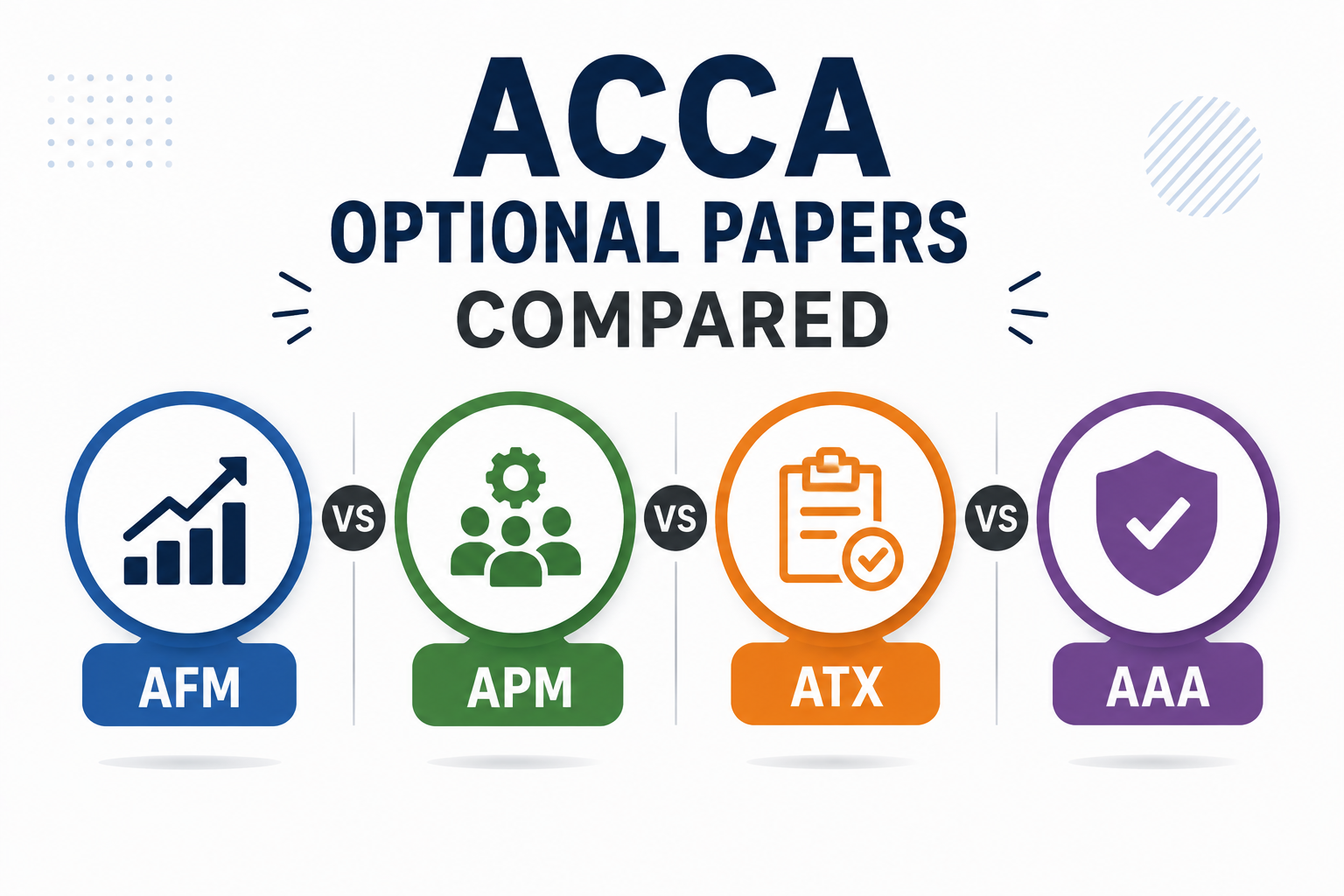
At Strategic Professional level, you pick two papers out of four: AFM, APM, ATX, and AAA. This ACCA Paper Selection matters more than most students realise. It’s not just about which exam you’ll clear easier. It’s about which sector you’re actually setting yourself up for. Here’s a straight comparison, based on what each paper actually demands and where it takes you.
The Choice Isn’t Just About Difficulty
Every one of these ACCA Optional Papers is hard. None of them rewards mugging up the night before. What separates them is the kind of thinking each one trains you for, and that ends up shaping the kind of career you walk into.
AFM: Advanced Financial Management
Do AFM if you want a career in corporate finance, treasury, or investment. It covers advanced valuations, mergers and acquisitions, risk management, and international financial strategy. Pass rates hover around 42 to 46%, which makes it demanding but not the hardest of the four.
AFM pairs extremely well with a CFA. If you’re serious about finance as a career, not just accounting, doing AFM alongside or before CFA gives you both the qualification breadth and the deep technical grounding recruiters look for in corporate finance and investment roles. Treat this pairing seriously if long term you see yourself in M&A, treasury, or investment banking adjacent roles.
APM: Advanced Performance Management
This is the paper students fear most, and for good reason. Pass rates sit around 32 to 40%, among the lowest across all Strategic Professional options. It’s not calculation heavy like AFM. It’s subjective. There’s often no single “right” answer, only a better argued one, and that unsettles students used to numerical papers with a clean correct figure at the end.
Here’s what most students miss about APM. It teaches you to think the way a COO thinks. It’s not really an accounting paper, it’s a strategic performance paper, about how a business actually gets managed, measured, and steered at the top. Short term, sitting through it, you might not see the value. It feels abstract and frustrating. Long term, this is an excellent exam to have done. It shapes how you look at a business, not just its numbers.
Give this exam if performance management, FP&A, or strategic finance roles are where you’re headed. With the right strategy and the right tutor, it’s absolutely passable. It just demands different preparation than a formula-driven paper.
ATX: Advanced Taxation
Go for ATX if you want to do tax filings globally. This paper builds on TX from Applied Skills and pushes into advanced tax planning, not just computation but genuine tax strategy. Pass rates run around 40 to 42%, making it decently difficult but genuinely doable with consistent practice.
ATX rewards structured preparation more than raw talent. If your career direction is tax advisory, whether domestic or international, this is the direct route in. It’s technical, but it’s learnable technical, not the open ended subjectivity you get with APM.
AAA: Advanced Audit and Assurance
Choose AAA if you see yourself working in IFRS, audit, or assurance. It’s consistently one of the two hardest papers alongside APM, with pass rates around 31 to 38% historically, though recent sessions show improvement, climbing closer to 40% in some sittings.
AAA isn’t conceptually complicated, it’s technically demanding. You need to write detailed audit procedures, evaluate internal controls, and reference ISA standards precisely, which trips up students used to calculation heavy papers. If audit, assurance, or deep IFRS work is your direction, this paper is non negotiable, and it’s the closest thing to real audit fieldwork before you actually do real audit fieldwork.
Why AFM vs APM and ATX vs AAA Comes Down to Sector, Not Just Difficulty
Every one of these papers gives you access to a different sector entirely. AFM opens the door to corporate finance and investment. APM opens the door to strategic and commercial finance roles, the kind that eventually lead to FP&A leadership or even COO track positions. ATX opens the door to tax, domestic and international. AAA opens the door to audit, assurance, and IFRS-heavy reporting roles.
When you’re weighing AFM vs APM, ask yourself whether you want to work with numbers that have a clean answer, or with judgement calls that require you to build and defend an argument. When you’re weighing ATX vs AAA, ask whether you’d rather specialise in tax strategy or in audit and assurance work.
How to Actually Pass These Papers
At ACCA Strategic Professional level, no tutor can guarantee you a pass. What a tutor can give you is the right strategy, structured practice, and feedback on your written answers. The actual work of passing comes down to you.
Practise mocks relentlessly. Read technical articles from ACCA’s own examiner reports and guidance. Discipline matters more here than at any earlier level of your ACCA Exam journey. Mugging up content won’t work at this stage. These papers test application under pressure, not recall.
One thing that sounds unusual but genuinely helps: dress professionally when you sit down to study or practise mocks. It sounds small, but it puts you in the right headspace to command the exam rather than just attempt it. For ATX, think and dress like a tax analyst. For AAA, think and dress like an auditor walking into a client’s office. For APM, think like someone about to present to a COO. It aligns your energy with the role you’re training for, not just the exam you’re sitting.
Building Your ACCA Study Plan Around Paper Selection
Your ACCA Study Plan should start with career direction, not with which paper looks easiest on a pass rate chart. Once you know your two options, structure your ACCA Preparation around consistent mock practice, examiner report review, and honest self assessment of where your written answers are actually losing marks, not just whether your final number was right.
Bottom Line
Don’t pick your ACCA Papers based purely on which pass rate looks friendliest. AFM if you’re building toward finance and want to complement it with a CFA. APM if you can handle short term discomfort for long term strategic thinking. ATX if global tax work is where you’re headed. AAA if IFRS and audit are your path. Each one is genuinely difficult, and each hands you a real ticket into a specific sector. Whatever you choose, get it right early in your ACCA Course, since your optional papers shape the rest of your career more than any other decision in the qualification. Choose the sector first, then commit to the discipline the paper demands.
The right ACCA optional exam can open the door to your dream role. Get expert guidance and exam-focused preparation with The WallStreet School.
Frequently Asked Questions
Ques 1) Can I choose any two of the four optional papers?
Yes. You pick any two of AFM, APM, ATX, and AAA. There’s no restriction based on your earlier papers, though your Applied Skills performance in the related paper, like PM for APM or TX for ATX, is a strong signal of readiness.
Ques 2) Which combination is easiest to pass together?
AFM and ATX tend to have marginally higher pass rates than APM and AAA, but “easiest” shouldn’t be your only filter. Choose based on where you actually want to work.
Ques 3) Is APM worth doing if I’m not aiming for a COO role?
Yes. Even if you never sit in a COO chair, the strategic thinking APM builds is valuable across FP&A, consulting, and general management finance roles.