
How relevant are the ACCA exams today and How do they compare to other professional qualifications?
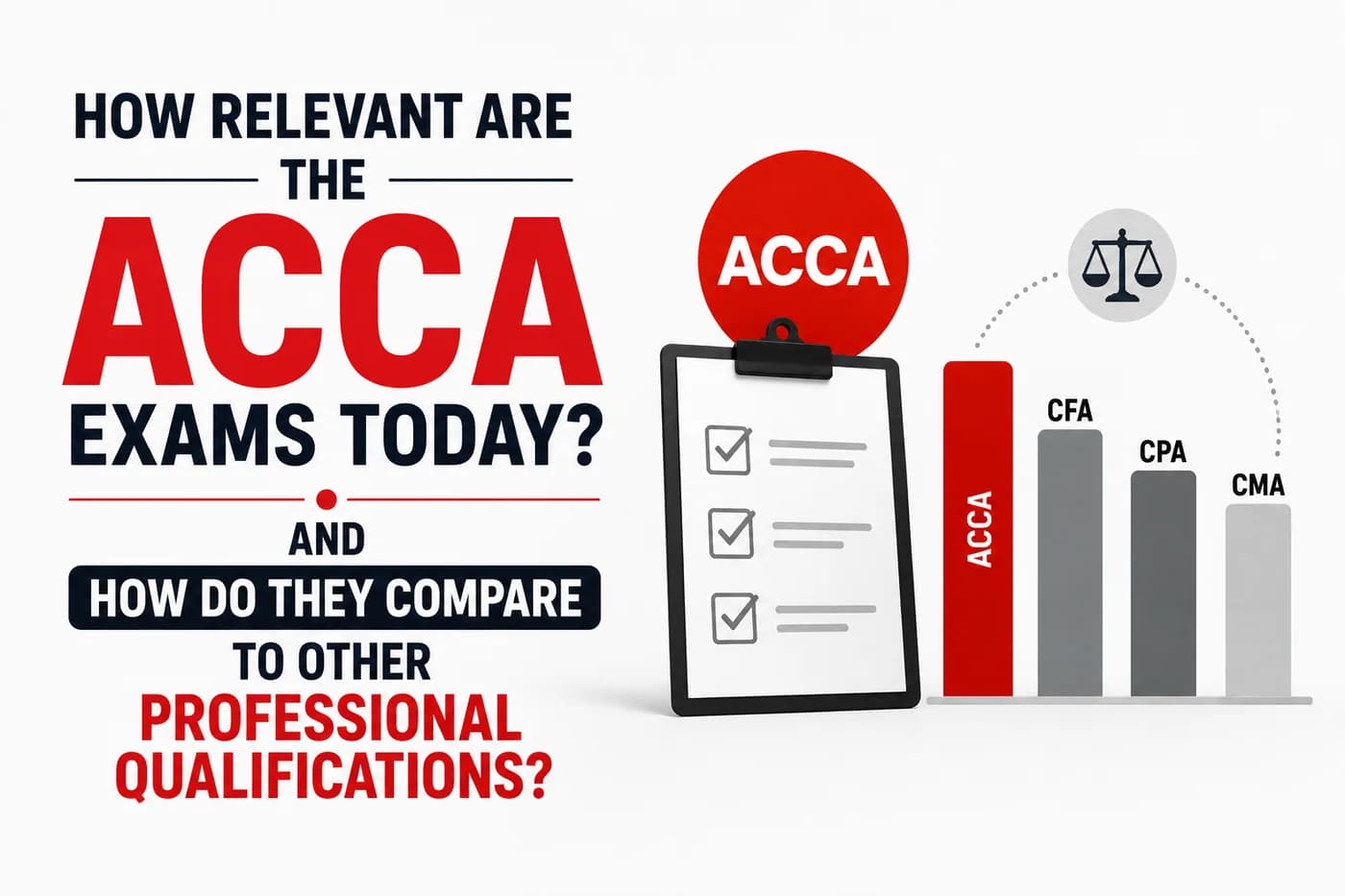
What has actually changed in 2026? The version of ACCA that exists now is not the same qualification it was five years ago. That matters,
What has actually changed in 2026?
The version of ACCA that exists now is not the same qualification it was five years ago. That matters, because a lot of the scepticism I hear is based on an outdated picture of what ACCA covers.
The syllabus has been redesigned into three levels — Knowledge, Expertise, and Strategic Professional. But more importantly, what is inside those levels has shifted. Data analytics is now embedded in the curriculum. There is a paper called Performance with Data Analysis. Digital finance and technology are not add-ons — they sit inside the core exams. And from 2026, ACCA has introduced a Professional Diploma in Sustainability and a Data Science Professional option, which tells you exactly what direction they see the profession heading.
Why does this matter? Because the finance roles being created right now — the ones that actually pay well and lead somewhere — require people who can do more than produce a set of accounts. They need professionals who understand ESG reporting, who can interpret data, who can sit in a strategy meeting and add something. ACCA in 2026 is genuinely trying to build that person.
The finance job is no longer just about closing the books. The employers I speak to want people who can close the books AND tell the business what the numbers mean. ACCA gets closer to that than most qualifications.
So how does it compare to the alternatives?
This is always the hardest part of the conversation — because people want a simple answer and the honest answer is: it depends on what you want to do.
Here is how I would frame each option to someone sitting across from me:
| Qualification | What it is really for | Global reach | Time to complete |
|---|---|---|---|
| ACCA | Global accounting, audit, tax, financial management across MNCs and Big 4 | 180+ countries — widest of any accounting qualification | 3–4 years while working |
| CFA | Investment management, portfolio analysis, equity research, capital markets | Global but investment-specific — not relevant outside that world | 3–5 years, very difficult |
| CPA (US) | US GAAP compliance and US-linked roles — limited utility outside North America | Mainly US-centric | 1–2 years |
| CA (India) | Indian taxation, audit, domestic compliance — respected within India, limited globally | Strong in India only | 4–5 years, very tough |
| CIMA | Management accounting, internal finance, commercial roles — narrower than ACCA | Good but narrower reach | 3–4 years |
The honest version: None of these is universally better than the others. The right one depends on where you want to work, what kind of roles you are targeting, and what geography matters to you. Anyone who tells you one qualification beats all others in every situation is selling something.
The ACCA vs CFA question — let me be direct
This is the comparison I get asked about most, and I think it causes a lot of unnecessary confusion. These two qualifications are not really competing. They are built for completely different careers.
CFA is a specialist credential designed around capital markets — portfolio management, equity research, asset valuation, investment analysis. It is one of the hardest professional exams in the world. Pass rates at each level are often below 40%. It is gruelling, specific, and deeply respected within investment circles. But it does not touch audit, tax, or corporate accounting in any meaningful way.
ACCA covers the full picture of corporate finance — how businesses are reported, taxed, audited, managed, and led. It is based on IFRS, which is the accounting framework used in over 140 countries. That is why ACCA professionals show up in roles from Financial Controller to CFO across industries and geographies.
If someone tells me they want to become a portfolio manager or work in asset management, I tell them to look at CFA. If they want to build a broad finance career that could take them to London, Dubai, Singapore, or Nairobi — ACCA is the one.
| ACCA | CFA | |
|---|---|---|
| What it covers | Audit, tax, financial reporting, management accounting, business strategy | Portfolio management, equity research, asset valuation, capital markets |
| Who it is for | Anyone building a broad, cross-sector finance career | Those specifically targeting investment and asset management roles |
| Typical roles it leads to | Financial Controller, CFO, Finance Director, Audit Manager, Tax Consultant | Portfolio Manager, Equity Analyst, Wealth Manager, Investment Banker |
| Pass rates | Moderate — most papers between 40 and 55 percent | Very hard — often below 40 percent at each level |
| Career flexibility | Very high — works across audit, industry, consulting, government | Narrow — highly respected within investment, less relevant outside it |
What employers are actually saying in 2026
I want to be careful here, because a lot of career advice just tells you what you want to hear. So let me share what I genuinely observe when I speak to hiring managers.
The employers I work with across Big 4, MNCs, financial services, and consulting are looking for three things that ACCA consistently delivers and a lot of other qualifications do not: breadth, portability, and demonstrated commitment to professional standards.
Breadth means they can hire someone who understands tax, reporting, and commercial finance — not just one narrow slice. Portability means the qualification works whether the person is sitting in Mumbai, Manchester, or Muscat. And professional standards means the Ethics and Professional Skills module is not optional — you cannot become an ACCA member without demonstrating it.
The one shift I have noticed in 2026 specifically is that employers are now asking much more directly about data literacy and sustainability knowledge. Five years ago these were nice-to-haves. Now they show up in job briefs. The fact that ACCA has embedded both into the core qualification — rather than just offering optional courses on the side — matters more than it used to.
| What employers flag in 2026 | Whether ACCA addresses it |
|---|---|
| Can this person work across different regulatory environments? | Yes — IFRS-based training covers 140+ countries without retraining needed |
| Do they understand ESG and sustainability reporting? | Yes — sustainability is now embedded in the core syllabus, not an elective |
| Can they do something with data, not just produce it? | Yes — Performance with Data Analysis is a core paper in the redesigned qualification |
| Do they have verified practical experience — not just exam passes? | Yes — 36 months of documented work experience is required for membership |
| Do they have a professional ethical framework? | Yes — Ethics and Professional Skills module is mandatory before membership |
The question is no longer just ‘are you qualified?’ It is ‘are you qualified for where finance is going?’ That is a different bar — and ACCA in 2026 is genuinely trying to meet it.
Who should seriously consider ACCA — and who should not
I will keep this straightforward, because I think this is where most career advice gets too soft.
| ACCA makes sense if you… | Think twice if you… |
|---|---|
| Want to work internationally — genuinely, not just in theory | Are only interested in Indian domestic roles — CA has more local currency there |
| Want flexibility to move between audit, tax, industry, and consulting over your career | Are specifically drawn to investment banking or portfolio management — look at CFA instead |
| Are working full-time and need a qualification that works around your job | Need something quick — ACCA is a 3 to 4 year commitment and should be taken seriously |
| Are targeting MNC finance teams, Big 4, or senior financial leadership roles | Are US-based and targeting US-specific compliance roles — CPA opens more doors there |
| Want a qualification that grows with you through CPD over decades | Already hold CA and need a short add-on — consider whether ACCA is the most efficient path |
The short version
ACCA in 2026 is genuinely relevant — more so than it was five years ago, because the qualification has moved with where the profession is going. It is not the right answer for everyone. But for anyone who wants a finance career that travels, that spans more than one function, and that gives them real options over a twenty-year horizon — it holds up very well against everything else on the market.
Just be honest with yourself about what you want. That is what will determine whether this is the right call — not what someone on LinkedIn said, and not what your colleague thinks.
FAQs
Ques 1 — Is ACCA harder than CA or CFA?
CA and CFA are both harder, honestly. CA has brutal pass rates and a long articleship. CFA is one of the toughest exams in finance full stop. ACCA is challenging but designed to be manageable alongside a full-time job. Most people who struggle with it do not struggle because the content is impossible — they struggle because they underestimate how much consistency it takes over time.
Ques 2 — Can ACCA take me to the Middle East or the UK if I am based in India?
Yes — and this is one of ACCA’s strongest cards. It is recognised across the UAE, Saudi Arabia, the UK, Singapore, and most major finance hubs. A lot of Indian professionals use ACCA specifically as the bridge to get there.
Ques 3 — I already have a BCom. Does ACCA still add value or am I just repeating myself?
The overlap is smaller than most people expect. The Strategic Professional level goes into governance, risk, and financial leadership at a depth most undergraduate programmes never touch. And your BCom likely gets you exemptions from a few early papers, so you are not starting from zero — you are starting from ahead.
Interested in Learning Finance Professionally?
Our courses take you from fundamentals to expert level — with live mentors and placement support.
Explore Our Courses