The finance skills recruiters value most are financial modeling, Excel skills, financial statement analysis, valuation skills, budgeting, forecasting and communication. For investment banking roles, add DCF, comparable company analysis and LBO modeling. The trick is not listing all of them at once, it is picking the ones that match the role and backing each with a real example.
Getting shortlisted for a finance job is not about stuffing your resume with buzzwords. Recruiters have seen resumes that say “Excel” or “financial analysis” and skim right past them. What actually catches their eye is proof that you can take messy financial data and turn it into something useful, explain it clearly and do it fast under a deadline. That is the whole game behind finance skills for resume writing and once this clicks, everything else falls into place.
This article breaks down 15 finance career skills worth putting on a resume, how they shift by role and how to phrase them so they sound credible instead of copy pasted from a template.
Why These Finance Skills Matter So Much?
Finance hiring has gotten sharper in the last few years. Companies want people who can plug in and start adding value quickly, which means financial analyst skills need to be visible on paper before the interview even happens. A recruiter scanning a resume for six seconds wants signals, not sentences, so every skill listed should work as a proof point rather than a decoration.
The good news is that finance skills for jobs fall into a handful of categories. Once these are clear, building a strong resume gets a lot less overwhelming.
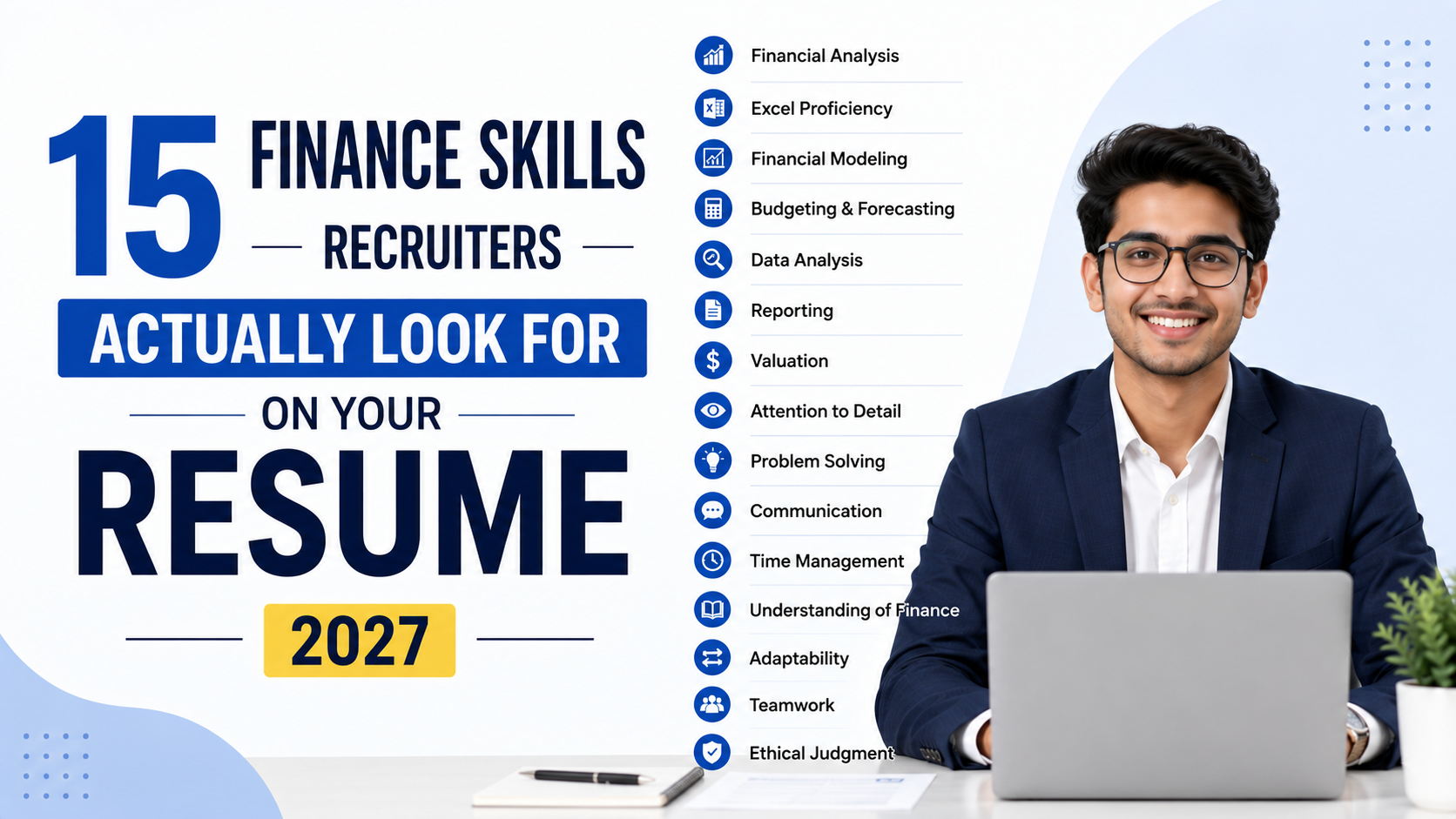
The 15 Finance Skills to Put on Your Resume
| Skill | What Recruiters Want to See? | How to Show It (examples) |
| 1. Financial modeling | Linked, auditable models, not random calculations | “Built a three statement model with revenue, working capital and cash flow forecasts.” |
| 2. Excel skills | Strong formula work and clean formatting | Mention PivotTables, XLOOKUP, INDEX MATCH, SUMIFS, Power Query where genuinely used. |
| 3. Financial statement analysis | Knowing how the P&L, balance sheet and cash flow connect | “Analyzed quarterly trends to spot margin and working capital drivers.” |
| 4. Budgeting and forecasting | Planning future performance against actuals | “Prepared monthly revenue and expense forecasts against budget.” |
| 5. Variance analysis | Explaining why numbers differed from the plan | “Performed budget versus actual analysis and explained cost movements.” |
| 6. Valuation skills | Crucial for banking, equity research and private equity | List exact methods, such as DCF, trading comparables, or precedent deals. |
| 7. Three statement modeling | Baseline for analyst roles across banking and FP&A | “Built an integrated model with depreciation, debt and working capital schedules.” |
| 8. DCF analysis | Estimating value through discounted free cash flow | “Performed DCF valuation using WACC, terminal value and sensitivity checks.” |
| 9. LBO modeling | Important for private equity roles | “Built an LBO model assessing debt paydown and IRR returns.” Only claim what can be defended in an interview. |
| 10. Comparable company analysis | Benchmarking against similar public businesses | “Prepared trading comps using EV/EBITDA and P/E multiples.” |
| 11. Accounting standards | Solid accounting knowledge behind every analysis | Mention IFRS, Ind AS or GAAP if relevant to the role. |
| 12. Financial reporting | Turning raw numbers into clear reports | “Created monthly reports tracking revenue, margin and cash flow.” |
| 13. Data tools: SQL, Power BI, Python | Common in FP&A, fintech, and analytics roles | “Used SQL and Power BI to build profitability dashboards.” |
| 14. Research and commercial analysis | Understanding industries and market drivers | “Conducted sector research on growth drivers and valuation benchmarks.” |
| 15. Communication and presentation | Explaining numbers to non-finance people | “Presented findings in concise PowerPoint decks.” |
These fifteen show up again and again in finance resume guidance and recruiters also reward analytical thinking, accuracy and the ability to quantify impact. A resume built only around technical labels without a measurable result tends to fall flat.
What Matters By Role?
A resume that lists everything under the sun does not impress anyone, it usually signals the opposite. Match the section to the target role instead.
| Target Role | Skills to Prioritize |
| Financial analyst / FP&A | Excel, financial statements, budgeting, forecasting, variance analysis, Power BI or SQL |
| Investment banking | Three statement modeling, DCF, comps, precedent transactions, LBO basics |
| Private equity | LBO modeling, investment memos, due diligence, return analysis, DCF and comps |
| Equity research | Financial statement analysis, forecasting, valuation, earnings analysis |
| Audit and accounting | IFRS or Ind AS, financial reporting, reconciliations, controls |
| Corporate finance / treasury | Cash flow forecasting, working capital analysis, capital budgeting |
For anyone chasing a banking career specifically, modeling, DCF, LBO and Excel are the screening keywords recruiters and applicant tracking systems look for most. Getting these right on paper often matters as much as the interview, since most resumes never make it past the first screen without them.
Make the Skills Section Actually Credible
Here is the part most people get wrong. A finance recruiter will almost always test any technical skill listed, so vague claims backfire fast.
Weak version: Skills: Excel, Financial Analysis, Valuation, PowerPoint, Communication
Stronger version: Financial Modeling: three statement models, DCF, comparable company analysis Excel: PivotTables, XLOOKUP, INDEX MATCH, SUMIFS, model formatting Analysis: budgeting, forecasting, variance and profitability analysis Tools: Power BI, SQL, Capital IQ or Bloomberg, only if genuinely used Reporting: IFRS or Ind AS fundamentals, management reporting, KPI dashboards
Then back it up with a project or internship bullet instead of leaving the skill floating on its own:
- “Built a DCF and comparable company valuation for a listed consumer company, estimating an implied equity value range from WACC sensitivities.”
- “Automated a monthly budget versus actual dashboard using PivotTables and XLOOKUP, cutting manual reporting time and flagging the largest variances.”
Each bullet has a task, a method or tool and a measurable outcome. That combination separates a resume that gets shortlisted from one that gets lost in the pile.
The Best Starting Set For Beginners
For students working toward ACCA, CPA, or a finance internship, here is a practical build order:
- Excel skills
- Financial statement analysis
- Accounting fundamentals such as IFRS or Ind AS
- Three statement modeling
- Budgeting, forecasting, and variance analysis
- DCF valuation and comparable company analysis
- PowerPoint and presentation skills
- Industry and company research
- Power BI or SQL
- Clear written and verbal communication
Once these feel solid, add LBO modeling, precedent transactions and tools like Capital IQ or Bloomberg for anyone targeting private equity. Mirror the language used in each job description and only keep claims that can hold up in an interview.
People Also Ask About Finance Skills for Resume
- What are the most important finance skills for resume writing?
Financial modeling, Excel, financial statement analysis, valuation and communication form the core across almost every finance role.
- Do financial analyst skills differ from investment banking skills?
Yes. Financial analyst skills lean toward budgeting and reporting, while banking roles focus heavily on modeling, DCF, comps and LBO analysis.
- How many skills should be listed on a finance resume?
Somewhere between eight and twelve well chosen skills, backed by real examples, beats an unfocused list of twenty or more.
- Can beginners claim advanced skills like LBO modeling?
Only if it can genuinely be explained and defended in an interview. Overstating finance career skills tends to backfire the moment a recruiter asks a follow up question.
Getting Help With the Resume Itself
Listing the right skills is half the job, phrasing them the way recruiters expect is the other half. The WallStreet School helps students and working professionals with exactly this, reviewing resumes line by line and reworking the skills section, project bullets and overall structure so everything actually lands the way it is meant to.
Lastly
Building a resume around finance skills is not about sounding impressive, it is about being specific. Recruiters spot vague claims from a mile away, so the resumes that stand out are the ones where every skill connects to a real task, a real tool and a real result. Whether the goal is a first internship or a move into investment banking, the same rule holds.
Pick the finance skills for jobs that matter for the role, prove them with actual work and let the resume do the talking before the interview even begins.