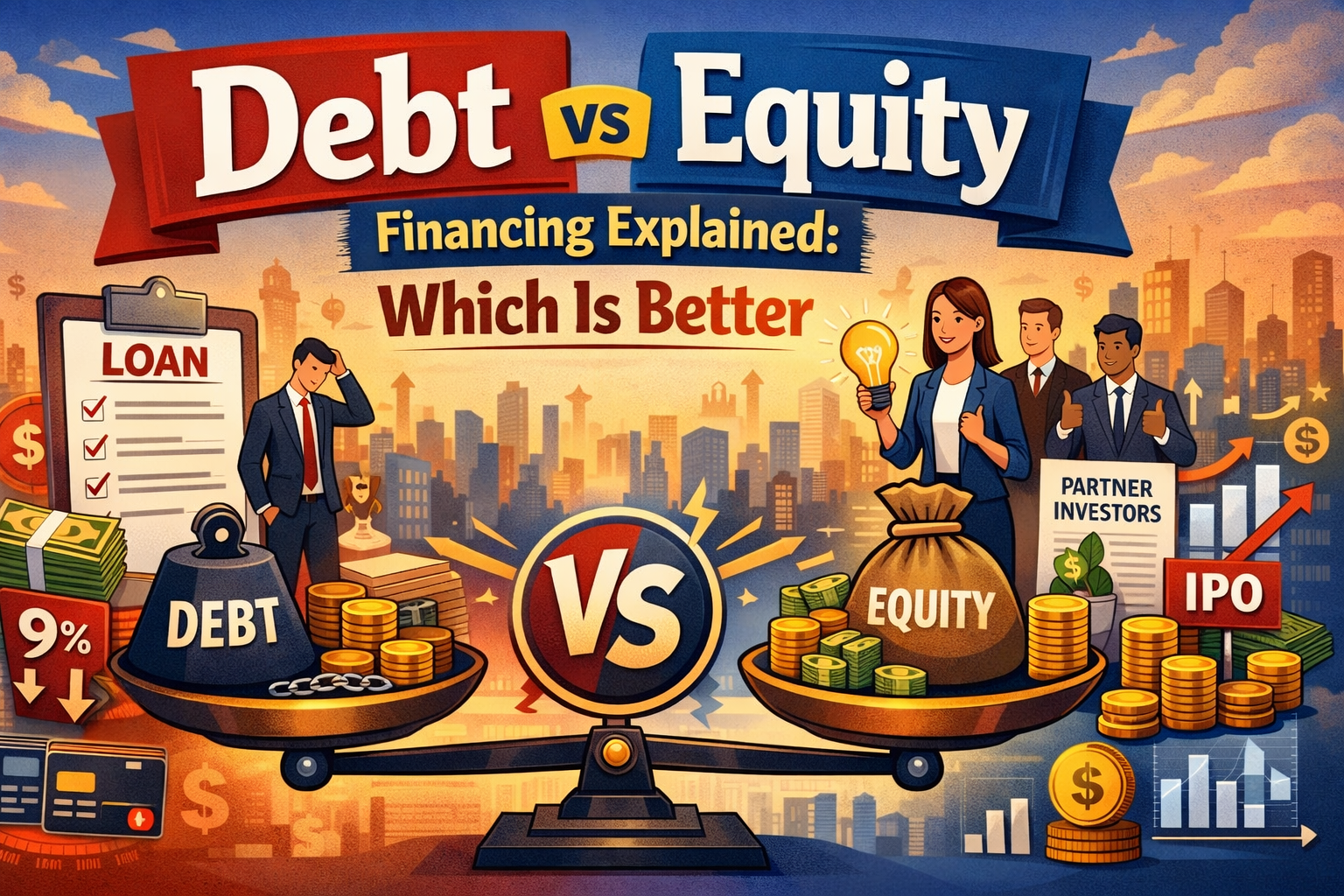
Companies usually raise funds in two main ways: by borrowing money i.e debt financing or by bringing in investors i.e equity financing. Most businesses rely on a combination of both, depending on their cash flow situation and how much ownership the founders want to retain.
To understand debt vs equity financing explained in simple terms, equity financing involves raising capital by offering a share of the business to investors. There is no repayment obligation, which makes it useful for long-term growth, but it reduces the owners’ stake in the company. Debt financing works differently. The business borrows funds and commits to paying interest and returning the amount over time, while full ownership remains intact.
Both approaches come with trade-offs. Equity eases cash flow pressure but spreads profits among more owners. Debt keeps control concentrated but creates fixed payment responsibilities. Choosing the right option depends on the company’s stage, financial strength, and future plans.
What Is Debt Financing?
Debt financing means raising money by borrowing it and agreeing to pay interest and return the amount over time, without giving up ownership of the business.
In this arrangement, the company takes funds from a lender such as a bank, an NBFC, an institution, or even the public through bonds. In return, the company commits to regular interest payments and repays the principal after a fixed period. In simple terms, debt financing works like a business loan.
Key Features of Debt Financing
Debt financing has some clear characteristics that make it easy to identify.
- First, interest payments are fixed. The company must pay interest regularly.
- Second, the principal amount must be repaid on time.
- Third, the lender does not become an owner. The lender has no say in daily business decisions.
- Fourth, interest paid on debt is usually tax-deductible. This reduces the actual cost of borrowing.
Debt financing works best for companies with stable and predictable cash flows. If a business knows it can earn regularly, it can safely commit to interest payments.
What Is Equity Financing?
Equity financing means raising money by bringing in investors who receive a share of ownership in the business instead of fixed repayment.
Instead of borrowing funds, the company allows investors to put money into the business in exchange for shares, which represent ownership. Because there is no fixed repayment or mandatory interest, investors earn returns only if the company performs well in the future.
This approach represents the ownership-based side of debt vs equity financing.
Key Features of Equity Financing
Equity financing also has some clear features.
- First, there is no obligation to repay money.
- Second, investors share profits, not interest.
- Third, ownership gets diluted. Founders give away a part of control.
- Fourth, investors often want a say in important decisions.
Equity financing is common in startups and young companies. These businesses usually do not have steady cash flows and cannot promise regular repayments.
Figure 1: Debt vs equity financing explained through a simple house analogy, where debt is shown as renting money with repayment and equity as selling ownership without repayment pressure.
Difference Between Debt and Equity Financing
Here is a clear comparison to make things easy.
| Basis | Debt Financing | Equity Financing |
| Ownership | Ownership remains with the company | Ownership is shared with investors |
| Repayment | Repayment of principal is required | No repayment obligation |
| Cost | Interest payments | Profit sharing with investors |
| Risk | Lower risk for lenders, higher pressure on the company | Higher risk for investors, lower pressure on the company |
| Control | Full control stays with owners | Investors may have a say in decisions |
| Suitable for | Mature companies with stable cash flows | Early-stage and high-growth companies |
Why Companies Choose Debt or Equity Financing?
No one financing option works for every business. Companies choose between debt and equity based on where they stand, how stable their income is, and how much control they want to keep. This decision-making process is what debt vs equity financing is really about.
- When Companies Prefer Debt Financing?
Companies usually turn to debt financing when their business is already earning money on a regular basis. If cash is coming in steadily, paying interest on a loan does not feel risky. Debt also makes sense for companies that do not want to give away ownership or involve outsiders in decision-making. For many established businesses, borrowing is simply a practical option, especially since interest payments reduce taxable income. Debt is commonly used for things like expansion, buying machinery, or funding projects that are expected to pay for themselves over time.
- When Companies Prefer Equity Financing?
Equity financing is more common when a business is still finding its feet or growing very quickly. At this stage, profits may be uncertain and cash flow can change from month to month, which makes loan repayments stressful. Because of this risk, banks often hesitate to lend. Equity funding removes that pressure and allows the company to focus on growth rather than repayments. Many startups also value equity investors for their guidance, contacts, and experience, not just for the money they bring in.
This stage-based logic is central to equity vs debt decisions.
Company Life Cycle and Financing Choices
A company’s financing needs change as it grows.
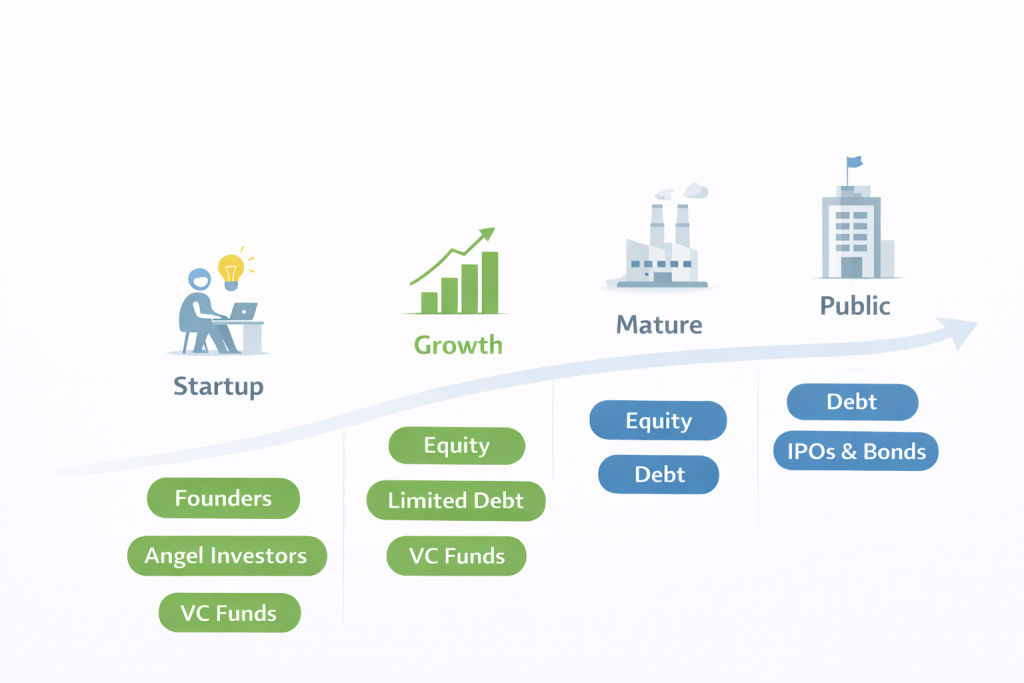
Figure 2: Company life cycle and financing choices visual explaining how businesses use equity financing in early stages and gradually shift toward debt financing as they mature.
- In the early stage, companies use equity financing from founders, friends, angel investors, and venture capital funds.
- In the growth stage, companies may still use equity but also start using limited debt.
- In the mature stage, companies rely more on debt financing because cash flows are stable.
This progression explains debt vs equity financing explained in a very natural way.
To see how debt and equity decisions translate into real financial numbers, the video below walks through a practical financial feasibility model:
Sources of Debt Financing vs Equity Financing
| Debt Financing Sources | Equity Financing Sources |
| Banks | Friends and family |
| NBFCs | Angel investors |
| Institutional lenders | Venture capital funds |
| Corporate bonds | Private equity funds |
| Public and private bond markets | Initial Public Offerings (IPO) |
This variety shows how flexible debt vs equity financing explained can be in practice.
Real Life Examples of Debt and Equity Financing
Real companies make this easier to understand.
Take Zomato, for example. Zomato relied heavily on equity financing in its early years. As a loss-making, high-growth startup, it raised money through multiple venture capital funding rounds to expand operations, acquire users, and enter new markets. Equity was the preferred option because there was no pressure to make fixed repayments during the growth phase.
Zomato later raised additional equity from public investors through its IPO. So far, the company remains debt-free, as it has not yet reached a stage where cash flows are stable and predictable, which is usually required for taking on debt.
Next, we can take Tata Motors. Tata Motors represents a more mature-stage approach to financing. As an established manufacturing company with steady operations, it has consistently relied on debt financing to fund expansion, capital expenditure, and large investments such as new vehicle platforms and international operations.
While Tata Motors has raised equity at different points in its history, debt has played a major role in its financing strategy through bank loans, bonds, and other borrowings. Stable revenues and asset backing allow the company to service interest and repay debt over time, making borrowing a practical and cost-effective option.
Now, these examples highlight a clear pattern in debt vs equity financing. Companies like Zomato depend on equity during early and high-growth phases, while established businesses like Tata Motors rely more on debt once cash flows and scale are in place.
Note: Financing choices change with maturity, not preference.
Advantages and Disadvantages of Debt Financing
| Advantages | Disadvantages |
| Ownership remains with the company | Repayment is mandatory |
| Interest payments are tax-deductible | Regular payments increase cash flow pressure |
| Costs are predictable | High debt increases financial risk |
| Lenders do not interfere in business decisions | Risk of default during weak business periods |
Understanding these trade-offs is essential in debt vs equity financing explained.
Advantages and Disadvantages of Equity Financing
| Advantages | Disadvantages |
| No repayment obligation | Ownership gets diluted |
| Better cash flow flexibility | Profits must be shared with investors |
| Business risk is shared with investors | Founders lose full control |
| No interest or fixed payment pressure | Investors may influence decisions |
This balance defines equity vs debt choices for founders.
People Also Ask about Debt vs Equity Financing
1. What is better, equity financing or debt financing?
Ans. Neither is always better. Equity suits startups and growth phases, while debt works better for stable businesses with predictable cash flows.
2. Is it better to be financed by debt or equity?
Ans. Debt is better when income is steady and control matters. Equity is better when flexibility is needed and repayment pressure must be avoided.
3. Why do startups prefer equity financing?
Ans. Startups lack steady income and assets. Equity helps them raise funds without repayment stress and focus fully on growth.
4. Does equity financing require repayment?
Ans. No. Equity financing does not require repayment. Investors earn returns only if the business grows and becomes profitable.
5. How to differentiate debt and equity?
Ans. Debt must be repaid with interest. Equity involves sharing ownership and profits without any repayment obligation.
6. Can a company use both debt and equity financing?
Ans. Yes. Most companies use equity early and add debt later as cash flows become stable.
The Verdict
There is no single winner in debt vs equity financing explained. Each option serves a different purpose. Debt financing is powerful for mature businesses that value control and predictability. Equity financing is essential for young companies that need flexibility and risk sharing. The smartest companies do not choose sides. They use both wisely at different stages.
If you understand debt vs equity financing explained, you know the foundation of corporate finance basics. And that knowledge helps you read businesses better, invest smarter, and think like a decision-maker.
Understanding how companies balance debt and equity is the first step. Applying this understanding to real company analysis is the natural next one, which is where practical financial modelling and valuation programs from The Wallstreet School can add value.