
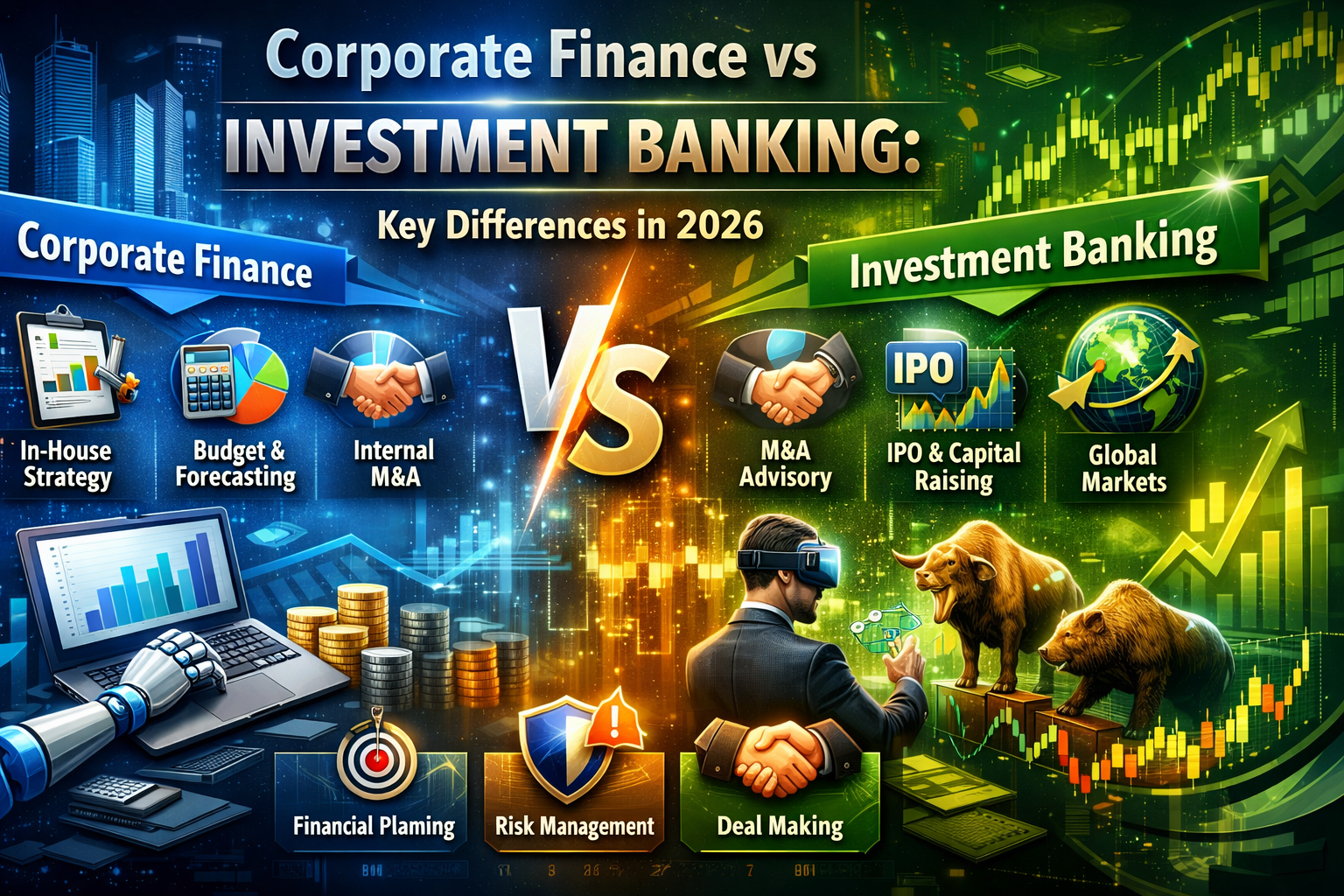
Both careers are in finance. Both pay well. Both look great on a resume. But the person working in corporate finance and the person working in investment banking are living very different lives by year three. The work is different, the pressure is different and the ceiling is different. Okay, but how do you actually decide which one makes sense for you?
According to BCG, combined revenues in this space hit close to $989 billion recently, fueled by an AI-driven boom. Picking the right side of it matters more than ever in 2026.
This article breaks down corporate finance vs investment banking so you can make a smarter choice for yourself.
Corporate Finance vs Investment Banking: The Core Difference
At the most basic level, corporate finance is about managing money inside a company. If you work in a corporate finance job, you are the person making sure the business has enough cash to operate, planning budgets and deciding where to invest the company’s own money.
Investment banking, on the other hand, is about helping other companies raise money or do deals. Investment bankers advise clients on mergers and acquisitions, help companies go public through IPOs or raise debt and equity capital. You are not managing one company’s finances. You are working on transactions for many different clients at the same time.
One easy way to think about it: corporate finance is internal, investment banking is external.
Here’s how that difference shows up in day-to-day work:
| Aspect | Corporate Finance | Investment Banking |
| Primary Focus | Internal budgeting, FP&A, strategy | External M&A, IPOs, capital raises |
| Hours/Week | 40–55 | 60–80+ |
| Clients/Stakeholders | Internal team, one company | Multiple C-suite clients |
| Key Skills | Accounting, Excel/Python, CFA/CMA | DCF/LBO modeling, pitchbooks, AI tools |
| Risk | Liquidity, operations | Market volatility, deal underwriting |
| Career Pace | Steady to CFO track (~40% of CFOs) | Fast to PE exits (~50% move to PE/VC) |
Skills You Need and How Careers Progress?
The work is different, so what you need to learn is different too.
The skills required for a corporate finance career versus an investment banking career are different in some important ways, even though both fields share a foundation in financial analysis.
| Corporate Finance Skills | Investment Banking Skills |
| Strong accounting knowledge and financial reporting | Building financial modeling from scratch, including DCF, LBO and M&A analysis |
| Excel modeling, budgeting and FP&A (financial planning and analysis) | Ability to build pitchbooks and present confidently to clients |
| Python or SQL skills are increasingly valuable for automation | High stress tolerance and the ability to work very long hours |
| CFA or CMA certifications are well respected and useful | CFA is useful but networking and deal experience matter more here |
| Strategic thinking and the ability to communicate with senior leadership | Python and AI tools are becoming a differentiator in top firms |
And those differences follow you all the way through your career.
Career Progression
| Level | Corporate Finance | Investment Banking |
| Starting Role | Financial Analyst | Analyst |
| Next Step | Senior Analyst | Associate |
| Mid Level | FP&A Manager | Vice President |
| Senior Level | Finance Director | Director |
| Top Role | VP of Finance, then CFO | Managing Director |
| Exit Options | CFO track, about 40% of CFOs come from this path | Private equity or venture capital, roughly 50% move into PE or hedge funds |
The path looks simple on paper but the timeline is a different story.
2026 Salary Comparison: US and India
All of that matters, but so does your paycheck, so let’s talk numbers.
When it comes to pay, investment banking jobs almost always start higher than corporate finance jobs. But there is a catch. Investment banking bonuses are tied to deal flow, which means your income can be high one year and rough the next.
Here is what entry-level to mid-career salaries look like in major markets right now:
Corporate finance salaries grow steadily toward the CFO level, which can cross $300,000 or more in large firms. Investment banking pay at the Managing Director level is often higher but the road there is brutal and most people do not stay in IB forever.
Corporate Finance vs Investment Banking Pros and Cons
Now that you know what each path looks like, the real question is what are you okay with.
Corporate Finance
| Pros | Cons |
| Better work-life balance, usually 40 to 50 hours a week | Slower salary growth compared to IB, especially in early years |
| More job stability, less dependent on market conditions | Less glamorous, but meaningful and sustainable long-term |
| Broad exposure to business strategy and operations |
Investment Banking
| Pros | Cons |
| High pay from day one, with large bonuses tied to deal success | Brutal hours, especially in the first two to three years |
| Rapid career development and an intense learning curve | High burnout rate and competitive culture at major firms |
| A prestigious brand name on your resume, opens many doors |
Corporate Finance vs Investment Banking: Who Should Choose What?
| Aspect | Corporate Finance Career | Investment Banking Career |
| Best if you want | Stability and work-life balance | High earnings and fast growth |
| Work style | Strategic, long-term planning | Deal-driven, high pressure |
| Personal time | Valued and protected | Sacrificed, especially early on |
| Ideal for | People who want to grow within one company | Highly competitive, ambitious professionals |
| End goal | Reach the CFO chair | Move into private equity or senior deal roles |
| Commitment | Steady, multi-year company journey | Intense first few years, then exit options open up |
For professionals in India who are eyeing international markets, a hybrid profile works well in 2026. Combining AI skills with either a corporate finance or investment banking background makes you competitive in Mumbai and across the Middle East. The finance career comparison between the two paths is not about which is better in absolute terms. It is about which fits your goals, risk tolerance and lifestyle.
Most candidates lose opportunities simply because their modeling is not sharp enough. Financial modeling is a skill that pays in both corporate finance and investment banking. The WallStreet School’s Financial Modeling and Valuation program fixes that gap. Start learning today.
Frequently Asked Questions
- Is corporate finance or investment banking better?
If you want balance and stability, go corporate finance. If you want big pay fast and can handle the grind, investment banking wins.
- Who earns more, CFO or investment banker?
A Managing Director in investment banking usually out-earns a CFO in the short term. But CFOs at large companies can absolutely close that gap over time.
- Can you go from corporate finance to investment banking?
Yes, but it takes work. You will need to sharpen your modeling skills, network hard and ideally get an MBA to make the switch stick.
- Is Big 4 corporate finance investment banking?
Not exactly. Big 4 firms do some deals and advisory work but it is not the same as a bulge bracket bank. Think of it as a stepping stone, not the real thing.
Conclusion
Corporate finance and investment banking are both strong finance career paths, but they are built for different kinds of people. Corporate finance offers stability, strategic depth and a sustainable career arc toward the CFO role. Investment banking offers higher early pay, intense learning and exits into private equity or hedge funds.
In 2026, both fields are being shaped by AI, digital assets and geopolitical shifts that are creating new opportunities, especially in fast-growing markets like the Middle East. The best move is to be honest about what you want from your career, build the right skills and stay current with where the industry is heading.
Whether you are just starting out or thinking about switching paths, understanding the real differences between corporate finance vs investment banking gives you a genuine edge in making that decision.


This breakdown clarifies a lot—especially how by year three, the experiences in corporate finance and investment banking diverge. It really highlights the importance of thinking about long-term fit, not just salary or prestige, when choosing a career path.