M&A Modelling 2026 stresses people out more than it should. Most guides online jump straight into formulas and accretion/dilution calculation without ever explaining what is actually happening. You read a few lines, get a headache, and start doubting whether you will ever understand this stuff.
This article finally fixes that. You are about to learn M&A Modelling 2026 in a way that feels simple and obvious. Each step of the merger model Excel process is broken down so cleanly that you can follow along even if you have never built a big financial model before.
By the time you finish reading, you will know how a company decides whether buying another company will make money or cause losses. You will be able to read a deal and understand the logic behind it.
This guide gives you the clarity you were searching for.
How M&A Modelling 2026 Works in 9 Steps
- Understand the deal
- Forecast the buyer
- Forecast the target
- Build Sources and Uses
- Do the Purchase Price Allocation
- Add synergies and integration costs
- Build pro forma financials
- Do accretion dilution
- Run sensitivity tests
To keep everything crystal clear, we will use one simple project from start to end.
A company called AlphaTech wants to buy another company called BrightApps (imaginary companies). The deal is worth 120 million. AlphaTech wants BrightApps because it wants a stronger mobile user base. This story will stay with us through every calculation. It keeps everything grounded, so beginners never get lost.
These project numbers we will use throughout:
- Purchase price: 120 million
- Cash paid: 70 million
- New debt: 50 million
- BrightApps shares: 6 million
- Offer per share: 20
- Buyer forecast revenue: 200, 220, 245 million
- Target forecast revenue: 60, 72, 86 million
- Cost synergies: 4, 6, 8 million
- Integration cost: 2, 1 million
- Net assets: 50 million
- FV adjustment: 10 million
- Goodwill: 60 million
- Buyer shares: 40 million
Now let’s break each one down.
Step 1. Understand the Deal and Structure the Offer
Before touching any Excel sheet, you need to know what the deal actually is. Who is buying whom? How much is the buyer paying? How are they paying? Cash or debt or stock.
This part sets the base for the whole merger model Excel file.
In our project, AlphaTech wants to buy BrightApps for 120 million. Part of it is paid using cash. The rest comes from new debt. Simple and clean.
Example:
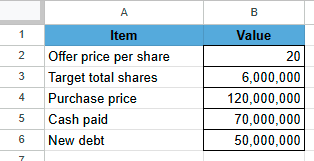
1.1 Deal Setup
This table becomes the heart of the M&A Modelling 2026 file.
Step 2. Forecast the Buyer Standalone
Before the companies combine, you need to know how the buyer performs alone. These are your finance projections.
This is normal valuation modelling work. You take the buyer’s revenue, costs and profit for the next 3 to 5 years.
Keep it simple. No need to turn into an economist.
Example:

1.2 Buyer Forecast
Net income builds from there.
This future view is important because investment banking teams compare the before and after impact once the deal closes.
Step 3. Forecast the Target Standalone
Now you shift to the company getting bought. Same easy flow. A few basic projections, no drama. These numbers help you understand the target’s strength on its own, which makes the combination later feel like putting two puzzle pieces together that actually fit.
Example:

1.3 Target Forecast
This forecast flows into the later combined model in the M&A Modelling 2026 process.
Step 4. Build Sources and Uses
This part explains the money movement. Straightforward stuff. Where the money comes from and where it goes. When this section is clean, the rest of the model feels stable. When it’s messy, everything gets confusing fast. So this sheet keeps the whole deal grounded.
Uses
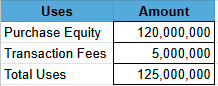
1.4 Uses of Funds
Sources
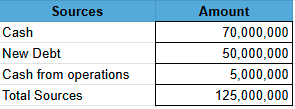
1.5 Sources of Funds
Sources match uses. This always stays equal. Otherwise, your sheet is broken.
Step 5. Purchase Price Allocation
PPA sounds complicated, but it’s really just breaking the purchase price into simple parts. You’re basically saying here’s what we bought, here’s what it’s worth, and here’s the extra amount we paid because the company has something valuable you can’t touch, like brand or customers. Once you see it laid out, it feels surprisingly normal.
Example:
1.6 Purchase Price Allocation PPA Schedule
This goodwill becomes a big line in the combined balance sheet once you finish the M&A Modelling 2026 build.
Step 6. Synergies and Integration
Companies buy other companies for synergies. This mostly means cost savings. Sometimes also revenue boosts but those are harder to prove.
In M&A Modelling 2026 you add synergy numbers in a separate block and then feed them into the combined income statement.
Example
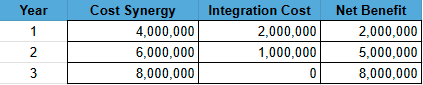
1.7 Synergies and Integration Costs
Your synergy benefit minus integration cost shows the real gain from the deal.
Step 7. Build the Pro Forma Financial Statements
Now the fun part. This is where buyer forecast + target forecast + PPA adjustments + synergy savings all merge into one combined view. This is the actual combined future company.
This is the core of a merger model Excel dashboard. This is where M&A Modelling 2026 gets judged by investment banking teams. (Pro Forma Financial Statements)
Example:

1.8 Pro Forma combined revenue
1.9 Pro Forma combined EBIT
This combined statement shows if the company becomes stronger or weaker.
Step 8. Accretion or Dilution (The Final Step)
Here’s the final check everyone waits for. This number tells you straight up whether the deal works or not. If EPS goes up, the deal is doing its job. If it falls, there’s something off in the logic. It’s honest, simple, and basically the deal’s report card.
Example:
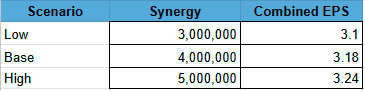
2.0 EPS Impact Calculation
This is accretive and usually considered a win.
If it goes down, then your M&A Modelling 2026 tells management to rethink the deal or renegotiate the price.
Bonus Check: Sensitivity and Scenario Analysis (Optional but Smart)
This is not a step. It is just an extra layer to help beginners understand how the deal behaves under different synergy scenarios. Deals are unpredictable. So you check what happens if things go slightly wrong or slightly better.
- You test interest rates
- You test synergy levels
- You test the purchase price
- You test revenue growth assumptions
Example:
2.1 Synergy Sensitivity Analysis on EPS
This makes your merger model Excel file look professional and ready for decision-making.
Once you reach the EPS result, the model is basically done. You’ve built everything you need. After this point, you’re not calculating anymore, you’re just understanding what the numbers mean. If the combined EPS goes up, the deal looks strong. If it drops, the deal needs to be rechecked. That’s the whole point of M&A Modelling 2026. It shows you, in simple numbers, whether the deal helps the buyer or creates more trouble than it’s worth.
Why this Matters for 2026 Skills
Companies are buying companies more aggressively because tech, AI, supply chain and global expansion move fast. Anyone working in investment banking or valuation modelling needs to understand M&A Modelling 2026 because this is where the real strategic decisions happen.
It is not about building fancy spreadsheets. It is about knowing how money moves and what makes a business stronger.
If you can build a clean and easy-to-understand merger model Excel file, you automatically stand out.
Common Mistakes to Avoid
- Overestimating synergies
- Ignoring integration costs
- Not checking if financing changes interest expenses properly
- Forgetting deferred tax in PPA
- Not reconciling goodwill correctly
- Leaving unbalanced balance sheets
- Hard-coding too much instead of linking formulas
Avoid these and your M&A Modelling 2026 skills will look top tier.
The Verdict
M&A Modelling 2026 is not about being a maths genius. It is about being organised. Think of it like building a Lego set. You add each block slowly. Forecasts, PPA, Synergies, Pro forma statements, EPS impact. When you put it all together, the picture makes sense.
If you’ve reached this point and feel that spark of oh I can actually learn this, then follow it. You’re already closer than you think. The WallStreet School’s Financial Modelling and Valuations course can take you from understanding the basics to building models with real confidence. It’s practical, structured, and designed to actually move your career forward.
Give yourself that upgrade. This might be the step that actually moves your career forward.
People Also Asked
1. How to build an M&A model?
Ans. You predict how both companies will perform, merge the numbers, factor in savings or costs, and see if the deal boosts earnings.
2. What are the steps in an M&A deal?
Ans. You spot a company to buy, figure out what it’s worth, decide how to pay, check the finances, set the terms, and choose to go ahead or drop it.
3. What is the financial model of M&A?
Ans. It’s a simple spreadsheet that shows what the two companies look like together and whether joining them actually makes more money.
4. Can ChatGPT build financial models?
Ans. It can help you plan the structure and formulas, but you still fill in the numbers and build the actual Excel file on your system.