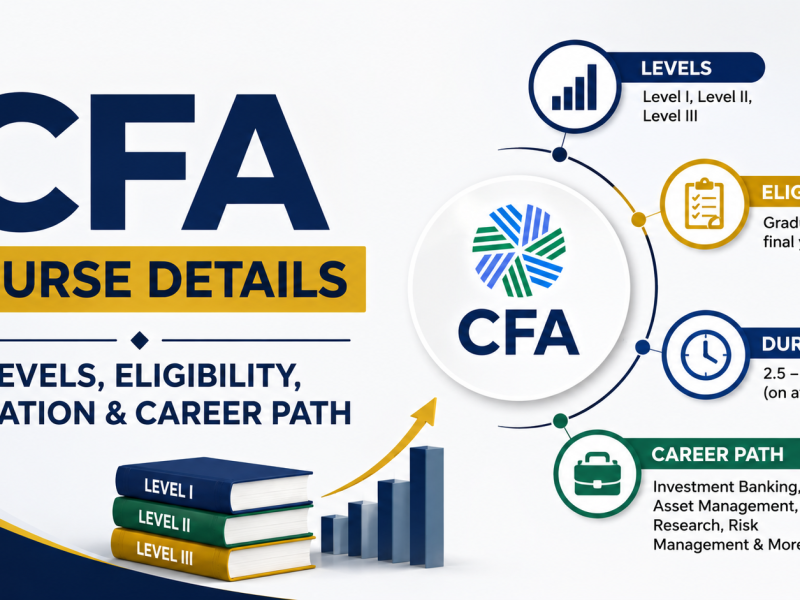
The Chartered Financial Analyst (CFA) program is a standard of excellence in the financial sector through which practitioners gain professional. It indicates advanced skills, professional ethics, and passion for achievement.
This guide covers the details of the Chartered Financial Analyst course, including eligibility and course curriculum. If you’re interested in pursuing the CFA certification, read on.
Understanding the CFA course
The Chartered Financial Analyst course imparts professionals with knowledge and understanding of investment management and financial analysis. It covers topics such as ethics, statistics, economics, financial reporting and analysis, corporate finance, stock and bond investments, fixed income, swaps, alternative investments, and portfolio management.
Benefits of the CFA course
The benefits of the Chartered Financial Analyst course are extensive.
-
Worldwide recognition
The CFA Institute’s approval makes it acceptable to firms, governments, and investors worldwide. This global recognition ensures that all CFA charter holders know the same topics and follow the same high professional standards.
A globally approved certificate is invaluable in an increasingly interconnected world where financial markets span borders. Employers generally prefer CFA charter holders for asset management, investment banking, research, and risk management positions because it displays their qualifications and dedication to excellence.
-
Career advancement
A Chartered Financial Analyst course boosts your career prospects and provides additional opportunities to develop and improve. CFA charter holders can pursue diverse job roles, rise in their current organisation or switch to new sectors.
Since the CFA program is rigorous, employers can determine whether applicants have the knowledge, abilities, and dedication to succeed in demanding professions. CFA charter holders earn more and are sought after for leadership positions that require investment management and financial analysis skills.
-
Networking opportunities
CFA candidates and charter holders have access to a broad network of finance professionals through the CFA Institute and its member organizations worldwide. This network allows them to exchange knowledge and collaborate with classmates, lecturers, and industry professionals.
Through CFA networking, candidates can locate jobs, build professional contacts, and stay current on industry trends and best practices. Attending local chapter events, joining online forums, or participating in professional development programs with other charter holders are all valuable tools for career advancement in the CFA network.
The CFA curriculum
The CFA program has a three-part exam to evaluate basic knowledge of investment tools, wealth planning, asset valuation, and portfolio management. The following table summarises each topic’s weight for each level in the exam.
| Curriculum topics | LEVEL I
(Weightage in %) |
LEVEL II
(Weightage in %) |
LEVEL III
(Weightage in %) |
| Ethical and professional standards | 15-20 | 20-15 | 10-15 |
| Quantitative methods | 6-9 | 5-10 | 0 |
| Economics | 6-9 | 5-10 | 5-10 |
| Financial statement analysis | 11-14 | 10-15 | 0 |
| Corporate issuers | 6-9 | 5-10 | 0 |
| Equity investments | 11-14 | 10-15 | 10-15 |
| Fixed income | 11-14 | 10-15 | 15-20 |
| Derivatives | 5-8 | 5-10 | 5-10 |
| Alternative investments | 7-10 | 5-10 | 5-10 |
| Portfolio management and wealth planning | 8-10 | 10-15 | 35-40 |
How to become a CFA?
-
Meet the eligibility criteria
Chartered Financial Analyst course candidates must satisfy certain conditions before joining the program. A bachelor’s degree from a reputable college or university and four years of investing or related experience are usually required. Working before, during, or after CFA meets the training requirement.
-
Register to take the exam
After meeting the requirements, candidates can take the CFA exam. Each of the three CFA training levels must be completed. Candidates should register early to secure a CFA Institute study kit and test slot. Test registration begins months before the exam.
-
Prepare for the exam
Each CFA level requires intensive study and preparation. Candidates can learn using the CFA Institute’s study materials, practice questions, and mock examinations. Many also attend online CFA courses or join study groups to understand challenging concepts better and prepare for the exam.
-
Take the exam
There are two sessions (morning and afternoon) for each exam level. Each session has multiple-choice questions.
Level I is offered in June and December, and the exam duration is 2 hours and 15 minutes. Level II and III are only given in June, and the exam duration is 4 hours and 24 minutes, divided into two parts of 2 hours and 12 minutes. Candidates must secure a passing score to advance in the program. Dedicated study and preparation can help candidates pass and acquire the CFA charter.
-
Gain job experience
Candidates aspiring for the CFA charter must pass all three CFA test levels and have four years of qualifying work experience.
Work experience is considered for full-time employment in a position that includes investing, researching investments, or contributing to the investment process. Work experience may be gained before, during, or after the CFA program. There is no deadline for this condition.
Wrapping up
The Chartered Financial Analyst course is significant in finance since it includes a challenging curriculum, focuses on ethics, and is recognised worldwide. Completing the program and acquiring the CFA license can boost work prospects in the finance industry.
FAQs
- What’s required to join CFA?
A bachelor’s degree and four years of related work experience are required for CFA admission.
- How often are CFA exams?
Level I is offered twice a year: in June and December. In June, only Levels II and III are offered.
- What are the most important reasons for getting the CFA charter?
Obtaining the CFA charter offers numerous benefits, including enhanced knowledge and skills, global recognition and prestige, career advancement opportunities, professional networking, and flexibility in career paths.