CFA vs FRM vs CFP: Which Finance Course Should You Choose?
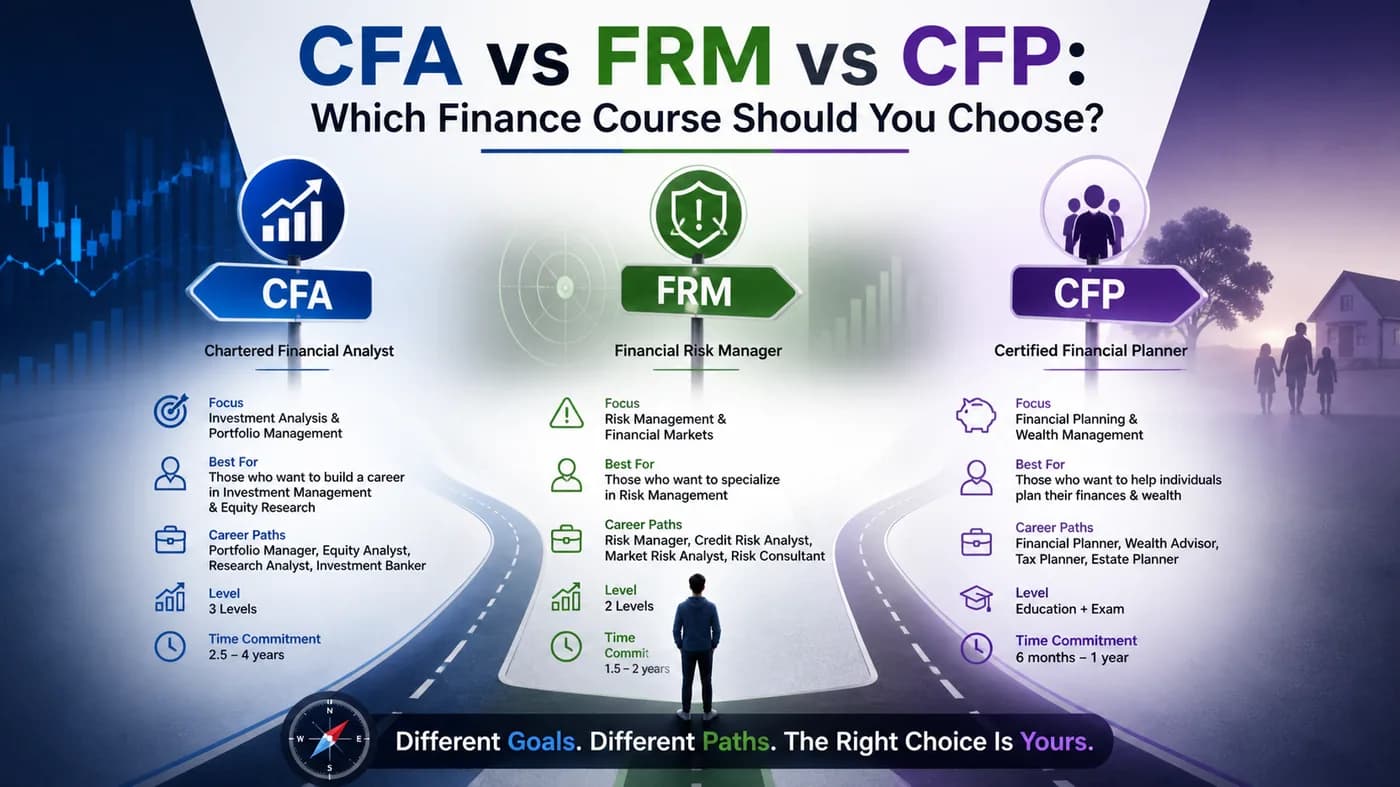
If you are currently debating “CFA vs FRM vs CFP: Which Finance Course Should You Choose?”, the answer depends entirely on your specific career trajectory.
If you are currently debating “CFA vs FRM vs CFP: Which Finance Course Should You Choose?”, the answer depends entirely on your specific career trajectory. To keep it simple- choose the CFA charter if your goal is to master investment management and portfolio analysis at an institutional level. Opt for the FRM course if you want to specialize in high-stakes risk management and financial modeling or pursue the CFP certification if you are driven by financial planning, tax strategy, and building long-term wealth for individuals and families.
Every ambitious finance professional eventually reaches this crossroads. You are staring at three distinct, prestigious, and highly demanding professional designations. But choosing the best finance certification is not just about picking the one with the highest starting salary or the easiest study schedule- because let’s be honest, none of them are “easy.” It is about understanding what you want your Tuesday morning to look like five years from now.
Let’s break down this massive finance course comparison and help you decide which path will actually lead to the career (and the paycheck) of your dreams.
The CFA Course: The Investment Titan
The Chartered Financial Analyst (CFA) designation is often described as the “gold standard” of the investment world. If you find yourself geeking out over market trends, valuations, and the mechanics of how billions of dollars move across global exchanges, this is your home.
The CFA course is not for the faint of heart. It is a grueling, three-level marathon that tests your knowledge of ethics, quantitative methods, economics, financial reporting, and portfolio management. For many, having a structured support system and experienced mentorship- like the dedicated programs at The WallStreet School in Delhi- makes the critical difference between burning out and crossing the finish line. It is arguably the most recognized certification for those aiming for the “buy side” of the industry.
- Why it’s the heavyweight champion of investment roles: The CFA charter forces you to develop a deep, structural understanding of financial markets that very few other certifications can match. You will learn to peel back the layers of complex financial statements, navigate the nuances of global capital markets, and build portfolios that stand the test of time, which makes you incredibly valuable to asset management firms and hedge funds.
- The daily reality of a CFA charterholder: You are the one making the call. Whether you are an equity research analyst building a valuation model or a portfolio manager deciding how to allocate funds across different sectors, your day is defined by data and the high-stakes pressure to beat the market benchmark. It is a world of constant learning where your output directly impacts the bottom line of massive portfolios.
The FRM Course: The Risk Ninja
If the CFA charterholder is the one taking the shot, the Financial Risk Manager (FRM) is the one calculating the probability of the goalpost moving mid-flight. Offered by the Global Association of Risk Professionals (GARP), the FRM course is the premier credential for those who want to be the guardians of financial institutions.
In a world defined by volatility, geopolitical shifts, and black-swan events, the FRM is your ticket to the heart of institutional stability. It is less about “picking winners” and more about “not losing the house.”
Because the curriculum is highly technical and math-intensive, many candidates opt for the hands-on, practical guidance offered at leading institutes such as The WallStreet School– ensuring that they don’t just memorize the formulas, but actually learn how to apply them to real-world risk scenarios.
- Why it’s the elite choice for quantitative-minded professionals: The FRM curriculum dives deep into market, credit, liquidity, and operational risks, forcing you to master the statistical and mathematical models that hold modern finance together. You are not just looking at a spreadsheet, instead you are looking at the potential for disaster and figuring out how to build a firewall around it using advanced derivatives and stress-testing methodologies.
- The high-stakes world of risk management: As an FRM, your role is to be the voice of caution in the room. You work with derivatives, stress testing, and value-at-risk (VaR) models, ensuring that even when the market goes haywire, your institution stays standing. It is a career for those who enjoy the chess match of modern finance and the technical challenge of modeling uncertainty in a fast-paced environment.
The CFP Certification: The Wealth Architect
The Certified Financial Planner (CFP) designation is the premier credential for those who prefer people over spreadsheets- or rather, those who prefer using financial tools to improve people’s lives. If the CFA is about managing money at the institutional level, the CFP certification is about managing life goals at the individual level.
This path is for the “relationship builder.” It is the gold standard for professionals who want to work in financial planning, estate planning, tax strategy, and retirement management. Since it blends hard technical knowledge with vital soft skills, finding the right training ground is key- premiere educators at The WallStreet School in Delhi, prioritizes this balance, teaching students how to move beyond the textbook and into the actual practice of wealth management.
- Why it’s the human side of the finance industry: The CFP curriculum is unique because it forces you to blend hard technical knowledge of tax codes and insurance products with the soft skills required to coach clients through their financial life stages. You are not just selling a product- you are becoming the trusted partner who helps a family buy their first home, fund a college education, or retire with dignity, often navigating delicate emotional landscapes along the way.
- The rewarding path of personal financial advisory: Your success is measured by the tangible impact you have on your clients’ futures. You are the navigator of their financial life, managing everything from their investment portfolio to their insurance policies, making it a highly rewarding, client-centric role that requires both sharp intelligence and a high emotional quotient to handle the varied personalities of diverse client bases.
The “Stacking” Strategy: Why Choose Just One?
In 2026, the “CFA vs FRM vs CFP” debate is starting to look less like a single-choice question and more like a strategy game. We are seeing a massive surge in “Stackable Certifications”—professionals who don’t choose between these three, but rather combine them to build a “Super-Finance” profile.
- The CFA + FRM Powerhouse: If you pair the CFA with the FRM, you become the ultimate “Risk-Adjusted Investor.” You can pick the stocks (CFA skill) and simultaneously build a defensive layer that protects the firm from market volatility (FRM skill). This combination is highly coveted by top-tier investment banks and hedge funds that want employees who understand both aggressive growth and defensive risk control.
- The CFA + CFP Synergy: This is the “Private Banking Dream Team.” By holding both the CFA charter and the CFP certification, you provide institutional-grade investment research (CFA) while offering personalized, high-touch wealth management (CFP). This allows you to serve Ultra High Net Worth (UHNW) clients who need deep investment sophistication combined with complex estate and tax planning.
- The Risk-Aware Planner (FRM + CFP): While rarer, this combo is gaining traction in the world of family offices. You can advise clients on their personal wealth goals (CFP) while using your deep technical knowledge (FRM) to hedge their entire family portfolio against macro-economic downturns and systemic risk, effectively acting as their personal chief risk officer.
Head-to-Head: Choosing the Right Path
Choosing the best finance certification for your career requires an honest look at your own professional DNA. Are you a “numbers and strategy” person, or a “people and planning” person?
If you are drawn to the CFA:
You thrive on competition, deep research, and the fast-paced nature of capital markets. You aren’t afraid of a multi-year, three-level slog because you know the payoff is a career that can take you to the top of the investment hierarchy, including roles like Chief Investment Officer or Senior Portfolio Manager at global firms.
If you are drawn to the FRM:
You enjoy the technical, quantitative side of the industry and want to specialize in a role where your analytical skills are the primary defense for a firm. You are happy working in the background of banks or trading firms, knowing that you are the expert who keeps the organization safe from catastrophic financial loss when everyone else is panicking.
If you are drawn to the CFP:
You find fulfillment in long-term relationships and want to be the person others turn to when they feel lost about their financial future. You want a career that offers more independence, the ability to build your own practice, and the satisfaction of seeing your advice directly improve a family’s quality of life.
The Reality of Career Mobility and Pay
Let’s talk about the elephant in the room- compensation. While we love the “passion” argument, these certifications are investments of time and money that need to pay off.
- The Investment Banking and Asset Management Route: The CFA designation is the gatekeeper here. It is widely recognized by employers in major financial hubs like New York, London, and Mumbai, making it the most versatile credential if you want to work for top-tier investment banks. It effectively acts as a global passport that signals you have the technical rigor to handle complex, institutional-level finance.
- The Specialized Risk and Compliance Route: The FRM is a laser-focused specialization. Because it is highly specific, your job opportunities are concentrated in risk management departments, regulatory bodies, and treasury functions. While you might not have the broad “generalist” appeal of a CFA, you are effectively “un-fireable” during market downturns because companies need risk experts most when things go wrong.
- The Wealth Management and Advisory Route: The CFP is a gateway to entrepreneurship. Many CFPs end up starting their own advisory firms, which allows for potentially uncapped income based on the assets they manage and the clients they acquire. While a CFA charterholder might be climbing the corporate ladder in a multinational firm, a CFP is often building their own brand, creating a different kind of financial freedom.
The Verdict: Which Finance Course Should You Choose?
So, back to the big question- CFA vs FRM vs CFP? If you are still feeling indecisive, try this thought experiment:
Imagine it is 2030. You are waking up on a Tuesday morning, prepping for a busy day at the office. Which of these three scenarios makes you actually want to get out of bed?
- You are analyzing quarterly earnings, tweaking your sector allocations, and discussing the macroeconomic impact of a new trade policy with a team of investment professionals. (CFA course)
- You are running stress-test simulations on a bank’s trading book, analyzing liquidity ratios, and presenting a report on potential credit risks to the Board of Directors. (FRM course)
- You are sitting down with a client couple, reviewing their retirement savings plan, explaining the tax benefits of their trust, and helping them map out the next decade of their financial life. (CFP certification)
At the end of the day, there is no “best” finance certification in a vacuum. The only “best” one is the one that aligns with your natural strengths and the lifestyle you want to lead. Don’t worry about which one is “harder” or which one “pays better” in the short term. Worry about which one you won’t get bored of in ten years.
Finance is a marathon, not a sprint- pick the race you actually want to run, and maybe, just maybe, start stacking credentials until you are the most dangerous person in the boardroom.
FAQs
1. What is the difference between CFA, FRM, and CFP?
The CFA is focused on investment management and portfolio analysis. The FRM specializes in identifying and mitigating financial risks within institutions. The CFP is geared toward personal financial planning, tax strategy, and helping families manage their long-term wealth.
2. Which certification is the hardest to clear?
The CFA is widely considered the most difficult due to its massive, three-level scope. The FRM is intensely quantitative and math-focused, while the CFP is more application-oriented, making it challenging in a different, practical way.
3. Which certification offers the highest salary potential?
CFA and FRM roles generally offer high, stable corporate salaries in investment banking or risk management. CFP income potential is highly variable, often scaling directly with your ability to grow a personal client practice through commissions and fees.
4. Can I pursue these certifications simultaneously?
It is generally not recommended to study for these simultaneously due to their intense individual workloads. The best strategy is to focus on completing one designation that matches your immediate career goal before pursuing a complementary certification later.
5. Do I need a specific background to enroll?
The CFA requires a bachelor’s degree, while the FRM has no strict enrollment barriers but mandates work experience for final certification. CFP requirements vary by region but typically involve completing specific coursework and professional experience in financial planning.
Interested in Learning Finance Professionally?
Our courses take you from fundamentals to expert level — with live mentors and placement support.
Explore Our Courses