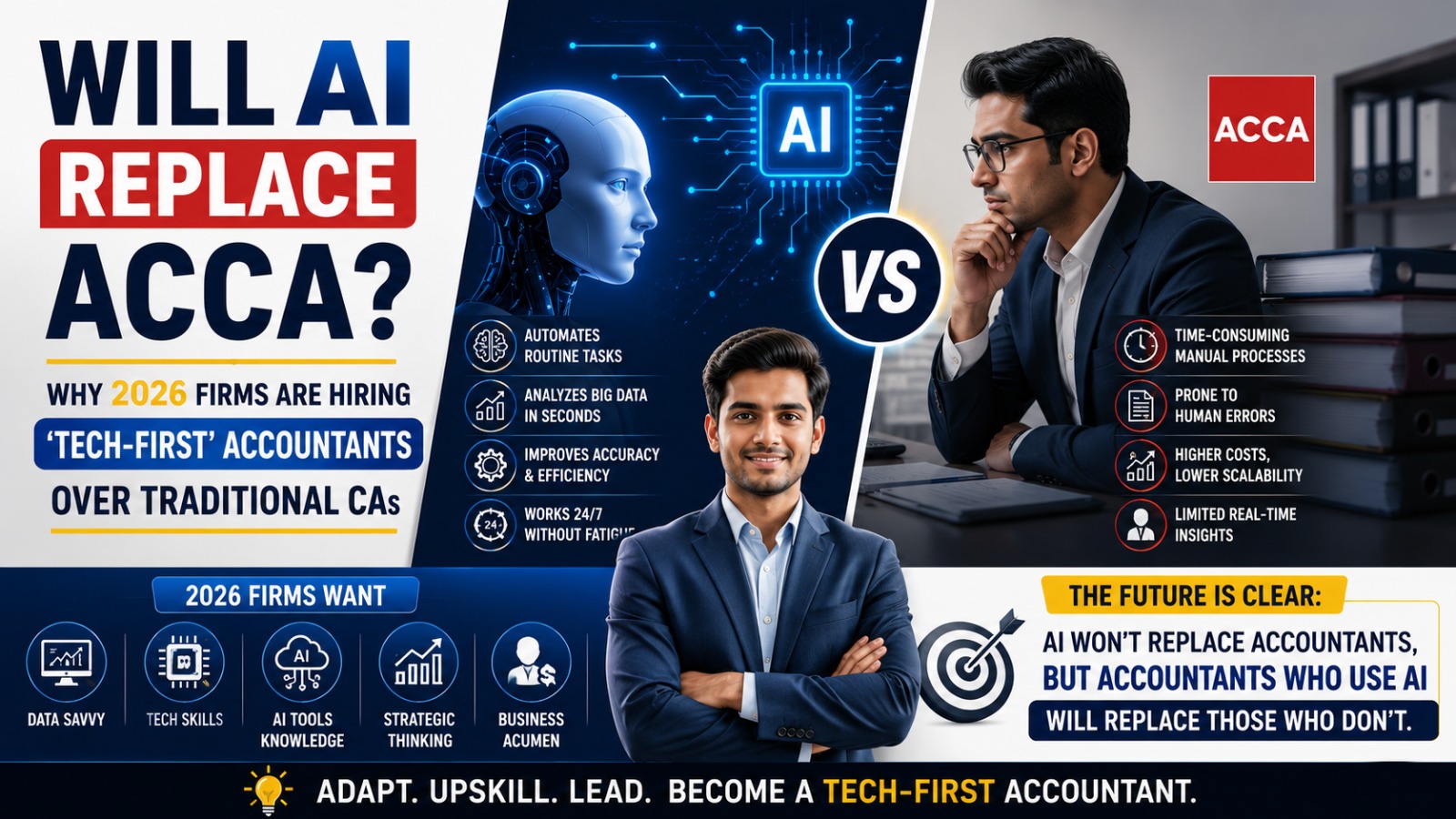
AI will not replace ACCA professionals but 2026 firms are absolutely hiring tech-first accountants over traditional CAs and the gap is growing fast.
AI is automating repetitive accounting tasks at a pace no one fully anticipated, which has made many finance professionals nervous. But the ones getting hired right now are not running from it. They are the ones who know how to use it.
ACCA has positioned itself right at the center of this shift by updating its curriculum with AI literacy, data analytics and strategic skills, making its members exactly what firms in 2026 are looking for.
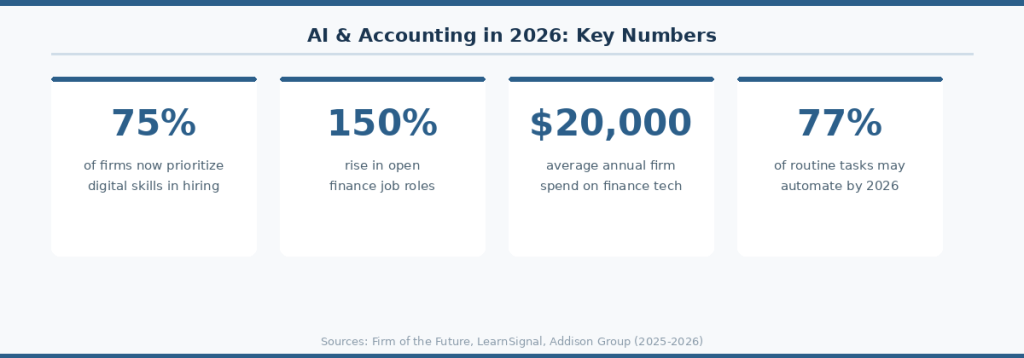
Figure 1: AI is reshaping accounting faster than most expected. These numbers show exactly where the industry is heading in 2026. Sources: Firm of the Future (Accountant Tech Survey 2025), Addison Group (Finance & Accounting Hiring Trends 2026), LearnSignal (Future Skills for Accountants 2026)
What AI Actually Does in Accounting?
Before we get into who is getting hired and who is not, it helps to understand what AI actually does in a finance function.
AI is very good at pattern recognition and repetitive processing. It can scan thousands of transactions, flag anomalies, generate reports and even predict cash flow gaps. These are tasks that used to require junior-level accountants working long hours. Now, a well-configured AI tool handles them in seconds.
But here is where ACCA vs automation gets interesting. AI does not know why a board of directors made a certain capital allocation decision. It cannot advise a multinational on whether to restructure its debt ahead of an acquisition. It cannot look at a client’s personal financial situation and recommend a tax strategy that also protects their family’s future. That requires human judgment, ethical reasoning and professional experience. ACCA qualifications build exactly these kinds of skills.
So will AI replace ACCA? No, not the thinking parts or the strategic parts but yes, the repetitive parts.
Why Firms in 2026 Want Tech-First Accountants?
The hiring landscape in 2026 has shifted in a pretty clear direction. Companies, especially multinationals, global capability centers and Big Four firms, are not just looking for people who understand balance sheets. They want tech-first accountants who can work alongside AI tools, interpret the outputs and turn data into decisions.
A recent industry survey found that around 75% of firms now prioritize digital skills when hiring for finance roles. Open finance positions have grown by 150% but these are not traditional roles. They are hybrid roles that require both accounting knowledge and comfort with tools like SQL, data analytics platforms and AI-assisted reporting software.
Firms are also spending more. The average company is now investing about $20,000 per year on finance technology. They want people who can actually use that investment, not just sit next to it.
This is where ACCA has a real advantage. The ACCA curriculum has already been updated to include modules on AI literacy, data analytics, ESG reporting and digital transformation. While some other qualifications are still catching up, ACCA members are being trained to step into AI accounting jobs 2026 and beyond not to compete with AI but to direct it.
How ACCA’s 2027 Syllabus Changes Align With What Firms Need?
ACCA is not just talking about staying relevant in the AI era. It is actually rebuilding its syllabus around it. The 2027 updates are some of the biggest changes in recent years and they match almost exactly what firms are looking for when hiring right now.
Here is what is changing and why it matters:
- Strategic Business Leader now focuses more on data-driven decision-making. Candidates are expected to read analytics outputs and advise on technology-led business change not just traditional financial strategy.
- Performance Management has been updated to include AI-assisted forecasting and automation in management accounting. Manual variance analysis alone is no longer enough.
- Digital and ESG Reporting has been strengthened across the Applied Skills level, reflecting what multinational employers expect from finance professionals handling global reporting today.
- Ethics and Professional Skills now has a dedicated section on responsible AI use in finance, directly addressing the growing need for governance and accountability in automated environments.
What this means in simple terms is that an ACCA student completing their qualification under the 2027 syllabus will already know the tools, frameworks and thinking patterns that employers are currently struggling to find in candidates. The qualification is not playing catch-up with the market. It is being designed to arrive there ahead of it.
ACCA vs CA: Who Is Getting Hired in the Tech Era?
This is probably the most searched comparison in Indian finance circles right now. Both ACCA and CA are respected qualifications but they serve different markets in 2026.
| Aspect | ACCA | CA (ICAI) |
| Best Suited For | MNCs, GCCs, Big Four advisory | India-specific statutory and tax work |
| Reporting Standards | IFRS (global) | Indian GAAP and local compliance |
| Tech Integration | AI, analytics modules built into the curriculum | AI training programs recently launched |
| Geographic Demand | Delhi, Mumbai, Bengaluru metros, international | Steady domestic demand across India |
| Hiring Edge | Finance transformation, FP&A, data-driven roles | Local audit, direct tax, SME compliance |
CAs remain the go-to for India-specific tax and statutory work and that demand is not fading. But for MNCs, GCCs and Big Four advisory roles, ACCA professionals are increasingly preferred, thanks to IFRS knowledge, global portability and a curriculum already built around AI and analytics.
The Real Risk: Ignoring Technology
Will AI replace ACCA professionals who actively embrace it? Almost certainly not. But ACCA vs automation is a different story for those who ignore it.
Leaders at ACCA India have been direct about this. The professionals at risk are not ACCA holders as a group. They are the individuals, regardless of qualification, who refuse to learn new tools and continue doing their work the same way they did ten years ago. If you are still manually compiling spreadsheets and resisting any technology your firm adopts, you are not being protected by your credentials. You are being left behind by your habits.
The future of ACCA in the AI era belongs to members who can do what AI cannot: think critically, communicate complex insights to non-finance stakeholders, manage client relationships and make judgment calls in situations that have no clear right answer.
You already know AI is not the threat. Staying unprepared is. The WallStreet School’s ACCA program gives you everything firms are actually hiring for right now.
What You Should Be Learning Right Now?
If you are an ACCA student or a qualified member wondering how to stay ahead in the AI accounting jobs 2026 market, here is what actually matters.
SQL and data querying skills are increasingly expected in finance roles, especially in GCCs and tech-forward firms. You do not need to be a developer but knowing how to pull and manipulate data yourself is a genuine advantage.
Familiarity with AI-assisted accounting tools like those used for automated close processes, anomaly detection and predictive forecasting will set you apart in interviews. Many of these tools have free tiers or trial versions you can practice with.
Understanding ESG reporting is also rising fast as a required skill, especially for companies with international investors or listed subsidiaries.
And perhaps most importantly, sharpen your advisory and communication skills. In a world where AI handles the number crunching, the person who can walk into a boardroom and explain what the numbers mean and what to do about them, will always have a seat at the table.
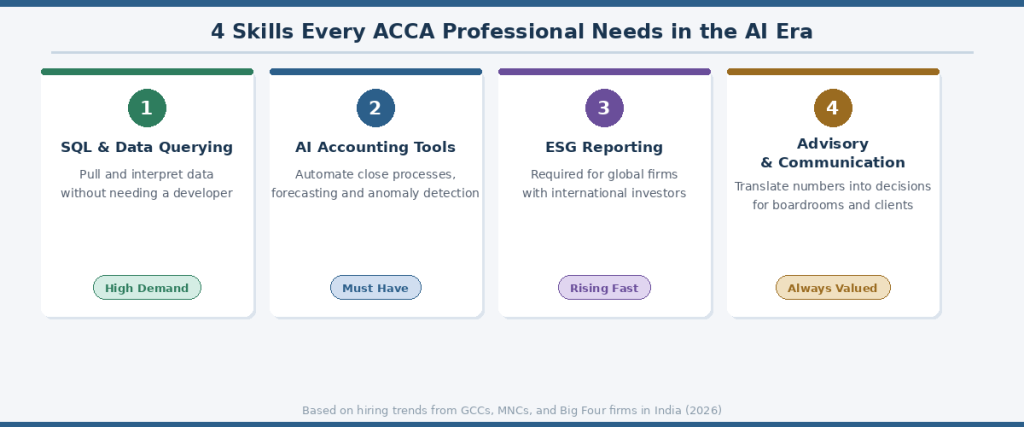
Figure 2: These are the four skills that firms are actively screening for when hiring ACCA professionals in 2026. Source: Based on hiring trends from GCCs, MNCs and Big Four firms in India (2026)
People Also Ask about will AI replace ACCA
Q1. Will AI replace ACCA professionals completely?
No. AI handles repetitive tasks but ACCA professionals bring strategic thinking, ethical judgment and advisory skills that no AI can replicate.
Q2. Is ACCA still worth it in 2026?
Absolutely. Demand is rising fast, especially in MNCs and GCCs. Firms want ACCA professionals who combine global finance knowledge with tech skills.
Q3. What skills do ACCA professionals need in the AI era?
Focus on SQL, data analytics and AI tools alongside your core ACCA knowledge. That combination is exactly what firms are hiring for right now.
Q4. Who has more job opportunities in 2026, ACCA or CA?
Depends on what you want. CA wins for India-specific roles. ACCA wins for global firms, MNCs and tech-forward finance positions.
The Bottom Line
Will AI replace ACCA? No. But it will absolutely replace the parts of the job that do not require a human. That is actually a good thing for qualified professionals who are willing to adapt.
The future of ACCA in the AI era looks strong, especially for those who position themselves as tech-first accountants with global knowledge, advisory mindset and digital fluency. The demand for AI accounting jobs 2026 is real and growing. Firms are not cutting finance headcount, they are redirecting it toward higher-value work.
ACCA vs automation is not a fight you need to win. It is a partnership you need to learn how to manage. The professionals who understand that will not just survive the AI shift in accounting. They will lead it.