Why Financial Modeling Is Becoming a Must-Have Skill in 2026
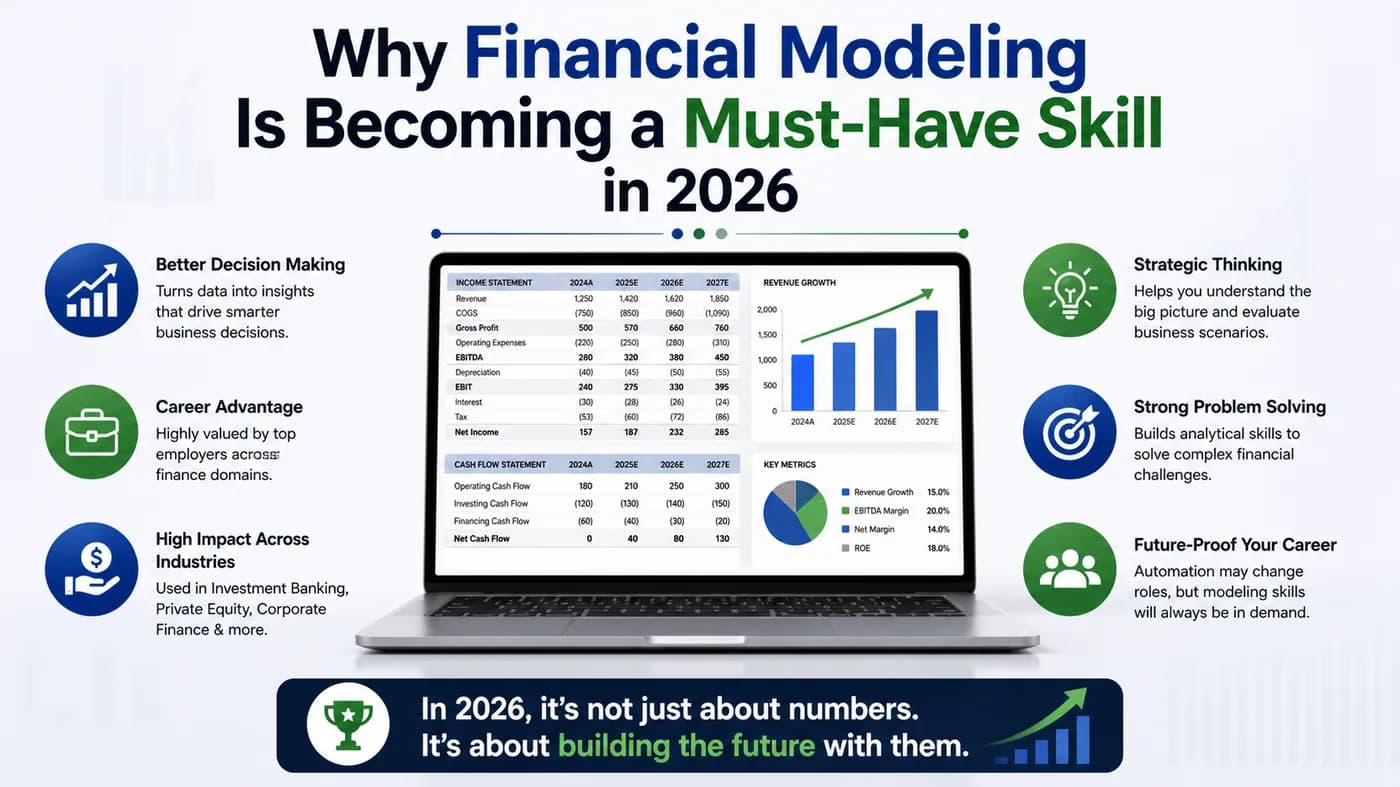
In the high-stakes poker game of modern business, relying on a “gut feeling” is a losing hand- the real winners are the ones who can
In the high-stakes poker game of modern business, relying on a “gut feeling” is a losing hand- the real winners are the ones who can map out every possible outcome before the cards are even dealt. Financial modeling is a must-have skill in 2026 because it acts as a strategic crystal ball, transforming raw, volatile data into a precise, high-stakes roadmap for profit, risk management, and long-term business survival.
While the core functionality of financial models– forecasting, valuation, and capital allocation, has remained consistent, the ecosystem surrounding it has shifted dramatically. Today’s business environment demands a higher level of precision and speed, turning standard spreadsheets into dynamic, predictive engines. Let’s explore why this specific set of finance skills 2026 is no longer optional for anyone looking to scale their career.
1. The Death of “Gut Instinct” Decision Making
We have officially entered the era of hyper-precision. In 2026, saying “I think this will work” simply does not cut it when you are pitching to a CEO or a board of directors. Organizations now demand numerical blueprints that stress-test every possible reality before a single dollar is spent, moving decisively away from subjective projections.
A robust financial model acts as a virtual laboratory where you can simulate economic downturns, supply chain disruptions, or sudden market booms. By mastering financial modeling skills, you are not just presenting numbers– you are providing a navigation system for a business. It allows stakeholders to see the future impact of today’s decisions, significantly lowering the risk of expensive errors and providing clarity in an otherwise chaotic marketplace.
2. The Great Integration: AI and Big Data
The most significant trend this year is the marriage of traditional valuation modeling and advanced technology. The 2026 finance professional isn’t just a spreadsheet wizard– they are a data architect who knows how to pair machine learning with core financial logic to drive better outcomes.
- Validating AI Outputs: AI tools are incredibly efficient at data entry and pattern recognition, but they lack the human-in-the-loop judgment required to navigate complex business nuances. You need to be the one who spots when an automated forecast is hallucinating or missing the real-world context that a machine simply cannot grasp on its own, ensuring the strategy remains grounded in reality.
- Building Hybrid Systems: The best financial models today integrate Python scripts or interactive Power BI dashboards with standard Excel sheets to create a more dynamic experience. This allows you to handle massive, unstructured datasets that would normally crash a traditional spreadsheet, giving you the power to model entire industry ecosystems rather than just one firm at a time.
3. The Salary Premium for Day-One Readiness
In the current job market, the salary gap between a “basic accountant” and a “financial modeler” has widened significantly in 2026. This premium exists because a certified modeler is “day-one ready”, as they don’t need to be taught the basics of business logic or spreadsheet architecture.
When you take a high-quality financial modeling course, you are essentially buying a shortcut to experience. Employers are willing to pay a significant premium for professionals who can walk into a meeting, open a blank file, and build a three-statement integrated model that captures the business’s actual operational flow without needing their hand held for the first several months.
4. More Than Just Math: It’s Storytelling
One of the most misunderstood aspects of valuation modeling is the belief that it’s all about the math. In reality, a model is a story told in numbers, and your ability to translate “Projected Revenue” into a compelling narrative for stakeholders is what makes you indispensable in a corporate environment.
- Simplifying the Complex: A great model is naturally transparent and modular, allowing others to follow your logic easily. Anyone, from the CFO to a non-finance manager, should be able to look at your assumptions and understand the specific “why” behind the results, rather than feeling overwhelmed by a “black box” calculation that hides the truth.
Visualizing the Win: In 2026, your Excel finance skills must include advanced dashboarding and sophisticated data storytelling to be effective. Executives simply do not want to dig through 5,000 rows of raw data– they want a clean, interactive chart that tells them exactly when the project will break even and what the most critical risks are to their bottom line.
5. Versatility Across Every Industry
Gone are the days when modeling was strictly reserved for Investment Bankers on Wall Street. In 2026, finance skills 2026 are being applied in sectors that traditionally avoided complex modeling, as every business is becoming a data-driven business.
- Startups: Founders need complex, robust models to prove their path to profitability to venture capitalists who are increasingly wary of “growth at all costs.” Your ability to build a model that shows exactly how they get from a heavy “burn rate” to actual profit is the definitive key to closing their funding rounds in a skeptical market.
- Corporate FP&A: In-house teams now use rolling, continuous forecasts to adjust budgets in real-time, moving away from static planning. This shifts the organization away from the “once-a-year” budget cycle that failed so many companies when economic volatility peaked, making the FP&A professional a highly valued strategic partner in long-term corporate growth.
6. How to Build Your Toolkit
If you feel like you are starting from zero, the barrier to entry has fortunately lowered thanks to structured, accessible learning paths. Here is how you can systematically build your financial analyst skills from the ground up:
- Master the Toolset: Start by moving beyond the absolute basics of Excel to unlock the full potential of the software. Focus on learning advanced functions like INDEX-MATCH, XLOOKUP, Pivot Tables, and Macros, which are the bricks and mortar of your financial fortress and will save you hundreds of hours in the long run while reducing manual errors.
- Understand the Interconnectivity: Learn how the Income Statement, Balance Sheet, and Cash Flow Statement interact on a granular level to show your true expertise. If you change a number on one, you should be able to predict exactly how it ripples through the other two, showing stakeholders you possess deep, systemic business knowledge and logical consistency.
- Choose a Mentor-Led, Practical Course: Theoretical lectures are fine for a classroom, but they won’t save you in a high-stakes interview. You need a financial modeling course that emphasizes “hands-on” case studies. If you are looking for the absolute gold standard, The WallStreet School in Connaught Place (Delhi) has effectively become the go-to destination for this exact reason.
Instead of drowning in abstract concepts, The WallStreet School mirrors the intensity and complexity of the corporate world. Here, you are not just a student, but an analyst in training. You will be building integrated models for real-world companies– from airlines to SaaS unicorns, learning the exact nuances that top-tier firms look for. It is the closest thing to an internship experience you can get without being on the job, giving you that “I’ve done this before” confidence that hiring managers are desperate to find.
7. The Future of the Profession
We are seeing a shift where finance teams are becoming leaner, and the remaining roles are increasingly high-leverage. By the end of 2026, professionals who lack these skills will find themselves limited to administrative and reporting tasks, while those who can “think in numbers” will lead the strategy for their organizations.
It’s no longer just about being proficient in a software program– it’s about being the person who can look at a chaotic pile of data and see the path to a billion-dollar success. Whether you are aiming for a position in Investment Banking, Corporate Finance, or a scrappy startup, your model is your greatest weapon.
Think of your financial model not just as a tool, but as a high-powered crystal ball—stop guessing where the money goes and start building the future, one cell at a time.
Frequently Asked Questions
Q1: Do I need a degree in finance to learn financial modeling?
A: No, you don’t. While a finance background helps with terminology, modeling is a practical skill focused on logic, accounting, and spreadsheet proficiency. Many successful modelers come from engineering, data science, or liberal arts backgrounds, provided they are willing to put in the time to learn accounting mechanics.
Q2: Which is the best Institute to learn financial modeling?
A: You should look for programs that prioritize experiential, hands-on learning over dry theory. In India, and specifically in Delhi, The WallStreet School has become the gold standard for this exact reason. Unlike programs that rely on static textbooks, TWSS bridges the gap between academic theory and corporate reality by focusing on 100% practical, case-study-based training.
Q2: Is Python replacing Excel for financial modeling?
A: Python is definitely gaining ground for handling massive datasets and automated data cleaning, but Excel remains the industry standard for presentation and small-to-medium scale modeling. The best strategy in 2026 is to be proficient in both—using Python to organize the data and Excel to build the final, client-facing model.
Q3: How much time does it take to become proficient?
A: If you dedicate 5–10 hours a week to a structured course, you can reach a “competent” level in about 3 to 6 months. Becoming a master who can build complex, multi-layered models from scratch takes longer, usually a year of consistent practice and real-world application.
Q4: Can I use financial modeling for personal investment decisions?
A: Absolutely, and it is a great way to practice. By building a valuation model for a publicly traded company, you force yourself to understand their business drivers. It is a fantastic way to sharpen your skills while applying the same rigor to your own portfolio that an analyst would apply to a client’s fund.
Q5: What are the most common mistakes beginners make?
A: The most common mistake is “hard-coding” numbers into formulas rather than referencing separate input cells. This makes the model inflexible and prone to errors. Another mistake is failing to build a robust “checks” page to verify that the balance sheet actually balances, which is the hallmark of a professional model.
Interested in Learning Finance Professionally?
Our courses take you from fundamentals to expert level — with live mentors and placement support.
Explore Our Courses