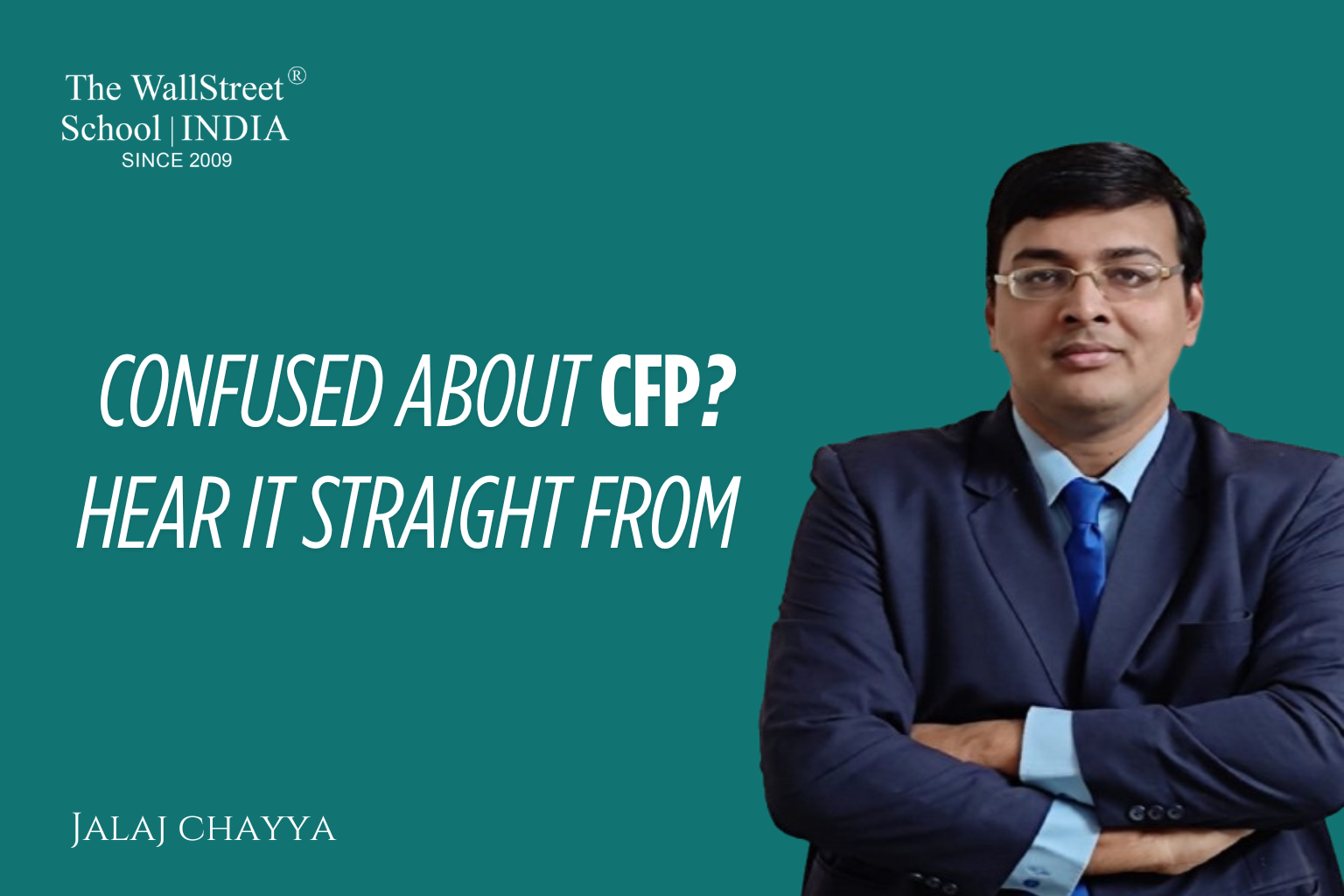
Meet CA CGMA Jalaj Chhaya, the Product Head of the CFP program at The WallStreet School. His journey in finance is a testament to the power of practical knowledge and strong mentorship. An experienced Senior Finance Manager with a demonstrated history of working in the trading, services and manufacturing industry, he brings real corporate insight into the classroom. He is skilled in Budgeting, Management Reporting, Financial Planning and Analysis, Internal Audit, Accounting, Income Tax and Internal Controls.
A qualified Chartered Accountant with over 12 years of corporate experience, Jalaj Sir has also completed CS and CIMA (UK), which makes him a well-rounded finance professional. With nearly a decade of teaching behind him, he even leads the CFP program at The WallStreet School with a clear mission — to change the way CFP is taught by focusing on real-world application and client-centric thinking instead of just textbook learning.
Below is a transcript of our conversation with Jalaj sir –
1. You’ve had a successful corporate career and taught a variety of finance courses. What inspired you to focus on CFP education?
I’ve taught subjects ranging from investment banking to international taxation. But I noticed a major gap in structured, practical personal finance knowledge. This gap existed not just among individuals, but even among finance professionals.
That realization is what drew me to the Certified Financial Planner (CFP) program. It is not only about numbers. It is about creating impact. A CFP professional can guide people through important life decisions such as buying a home, planning a child’s education, preparing for retirement, or navigating a financial crisis. These decisions are not just financial. They are personal and deeply human.
The turning point for me was meeting clients who had wealth but lacked clarity, or worse, had no confidence in managing it. That is when I knew I wanted to help train the next generation of financial planners. People who could combine technical knowledge with common sense and empathy.
If I can help bridge the gap between fear and greed, and empower people to make better financial decisions or support others in doing so, that would be a meaningful beginning.
2. What exactly is the CFP® certification, and how is it different from other finance designations like CFA or CPA?
The CFP® (Certified Financial Planner) certification is considered the gold standard in personal financial planning. It is globally recognized and highly respected. This certification is designed for professionals who want to help individuals and families make informed, strategic decisions about their entire financial life, rather than focusing on just one part of it.
Other finance designations like CFA or CPA are also valuable, but they serve very different purposes.
- The CFA (Chartered Financial Analyst) focuses on investment management, portfolio analysis, and equity research. It is best suited for those who want to work in fund management or institutional investing.
- The CPA (Certified Public Accountant) is more focused on accounting, auditing and tax compliance. It is essential for roles in taxation, audit, or corporate accounting.
- The CFP® is meant for professionals who want to work directly with clients, guiding individuals and families through real-life financial decisions. These may include investments, insurance, retirement planning, tax strategy, and estate planning, all brought together into one clear and integrated financial roadmap.
What makes the CFP® truly stand out is not just its technical depth but its emphasis on ethical practice, long-term client trust and well-rounded financial advice. If your goal is to be the person others rely on to solve real financial problems in a practical and meaningful way, the CFP® designation can help you become exactly that.
3. Who typically joins the CFP program?
The beauty of the CFP® program is that it attracts a diverse mix of ambitious professionals, all united by one common goal: to help people make smarter financial decisions.
-Young Finance Graduates:
Fresh out of B.Com, BBA, or MBA, these students want a competitive edge early in their careers.
-Career Switchers:
Many professionals from banking, insurance, or sales backgrounds find themselves doing “financial advice” without formal training. They join CFP® to back their experience with global-level expertise, build trust, and grow faster in their roles.
-Working Professionals in Finance:
Relationship managers, wealth managers, mutual fund distributors, and insurance agents often pursue CFP® to stand out in the crowd.
-Entrepreneurs & Independent Advisors:
Some join to build their own practice, becoming a one-stop shop for financial planning.
4. What are the most common questions you get from students and how do you answer them?
Some of the most frequent questions that I encounter almost daily are:
- Will CFP® get me a good job?” or “Is it better than MBA or CFA?”
I tell them: CFP® is for those who want to be trusted financial advisors, not just analysts or accountants. It’s client-facing, practical, and high in demand — especially in India’s growing wealth management sector.
- Another common question is, “Is doing CFP® tough?” My answer: It’s manageable with the right guidance. Our training breaks concepts down step-by-step, with real-life case studies to build confidence.
- Many also ask, “Can I start my own practice?” Absolutely — CFP® gives you both credibility and capability to build an independent advisory brand.
- Can I manage CFP while in college or working full-time?
Yes, absolutely. Many of our students balance jobs or college. The key is building a routine, and I mentor each student on how to do this effectively.
- Is CFP enough to get a job?
No doubt about it as it opens up strong opportunities in financial planning, wealth management and banking. Where this certification gets you shortlisted, confidence and practical skills you gain get you selected.
- I haven’t studied finance before. Can I still do CFP?
Definitely. It starts from the basics. If you’re curious and willing to learn, you’ll do well—even without a finance background.
- Will CFP help me go abroad?
I usually tell them CFP is globally recognized with a curriculum aligned to international standards. But even in India, demand for CFPs is rising rapidly so it’s a valuable qualification whether you plan to go abroad or stay in your home country.
Ultimately, I say: If you’re passionate about helping people with money, you’re in the right place.
5. You’ve observed how CFP is taught elsewhere. What gaps did you notice and how did you address them at The WallStreet School?
One major gap I noticed elsewhere was the lack of practical application. Many programs focus heavily on theory but don’t show how to build a financial plan, talk to a client, or analyze real-life cases. Students often finish the course knowing concepts, but not how to use them.
At The WallStreet School, we changed that. We bring real-world scenarios, client simulations, and industry tools into the classroom. Every module is backed with practical exercises — not just lectures.
Another gap was in student support. We ensure personal mentoring, doubt-solving sessions, career guidance, and even help with job placement. Our goal is simple: make students exam-ready, client-ready, and career-ready.
6. How is the CFP course here at The WallStreet School structured differently?
At The WallStreet School, we’ve reimagined CFP training to bridge the gap between theory and real-world practice. Our program is structured into modular learning paths, aligned with FPSB’s curriculum, but delivered with live, interactive classes, recorded sessions, and practical assignments.
And what sets us apart is that every topic is backed by real-life case studies, financial planning tools and client-based scenarios — not just exam preparation. We conduct mock tests, concept drills, and one-on-one mentoring, ensuring students don’t just pass, but understand and apply.
We also guide students on how to pitch a financial plan, start a practice, or ace an interview in wealth management roles. Plus, our trainers are industry professionals with years of experience, not just academic instructors.
7. What kind of practical assignments or case studies do you give during the course to help students gain real-world skills?
A high-quality CFP® course doesn’t just prepare you for the exam but prepares you for the client meeting room. That’s why at The WallStreet School, we embed practical learning into every step.
Students work on:
- Comprehensive financial plans for sample clients — covering insurance, investment, retirement, tax, and estate.
- Case studies based on real-life profiles — like a salaried professional, business owner, or retired couple — to understand varying needs.
- Risk profiling exercises, goal-based planning, and asset allocation simulations.
- Capstone projects where students present a full plan to a mock client panel — building both competence and confidence.
We also train students to use industry-standard tools and client interaction skills, making them truly job- and practice-ready.
8. How can a student meet the 6,000-hour (or 4,000-hour fast-track) experience requirement efficiently while still studying?
Students don’t have to wait till they finish the CFP® exams to start gaining experience.
They can begin earning hours while studying by working in finance-related roles such as:
- Financial planning support
- Insurance advisory
- Mutual fund distribution
- Client servicing in wealth management
- Tax filing or investment advisory roles
If you’re on the 4,000-hour fast-track (apprenticeship pathway), your experience must be more structured, under a qualified supervisor — but it’s still doable alongside your studies, especially if you’re in a part-time role or internship.
At The Wall Street School, we guide students to find relevant roles early, build resumes, and connect with industry mentors — helping them hit the experience target faster without your learning taking a backseat.
It’s all about starting early, staying consistent, and choosing the right environment.
9. What average salary uplift or career mobility have recent CFP holders seen in India and globally?
In India, CFP holders experience notable salary growth: entry‑level professionals earn around ₹4–5 LPA, while mid-level planners (4–9 years’ experience) average ₹6–12 LPA. Senior wealth managers easily cross ₹15 LPA, and niche roles like mutual fund managers or portfolio managers can earn ₹15–30 LPA+, sometimes even higher . According to SalaryExpert, the average gross CFP salary in India is ₹13.6 LPA, including bonuses
Globally, CFP certification offers a strong boost: in the US, average base salary is about US $77K, with experienced planners earning up to $125K+ . Anecdotal evidence from Reddit shows CFPs negotiating $15K–$40K pay bumps, moving from $65K → $82K or straight to $145K+ after job changes
Across markets, CFP certification enhances trust, opens doors to better roles, and often delivers salary increases from 20% to over 50%, especially when combined with career shifts or promotions.
So Before You Decide, A Few Words from Jalaj Sir :
If you’re unsure about CFP, ask yourself one thing: Do I want a career where I help people live better financial lives — and get paid well for it? If the answer is yes, CFP is one of the best choices you can make.
It’s not just a certification but a career of trust, impact and growth. With rising incomes and financial awareness in India, the need for qualified financial planners has never been higher.
You don’t need to be a math genius, just someone who’s willing to learn, solve real problems, and make a difference.
Ask Your Own Questions
If you’re still exploring the CFP course or confused about what it can do for your career — you now have the chance to get your doubts cleared directly by Jalaj Sir. We’re inviting you to submit your questions using the email ID below – jalaj.chhaya@thewallstreetschool.com Thanks for your helpful tips, Jalaj Sir. We truly appreciate the clarity and depth you’ve shared about the CFP program. Since we know you also head the CIMA course at The WallStreet School, we look forward to hearing your insights on the CIMA pathway in an upcoming interview as well.