How US CMA Skills Help You Get Better at Budgeting and Cost Control?
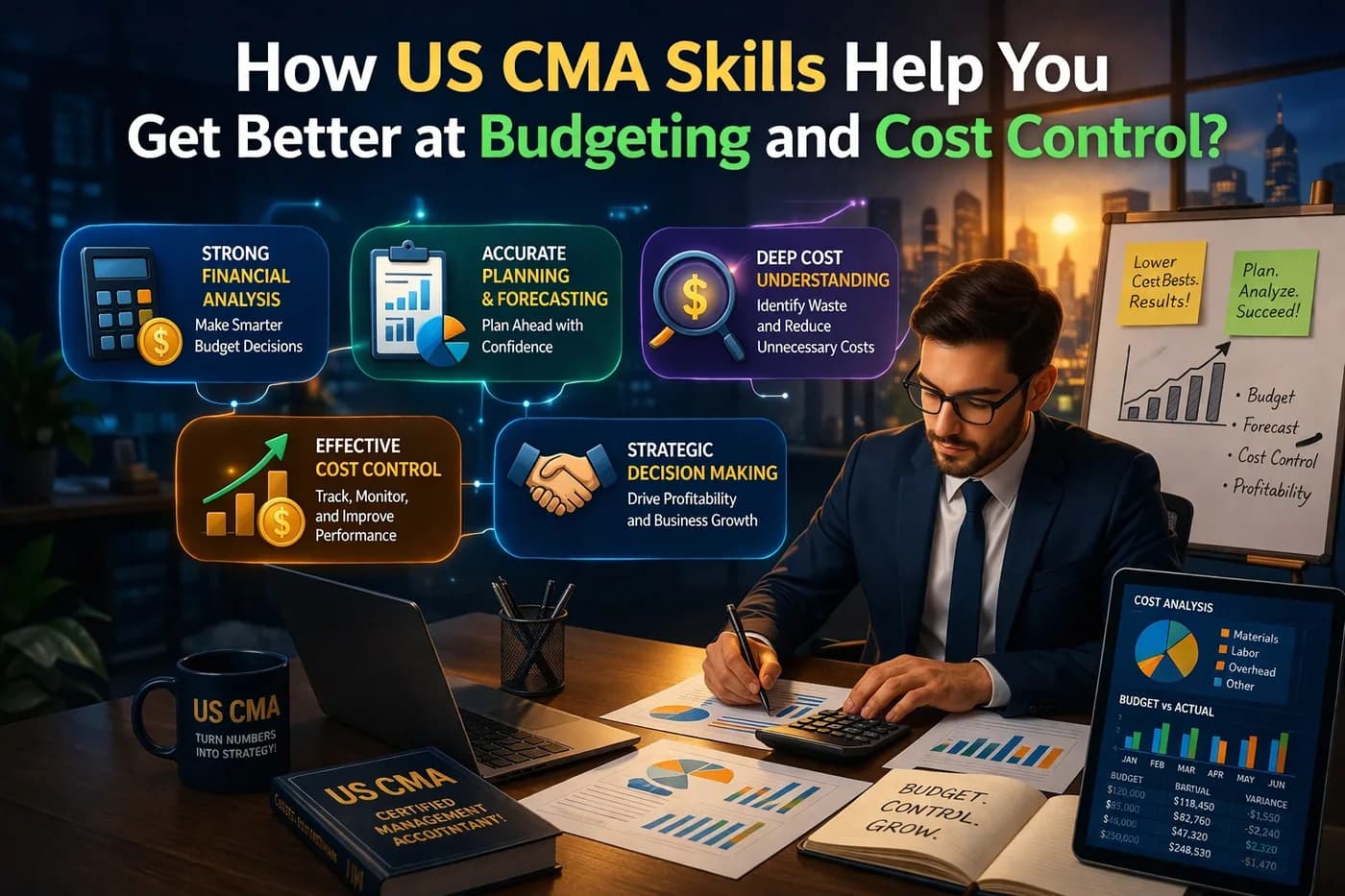
cost control jobs? Let us be straight with you – Yes, it is. And in this article, we will tell you exactly how CMA cost
cost control jobs? Let us be straight with you – Yes, it is.
And in this article, we will tell you exactly how CMA cost management skills work in real jobs, what you will actually learn and why companies in 2026 are looking for people with this certification.
Let us get into it.
What Is US CMA and Why Does It Matter for Finance Jobs?
The Certified Management Accountant (US CMA) is a certification from the IMA. It is actually one of the most respected certifications for people who want to work in financial planning CMA roles, cost control, budgeting and business decision making.
Here is something interesting – CMAs on average, earn about 21% more than people without the certification in similar roles. That is not a small number.
Part 1 of the US CMA exam covers financial planning, performance and analytics. Around 20% of that is budgeting alone. So if budgeting and cost control is what you want to do, this exam covers exactly that.
The CMA Skills You Actually Use at Work
So, when you clear the US CMA exam and start working, what skills do you actually use day to day?
1. Budgeting and Forecasting
This is the big one. CMA in budgeting roles means you are the person who figures out where the money goes. You learn flexible budgeting, which means adjusting your budget based on how much the company actually produces. You also learn zero-based budgeting, where every single expense has to be justified from scratch every year. No carrying over old numbers just because.
These are not just exam topics. Real companies use these. A manufacturing company in Delhi, for example, might use zero-based budgeting to cut waste in a department that has been overspending for years, justifying every expense anew for 15-30% savings.
2. Cost Accounting Skills CMA Gives You
The cost accounting skills CMA trains you in are some of the most practical things. You learn Activity-Based Costing, which is basically assigning costs to the actual activities that cause them. So instead of spreading costs equally everywhere, you find out which product or service is actually expensive to make.
This matters a lot. Imagine a company making two products. Without Activity-Based Costing, they might think both are equally profitable. With it, they realize one product needs 3x more machine hours and is actually eating into profits.
Amazon actually uses a version of this to figure out which product categories cost more to store and ship. That is why their pricing and fulfillment decisions are so sharp. Unilever does the same across their FMCG product lines to decide where to invest and where to pull back.
That is the kind of insight you bring to the table.
3. Variance Analysis
This one comes up in almost every budgeting conversation. Variance analysis means comparing what you planned to spend versus what you actually spent and then figuring out why there is a difference.
Was the raw material more expensive? Did production slow down? Did sales volume drop? These are the questions cost control techniques CMA teaches you to answer with data.
Maruti Suzuki, for example, tracks material cost variances every single month across thousands of components. One small deviation in steel prices shows up immediately and the team acts on it before it becomes a bigger problem.
Real Job Roles Where These Skills Are Used
Let us talk about where you actually end up using all of this.
- Budget Analyst
A budget analyst sits with department heads and helps them plan their spending for the year. You use forecasting to predict future costs based on past trends. You use variance analysis every month to tell your manager if things are on track or going sideways. This is a very common role for people with CMA in budgeting roles.
- Cost Controller
A cost controller’s job is simple to explain but hard to do. Keep costs from going out of control without stopping the business from running. You use Activity-Based Costing, you track expenses in real time and you flag things that look off. This is where CMA cost management skills really shine.
- Financial Manager
This is the senior level. You are not just tracking costs anymore. You are making decisions about where to invest, where to cut and how to make the business more profitable. Financial planning CMA training prepares you to think at this level.
In India, these roles in cities like Delhi, Mumbai and Pune are paying anywhere from 12 to 25 lakhs per annum, depending on experience. In the US, similar roles start around 75,000 dollars a year.
What 2026 Is Adding to Cost Control?
- AI and Machine Learning in Budgeting
Companies are now using AI tools to do real-time cost monitoring. Instead of waiting for the month-end report to find out something went wrong, AI flags it immediately. As a CMA you need to understand how to work with these tools, read the outputs and make decisions based on them.
Some estimates say AI-driven cost controls have helped companies save around 20% on IT-related costs alone.
Companies like Infosys and Wipro are already using AI dashboards internally to monitor project costs in real time. Even mid-sized Indian manufacturers are moving in this direction now.
- ESG and Sustainability Costing
ESG stands for Environmental, Social and Governance. More companies now have sustainability budgets. They are tracking carbon footprint as a cost. They are reporting on social impact. This is a newer area where cost accounting skills CMA holders are being asked to step in because it involves the same kind of cost tracking and budgeting logic but applied to non financial metrics.
- Python and Excel for Financial Modeling
This is something practical. If you know how to build a budget model in Excel or even write a simple Python script that pulls cost data and runs variance analysis, you are ahead of 80% of candidates. The CMA gives you the knowledge. Learning tools like these gives you the edge.
A Simple Example to Make This Click
Let us say you work at a mid-sized manufacturing company. Every month the production cost is going higher but nobody knows exactly why.
You sit down with the data. You run an Activity-Based Costing analysis and find that one product line is using way more machine hours than anyone realized. You run a variance analysis and find that material costs for that product jumped 12% last quarter because of a supplier issue that went unnoticed.
You bring this to the manager with a simple report. The company switches suppliers, restructures that product line and saves 8% in costs within two months.
That is what budgeting roles in finance look like in real life. That is what a CMA actually does.
Is the CMA Worth It for You?
If you are in finance and you want to move into roles that involve budgeting and cost control, the answer is yes. The CMA gives you a structured way to learn cost control techniques CMA professionals use in actual companies. It is recognized globally. It pays well. And in 2026 with companies leaning into AI and sustainability, having a CMA means you are already trained to think in the right direction.
You can usually recover the cost of the exam and study materials within 6 months of landing a better role. That is a solid return.
The WallStreet School has a US CMA program that prepares you for exactly the kind of roles we talked about in this article. The training is structured and practical. What also helps is that they offer 100% placement support so you are not figuring out the job hunt alone.
People Also Ask about US CMA skills in budgeting and cost control
- CMA vs ACCA for budgeting and cost control?
CMA is built for internal cost decisions and budgeting. ACCA is more about compliance and reporting.
- Can I get a budgeting job without CMA?
Yes you can. But CMA holders get better roles and better pay. It just gives you a stronger case in interviews.
- Is CMA useful in India?
Very much. Manufacturing and FMCG companies across Delhi, Mumbai and Pune actively hire CMAs for cost control and budgeting work.
- Does The WallStreet School provides placement after US CMA course?
Yes, The WallStreet School provides 100% placement support after US CMA course.
The bottom line is this. US CMA skills are not just exam topics. They are real tools that real companies need. If you want to work in budgeting and cost control, this is one of the smartest steps you can take in 2026.
Interested in Learning Finance Professionally?
Our courses take you from fundamentals to expert level — with live mentors and placement support.
Explore Our Courses