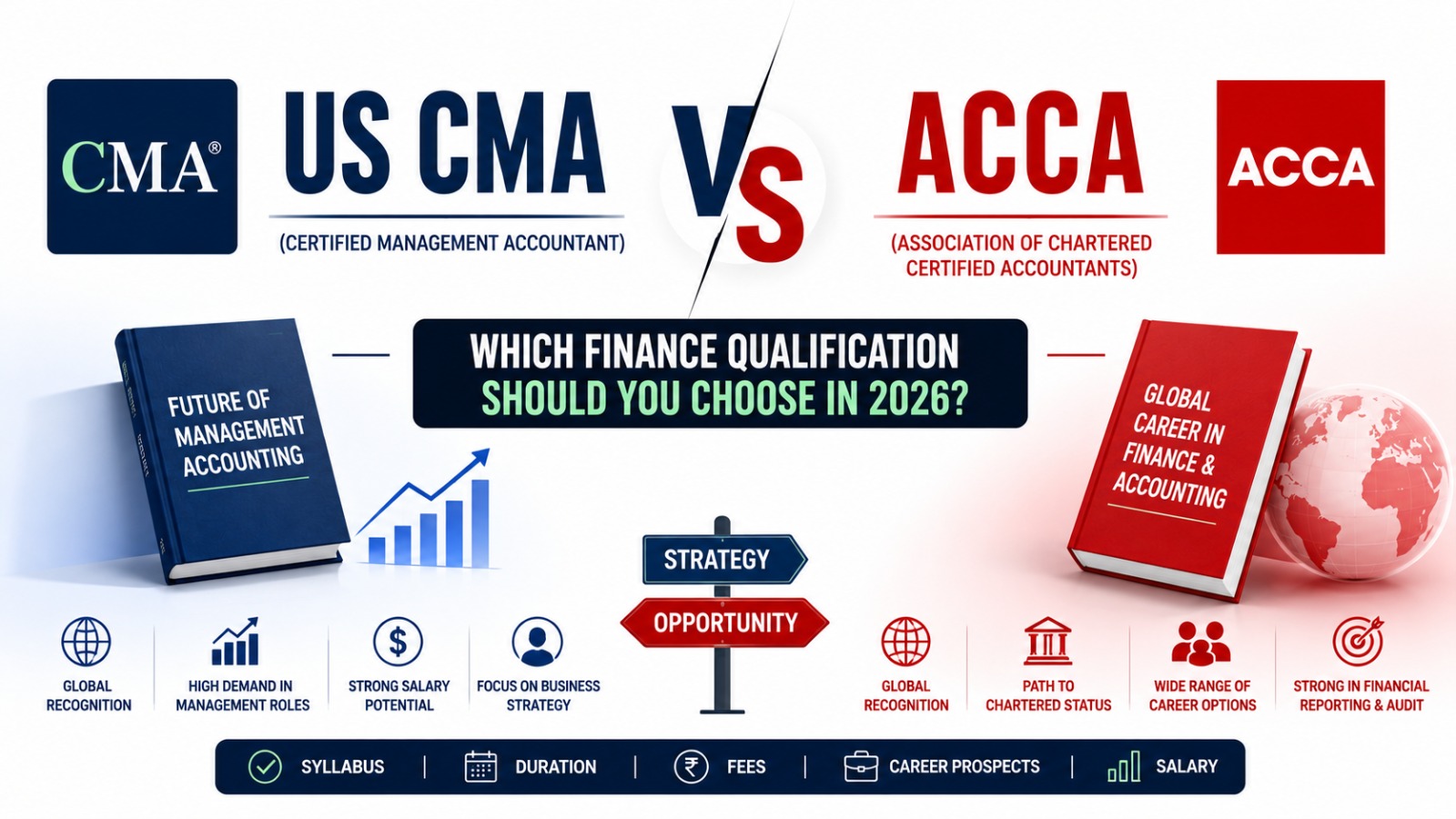
is acting like it is the only option that exists in finance.
You do not have anything against CA. But you also do not want to do something just because everyone else is doing it. Then you found US CMA vs ACCA. Both seem legit. Both seem global.
But you have no clue which one is actually right for you, which one is worth the money and which one will matter five years from now.
That is exactly what this article is going to help you figure out.
US CMA vs ACCA explained here in under a few minutes:
What Is US CMA?
The US CMA full form is Certified Management Accountant. It is a US-based professional certification offered by the IMA, which stands for the Institute of Management Accountants. The US CMA course is designed for people who want to work on the decision-making and strategy side of finance inside a company.
Think of it this way. Toyota, one of the most successful automobile companies in the world, stays profitable not just by selling more cars but by managing its costs extremely tightly. The company uses lean manufacturing, just-in-time inventory systems and careful cost variance tracking. This is exactly the kind of financial thinking the CMA USA course develops.
When you look at the US CMA syllabus explained in detail, you find topics like,
- Capital budgeting
- Working capital management
- Cost management in CMA
- Variance analysis
- Financial planning and analytics
Starting in 2026, the updated syllabus also puts strong emphasis on technology, data dashboards and AI-driven financial decisions, which shows just how modern this qualification is.
Before you decide, watch this:
So if you are someone who enjoys asking questions like “how do we cut manufacturing costs here?” or “is this investment worth making for the company?” then the US CMA course is probably your match. It is a management accounting course that places you right at the center of business strategy.
Now that you know what the US CMA is, there is something important worth knowing. There are actually two qualifications of CMA.
The one you just read about is the US CMA, the second is the Indian CMA, Cost and Management Accountant, offered by ICMAI, the Institute of Cost Accountants of India. Three levels, takes 3 to 4 years including articleship, focuses on cost accounting, taxation, and auditing under Indian regulations. Strong for PSUs and domestic firms. It has some presence in neighbouring countries and the Middle East but does not carry the same global weight as the US CMA.
Same name. Completely different qualifications.
What Is ACCA?
ACCA stands for the Association of Chartered Certified Accountants. It is a UK-based accounting qualification and one of the most recognized in the world. ACCA focuses on accounting, financial reporting, auditing, taxation and corporate laws.
If the US CMA is about making smart financial decisions from inside a company, ACCA is about making sure the company’s financial records are accurate, properly reported and compliant with the law. It is the qualification you pursue if you want to work in audit, compliance or financial reporting at a global level.
ACCA is built on International Financial Reporting Standards or IFRS, which is why it carries weight in so many countries. Think about a company like Infosys or any Indian firm listed on international stock exchanges. They have investors sitting in the UK, US and Europe who need financial reports they can read and trust. Everything has to follow IFRS, get audited properly and meet global compliance standards. That is exactly the kind of work ACCA professionals are trained to handle and why the Big Four firms that audit these companies are always hiring ACCA-qualified people.
In India, ACCA-qualified professionals are hired by Big Four firms like KPMG, Deloitte, EY and PwC, as well as by multinational companies that follow IFRS. Many Indian ACCA graduates have gone on to work in the UK, UAE, Singapore and other markets, which shows the real global mobility this qualification offers.
Is ACCA even possible for you right now? Watch this first:
US CMA vs ACCA: Core Difference
The difference between US CMA and ACCA comes down to one clear thing: what side of finance you want to work on.
| Your role | US CMA | ACCA |
| What you manage? | Costs, budgets, resources, financial planning | Accounting process, taxation, auditing, compliance |
| Who you report to? | Internal management and leadership | Regulators, stakeholders, external bodies |
| Core question you answer | What should the business do next financially? | What happened in the company’s finances? |
| Focus | Decision making and strategy | Reporting and compliance |
| Where you sit? | Inside the business in a finance or strategy role | Audit firms, compliance teams, Big Four firms |
Both qualifications overlap in some technical areas, but their core purpose is different. ACCA is more concerned with reporting what happened in a company’s finances. The management accounting course behind the US CMA is concerned with deciding what should happen next.
This is why comparing US CMA vs ACCA is really not about which is better overall but about which one fits the career you actually want.
US CMA vs ACCA: Syllabus and Exam Structure Comparison
| Exam Parameter | US CMA | ACCA |
| Number of exams | 2 parts | 13 papers across 3 levels |
| Exam levels | Part 1: Financial planning, performance and analytics. Part 2: Strategic financial management | Applied Knowledge, Applied Skills, Strategic Professional |
| Exam duration | 4 hours per part | Varies by paper |
| Exam format | 100 MCQs plus 2 scenario-based essay questions OR Case-Based Questions (CBQs). CBQs are optional from May/June 2026 and mandatory from September/October 2026 onwards | MCQs and written questions depending on level |
| What it tests | Real world business application and decision making | Technical accounting knowledge and practical application |
| 2026 updates | Strong emphasis on AI, technology, data dashboards, ESG reporting and blockchain | No major structural change until 2027. Current 13 paper format continues as is |
| Exemptions for B.Com | Based on education and work experience | Up to 5 papers |
| Exemptions for CA | Based on education and work experience | Up to 9 papers, only 4 remaining |
| Passing approach | Think like a business decision maker, not rote learning | Practical thinking and technical accuracy |
Both exams reward practical thinking over rote learning. Neither is easy but both are achievable with the right preparation and coaching.
US CMA vs ACCA: Cost and Duration Comparison
Let us talk money and time because that is what actually matters when you are making this decision:
| Attribute | US CMA | ACCA |
| Duration | 6 to 12 months | 2 to 3 years for a fresh student |
| With exemptions | No major change in timeline | Can be reduced significantly |
| Daily study requirement | 2 to 3 hours for college students | Varies by level and papers remaining |
| Total cost in India | 1 lakh to 1.5 lakh rupees for exam fees alone | Around 2 to 4 lakh depending on exemptions and coaching |
| What the cost covers | IMA membership around 27k annual, entrance fee 21k one time, and around 38k per part | Registration, annual subscription, exam fees per paper ranging from 9.5k to 16.5k per paper, plus coaching |
| Speed to workforce | Can enter with a global qualification in under a year | Longer runway before full qualification |
| Best for | Students who want to qualify fast and start working | Students who can commit to a longer qualification journey |
On the US CMA vs ACCA timeline comparison, US CMA works out cheaper overall with a more predictable fee structure. ACCA costs vary depending on how many papers you sit for and how many exemptions you receive.
US CMA vs ACCA: Career Scope and Job Opportunities
Here is where both qualifications actually take you in the real world:
| Category | US CMA | ACCA |
| India demand | Growing in manufacturing, FMCG, technology, and startups | Strong in Big Four firms, MNCs, and banking |
| Global demand | US, Middle East, and Southeast Asia | UK, UAE, Singapore, and 180+ countries |
| Geographic reach | Strong in specific markets | Broader global mobility |
| Typical roles | Corporate finance, FP&A, cost management, business finance | Audit, compliance, financial reporting, taxation |
| Where you work | Inside a company in a finance or strategy team | Audit firms, Big Four, banks, MNC compliance teams |
| Who hires you | Manufacturing companies, tech firms, funded startups | Big Four firms, multinational corporations, financial services |
| International mobility | Possible but tied to specific regions | Higher chance of moving abroad through firm transfers |
US CMA vs ACCA: Side by Side Comparison
Here is a quick breakdown of how the two qualifications compare across the key factors:
| Factor | US CMA | ACCA |
| Offered by | IMA, United States | ACCA, United Kingdom |
| Focus area | Management accounting, strategy, decision making | Accounting, audit, taxation, compliance |
| Duration | 6 to 12 months | 2 to 3 years |
| Number of exams | 2 parts | Up to 13 papers |
| Exemptions | Based on education and work experience | Available for B.Com, CA, CS holders |
| Best suited for | Corporate finance, FP&A, cost management roles | Audit, compliance, Big Four firm roles |
| India scope | Growing in manufacturing, tech, FMCG sectors | Strong in MNCs, Big Four, and banking |
Who Should Choose Which?
The US CMA vs ACCA decision really comes down to your career direction. There is no one-size-fits-all answer here.
Go for the US CMA course if:
- You want to work inside a company in a finance or strategy role
- You enjoy cost management in CMA and financial planning
- You want a qualification you can complete in under a year with a clear global focus on management accounting
Go for ACCA if:
- You want to work at a Big Four firm or in an audit and compliance team
- You are aiming for companies that follow IFRS-based reporting
- You want a degree recognized in over 180 countries with strong pathways to international career moves
Many students from commerce backgrounds also pursue both over time. They complete the US CMA course first to enter the workforce quickly, then pursue ACCA to add global accounting credibility. That path is more common than people think.
A lot of students pick the right qualification and then end up at the wrong place to study it.
Does Coaching Actually Make a Difference in ACCA and US CMA?
Most students spend weeks going back and forth on this decision and then do nothing. Do not be that person. If you have made it this far, you already know which one feels right for you. The next step is just finding the right place to actually do it.
The WallStreet School has been training ACCA and US CMA students in India since 2009. And the results are not just talk. Look at what our ACCA students did in December 2025:
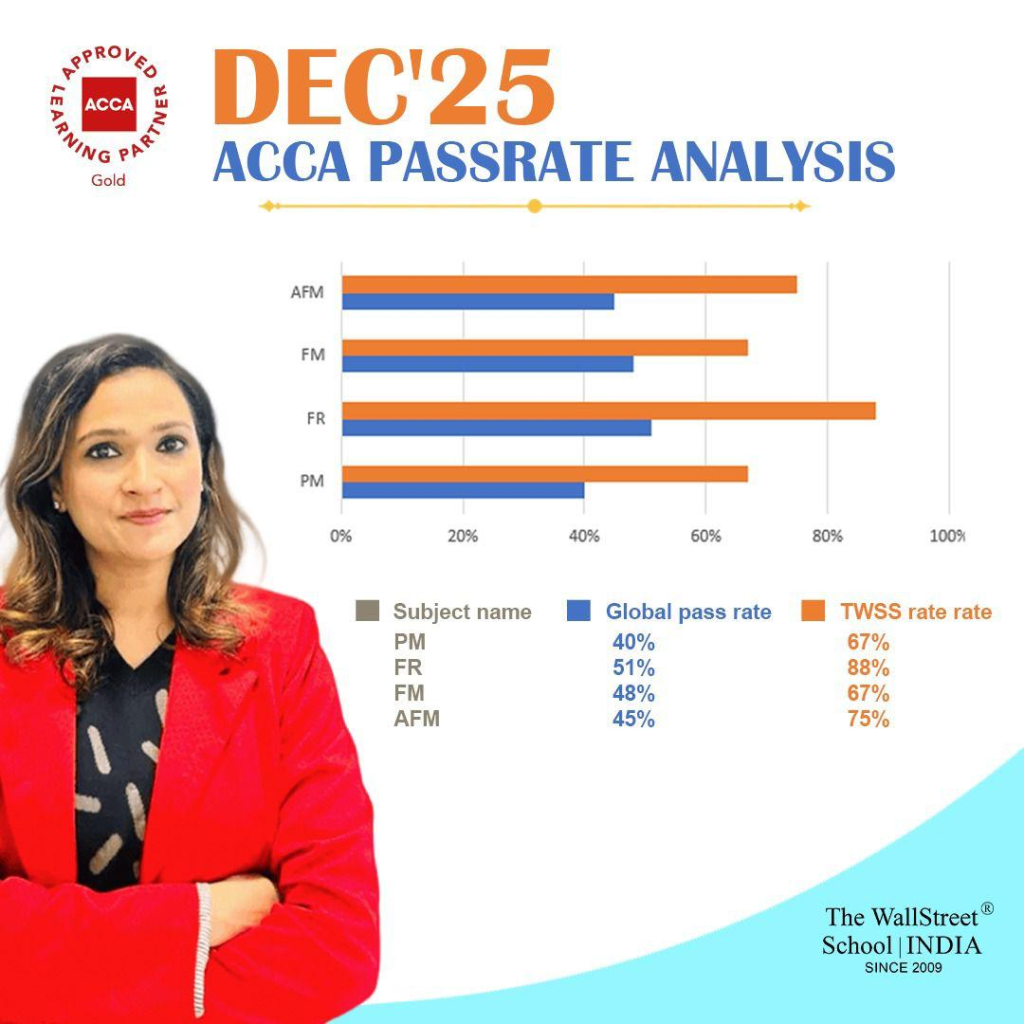
| Subject | Global Pass Rate | TWSS Pass Rate |
| PM | 40% | 67% |
| FR | 51% | 88% |
| FM | 48% | 67% |
| AFM | 45% | 75% |
That gap between the global average and The WallStreet School (TWSS) numbers is not luck. That is what happens when concepts are taught right and someone is actually pushing you to show up every day.
TWSS students on the US CMA side have cleared both parts and walked straight into corporate finance and FP&A roles. On the ACCA side, students have gone from Big Four India to Big Four abroad.
That is not a promise. That is a track record. So if you are serious about this, stop sitting on the fence.
People Also Ask about US CMA vs ACCA
1. Is CMA US better than ACCA?
US CMA wins if you want to work inside a company managing finance and strategy. ACCA wins if audit, compliance or Big Four is where you are headed.
2. Is CMA equal to ACCA?
They are equal in terms of global respect but they are not the same thing at all. One is for management accounting. The other is for audit and reporting. Comparing them directly is like comparing a doctor to a surgeon.
3. Which is higher salary, CMA or ACCA?
US CMA pays better in corporate finance roles in India. ACCA pays better if you manage to move abroad through a Big Four firm. Location and role matter more than the qualification itself.
4. Can I do ACCA after US CMA?
Yes and it actually makes a lot of sense. Clear US CMA, get into the workforce, then do ACCA on the side. By the time you finish both you are in a completely different league than most finance graduates.
Final Word
The US CMA vs ACCA debate does not have one universal right answer. It has a right answer for you, based on the kind of work you want to do every day.
If you want to be the finance professional inside a business who helps it run smarter, spend better and plan further ahead, the management accounting course that is US CMA will serve you very well. If you want to be the accountant who ensures global companies report accurately, stay compliant and meet international standards, ACCA is the stronger choice.
Both qualifications demand real commitment in terms of time, money and effort. Both deliver strong outcomes when paired with the right study plan and coaching. The key is to pick the one that fits what you actually want to build in your career and then give it everything you have.