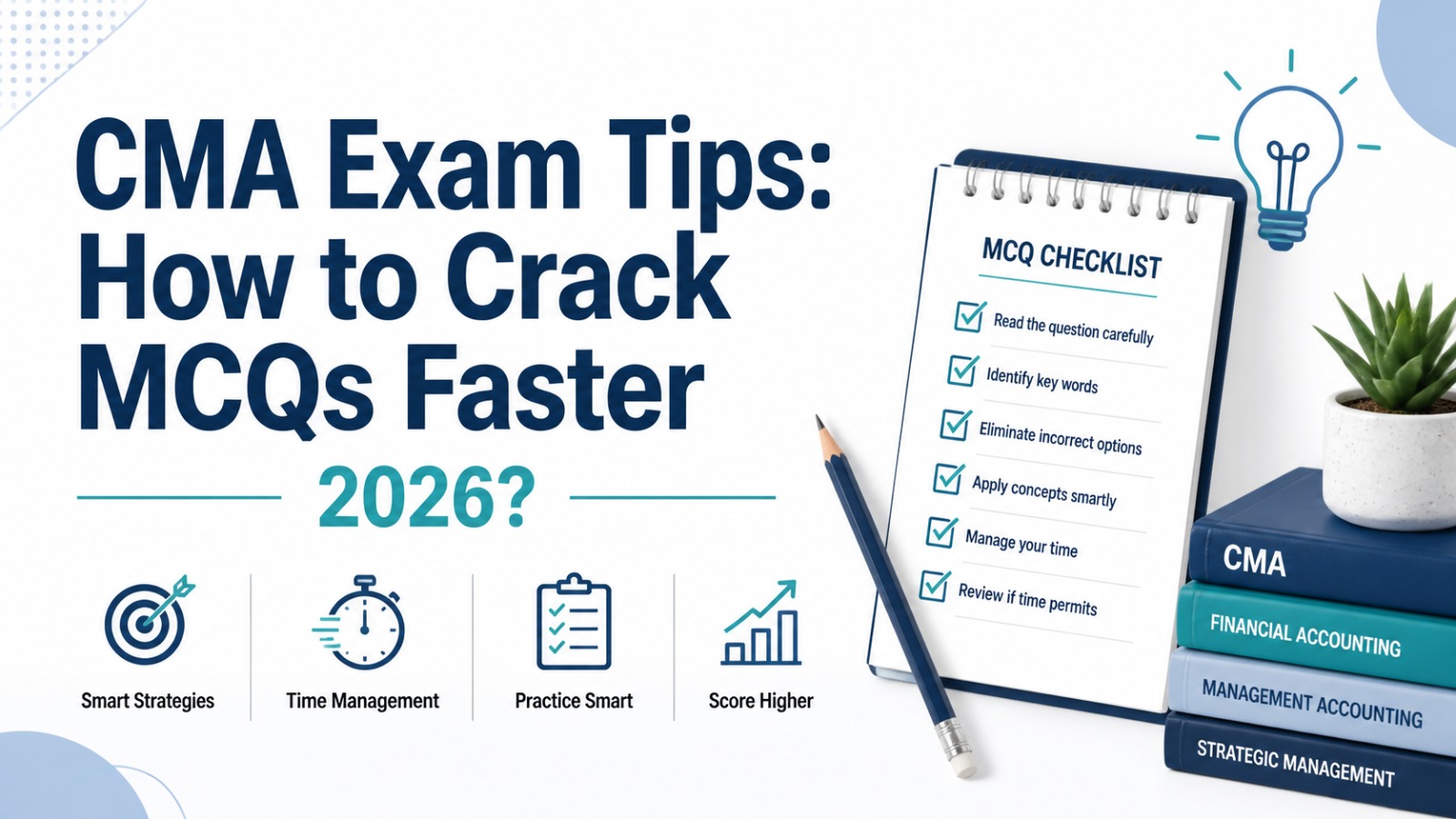
Every year, thousands of candidates prepare for the US CMA exam with strong conceptual knowledge and still walk out of the exam hall feeling defeated. Not because they did not study enough. But because they ran out of time, or second-guessed too many answers, or never figured out how to pace themselves through 100 questions in three hours.
Most CMA exam tips out there tell you to “practise more MCQs” and “manage your time well.” Useful advice. Also, advice that has helped nobody finish 100 questions in three hours without sweating through their shirt.
The candidates who actually pass on the first attempt are not smarter. They are just playing a different game. They treat the CMA exam like a sport with a specific playbook, not a knowledge test you can brute-force your way through.
Watch this before your next study session. It connects well with everything below:
What the US CMA Exam Looks Like?
Before getting into strategy, it helps to understand the format. Each part of the US CMA exam has 100 MCQs and two essays, all within a four-hour total window. The MCQ section runs for three hours and carries 75% of your score.
From May 2026, the two traditional essays are replaced by case-based questions, called CBQs. These are more interactive in format, covering drag-and-drop and numerical entry style questions. The 100 MCQs and their 75% weightage remain exactly the same. This is a format modernisation, not a syllabus overhaul. What changes is how Section B tests you, not what it tests.
The IMA recommends targeting around 1.5 minutes per MCQ. Top scorers do it in one to 1.2 minutes. That gap is not luck. It is a strategy.
Tip 1. Start with an Error Log
One of the most overlooked CMA exam tips is to find out exactly where you lose marks before you start heavy drilling. Most candidates jump straight into a textbook or a video lecture. That feels productive but it teaches you what you already know.
Do a diagnostic test of 50 to 100 questions first. Log every mistake. Note whether you got it wrong because you misread the question, forgot a formula, or genuinely did not understand the concept. This error log becomes the backbone of your entire CMA study plan.
Once you know your weak spots, you stop practising randomly and start fixing real problems.
Tip 2. Build a CMA Study Plan With Clear Phases
A structured CMA study plan beats a vague “study every day” approach every time. Think in three phases.
- Phase 1 covers the first four weeks. This is your concept phase. Read the material, understand the logic behind it and avoid heavy MCQ drilling until you have a foundation. For CMA Part 1 tips, this means focusing on financial reporting, cost accounting and performance management, since these carry the highest weightage. For CMA Part 2 preparation, this phase should cover financial decision-making, risk management and investment decisions in depth.
- Phase 2 runs from week five to week ten. This is your drilling phase. Set a target of 3,000 or more MCQs over these weeks. Always practise under timed conditions. Use the 3-2-1 revision method: three rounds of full-topic MCQs, two rounds of weak-area-only questions and one final round of full mock simulations.
- Phase 3 is the final two weeks. No new content. Only review, stamina-building and time management CMA exam practice. Run full three-hour mock exams weekly and treat them like the real thing.
Tip 3. The TR3 Method: The Most Practical US CMA MCQ Strategy
Here is a US CMA MCQ strategy that top scorers use and rarely explain clearly. It is called TR3, and it changes everything about how you move through the exam.
As you read each question, categorise it instantly into one of three types. Type A questions are quick wins you can answer in 30 to 45 seconds. Type B questions need 60 to 90 seconds of analysis. Type C questions are complex calculations or unfamiliar scenarios that you flag for later.
- In Round 1, knock out all your Type A questions without pausing.
- In Round 2, return to Type B.
- In Round 3, tackle Type C with whatever time remains.
This approach builds a buffer of 20 to 30 minutes for review, which most average candidates never have because they move through questions linearly and stall.
Check your pace every 25 questions. If 25 questions take you more than 30 minutes, you are behind. Adjust immediately.
The Brain Dump Trick Every Scorer Uses
This is one of the most practical CMA MCQ tricks available and it costs nothing.
Before the exam begins, you get a 15-minute tutorial period to understand the interface. Most candidates scroll through instructions they already know. Top scorers use this time to write down 50 to 100 key formulas, ratios and decision rules on their scratch paper. The DuPont equation, contribution margin formula, working capital ratios, variance analysis shortcuts and any threshold values you tend to forget under pressure.
When a calculation-heavy question appears mid-exam, the formula is already written in front of you. No mental retrieval under pressure. This single habit saves 10 to 20 seconds per question, which can add up to 30 or more minutes across the entire section.
How to Handle Questions You Are Unsure About?
Here is where many CMA MCQ tricks fall apart in practice. The advice to “eliminate wrong answers” is correct, but most guides skip the faster version of it.
Read the question stem first and mentally form an answer before you look at the options. This prevents the four choices from hijacking your instinct. Then scan all options and eliminate the two that are clearly wrong. This moves your odds from 25% to 50% before you do any real analysis.
Since there is no negative marking on the US CMA exam, never leave a question blank. If you are stuck after elimination, pick the most technically precise or conservative option. The exam tends to reward rule-based thinking over gut reactions.
Time Management CMA Exam: The Skill That Ties Everything Together
All the CMA exam tips above are only useful if you practise them under real exam conditions. This is where time management CMA exam preparation becomes non-negotiable.
Run at least four to six full-length three-hour mock sessions before your test date. Use the same scratch paper technique. Use the TR3 method every time. Track your average time per question across each session and watch it drop from 1.8 minutes to 1.2 minutes over weeks.
For CMA Part 2 preparation specifically, pay extra attention to timing. Part 2 questions on financial decisions and risk scenarios tend to be longer and more context-heavy. The time pressure is just as real, sometimes more so.
AI Tools That Make CMA Exam Preparation Sharper
Your CMA exam preparation in 2026 can also benefit from adaptive platforms.
Hock LMS is one of the best tools available for this. Here is what makes it stand out:
- Built-in Passmap facility that tracks your readiness across every topic
- Gives you a clear percentage-based exam readiness score so you always know exactly where you stand
- Keep practising until that score hits 80 to 90%. That is the point where your knowledge is consistent enough to hold up under real exam pressure, not just in practice
Beyond Hock, other platforms also help. Surgent’s AI uses a ReadySCORE system that tells you how ready you are in real numbers. UWorld and Gleim offer detailed analytics that show your average time per question and error patterns by topic.
These tools work best as a complement to a structured CMA study plan. AI can identify what to fix. Only disciplined practice actually fixes it.
What Passing Candidates Do Differently?
The candidates who crack CMA exam on their first attempt are not special. They are prepared. They know how to crack CMA exam conditions through deliberate practice, not just content knowledge.
Start with an error log. Build your CMA study plan in phases. Use the brain dump before the clock starts. Apply the TR3 method throughout. And run enough full mocks that by exam day, hitting 100 questions in under 3 hours feels like a normal Tuesday.
The exam does not get easier. But with the right approach to CMA exam preparation, you get a lot better at it.
If you are looking for structured guidance alongside your self-study, The WallStreet School’s US CMA program covers the full syllabus with faculty who have cleared the exam themselves. Worth exploring if you want a clear roadmap from day one.
People Also Ask about CMA MCQ Tricks
Q1. How many MCQs are there in the CMA exam and how much time do I get?
Each part has 100 MCQs with a three-hour window. That works out to roughly 1.5 minutes per question, so pacing matters a lot.
Q2. What is the best CMA study plan for first-attempt success?
Study in three phases: concepts first, then heavy MCQ drilling, then full mock exams. Rushing into questions before building a base is where most candidates go wrong.
Q3. How can I improve my speed on CMA MCQs without losing accuracy?
Practise under timed conditions daily. Use the TR3 method to sort questions by difficulty and stop spending too long on questions you can flag and return to.
Q4. Are CMA Part 1 and Part 2 equally difficult to crack?
Both are tough but in different ways. Part 1 tests more calculation-heavy topics. Part 2 leans toward analysis and judgment. Your weak areas decide which one feels harder.
Q5. Does The WallStreet School provides placement support after US CMA course?Yes, The WallStreet School provides 100% placement support after the US CMA course.