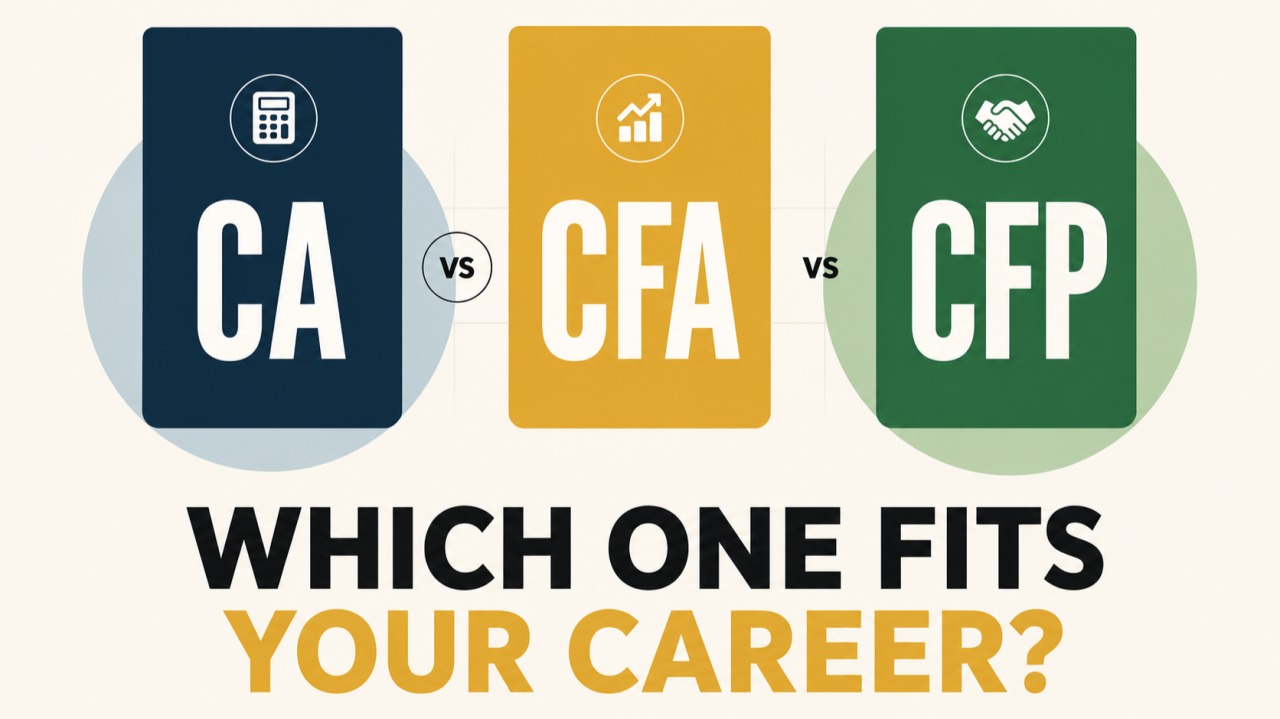
CA (Chartered Accountant) is best suited to accounting, audit and tax careers. CFA is built for investment analysis and capital markets. CFP certification is designed for financial planning, wealth advisory and client-centred finance. These three finance certifications are not interchangeable – each leads to a distinctly different professional path.
Watch our faculty, Jalaj Chhaya, break down all three qualifications in under 6 minutes – covering what each one actually prepares you for and how to pick the right one based on where you want to go:
Every year, thousands of students and young professionals end up Googling some version of the same question: CA or CFA or CFP? These three finance certifications might look like three options sitting in the same category, but they actually lead to very different career identities. One is built around accounting, audit, tax and compliance. One is designed for investment analysis, capital markets and portfolio management. One is for financial planning, client advice and long-term wealth decisions. The confusion is fair, all three live inside the broad world of finance. But what they prepare you for is quite different.
In India, this comparison matters even more in 2026 because the finance profession itself is changing. The country’s mutual fund assets under management stood at Rs 81.92 lakh crore as of 30 April 2026 and Deloitte estimates that India’s wealth-management industry has a US$1.6 trillion AUM growth opportunity between FY24 and FY29. At the same time, FPSB India reports that the number of CFP professionals in India rose 9.9% year on year to 3,534 by 31 December 2025, while the global CFP community has crossed 236,300 professionals. In other words, the market is not only growing in investing and accounting; it is also growing in the need for trusted planners who can guide individuals and families through increasingly complex money decisions.
So before asking which is the best finance course for your goals, it is smarter to ask a more useful question: what kind of finance work do you want to do for the next decade?
What Does Each Finance Qualification Actually Cover?
If you want to work in audit, taxation, statutory compliance, financial reporting, internal controls, assurance or core accounting leadership, the Chartered Accountant (CA) qualification remains one of India’s most established and respected routes. ICAI’s qualification is built around a formal structure of Foundation, Intermediate and Final levels, supported by articleship and training under the new scheme of education and training. For students who want a strong professional identity within India’s accounting and compliance ecosystem, CA remains highly relevant.
If you want to build a finance career in investment analysis, equity research, asset management, institutional finance, portfolio management or global capital markets, the CFA course is typically the more natural fit. CFA Institute positions the program around advanced investment analysis and portfolio management, delivered across three levels with substantial study commitment. It is globally recognized and tends to appeal to those who enjoy valuation, markets, economics, asset classes and analytical depth.
CFP certification sits in a different lane. It is not primarily an accounting and investment-only qualification. It is a financial planning qualification. Through FPSB India’s pathway, candidates move through specialist coverage in investment planning, retirement and tax planning and risk and estate planning, before progressing toward CFP certification. That structure makes CFP unusually practical because it mirrors the real questions clients ask in day-to-day financial life rather than limiting learning to one narrow technical lane. That matters because real-world clients rarely arrive with only one question. They do not only ask about a stock. They ask whether they can retire on time, how to protect their family, how to save for a child’s education, what to do with bonuses, how much insurance is enough, how to structure investments and how tax and estate choices affect long-term outcomes.
CA vs CFA vs CFP: Three Different Zones of Finance
That is why CA, CFA and CFP should not be viewed as substitutes in a simplistic sense. They are more accurately viewed as routes into different zones of finance.
| Qualification | Strongest In | Core Strength |
| CA | Precision, regulation, accounting standards, tax interpretation and control | Deep accounting and compliance expertise |
| CFA | Security analysis, investment frameworks, portfolio theory and capital-market decision-making | Investment thinking and analytical rigour |
| CFP | Personal finance, advisory conversations, financial planning frameworks, ethics and long-term client-centred decision-making | Whole-life financial planning and advice |
When comparing CFA vs CA specifically, the distinction is straightforward:
| CFA | CA |
| Sharpens investment thinking and analytical rigour | Builds deep accounting and compliance expertise |
| Best for capital markets, investment analysis and portfolio roles | Best for audit, tax, compliance and controllership roles |
Both comparisons matter when choosing where to build your career. Seen this way, the right comparison is less about prestige and more about fit.
Who Should Choose CA, CFA or CFP?
| Description | CA | CFA | CFP |
| Best suited for students who… | Like numbers and want to work in accounting, tax or audit | Love markets, investing and want to analyse stocks or manage portfolios | Want to work with people and help them plan their financial lives |
| Market status | Very well known and respected in India | Very well known and respected globally | Growing fast and people are actively searching for it |
| Why it is growing? | Companies always need accountants, tax experts and auditors | Banks and investment firms always need analysts and researchers | More Indians are investing and earning and need proper guidance |
| What the market needs? | Professionals who handle numbers, filings and compliance | Professionals who analyse investments and manage money | Advisors who help people plan retirement, taxes and long-term goals |
Who Is the CFP Certification Right For?
So who should seriously consider CFP certification?
| Who | How CFP Helps |
| Students who want a client-facing career | Builds a strong foundation for working with people, explaining money simply and growing authority in personal finance |
| Bankers, wealth managers, mutual fund distributors, insurance professionals and relationship managers | Helps move from selling products to offering real solutions and advice |
| Graduates, MBA students and professionals from B.Com, BBA, economics or banking backgrounds | Can be pursued after graduation or alongside an MBA — compatible with most finance-related degrees |
| Finance professionals who already understand numbers | Helps reposition into advisory, planning and client strategy roles |
| Entrepreneurs, trainers and educators in personal finance | Strengthens credibility and trust in a market where people want qualified advice |
One of the strongest arguments for CFP is that it combines technical knowledge with real human relevance. Most finance qualifications stay within one domain – CFP does not. It also carries global recognition, which matters because personal finance today is shaped by international practices, cross-border goals and a connected professional world. The certification belongs to a worldwide ecosystem, not just the Indian market.
CA builds strength in reporting, controls and compliance. CFA builds strength in investment thinking and market analysis. CFP trains you to connect finance to actual life decisions, retirement, insurance, family goals, long-term strategy in ways that go beyond running numbers.
For most clients, that gap between information and guidance is everything. CFP is built to close it.
CFP should not be measured only by salary comparisons. It opens doors in advisory, wealth and planning careers but more than that, it shapes the kind of professional you become. Being trusted and client-ready pays off in ways that are hard to quantify but very real over time.
The market context backs this up. Deloitte points to a major expansion in India’s wealth-management space and AMFI’s data shows how large the investment base has already grown. More investors and more affluent households means more demand for people who can genuinely guide financial decisions. A growing market does not automatically produce great advisors but it does create room for people who are trained properly.
CFP works here because it does not stay in one lane. It covers investment planning, retirement, tax, risk and estate thinking in one qualification useful as a standalone path, layered on top of a graduation, MBA, banking career or any other finance background.
None of this is a dig at CA or CFA. CA remains the strongest route for accounting, audit and compliance. CFA remains a top brand in investment management. The point is not that CFP beats either – it is that CFP is growing in importance inside a part of finance that is itself becoming more important.
Most comparison articles treat CA, CFA and CFP like three products on the same shelf. They are not. They are three different professional lenses. And in 2026, the financial planning lens is long overdue for more attention.
Choosing the Best Finance Course: A Simple Filter
For someone deciding today, this filter can help you identify the best finance course for your goals.
| Qualification | Choose It If You Are Drawn To | What It Helps You Do |
| CA | Accounting, assurance, tax and structured corporate finance roles | Handle financial reporting, compliance and audit with precision |
| CFA | Investing, research, valuation and capital markets | Analyse securities, manage portfolios and drive investment decisions |
| CFP | Financial planning, wealth conversations, long-term advice and client-centred finance | Discuss goals, retirement, cash flows, insurance, tax and family financial decisions in a way clients immediately relate to |
In fact, one of the most useful outcomes of this comparison is realizing that many students are not confused because the qualifications are similar; they are confused because nobody has helped them define the work they actually want to do.
That is why the CA vs CFA vs CFP debate should end with clarity, not with a winner.
And if the future you want involves helping real people make better money decisions across investing, retirement, tax, insurance and long-term financial goals, then CFP is no longer a side option. It is becoming one of the most relevant finance qualifications to consider in India today.
People Also Ask about CA vs CFA vs CFP
- What is the difference between CA, CFA and CFP?
CA is for accounting, audit and tax. CFA is for investment analysis and capital markets. CFP is for financial planning and client advisory. Three qualifications, three completely different career paths.
- Which is the best finance course in India for 2026?
Depends on what you want to do. CA for accounting and tax. CFA for investing and markets. CFP for financial planning and wealth advisory. There is no single best, only the right fit for you.
- Should I choose CFP vs CFA?
CFA is for people who want to work with investments and capital markets. CFP is for people who want to help individuals plan their financial lives. Different goals, different qualifications.
- What is the difference between CFA vs CA?
CA trains you in accounting, audit and taxation. CFA trains you in investment analysis, valuation and portfolio management. One is about financial reporting, the other is about financial markets.
- Can I pursue CFP certification after CA or CFA?
Yes and many professionals do. CFP adds client advisory skills to your existing technical background, a strong combination for wealth management and planning roles.
- What finance career paths does CFP certification open in India?
Financial planning, wealth advisory, retirement planning, relationship management and personal finance consulting. With India’s wealth industry expanding fast, demand for CFP professionals is only going up.
Why CFP Is Picking Up Now?
- India’s wealth management industry is growing fast. Deloitte estimates a US$1.6 trillion AUM growth opportunity between FY24 and FY29.
- More Indians are investing than ever before. AMFI reports mutual fund industry AUM at Rs 81.92 lakh crore as of 30 April 2026.
- CFP is gaining steady ground in India. FPSB India reported 3,534 CFP professionals by December 2025, up 9.9% from the previous year.
- The role is built around people and relationships, making it a strong fit for careers grounded in trust and long-term advice.
- CFP is globally recognised and sits well alongside a graduation, MBA or any other finance degree, it adds to your profile rather than replacing what you already have.