Financial Modelling & Valuation: Skills You Need & Where They Lead
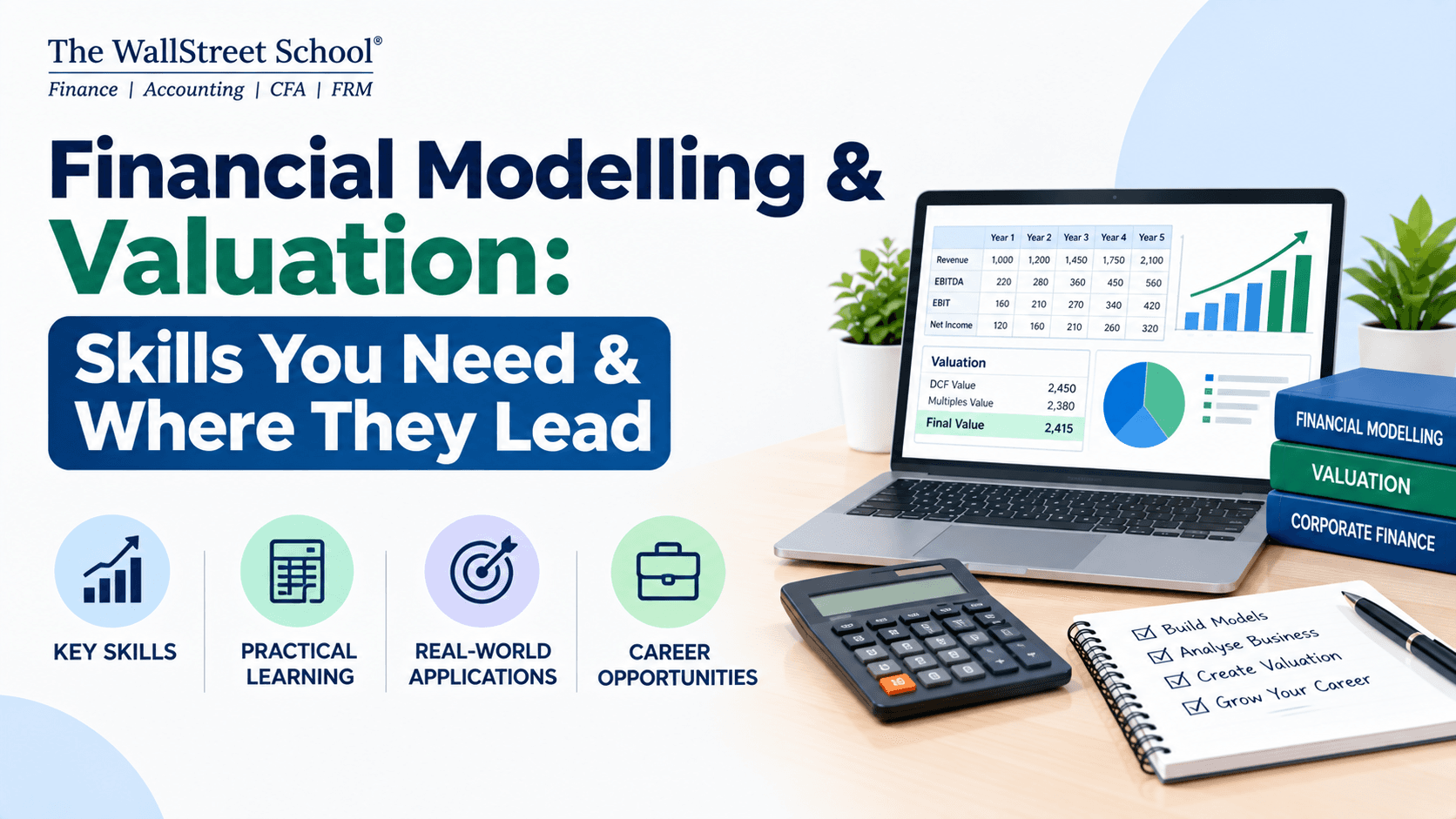
Financial modeling and valuation means turning a company's past numbers and future assumptions into a clear estimate of what the business is worth. Building real financial modeling skills and valuation skills takes solid accounting basics, fast Excel work, and comfort with methods like DCF valuation and comparable company analysis. Recruiters checking for investment banking skills, equity research skills, and general financial analyst skills usually look for exactly this combination before they even glance at your resume properly.
Why Everyone Talks About Financial Modeling and Valuation
Picture a BCom student with three browser tabs open. One has an ACCA syllabus, one has an internship listing asking for strong financial modeling skills, and one has a video promising to teach DCF valuation in twenty minutes. Sounds familiar? Most students chasing investment banking skills or equity research skills land in this exact spot at some point.
Here is what nobody explains clearly enough. Financial modeling and valuation is not some rare gift reserved for IIT or IIM toppers. It is a practical, learnable craft. Once the connection between a company's financial statements and its financial valuation clicks, everything else becomes practice and repetition rather than talent.
What Financial Modeling Actually Means?
A financial model is usually just an Excel sheet that represents a real business, linking assumptions like pricing, hiring, working capital and debt to the three main financial statements: the income statement, the balance sheet, and the cash flow statement. Together these three form the base for every serious financial analysis exercise.
A good model does more than have formulas filled in everywhere. It should stay internally consistent and flexible enough that one changed assumption updates everything automatically, including the final financial valuation. Raise prices by 5 percent, and a solid model should instantly adjust revenue, margins, tax, cash flow, and valuation together.
The Core Skills Behind Strong Financial Modeling Skills
Real financial modeling skills are not just Excel shortcuts. They come from several areas working together, and any decent financial modeling course tends to teach them in this order.
Skill Area
What to Learn
Why It Matters
Accounting
Statements, depreciation, deferred tax, working capital
Base for all financial analysis
Excel
Shortcuts, formulas, XLOOKUP, error checks
Backbone of daily financial analyst skills
Forecasting
Driver based revenue, cost and margin trends
Core of any financial modeling course
Valuation
DCF valuation, comparables, precedent deals
Produces the actual financial valuation
Scenario work
Base, upside, downside, sensitivity tables
Shows how valuation skills apply under pressure
Communication
Memos, decks, plain conclusions
Makes financial analysis usable for decisions
Notice accounting and Excel sit before valuation. That order matters, since financial analysis built on shaky statement knowledge rarely holds up under questioning. Each area also builds financial analysis for later work, whether that means investment banking skills, equity research skills, or financial analyst skills on any given day.
Valuation Methods Every Beginner Should Master
If modeling is the engine, valuation is the destination. Financial valuation usually rests on three core approaches, and knowing why their answers differ matters as much as knowing how to calculate each one.
DCF valuation estimates worth from future free cash flows, discounted using the weighted average cost of capital, or WACC. Inputs include revenue growth, margins, tax rate, capex, and terminal value. DCF valuation is powerful because it is grounded in real cash generation, though a small shift in WACC can swing the number quite a bit, which is exactly why practicing DCF valuation on real companies builds valuation skills faster than reading theory ever could.
Comparable company analysis values a business against similar listed peers using multiples like EV to revenue, EV to EBITDA, and price to earnings, then applies a sensible range to the target.
Precedent transactions looks at prices paid in past merger deals for similar companies. Since acquisitions often carry a control premium, these multiples usually run higher than public market ones.
Once these basics feel comfortable, useful additions include leveraged buyout modeling for private equity, merger models with accretion or dilution work, and sector specific approaches like bank valuation using price to book.
Where These Skills Actually Lead?
Strong financial modeling skills and valuation skills are transferable, though the daily grind looks different depending on where they land. Some roles lean on investment banking skills, others on equity research skills, and many just need sharp financial analyst skills for daily financial analysis.
Career Path
How the Skills Get Used
Investment banking
Pitch books, merger models, financing, where investment banking skills matter most
Equity research
Forecasting listed firms, writing views, built entirely on equity research skills
Private equity
Deal screening, LBO analysis, returns modeling
FP&A
Budgets, forecasts, variance analysis, day to day financial analyst skills
Valuation advisory
Independent reports for reporting, litigation, and tax matters
Credit and ratings
Debt service checks, covenant modeling, sharpens financial analyst skills further
In India, these same skills also open doors into Big Four transaction advisory and NBFC credit roles, all of which lean on practical financial analysis over textbook theory.
A Practical Learning Path for Beginners
For someone targeting investment banking skills, private equity, or equity research skills straight out of a finance degree, this order tends to work best.
Get accounting fundamentals solid first, so every entry's effect on the statements feels intuitive
Build real Excel speed before advanced formulas, since clean fast output matters everywhere
Build one three statement model from a real annual report, forecasting three to five years forward
Learn DCF valuation and comparable company analysis properly, calculating free cash flow, WACC, and implied share price
Add LBO and transaction modeling if private equity or investment banking skills are the actual goal
Assemble a small portfolio: one model with DCF valuation, one comparables valuation, and one LBO case study
Practice presenting the conclusion in one page: overview, assumptions, valuation range, and risks
Most structured programs built around a financial modeling course follow exactly this sequence, moving from accounting through Excel into valuation rather than jumping straight to formulas.
What Recruiters Actually Notice?
Whether the goal is investment banking skills, equity research skills, or financial analyst skills, recruiters want proof, not claims. A certificate from a financial modeling course signals interest, but it rarely replaces a real work sample. Saying "I completed a course" is weaker than saying something like this in an interview:
"Built a five year model for a listed consumer company, valued it through DCF valuation and EV to EBITDA comparables, and tested a 100 basis point WACC increase."
That single sentence shows accounting knowledge, Excel comfort, sharp financial analysis, and clear communication, all bundled into one line.
Bringing It All Together
The winning combination looks like this: solid accounting fluency, fast Excel plus three statement modeling, comfort with DCF valuation and comparables, and finally the investment banking skills, equity research skills, or financial analyst skills needed for the specific path chosen.
Financial modeling and valuation will not guarantee a seat at a top firm on its own, especially in private equity where deal experience carries real weight. But among everything a student can build early, this remains the clearest and most demonstrable proof of genuine valuation skills, through personal projects, internships, and write ups that show real financial analysis in action.
Where The WallStreet School Fits In?
Reading about DCF valuation is one thing. Building a model under someone who actually checks your work is another. That gap is what The WallStreet School's financial modeling course closes.
The course covers accounting, Excel, three statement modeling and valuation through DCF valuation, comparables and precedent transactions, plus LBO and merger work for investment banking skills or private equity readiness, with dedicated equity research skills sessions. Students build real projects instead of watching scattered videos, guided by instructors with actual industry experience.
People Also Ask about Financial Modeling and Valuation Skills
What is the difference between financial modeling and financial valuation?
Financial modeling is the process of building the spreadsheet that projects a company's future. Financial valuation is the output, the actual estimate of worth, usually derived from that model through DCF valuation or comparables.
Do I need a financial modeling course to learn these skills?
Not strictly, but a structured financial modeling course saves time by teaching accounting, Excel, and valuation skills in a logical sequence instead of scattered videos.
Which valuation method should beginners learn first?
DCF valuation is usually taught first because it forces genuine understanding of cash flow and WACC, which makes the rest of financial valuation much easier to grasp.
Do these skills help outside investment banking and private equity?
Yes. FP&A, credit analysis, and valuation advisory all rely on the same financial analyst skills and financial analysis habits, just applied to different questions, and many of these roles value equity research skills just as much as core investment banking skills. Even outside finance teams, employers scan resumes for financial analyst skills and equity research skills as a baseline filter.
Interested in Learning Finance Professionally?
Our courses take you from fundamentals to expert level — with live mentors and placement support.
Explore Our Courses