FRM Part 1 Study Plan: How to Structure Your Preparation Month by Month
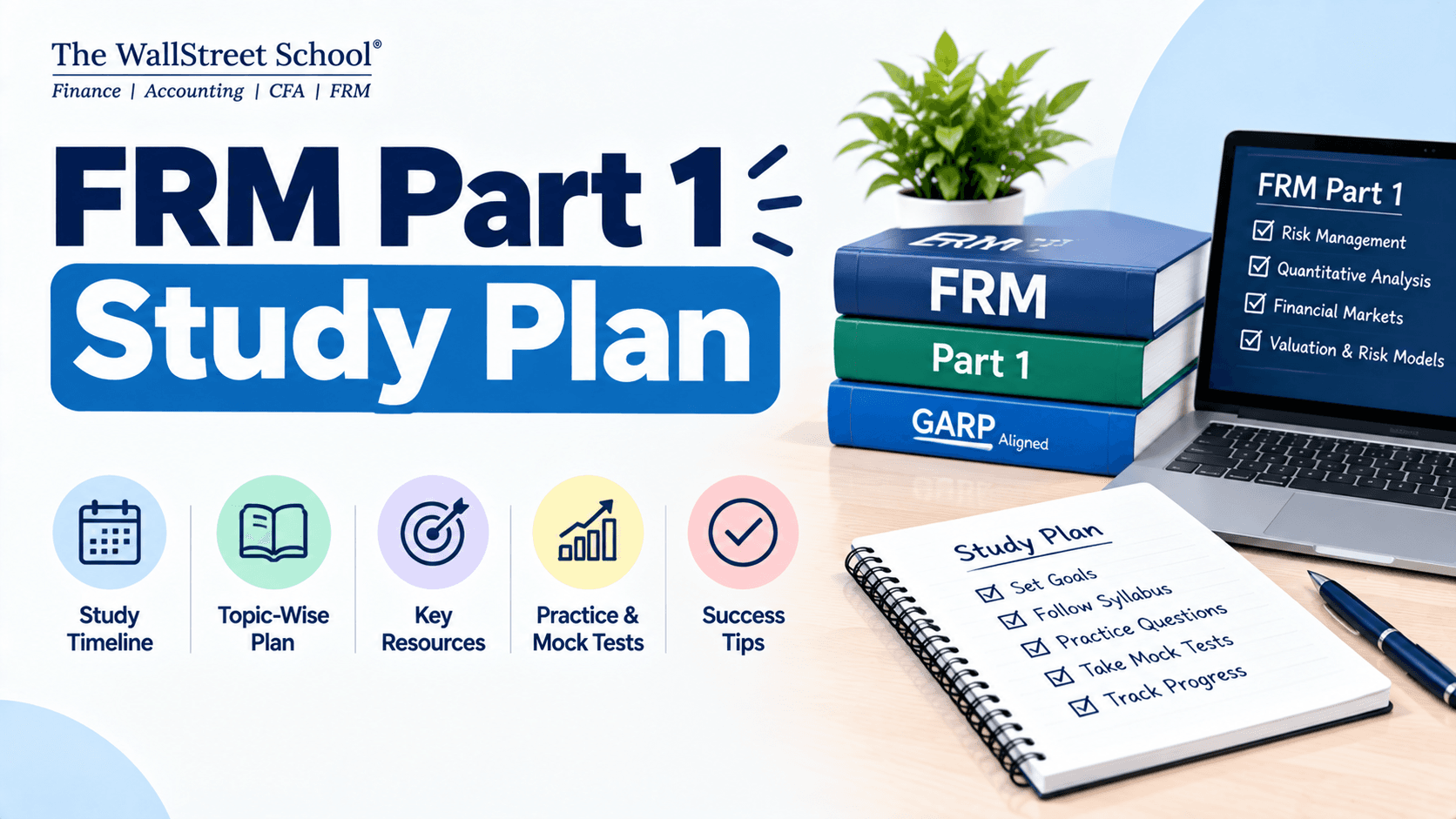
You have opened the FRM Part 1 syllabus . There are formulas, statistics, derivatives, risk models, financial markets and a long list of topics staring back at you. And then comes the obvious question
You have opened the FRM Part 1 syllabus. There are formulas, statistics, derivatives, risk models, financial markets and a long list of topics staring back at you.
And then comes the obvious question that you ask yourself - How am I supposed to finish all of this?
The answer is not studying for 10 hours a day. It is having a proper FRM Study Plan.
FRM Part 1 is a demanding exam, but the preparation becomes much easier when you stop looking at the syllabus as one huge task. Break it into smaller targets, give yourself enough time to practise, and keep the final few weeks for revision and mock tests.
For most students, a 4 to 6 month FRM Part 1 Preparation plan is a comfortable starting point. If you have more time available, use it. If you are working or studying alongside FRM, you may need a little longer.
Here is how you can structure your preparation month by month.
First, Understand What You Are Preparing For
Before making a timetable, know what FRM Part 1 actually covers-
Foundations of Risk Management
Quantitative Analysis
Financial Markets and Products
Valuation and Risk Models
There are 100 multiple-choice questions to be completed in four hours.
A student who only reads the study material may understand the theory but struggle in the exam.
A student who only solves questions without understanding the concepts will face a different problem.
Your FRM Preparation needs both.
A 5-Month FRM Study Plan
If you are preparing alongside college or a job, a five-month plan gives you enough breathing room without allowing the preparation to drag on indefinitely.
Here is the basic roadmap:
Month
Main Focus
Priority
Month 1
Foundations + Quantitative Analysis
Build your base
Month 2
Quantitative Analysis + Financial Markets
Learn and practise
Month 3
Financial Markets + Valuation & Risk Models
Finish the syllabus
Month 4
Revision + Question Practice
Find weak areas
Month 5
Mock Tests + Final Revision
Exam preparation
Now let's break it down properly.
Month 1: Build Your Foundation
Focus: Foundations of Risk Management + Quantitative Analysis
Don't begin your preparation by trying to finish as many chapters as possible.
Your first month is about getting comfortable with the subjects.
Start with Foundations of Risk Management
This is a good place to begin because it introduces many of the basic ideas you will encounter throughout your FRM journey.
Spend time understanding:
Different types of financial risk
Risk management principles
Risk management frameworks
Corporate governance
Risk culture
Measuring and managing risk
Don't try to memorise everything after reading it once, just ask yourself:
Could I explain this to someone else in simple words?
If you can, move ahead. If you cannot, go back and read it again.
Then move to Quantitative Analysis
This is where many students become nervous. Don't let the formulas scare you.
Start with the basics and gradually build up:
Probability
Random variables
Probability distributions
Descriptive statistics
Sampling
Hypothesis testing
Correlation
Regression
Time series
By the end of Month 1
You should have:
Completed Foundations
Covered a good portion of Quantitative Analysis
Started solving topic-wise questions
Created a short formula sheet
Identified the areas where you are struggling
Month 2: Get Comfortable With Quant and Markets
Focus: Finish Quantitative Analysis + Financial Markets and Products
Month 2 should be more practice-heavy than Month 1.
Finish your remaining Quantitative Analysis topics and start solving questions regularly.
And don't just check your score.
Pay attention to why you got something wrong. For example, was it because:
You forgot the formula?
You misunderstood the concept?
You made a calculation mistake?
You rushed through the question?
You didn't understand what the question was asking?
Keep a simple mistake log. It may feel unnecessary at first, but it becomes extremely useful during final revision.
Start Financial Markets and Products
Once your quantitative base is developing, move into financial markets and products.
This section covers areas such as:
Bonds
Interest rates
Foreign exchange
Futures
Forwards
Options
Swaps
Commodities
Financial markets and participants
Your Month 2 goal
By the end of this month, Quantitative Analysis should be completed or very close to completion. You should also have made a solid start on Financial Markets and Products.
Most importantly, questions should now be part of your weekly routine.
Month 3: Finish the Syllabus
Focus: Financial Markets and Products + Valuation and Risk Models
This is your final syllabus-completion month. Finish Financial Markets and Products and move into Valuation and Risk Models.
This section brings together many of the concepts you have already encountered and introduces areas such as:
Valuation
Value at Risk
Volatility
Backtesting
Stress testing
Risk models
Model assumptions and limitations
At this point, don't treat every chapter equally. Some topics will click quickly. Others may take two or three attempts. That's normal.
If a difficult topic takes you twice as long as another chapter, don't panic and completely abandon your schedule. Mark it as a weak area and keep moving.
You will come back to it during revision.
A good rule for Month 3:
Don't wait until you finish the entire syllabus before practising questions.
If you finish a chapter today, start its questions tomorrow.
That way, you know immediately whether you actually understood it.
By the end of Month 3
Your first complete reading of the syllabus should be done.
You should also have:
A formula sheet
An error log
Topic-wise practice completed
A list of weak areas
Now the real preparation begins.
Month 4: Shift From Learning to Practising
This is where your FRM Study Plan changes. For the first three months, you were mainly learning. Now you need to start testing yourself.
Go back through all four areas and solve mixed questions. Don't always practise questions chapter by chapter.
Why? Because the actual FRM Exam won't tell you:
This is a Quantitative Analysis question. Now use this formula.
You need to recognise what the question is testing on your own. Start mixing topics. One question may involve probability. The next may test derivatives. The next may ask about risk management. That change in context is something you should practise before exam day.
Create an FRM Error Log
This is one of the simplest things you can do during your preparation.
Keep a small table like this:
Problem
Why I Got It Wrong
What I Need to Do
VaR calculation
Formula confusion
Revise + practise
Bond question
Misread the question
Slow down
Probability
Calculation error
Solve similar questions
When you revise later, don't start from page one. Start with your mistakes. That's where your marks are hiding.`
Month 5: Mock Tests and Final Revision
By Month 5, you shouldn't be spending most of your time learning completely new concepts.
Your focus should be practice, mock test, analyse then revise all of theses and repeat
Take full-length mock tests under exam-like conditions. Don't pause after every question.
And definitely don't keep your phone beside you. Treat the mock like the real thing. Then comes the important part:
Analyse the mock.
A score alone doesn't tell you much. Suppose you scored 65%. You need to know:
Which questions did you get wrong?
Which ones did you guess?
Which topics took too much time?
Where did you make silly mistakes?
Which concepts still feel unclear?
A question you guessed correctly is not necessarily a strength. Mark it for revision too.
How Many Hours Should You Study for FRM Part 1?
There is no single number that works for everyone. Someone with a strong finance and quantitative background may need less time than someone seeing probability, statistics or derivatives for the first time.
Instead of asking: How many hours should I study every day?
Ask - How many hours can I realistically study every week?
For example:
If you can study around 10 hours a week
A 5 to 6 month plan may suit you.
If you can manage around 15 hours a week
A 4 to 5 month plan can work well.
If you can study 20+ hours a week
You may be able to complete the syllabus sooner and spend more time on revision.
Don't underestimate consistency. Two focused hours every weekday can be more useful than studying for eight hours once a week.
What If You Only Have 3 Months?
Three months is tight, but it doesn't mean preparation is impossible.
You simply cannot afford to spend too much time making elaborate notes or repeatedly reading the same chapter. A simple three-month plan could look like this:
Month 1: Foundations + Quantitative Analysis
Month 2: Financial Markets and Products + Valuation and Risk Models
Month 3: Revision + Questions + Mock Tests
The biggest difference is that you need to practise questions alongside your learning.
Start learning, practising then identify weakness and revise all you have learned.
7 Common FRM Preparation Mistakes
1. Studying without a timetable
Put your study hours on your calendar.
2. Avoiding Quantitative Analysis
If you keep postponing the difficult topics, they will eventually pile up.
Start early.
3. Leaving questions for the last month
Questions aren't only for testing yourself. They are part of learning.
4. Making huge notes
Your revision material should become shorter as the exam gets closer. Not longer.
5. Memorising without understanding
This is especially risky with derivatives, valuation and risk models. Understand the logic first.
6. Ignoring mistakes
Getting a question wrong is useful if you understand why. Repeating the same mistake five times is not.
7. Taking mock tests too late
You need enough time to work on the weaknesses your mocks reveal.
How The WallStreet School Can Help With FRM Preparation
You can absolutely prepare for FRM Part 1 through self-study. But not everyone learns well by sitting alone with a study book and figuring everything out from scratch.
This is where structured coaching can make a difference.
The WallStreet School helps students bring more structure to their FRM Preparation, especially when they are struggling to decide what to study first, how to approach difficult quantitative concepts or how to balance learning with question practice.
For many students, the biggest benefit of a structured course isn't simply having lectures.
It's having someone break a large syllabus into smaller, manageable pieces. Instead of wondering: What should I study today, you already have a roadmap to follow.
That can be particularly useful if you're preparing alongside college or a full-time job.
Of course, coaching does not replace self-study. You still need to practise questions, revise regularly and take mocks.
Think of it as reducing the amount of time you spend figuring out how to prepare, so you can spend more time actually preparing.
Frequently Asked Questions
1. How many months are enough for FRM Part 1?
For most students, 4 to 6 months is a practical preparation window. The ideal duration depends on your finance background, quantitative skills and the number of hours you can study each week.
2. Is 3 months enough for FRM Part 1?
Yes, three months can work if you can dedicate enough time to preparation. You will need to follow a tighter schedule and practise questions alongside your studies instead of leaving them until the end.
3. How many hours should I study for FRM Part 1?
There is no fixed number for every student. A preparation plan based on roughly 10 to 15 focused hours per week can work well for many working professionals and students, while beginners may need more time.
4. What should I study first for FRM Part 1?
A practical approach is to begin with Foundations of Risk Management, then move into Quantitative Analysis before progressing to Financial Markets and Products and Valuation and Risk Models.
5. Can I prepare for FRM Part 1 while working or studying?
Yes. In fact, many candidates prepare alongside college or a job. The key is to set a fixed weekly schedule rather than relying on whatever free time happens to be left at the end of the day.
Interested in Learning Finance Professionally?
Our courses take you from fundamentals to expert level — with live mentors and placement support.
Explore Our Courses