
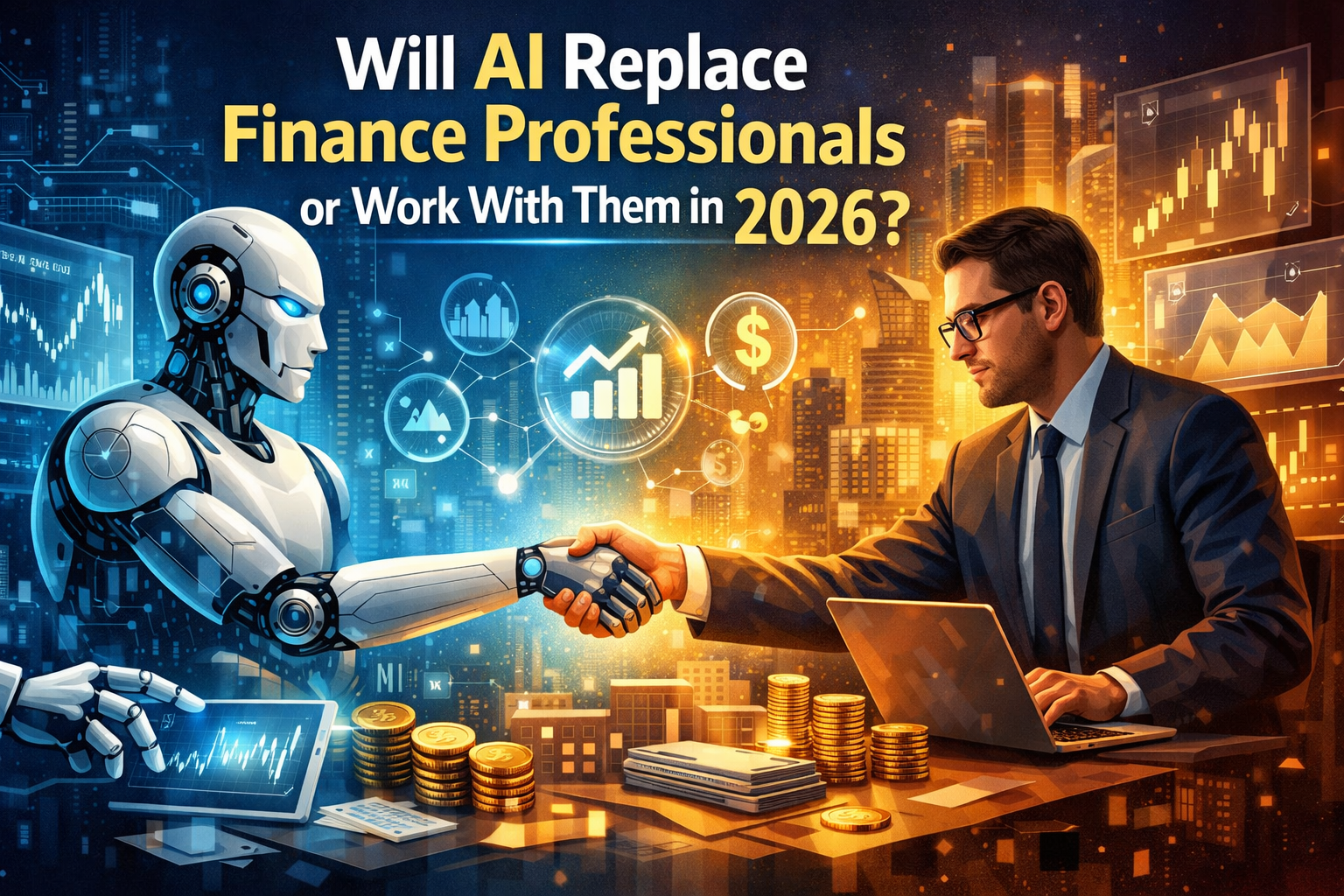
Nobody in finance is having a calm conversation about AI right now. Either someone is convinced it will wipe out half the profession in three years or they are dismissing it as overhyped tech with a hallucination problem.
What is actually happening is more specific and useful to understand if you work in this field. AI vs human finance professionals is not a clean contest with a winner. It is a division of labor that is still being figured out in real time, inside real firms, by people trying to do their jobs faster and with fewer errors.
Why 2026 is a Different Conversation?
AI in finance is not some new thing that showed up last year. Algorithmic trading, credit scoring models, fraud detection systems have existed for over a decade. What changed recently is the layer that touches professional work directly. AI is now inside analyst workflows, inside client-facing advisory tools and inside FP&A processes. It is not just back-office automation anymore.
That shift has a direct bearing on the impact of AI on finance jobs because it means the tasks being automated are no longer just clerical. They are analytical. A decent AI model can now write a basic earnings summary, catch loan agreement violations in a lending portfolio or run stress tests overnight without anyone asking it to. That used to require a junior analyst or two.
On top of that, finance sits in a different regulatory category than most industries. Any AI-driven advice touching someone’s savings, loans or investments is held to a higher standard by regulators. That is not going away. If anything, RBI-style risk-first frameworks and their equivalents globally are getting stricter, not looser. So the question is not just what AI can do technically. It is what it can do within the constraints of accountability, trust and professional liability.
What AI Is Actually Good At?
On specific, well-defined tasks, AI is genuinely better. Not in a vague future sense. Right now.
Data gathering and cleaning is the obvious one. AI can go through thousands of filings, extract key numbers, reconcile inconsistencies and flag things that do not add up in the time a human analyst would spend opening the third tab. Research on this has shown AI models outperforming analysts on earnings forecast accuracy in controlled conditions, roughly 60% versus 53%, when the task is standardized enough for the comparison to be fair.
Scenario generation is another real advantage. Need forty DCF variations with different growth assumptions? Need to stress-test a credit portfolio against six macroeconomic scenarios before a morning committee meeting? AI handles that in minutes. Backtesting strategies across fifteen years of market data used to be a weekend job. It is now a prompt.
Routine monitoring is where AI simply does not tire. Watching counterparty exposure limits, tracking news sentiment across hundreds of companies and flagging unusual transaction patterns in a lending book. A team of humans cannot match that coverage at that cost.
For professionals where a large portion of the day is spent on these tasks, the impact of AI on finance jobs is already visible. The honest version of this is not that jobs are disappearing, it is that the work is being compressed. Work that used to justify two analysts can be done by one analyst who knows how to use the tools.
Where Humans Are Not Being Replaced?
Here is where the conversation usually goes wrong. People point to the tasks AI performs well, extend that logic too far and conclude that finance professionals are heading toward extinction. That logic breaks down the moment you look at what finance actually involves at a professional level.
Judgment calls in messy situations are still almost entirely human. Reading a management team across three years of earnings calls, sensing that a company’s guidance is optimistic in a way the numbers do not fully reveal, knowing when a model assumption is technically defensible but practically wrong. These are not tasks with clean inputs and correct outputs. They require pattern recognition built from years of experience in specific contexts.
Client relationships, particularly in wealth management, operate on trust that takes years to build and seconds to lose. Behavioral coaching through a market downturn, helping a family restructure wealth after a death and talking someone out of a terrible decision they are convinced is brilliant. A robo-advisor can send an automated nudge. It cannot have that conversation.
Governance and sign-off remain human responsibilities. Someone has to put their name on the recommendation, explain the reasoning to a regulator and accept accountability if it goes wrong. That legal and professional exposure is not something AI absorbs. It sits with the human professional, which means that human professional needs to genuinely understand what they are signing off on.
How Does the Impact of AI on Finance Jobs Break Down by Role?
The picture looks different depending on where you sit. Here is what it means for each role specifically.
Financial Analysts (Equity Research, Credit, M&A)
- AI handles: pulling comps, building first drafts of models, screening for red flags
- Human job: forming the actual view, challenging the model’s assumptions and communicating the thesis in a way that lands with decision-makers
Wealth Advisors and Financial Planners
- AI handles: portfolio construction and rebalancing for mass-market clients at a cost no human can match
- Human job: multi-generational planning, business sale proceeds, estate and tax strategy
- The middle ground of straightforward portfolios for relatively affluent clients is genuinely contested right now
Risk Managers (FRM-Adjacent Roles)
- AI handles: real-time monitoring, scenario generation and flagging early warning signs
- Human job: model governance, understanding where the model breaks down and explaining the findings clearly to a board
Corporate Finance and FP&A (ACCA / CMA Tracks)
- AI handles: variance analysis and rolling forecasts across business units
- Human job: interpreting what the numbers actually mean for strategy and getting business unit heads to change behavior based on them
A Practical Framework for AI vs Human Finance Professionals?
Rather than a general principle, it helps to have a working test.
| When to use | AI-Led | Human-Led |
| The task is clearly defined and repeatable | A decision carries real accountability | Most real-world situations in 2026 |
| Structured, clean, rule-based | Messy, novel, or emotionally charged | AI handles the structured part, human handles the rest |
| Can be checked without deep judgment | Someone needs to own it if it goes wrong | AI drafts, human challenges and signs off |
| A human always reviews before anything consequential happens | The human is the decision-maker, not just the reviewer | Human decides which outputs are worth acting on and why |
| AI screens a lending portfolio for covenant breaches | Human explains a risk call to a board or a client | AI runs twenty scenarios overnight, human picks three to present and builds the story around them |
Here is what that looks like in practice.
Take credit underwriting as a real example. A lending team runs an AI model that scores thousands of loan applications and ranks them by risk. The obvious rejections go out automatically. The clean approvals move forward without anyone touching them. The human underwriter only steps in for the borderline 20 percent where the score alone is not enough, like a business owner whose income looks inconsistent on paper because of seasonal contracts but is actually solid. AI cleared the pile. The human handled the calls that actually needed a brain.
What Should the Future of Finance Professionals Do About It?
For finance professionals building careers in the ACCA, CMA, CFA or FRM space, the practical steps matter more than the philosophical framing.
Get comfortable with the tools, properly
- Use NotebookLM to research and summarize large documents like annual reports or regulatory filings before a client meeting
- Use Claude to draft an analysis, check your reasoning or stress test assumptions on a model you are building
- Use Zapier to automate repetitive handoffs like sending reports, filing data or triggering alerts so you spend zero time on tasks that do not need your brain
- Know how to spot when a model is confidently wrong, because it will be sometimes
- Treat AI like a junior analyst you need to supervise carefully, not a calculator you can trust blindly
Protect the skills AI cannot replicate
- Writing clearly and making complex numbers easy to understand for non-finance people
- Speaking with credibility in front of clients, committees, or boards
- Asking the right question rather than just answering the obvious one
- Navigating the internal politics of financial decisions inside an organization
Build local regulatory knowledge if you are in India
- Understanding how RBI guidelines interact with specific lending structures is not something a general AI model can reliably carry out
- Knowing how a fintech platform navigates SEBI requirements is contextual and local
- This kind of on-the-ground regulatory fluency is an advantage worth building deliberately, because AI does not have it yet and clients know that
If you are looking for a structured way to start, The Wall Street School’s AI for Finance program is built exactly for this, teaching finance professionals how to use AI tools in real workflows without losing the judgment that makes them valuable.
People Also Ask about AI vs human finance professionals
- Can AI replace financial analysts?
Not fully. AI handles data and drafts. Humans form a view, defend it and take accountability. Both are needed right now.
- Is AI financial advice safe for personal decisions?
For basic research, yes. For anything involving real money or long-term planning, always go to a licensed professional. Do not skip that step.
- How do ACCA, CMA, CFA, and FRM candidates stay relevant as AI grows?
Focus on judgment, ethics and client work. AI can run a DCF. Knowing when to trust it or throw it out is still yours.
- Who actually wins, AI or human finance professionals?
Neither wipes the other out. AI takes the repetitive tasks. Humans keep the judgment calls. Those who use both well pull ahead.
The Bottom Line
The debate will keep going. Someone will always have a hot take about AI wiping out finance jobs and someone else will always push back. None of that matters much if you are actually working in this field. What matters is knowing which parts of your job AI does better than you, letting it do those, and getting sharper at the parts it cannot touch. That is not a grand strategy. It is just common sense. The people treating it that way are already pulling ahead. The ones still arguing about who wins are falling behind.

