ACCA vs CFA: What Your Actual Workday Looks Like on Each Path
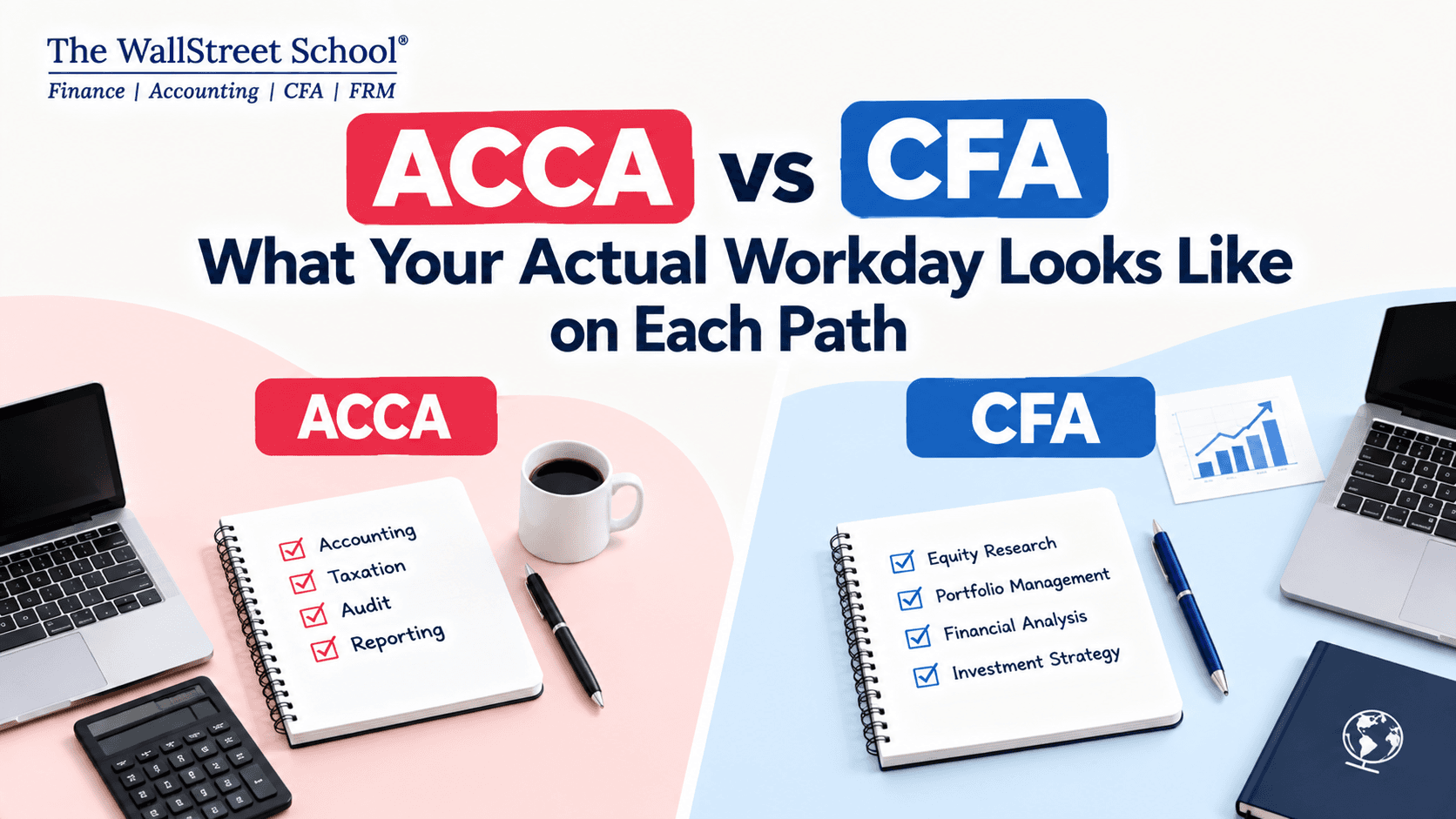
Forget the salary charts for a second. The real question in ACCA vs CFA is what you would be doing at your desk every day, and who you would be doing it for. Both are respected Professional Qualifications, but they lead to very different shapes of a Finance Career. Here is what each path actually looks like in practice, not just on paper.
Two Desks, Two Completely Different Jobs
Pick CFA vs ACCA based on the work, not the acronym. A CFA charterholder sits on an investment desk, reading market data and deciding what to buy or sell. An ACCA professional sits inside a company's finance department, making sure the numbers are accurate and the business is run responsibly. Same broader industry, entirely different daily reality.
This distinction matters more than people admit when choosing. Someone who enjoys reading equity research and predicting stock movement will find CFA work genuinely engaging. Someone who enjoys building financial statements and understanding how a business actually makes money will find ACCA work far more satisfying. Chasing the higher salary chart without asking which desk you would actually enjoy sitting at, year after year, is how people end up capable but unhappy five years in.
What a Day on the CFA Path Looks Like
The CFA Course leads you onto an investment management or capital markets desk. Early on, as a Research Analyst, your day involves reading equity research reports, building financial models, and pulling data from market terminals to figure out whether a stock or bond is priced correctly. It is detail heavy work, spent mostly staring at spreadsheets and price charts.
Move up to Portfolio Analyst, and you start contributing directly to portfolio performance graphs and investment decisions rather than just supporting someone else's call. By Portfolio Manager, you are making the calls yourself, managing real client money and getting judged on returns. At the senior end, Chief Investment Officer, your day shifts from individual stock calls to overseeing an entire investment strategy across a fund or firm.
Every stage of this CFA Career ladder sits inside the same world, asset management firms, hedge funds, and investment banks. The environment barely changes, only your seniority within it does.
What a Day on the ACCA Path Looks Like
The ACCA Course leads you into a corporate finance department instead. Early career work usually sits in audit or financial reporting, going through financial statements, checking audit reports, and learning how different companies actually record their numbers. This is precise, document heavy work, closer to detective work on a company's books than market speculation.
Move up to Senior Financial Analyst, and your day starts including budgeting dashboards and forecasting models, work that shapes what a company plans to spend and earn next year. By Finance Manager, you own specific parts of a business's finance function directly. At the senior end, Finance Director or CFO, your day is less about individual numbers and more about business performance overall, guiding company strategy using the finance function as your lens.
Where the Environments Genuinely Split
A CFA career stays inside investment focused firms your entire career. An ACCA Career can move across technology, manufacturing, healthcare, retail, and financial services, since every one of those industries needs someone managing its finances. This alone is probably the biggest practical difference between the two paths, not the salary numbers people usually lead with.
Geography splits differently too. ACCA, recognized across more than 180 countries, works as a genuine passport for relocating abroad, particularly the UK, UAE, or Singapore. CFA carries global respect as well, but specifically within investment circles, not as a broad employability credential the moment you land in a new country.
The nature of judgment differs sharply too. CFA work gets judged on investment performance, numbers shaped by market conditions outside your control. ACCA work gets judged on accuracy and how well you manage a finance function, outcomes tied more directly to your own effort.
How the Pay Compares at Each Stage
CFA Salary starts around Rs 5 to 8 LPA, climbs to Rs 25 to 45 LPA mid career, and crosses Rs 60 LPA to Rs 1 crore at senior Portfolio Manager or CIO level, concentrated almost entirely within investment firms.
ACCA Salary starts around Rs 4 to 8 LPA, reaches Rs 10 to 14 LPA at mid level in a Big 4 or MNC role, and hits Rs 25 to 50 LPA at Finance Director level, with CFO roles at large companies also crossing Rs 1 crore.
Both reach strong compensation eventually. The real difference is how many different companies and industries will pay you that well, and that is where ACCA clearly wins on breadth.
Making the Actual Call
If reading markets and making investment calls sounds like a day you would enjoy, the CFA path fits that directly, and the entire career ladder is built around it. If understanding how a business runs financially, and eventually leading that function, sounds more like your kind of work, ACCA fits better, with far more industries open to you along the way.
If you are still unsure, talk through your actual interests with someone who has guided students through both paths.
The WallStreet School's faculty hold these certifications themselves and can map your interests against the real daily work each path involves, not just the numbers on a salary chart.
Frequently Asked Questions
Which path involves more client facing work?
CFA roles at senior levels involve direct client relationships around portfolio performance. ACCA roles focus more on internal business operations.
Is one career path more stressful than the other?
Both carry pressure, but differently. CFA work is tied to market volatility, while ACCA work is tied to deadlines and compliance accuracy.
Which path offers more industry variety day to day?
ACCA, clearly. Every industry needs finance professionals, while CFA careers stay concentrated in investment focused firms specifically.
Do both paths eventually lead to leadership roles?
Yes, CIO for CFA professionals and CFO for ACCA professionals, though the work leading up to each role looks very different.
Which path suits someone who prefers structured, process driven work?
ACCA generally suits that preference better, since the work centers on accuracy, compliance, and structured financial reporting cycles.
Interested in Learning Finance Professionally?
Our courses take you from fundamentals to expert level — with live mentors and placement support.
Explore Our Courses