

Think about the last time you looked at a finance job description. Somewhere between “advanced Excel skills” and “experience with data analytics tools,” you probably realized the role sounds nothing like what finance used to be. A decade ago, knowing Excel and basic accounting was enough to land a solid job. Today, hiring managers expect much more. AI literacy, data analytics, and working with automated tools while still communicating clearly with numbers are now standard requirements. Recent Finance Skills Gap Reports show that companies are struggling to find professionals who can bridge traditional financial knowledge with modern tech.
This guide cuts through the noise and maps out exactly which skills matter in 2026, whether you are working toward a corporate finance role, building your edge in equity research or preparing for certifications. No fluff, just what actually matters and how to get there.
Core Technical Finance Skills
These are the foundations that every finance professional needs, from a junior analyst to a CFO.
- Financial Statement Analysis and Accounting: You need to be comfortable reading a balance sheet, income statement and cash flow statement. Knowing key ratios like debt-to-equity, current ratio and return on equity helps you assess a company quickly. Understanding IFRS and local accounting standards also matters, especially for roles that operate across markets.
- Financial Modeling and Valuation: Building DCF models, running comparables and structuring LBOs are core finance analyst skills that appear in nearly every job description for investment banking, equity research and corporate strategy. These models help teams forecast performance and make high-stakes investment decisions with confidence.
- Budgeting and Forecasting: If you are targeting FP&A or management accounting, this is the skill that will get you through the door faster than almost anything else. It involves building annual budgets, doing variance analysis and updating rolling forecasts so leadership always has a clear picture of where the business stands financially.
Data, Tools and AI-Enabled Finance Skills
This is where modern finance career skills separate average professionals from strong performers. Most job descriptions in 2026 expect at least intermediate knowledge of the tools listed below.
- Excel, Power BI, SQL and Python: Excel is still widely used in most finance teams, but employers now expect you to go beyond basic formulas. Power BI and SQL help you pull and visualize large datasets quickly. Python is increasingly common for automating reports and building advanced models. Listing these tools with specific use cases on your resume matters a lot when going for finance analyst skills-focused roles.
- ERP Systems: Familiarity with SAP, Oracle, NetSuite or Tally is treated as a baseline in many corporate environments. These systems manage everything from general ledger entries to financial consolidation across large organizations.
- AI-Assisted Finance Tools: This is one of the fastest-growing additions to the corporate finance skills checklist. Finance teams in 2026 are using AI tools to automate data checks, generate first-draft reports and run scenario analysis faster than ever before. Learning how to use these tools effectively and verify their outputs is a skill that not many professionals have mastered yet, which makes it a strong differentiator.
Analytical and Risk Management Skills
Strong finance career skills go well beyond running models. They also require sharp thinking about risk and the ability to turn raw data into business decisions.
Quantitative and Analytical Thinking: You need to look at a large dataset and identify what actually matters, not just what is there. This shows up every day, whether you are reviewing a budget or analyzing a potential acquisition target.
Risk Analysis and Management: Credit risk, market risk, operational risk and ESG-linked risks are areas that strong finance analyst skills must cover. Knowing how to stress-test a scenario and build a mitigation strategy is extremely valuable, especially for roles connected to FRM or financial risk management.
Critical Thinking and Problem Solving: Every finance role requires you to frame problems correctly, challenge your assumptions and recommend solutions that balance risk and return. Employers consistently list this among the top corporate finance skills they screen for during interviews.
Soft Skills That Actually Matter in Finance
The best finance skills combinations always include strong communication. Numbers mean very little if you cannot explain them clearly to the right people at the right time.
- Storytelling with Data: Whether you are presenting to a board or walking a sales team through a variance report, you need to translate complex financial insights into plain language. This is one of the most underrated finance analyst skills and also one of the hardest to develop.
- Attention to Detail and Ethics: In regulated finance environments, accuracy is non-negotiable. A single error in a report can have serious consequences. Ethics and compliance are equally critical, especially as AI tools become more involved in producing financial outputs.
- Adaptability and Commercial Awareness: Employers in 2026 want finance professionals who understand the business, not just the spreadsheets. Following market trends, understanding how economic conditions affect your company and being willing to keep learning continuously are qualities that set strong candidates apart from the rest.
Role-Specific Skill Mapping
Different finance roles need different skill sets. Use this table to identify which corporate finance skills or finance analyst skills you need to focus on based on your target role.
| Finance Role | Key Skills Needed |
| Corporate FP&A | Budgeting, forecasting, Power BI, Excel, data storytelling |
| Investment Banking | Financial modeling, DCF valuation, Excel, Python, deal structuring |
| Risk Management | Quantitative analysis, stress-testing, FRM concepts, regulatory knowledge |
| Fintech / Data Finance | SQL, Python, AI analytics, automation, data visualization |
How to Show Finance Career Skills on Your Resume?
Knowing the right skills is one thing. Presenting them clearly on paper is another and it is where many candidates fall short.
Use ATS-friendly terms like “DCF valuation,” “Power BI dashboards,” “SQL for data analysis,” and “AI-assisted risk modeling.” Quantify your work wherever you can. Instead of writing “built financial models,” say “built a 12-month rolling forecast model in Excel that reduced budget variance by 15%.” This level of detail makes your finance analyst skills stand out clearly.
If you use AI tools in your day-to-day work, position them as supporting tools rather than the headline skill. Writing “used AI-assisted analysis to accelerate scenario planning” works far better than simply saying “used ChatGPT.”
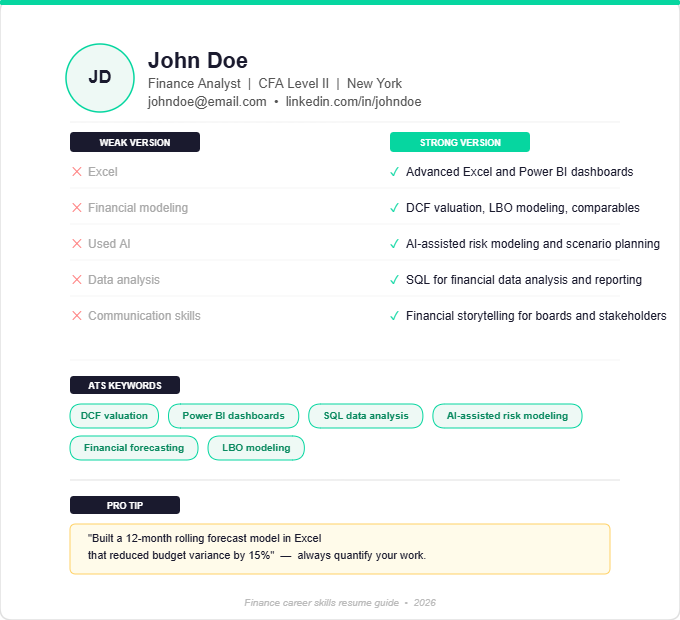
Figure: How your finance skills section should actually look on a resume in 2026.
A Simple 6-Month Upskilling Plan for 2026
Building finance career skills does not have to be overwhelming. Here is a practical quarter-by-quarter approach that works whether you are starting from scratch or filling specific gaps.
Months 1 to 2: Refresh accounting basics, strengthen Excel to an intermediate level and start an introductory financial modeling course.
Months 3 to 4: Move into Power BI or SQL for dashboarding and data analysis. Practice explaining financial data in simple language to non-finance audiences. This builds the storytelling side of your corporate finance skills.
Months 5 to 6: Add Python basics for automation, explore AI-assisted finance workflows and work on stress-testing and scenario analysis. If you are studying for ACCA, CFA or FRM, layer these finance skills into your study plan so they reinforce each other.
People Also Ask about Finance Career Skills
- Which skill is most demanding in 2026?
Data analytics combined with financial modeling is what employers want most right now. If you can also work with AI tools, you are ahead of most candidates.
- Is it still worth building a career in finance in 2026?
Absolutely. Finance roles are growing, salaries remain strong and companies always need people who can manage money well and make smart decisions with data.
- Which skills are actually worth your time in 2026?
Start with Excel, Power BI and basic Python. Then add financial modeling and learn how AI tools fit into everyday finance workflows. That combination is hard to beat.
- What does it actually take to hold your own in a finance career?
You need strong finance career skills like financial analysis, budgeting and risk management, plus the ability to communicate what the numbers actually mean to people who are not finance professionals.
Final Thoughts
Remember that job description we talked about at the start, the one that felt like it was asking for more than you signed up for? That feeling is valid. But now you know exactly what is behind it and what to do about it.
The finance career skills that matter in 2026 build on what you already know. Accounting, modeling, analysis – that is still the core. The tools and data fluency just sit on top of it. Start with one thing this week and actually sit with it long enough to get good. The professionals leading finance teams in five years are building these habits right now. You can be one of them.Whenever you are ready to take the next step, we have a course built around exactly what this guide covers. [Take a Look]
