Four Degrees, One Qualification: How ACCA Exemptions Actually Differ
Picture four students standing at the same starting line. One holds a B.Com , one a BBA, one a CA, one a CMA. They are all about to begin ACCA, but the distance each of them has left to walk is nowher
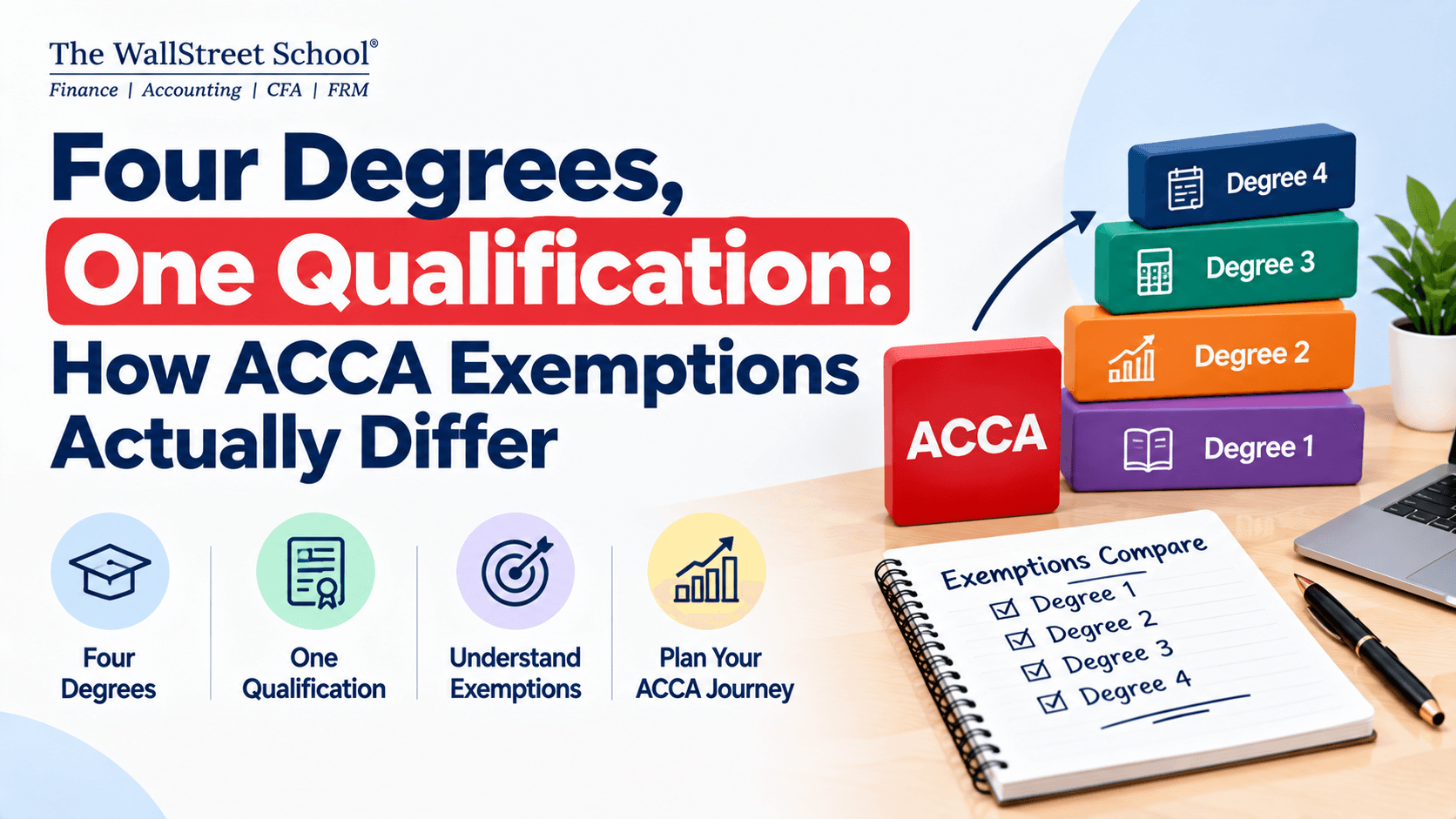
Picture four students standing at the same starting line. One holds a B.Com, one a BBA, one a CA, one a CMA. They are all about to begin ACCA, but the distance each of them has left to walk is nowhere close to equal. Here is exactly how far each path actually takes you.
The Same Finish Line, Very Different Starting Points
Every route eventually leads to the same place, a fully qualified ACCA member. But the number of ACCA Papers you still need to clear depends entirely on what you studied before you got here. ACCA has 13 papers in total, and exemptions can only reduce the first 9, spread across Applied Knowledge and Applied Skills. The last 4, Strategic Professional, stay fixed for every single candidate regardless of background.
This is worth sitting with for a second. No degree, however strong, shortens the final stretch of the qualification. What it shortens is the runway before that stretch begins.
B.Com: A Solid Head Start
ACCA Exemptions BCom graduates receive typically land between 3 and 4 papers, usually Business and Technology, Management Accounting, Financial Accounting, and occasionally Corporate and Business Law. This covers most of Applied Knowledge before you have opened a single ACCA textbook.
ACCA After BCom from a university that carries ACCA accreditation can look noticeably different. Some accredited programs push exemptions up to 5 or 6 papers, since ACCA has already mapped their entire syllabus against its own. Over 80 Indian universities sit on this recognised list as of 2026, so checking your own institution's status is worth ten minutes before you assume the standard range applies to you.
BBA: The Path People Underestimate
ACCA Exemptions BBA graduates get is often the biggest surprise in this comparison. A general BBA, built around management theory rather than accounting, usually earns just 1 exemption, Business and Technology. That leaves 12 of 13 papers still ahead, a genuinely different starting position from B.Com despite both being undergraduate business degrees.
ACCA After BBA improves meaningfully if your specialization was Finance or Accounting and your college has strong ACCA mapping. In those cases, 2 to 3 exemptions become realistic, sometimes stretching into Management Accounting or Corporate and Business Law. The deciding factor is never the degree title, it is how technical and accounting heavy your actual coursework was.
CA: The Shortest Distance to the Finish
ACCA Exemptions CA holders get scales sharply with how far you went in the CA route. CA Intermediate typically earns 5 to 6 exemptions. A fully qualified Chartered Accountant who cleared CA Final gets the maximum possible, 9 exemptions, covering the entirety of Applied Knowledge and Applied Skills in one sweep.
ACCA After CA for someone fully qualified means walking straight into Strategic Professional. Only 4 papers remain, Strategic Business Leader, Strategic Business Reporting, and two option papers. This is the shortest realistic path to ACCA available to any Indian professional today, and it exists because ICAI's technical syllabus already overlaps heavily with ACCA's own content.
CMA: Strong Overlap, One Extra Condition
ACCA Exemptions CMA professionals receive depends on more than just clearing the exams. ICMAI CMAs who complete their finals typically get 7 exemptions outright. Add 5 or more years of relevant work experience, and this can climb to the full 9, putting a CMA in the exact same position as a fully qualified CA.
ACCA After CMA without that experience threshold still leaves most of Applied Knowledge and Applied Skills behind you. The overlap exists because ICMAI's cost and management accounting content shares real technical ground with ACCA's syllabus, not because of any special arrangement between the two bodies.
Why the Highest Number Is Not Always the Right Call
A CA Final holder walking into Strategic Professional with 9 exemptions is genuinely prepared for it, because CA Final itself demands that level of rigor. A B.Com graduate claiming 4 exemptions purely because the ACCA Exemption Calculator allowed it, without real recall of those subjects, can walk into later papers with quiet gaps that surface at the worst possible moment.
This is exactly the kind of judgment call worth making with someone who has actually watched students at every stage of this journey, not just a calculator screen.
At The WallStreet School, mentors go through a student's academic transcript paper by paper, flagging which exemptions are genuinely safe to claim and which ones deserve a second look before locking them in.
Turning Four Different Paths Into One Plan
Whichever degree you are starting from, the process forward looks the same. Run your qualification through the calculator, register with ACCA, submit your transcripts for official confirmation, and let your real exemption count, not your assumed one, shape your study plan. The distance each of these four paths covers is different, but the discipline required to finish strong is exactly the same for everyone.
Frequently Asked Questions
Which degree offers the most ACCA exemptions?
A fully qualified CA gets the maximum possible, 9 exemptions, followed closely by CMAs with sufficient work experience.
Why do BBA graduates get fewer exemptions than B.Com graduates?
BBA programs generally focus on management theory, while B.Com covers the technical accounting content ACCA's early papers require.
Can exemptions ever reduce the Strategic Professional papers?
No. All four Strategic Professional papers must be cleared by every candidate, regardless of qualification or exemption count.
Does work experience affect CMA exemptions specifically?
Yes. ICMAI CMAs typically need 5 or more years of relevant experience to reach the maximum of 9 exemptions.
Should a student always claim the highest number of exemptions available?
Not automatically. If understanding of the underlying subject is weak, sitting that paper again can prevent problems later.
Interested in Learning Finance Professionally?
Our courses take you from fundamentals to expert level — with live mentors and placement support.
Explore Our Courses