FRM Study Materials: What Actually Works Best?
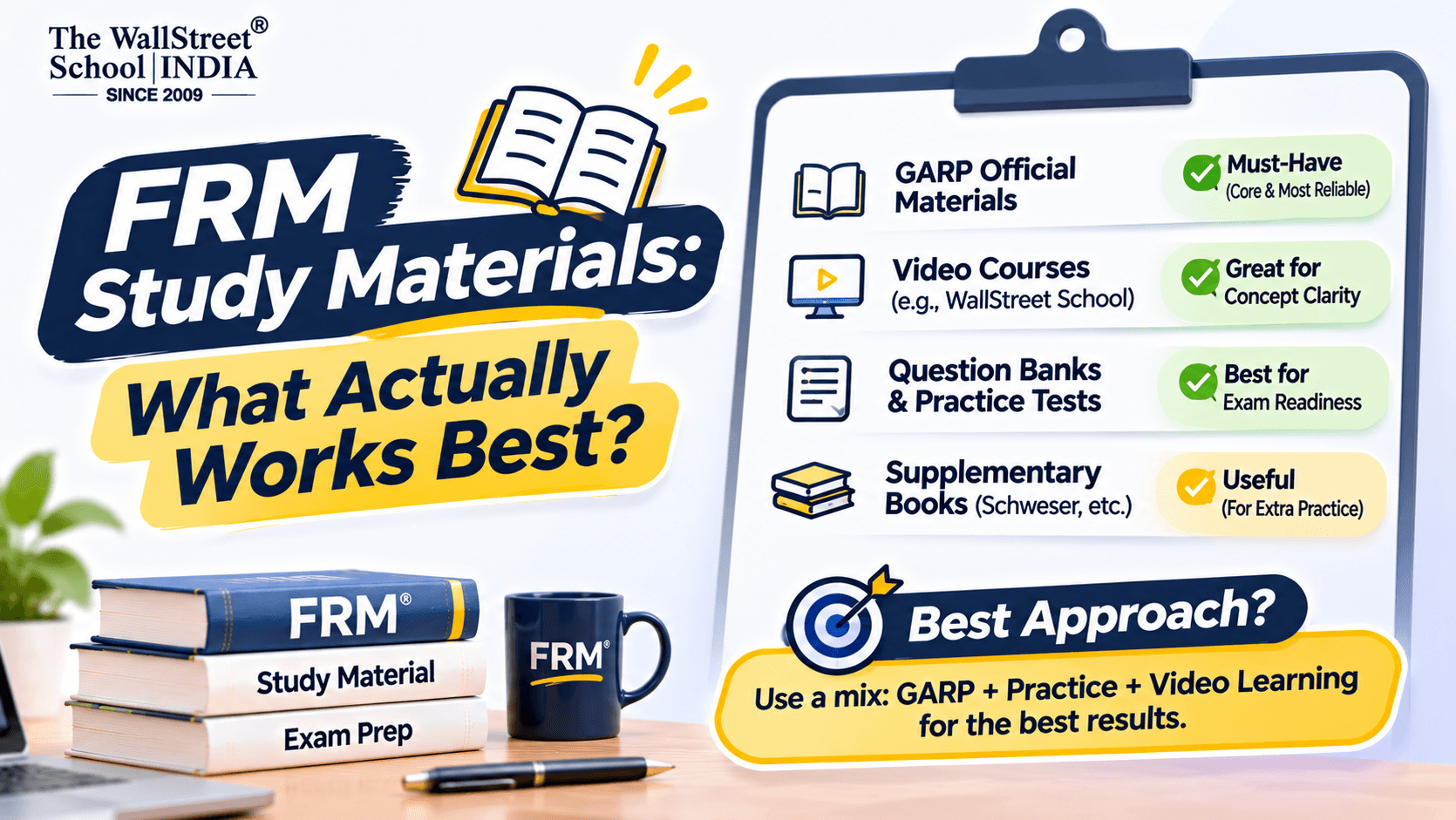
Pass rates improve when candidates go deep on fewer resources not wide across many. The right FRM study materials are: the official GARP curriculum, a question bank and timed full-length mocks. That's the core. Everything else is noise.
Most FRM candidates don't fail because they studied too little. They fail because they studied the wrong things, or spread themselves too thin across a dozen half-used resources.
This guide is different. It's built around what actually produces results in the FRM exam, not what looks impressive on a study plan.
What the FRM Syllabus Actually Covers
Before you pick a single resource, get clear on the FRM syllabus structure. The FRM course, run by GARP, is split into two distinct exams , and they test very different things.
FRM Part 1 is about foundations. You'll cover Quantitative Analysis, Foundations of Risk Management, Financial Markets and Products, and Valuation and Risk Models. Think of it as building your risk vocabulary.
FRM Part 2 shifts to application. Market Risk, Credit Risk, Operational and Liquidity Risk, Investment Management, and Current Issues in Financial Markets. You're expected to use the tools, not just know them.
The syllabus weightings matter here. Heavier topics deserve more of your calendar. Getting this sequencing right early saves you weeks later.
The FRM Study Materials That Hold Up
Here's what candidates who pass consistently have in common: they're selective.
The GARP curriculum is non-negotiable. Every question on the actual exam traces back to it. Third-party notes can supplement it , they can't replace it.
A structured question bank is where understanding gets stress-tested. Passive reading gives you recognition. Practice builds the recall you need under exam pressure.
Concise revision notes work best when used late in preparation, not as a starting point. They compress what you already understand. They can't build understanding from scratch.
Timed mock exams are the closest simulation you have to the real thing. Nothing else trains your pacing or reveals your blind spots quite like a four-hour timed mock.
One pattern consistently separates candidates who pass from those who don't: focus. A crowded study desk doesn't mean a prepared mind.
Right Flow Matters More Than Speed
Part 1 is where the foundation gets built or where it gets skipped. Don't skip it.
The right order for your FRM Part 1 study material:
Quantitative Analysis first. Math underpins almost every other topic. Shaky quant skills will slow you down everywhere else.
Financial Markets and Products second. Build your market fluency before tackling valuation.
Valuation and Risk Models third. This is where theory connects to real pricing logic.
Foundations of Risk Management last. It ties everything together and reads much better once you have context.
This isn't arbitrary. Each topic builds on the previous one. Jump ahead, and you'll find yourself circling back, which costs time you don't have.
FRM Practice Questions: Where Preparation Actually Happens
Here's the honest truth about FRM exam preparation: reading the curriculum is necessary, but it's not sufficient.
FRM exam questions test judgment, not just knowledge. GARP constructs questions designed to distinguish candidates who understand concepts from those who've memorized them. That's a meaningful difference , and it shows up in your score.
Work through FRM practice questions every single day. Not once a week. Every day.
Time each set. The real exam runs at roughly 1.5 minutes per question. If you're not practicing at that pace, you're not preparing for the exam you'll actually sit.
When you find your questions are wrong, stop. Don't just note the correct answer, understand why the logic leads there. That's where real learning happens.
Track your weak areas by topic. Revisit them within 48 hours. Memory degrades fast, and spaced repetition is what makes knowledge stick.
Mock exams deserve their own block of time. Sit one full-length mock under actual exam conditions, no interruptions, strict timing. The discomfort is the point. It exposes gaps you didn't know you had.
A Simple FRM Exam Preparation Strategy That Works
Complicated study plans rarely survive contact with real life. The ones that do share a common structure.
The Main Pillar
Commit fully to authentic study resources
-primary GARP approved source,
-question bank with detailed explanations and
-a set of concise notes for the final revision phase.
THE REPETITION PILLAR
This Pillar says revisit what you get wrong until you get it right
-Flag every incorrect answer.
-Return to flagged answers on a weekly schedule.
-Revise and practise them until the logic becomes instinctive, not forced.
THE SIMULATION PILLAR
Build real exam stamina before exam day.
-Time every practice session from the start.
-Complete at least two full-length mocks before your exam date.
-Treat mock conditions seriously, environment matters.
A scattered approach covers everything and masters nothing. A focused one targets what the FRM exam actually rewards.
Your Next Move
The syllabus doesn't change. The question pool is finite. What changes is how deliberately you use your preparation time.
Stop adding more resources to your list. Start going deeper on the right ones.
Are you building FRM mastery or just building a longer study plan?
Frequently Asked Questions
What are the best FRM study materials for beginners?
Start with the official GARP curriculum. Pair it with a quality question bank from day one. Save summary notes for the revision phase , not the learning phase.
How much does FRM exam preparation typically cost?
It depends on your approach. The GARP curriculum registration comes with a study guide. Adding a third-party FRM course, question bank, or mock exam package increases the total. Costs vary by provider.
How long does FRM Part 1 preparation take?
Most candidates invest several months into FRM Part 1 study material. The exact timeline depends on your quantitative background and how many hours per week you can realistically commit.
What's the biggest mistake candidates make in FRM preparation?
Accumulating too many resources without doing enough practice. Reading without testing creates familiarity , not readiness. FRM exam questions require active recall under time pressure.
Are FRM practice questions more valuable than reading the textbook?
Both matter, but at different stages. The curriculum builds your conceptual foundation. FRM practice questions build your exam-day performance. You need both, in the right order.
Can I pass the FRM without enrolling in a paid FRM course?
Yes. The GARP curriculum plus disciplined self-study is a proven path. A structured FRM course adds value for candidates who need accountability, guided sequencing, or expert doubt-clearing.
Interested in Learning Finance Professionally?
Our courses take you from fundamentals to expert level — with live mentors and placement support.
Explore Our Courses