
Financial Modeling Course vs. Self-Teaching: Which Works Better in 2027?
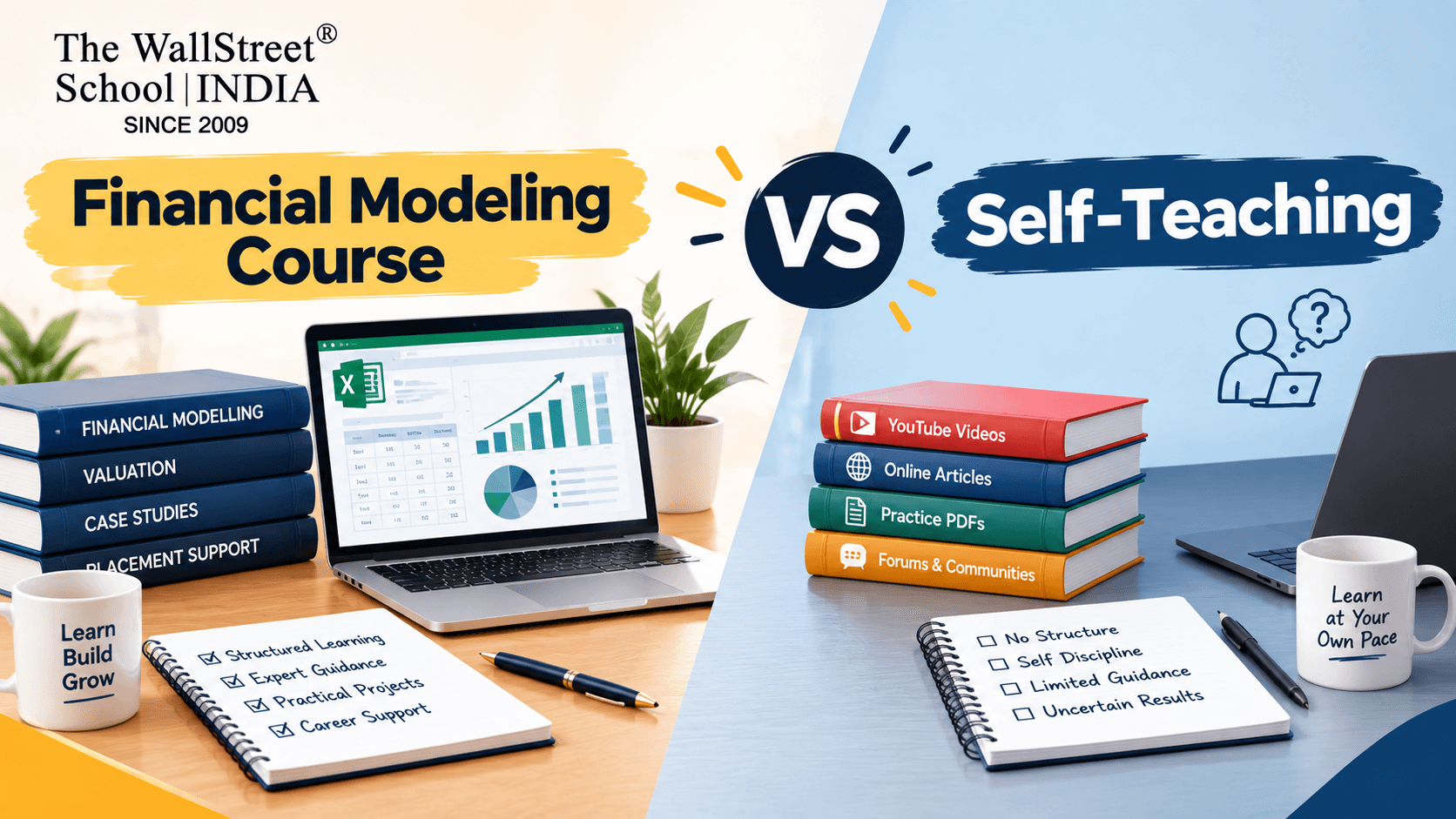
Most people frame this wrong. They think it's course versus no course. But the real question is structured, output focused learning versus random YouTube videos and scattered articles you found at midnight.
Think about it this way. You can technically learn to swim by watching a hundred videos of Olympic swimmers. But you will drown the first time you jump in the pool without a coach correcting your strokes. Financial modelling works the same way.
The Self-Teaching Route Comparison
Let's give self teaching its due credit first, because it does have real upsides.
Pros of Self-Teaching | Cons of Self-Teaching |
|---|---|
Zero cost | Time drain - 60 hours often balloons into 150+ hours |
Complete flexibility on schedule | Logical gaps between accounting, Excel and valuation |
Builds self-reliance and grit | Zero stress testing until it breaks in an interview |
Self teaching isn't a bad choice for everyone though. It really comes down to where you're starting from and what you're aiming for. Some people jump into financial modeling with years of finance classes already behind them, while others start from scratch and just wing it with whatever video ranks first on YouTube. That difference in starting point changes everything about whether self teaching will actually work for you.
Self-Teaching Works Best When:- |
|---|
|
|
|
Paid Financial Modeling Courses Comparison
Now let's talk about what a good, structured financial modeling course actually gives you that free resources usually can't.
Pros of Paid Courses | Cons of Paid Courses |
|---|---|
Structured, logical sequencing from basics to advanced models | Upfront cost, ranging from ₹25,000 to ₹80,000+ |
Portfolio-ready models for resume and LinkedIn | Fixed curriculum, less flexible than learning at your own pace (well, that depends if the course is offline or online) |
Recognized certifications that help pass HR screening | Quality varies a lot, some courses are all theory and no practice |
A good structured course does a lot of heavy lifting that self study just can't replicate. It's not only about the certificate you get at the end, it's about how the learning is organized, what you actually walk away with and how the market perceives it once you start applying for roles.
Red Flags to Avoid:- |
|
|
|
|
Not every paid course is worth your money. If you're not building actual models with your own hands, you're not really learning financial modeling skills, you're just watching a movie about it.
What a Good Financial Modeling Course Should Look Like?
Whether you're a finance student, a fresh graduate, or someone switching careers into FP&A, IB, or PE, the checklist below can save you from wasting money on the wrong course.
Pick something output-driven, meaning by the end you should walk away with an actual clean three statement model, a proper DCF valuation and at least one LBO or M&A model if investment banking or private equity is your goal.
Make sure the financial modeling course online you choose takes somewhere around 60 to 150 plus hours to complete properly. Anything that promises mastery in a 10 hour crash course should raise a red flag immediately. Look for real case studies, ideally involving Indian or global companies, some form of interview preparation covering technical questions and modeling tests and if possible, a community or mentor support system.
A few things consistently show up in the courses that are actually worth the money. Some are extremely technical and widely respected inside banks, usually priced somewhere around 45 to 55 thousand rupees and these tend to suit people who want the deepest possible modeling skills. Others offer a broader finance foundation that works well if you are leaning FP&A or a more generalist path, typically priced between 47 to 80 thousand rupees per year. There are also programs known specifically for strong IB focused modeling and solid interview prep. And then there are India specific programs that include live classes, mentorship and placement support, though these usually run longer, around 6 to 9 months, with a lot more hand holding along the way.
And then there are India specific programs, like the one we (The WallStreet School) offered, that include live classes, mock practices, mentorship and 100 % placement support with real time data, though these usually run longer, around 6 to 9 months, with a lot more hand holding along the way.
Lastly
Whatever you pick, commit to it fully for 3 to 6 months, putting in at least 5 to 8 hours a week of real hands on practice, not passive watching. Use free resources as a supplement, but let one structured source be your core.
In the end, what matters is consistency and practice, not how you learned. The market only cares whether you can open Excel and build a model that holds up under pressure.
So ask yourself honestly how much time you can commit weekly, what your end goal is, whether IB, PE, or FP&A and how much you can invest. Once that's clear, the choice gets simple. Pick one path and actually finish it.
People Also Asked Financial Modeling Course vs. Self-Teaching
Is a financial modeling course worth it or should I just self teach?
Depends on your goal. Self teaching works for basic FP&A roles but a structured financial modeling course saves time and gets you interview ready for IB or PE faster.How long does it take to learn financial modeling on your own?
Realistically 150 plus hours, since trial and error, wrong tutorials and debugging broken formulas eat up way more time than people expect going in.What is the average cost of a good financial modeling course in India?
Most solid programs range between 25,000 to 80,000 rupees, depending on depth, mentorship and whether placement support or live classes are included.Can I get an investment banking job through self taught financial modeling skills?
It's tough but not impossible. You'll need a strong portfolio and real proof of skill, since certifications usually carry more weight with recruiters.What should a beginner learn first in financial modeling?
Start with accounting basics, then move into three statement models before touching DCF or LBO models. Skipping this order creates gaps later.Are online financial modeling certifications actually recognized by employers?
Yes, well known ones are. Recruiters often use them as a quick screening signal, especially when resumes are getting filtered fast in bulk.
Interested in Learning Finance Professionally?
Our courses take you from fundamentals to expert level — with live mentors and placement support.
Explore Our Courses