How Long Does It Actually Take to Learn Financial Modelling?
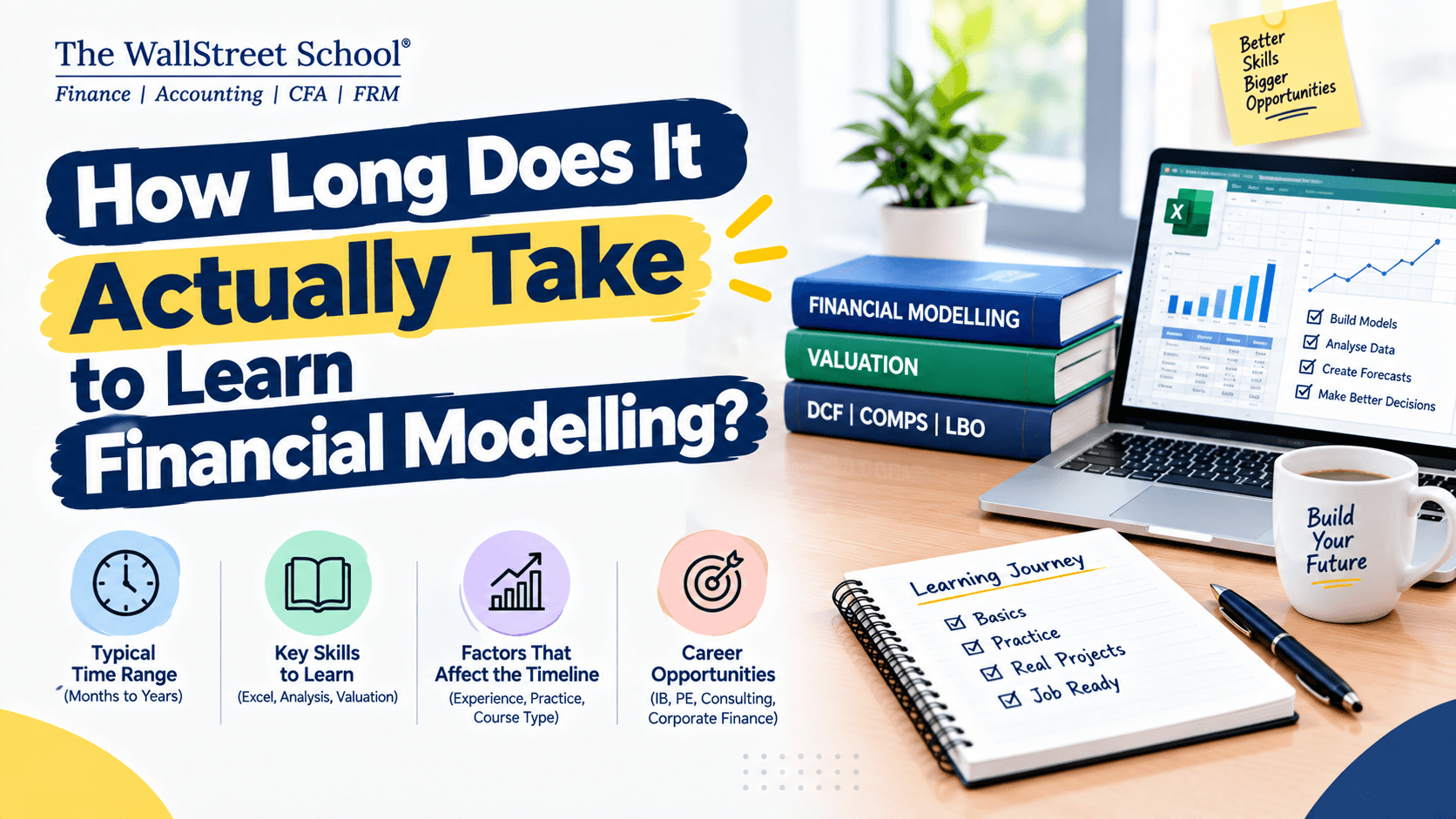
For most beginners, basic financial modelling proficiency takes about 6 to 12 weeks of focused study. If the target is job ready, interview level skill, meaning DCF, three statement modelling, and a basic LBO, that usually takes 3 to 6 months of consistent, deliberate practice.
That is the broad range. Now let us break it down by goal, because "learn financial modelling" means something different to a college student building their first Excel sheet than it does to someone prepping for analyst interviews at a bulge bracket bank. This breakdown is really the clearest way to answer the Financial Modelling Course Duration question for your own situation, rather than relying on one generic number.
Level 1: Just the Basics
If all you want is to understand how models work and build simple ones, this is the fastest level to reach. It usually takes 4 to 8 weeks, or roughly 30 to 60 hours of study, depending on how much time you can put in each week.
At this stage, you will be able to build simple revenue and cost projections, create basic Excel models with scenarios and charts and understand three statement logic at a high level. It is enough to speak the language of finance in meetings and case discussions, but it is usually not enough to clear a technical interview for investment banking, private equity, or equity research roles.
Think of this level as learning enough Spanish to order food, not enough to hold a business negotiation.
Level 2: Job Ready for Analyst Roles
This is where most people aiming for investment banking, equity research, FP&A, or private equity analyst roles need to land. Reaching this level typically takes 3 to 6 months, which works out to around 200 to 300 hours of deliberate, focused practice.
By the end of this stage, you should be able to build fully integrated three statement models from scratch, perform DCF valuation with sensitivity and scenario analysis, understand and construct a basic LBO model and carry out model auditing, error checks and present clean, presentation ready outputs.
Interestingly, many Indian professionals who are studying alongside a job or preparing for CA or CFA exams manage to reach this level in just 3 to 4 months when they follow a structured course and stay consistent with practice. This is a strong argument for choosing a proper Financial Modelling Course Online rather than trying to stitch together random YouTube videos and free PDFs, simply because structure saves time. A good Financial Modelling Course Online also tends to have a clearer view of Financial Modelling Course Duration than self study, because someone has already tested the syllabus on real students.
Level 3: Advanced Mastery
The highest level involves handling complex deals such as M&A accretion and dilution, merger models, project finance, infrastructure modelling, or sector specific models. Some professionals even build in Monte Carlo simulations or advanced scenario testing at this stage.
Reaching mastery generally takes 6 to 12 months or more of real project experience. And here is the honest part nobody likes to hear: mastery does not come from finishing a course. It comes from doing actual deal work, auditing models built by others and repeating the process across enough transactions that patterns start to feel obvious rather than confusing.
So if someone promises total mastery in four weeks, treat that claim with skepticism.
What Actually Affects Your Timeline?
Not everyone moves at the same speed and that is completely normal. A few factors decide how fast you personally will progress.
Where you are starting from matters. Solid accounting knowledge and Excel comfort can cut your learning time. Commerce and finance students generally reach job ready status faster than people from an unrelated background, simply because they are not learning accounting and Excel at the same time.
Weekly hours matter just as much. Someone studying 10 to 15 hours a week can realistically become job ready in about 3 to 4 months. Someone managing only 5 to 7 hours a week, perhaps alongside a full time job, will likely need closer to 5 to 7 months. Neither pace is wrong, it just means your calendar needs to match your ambition.
The learning path you choose changes everything. A structured Financial Modelling Training program, live or self paced, can get you to solid basics in 6 to 10 weeks and to job ready level in about 3 months with regular practice. Self teaching through scattered free resources often stretches that same journey to 4 to 8 months, mostly because nobody is correcting your mistakes early.
Financial Modelling Course for Beginners: Where to Start?
If you are searching for a financial modelling course for beginners, resist the urge to jump straight into DCF and LBO tutorials on day one. Every solid financial modelling course for beginners starts with the fundamentals, Excel comfort and basic accounting logic, before touching a single valuation model. Skipping this step is the main reason people feel lost halfway through and quietly give up.
How to Do Financial Modelling the Smart Way?
If there is one lesson buried in all of this, it is that how to do financial modelling well has less to do with talent or time and much more to do with structure and consistency. People who follow a clear syllabus and build real projects consistently outpace people relying purely on motivation and scattered resources.
Financial modelling skills are not built overnight and that is fine, because nobody expects them to be. What matters is picking a realistic timeline based on your starting point and weekly availability, then sticking to it.
The WallStreet School is one such institute that offers a structured financial modeling course built around this exact roadmap, which is worth exploring if you would rather follow a tested path than figure it out on your own.
People Also Ask About Financial Modelling Course Duration
How long does a financial modelling course take to complete? Most financial modelling courses take 3 to 4 months for job ready skills, though basics can be picked up in 6 to 8 weeks.
Is financial modelling hard to learn for beginners? Not really. With consistent practice and a structured course for beginners, most people build solid Excel and valuation skills within two to three months.
What is included in a financial modelling course syllabus? A typical syllabus covers Excel basics, three statement modelling, DCF valuation, comps and LBO fundamentals, ending with real case studies and mock interviews.
Can I learn financial modelling through an online course? Yes, a good online course works well if it includes structured lessons, practice files and mentor feedback, matching the pace of in person training.
Does financial modelling help in getting a finance job? Strong financial modelling skills are highly valued in investment banking, equity research, and FP&A roles and often decide who clears the technical interview.
Lastly
There is no single correct answer to how long financial modelling takes, because it genuinely depends on your starting point, your weekly hours and how you choose to learn. Basic comfort with models might take you a couple of months. Interview ready skill for analyst roles usually needs a solid 3 to 6 months of focused work. True mastery is a longer game, built through real deals over 6 to 12 months or more.
The good news is that with a clear plan and a bit of consistency, this is one of those finance skills where steady effort really does compound. Pick your target level, be honest about how many hours you can commit each week, and choose a learning path that keeps you accountable instead of leaving you to figure it all out alone.
Interested in Learning Finance Professionally?
Our courses take you from fundamentals to expert level — with live mentors and placement support.
Explore Our Courses