Fresh Issue vs OFS: Why It Matters to Investors
Two companies launch their IPO on the same day. Both raise Rs 1,000 crore. One uses every rupee to build new plants and clear its debt. The other doesn't get a single rupee. Its existing owners walk away with the cash.
Both are real IPOs. Both are legal. Yet the difference between them is one of the most useful things a first-time investor can learn. It's called a fresh issue vs OFS. It tells you where your money goes once you press the apply button. We'll explain it in plain words, with one simple example
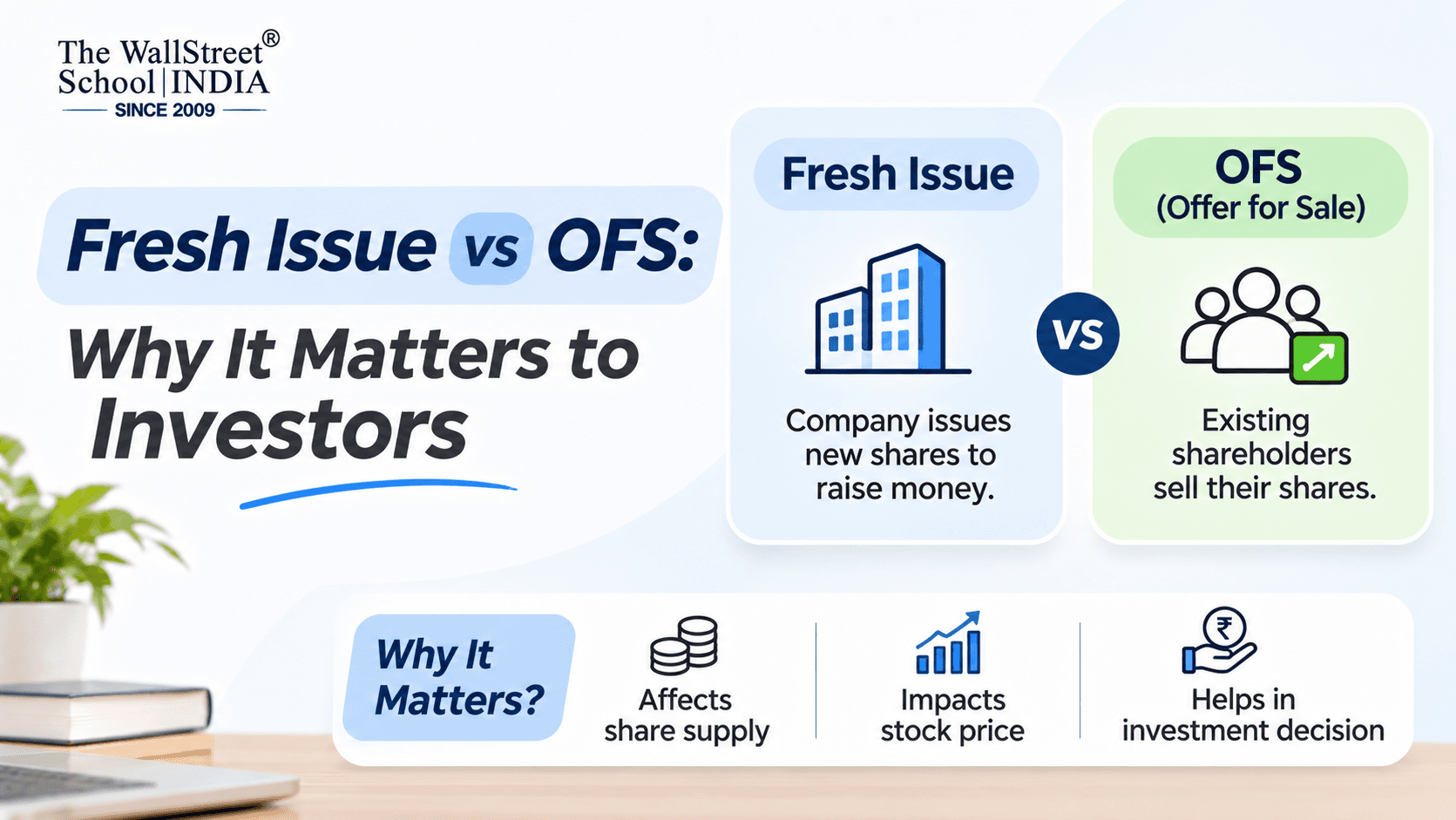
Fresh issue means when the company creates new shares and sells them. The money goes into the company.
Offer for sale (OFS) happens when existing shareholders sell shares they already own. The money goes to them, not to the company.
Most IPOs have a bit of both. The split is printed in the offer document and it's the first thing we'd check.
So before asking if this IPO is good, first understand who gets the money?
Lets understand through the Swiggy way
When Swiggy went public in November 2024, two things happened inside the same IPO.
Fresh issue: Swiggy created new shares and sold them. That money went into the company, for things like technology, brand marketing and debt repayment.
Offer for sale: Early investors who already owned Swiggy shares sold part of their holding to the new public investors. That money went to those investors. Swiggy got nothing from this part.
Same IPO, same price but different results for the company. That's the heart of a fresh issue IPO VS an OFS. We'll put exact numbers on it in a moment.
This means a fresh issue can help a business grow. An OFS, by itself, can't help.
Swiggy's Rs 11,327 crore IPO and two ways it could have gone
Let’s put real numbers on this. For the rest of the blog we’ll follow Swiggy’s IPO, which opened in November 2024. All figures are as reported around the time of the issue
Before the IPO, Swiggy had about 212.31 crore shares.
The issue price was Rs 390 per share.
The total IPO size was Rs 11,327 crore.
Swiggy didn't raise that money in one go. It split it into two parts.
Fresh issue: 11.54 crore new shares at Rs 390. That put Rs 4,499 crore into the company, before issue costs.
OFS: Existing investors sold 17.51 crore shares they already owned. That's Rs 6,828 crore. It went to the sellers. Swiggy didn't see a rupee of it.
After the IPO: the share count rose to about 223.8 crore. That's an increase of roughly 5.4%.
Let's say Swiggy still raised the same Rs 11,327 crore at the same price, but split it differently. The first row below is what really happened. The other two rows are just our “what if” cases.
Version | Fresh issue in cr. | OFS in cr. | Cash into the company in cr. | Cash to selling shareholders in cr. | Shares after IPO in cr. |
Swiggy as it happened | 4,499 | 6,828 | 4,499 | 6,828 | about 223.8 |
What if it were all fresh issue | 11,327 | 0 | 11,327 | 0 | about 241.3 |
What if it were all OFS | 0 | 11,327 | 0 | 11,327 | 212.3 |
Look at the last row. Investors would still have paid Rs 11,327 crore. Swiggy's bank balance wouldn't have moved and neither would the share count. Only the owners would have changed.
This suggests that the headline IPO size tells you how much investors paid. It doesn't tell you how much the company received.
Difference between Fresh issue and OFS
Fresh issue | Offer for sale (OFS) | |
Who sells the shares | The company, by creating new shares | Existing shareholders such as promoters and early investors |
Where the money goes | Into the company | To the selling shareholders |
Total shares after IPO | Goes up | Stays the same |
Existing owners' stake | Gets diluted (a smaller percentage) | Changes hands, but the total doesn't grow |
Company's balance sheet | More cash or less debt | No change |
What it usually signals | The business needs money to grow or repay debt | Owners want to cash out or the business doesn't need funds |
Where to read about it | "Objects of the Issue" section | "Selling Shareholders" section |
Why companies pick one route or the other?
Everything happens for a reason. When companies go for a fresh issue when they need money for something specific:
-Building a new plant or expanding capacity
-Paying off loans, which cuts interest costs
-Funding day-to-day working capital
-Buying another business
Selling shareholders go for an OFS when they want to take some money off the table:
-A private equity or venture fund that invested years ago wants its exit
-Founders want to cash out a small slice of what they built
-The business is already well funded and doesn't need fresh capital
Most IPOs mix the two. A pure OFS isn't a bad thing, also a pure fresh issue isn't a guarantee of any success either. Don't judge the route only, focus on the reason behind it.
Five well-known IPOs, five different splits
Understanding through Real names makes it stick. Here are five popular IPOs most Indian investors have heard of, with the split as reported around each issue.
IPO | Year | Total size (in crore) | Fresh issue (in crore) | OFS (in crore) | Who got the money |
Zomato | 2021 | 9,375 | 9,000 | 375 | Mostly the company. Info Edge sold a small slice |
Paytm (One97) | 2021 | 18,300 | 8,300 | 10,000 | Sellers got more than the company |
Swiggy | 2024 | 11,327 | 4,499 | 6,828 | A mix that leaned towards the sellers |
Hyundai Motor India | 2024 | 27,870 | 0 | 27,870 | All of it went to the Korean parent |
LIC | 2022 | 20,557 | 0 | 20,557 | All of it went to the government |
Each one worked differently, so this implies the split doesn’t tell you if the share price will go up or down. It only tells you who got the money
How to read the split before you apply
Mostly fresh issue, with clear uses: The company is raising money to grow or to cut debt. Check that the plan is believable. Paying off loans is easy to verify. A vague growth story isn't.
Mostly OFS: The business may not need the money or the sellers want out. Ask who is selling and how much of their own holding they're selling.
Promoters selling heavily: Compare what they sell with what they own. A small slice is routine. A large chunk of their stake deserves a question.
Early investors selling: A private equity fund exiting after several years is normal. It's not a verdict on the business.
Lots of general corporate purposes": This is a catch-all bucket. It can hide a lack of plan. SEBI caps it, but it's still worth reading.
As we talked about Swiggy, about 40% of its IPO was fresh issue and 60% was OFS. That leans towards the sellers. The questions to ask are what the Rs 4,499 crore will do and why early investors want out now.
5 mistakes investors make:
Reading the headline size as the company's raise. A Rs 1,000 crore IPO doesn't mean Rs 1,000 crore reached the company. Half of it may be OFS. Then the company got far less.
Treating every OFS as a red flag. Early investors have to exit somewhere, after all. A big OFS isn't automatically bad. It just needs an explanation.
Ignoring dilution. A fresh issue adds shares, so check earnings per share on the post-IPO count, not the old one.
Skipping the "Objects of the Issue" section. It tells you, line by line, what the new money is for.
Judging an IPO only by subscription numbers. A heavily subscribed IPO can still send most of its money to the sellers. Heavy demand says nothing about that.
Most of these mistakes can be avoided if you read one page of the offer document.
Where to find the split?
You don't need any special access. It's all public.
Offer document: The red herring prospectus (RHP) has a summary near the front called "The Offer". It shows the fresh issue amount and the OFS amount separately.
Objects of the Issue: This section, also called Objects of the Offer, lists how the fresh money will be used.
Selling shareholders: The document names each seller and the number of shares they're offering.
Exchange and broker pages: The BSE and NSE IPO pages and most broker apps show the fresh issue and OFS sizes before you apply.
Spend five minutes on these sections before you put money in.
FAQs
Q1. What is the meaning of OFS in an IPO?
OFS stands for offer for sale. It's the part of an IPO where existing shareholders sell shares they already own to new investors. The money goes to those shareholders and not to the company.
Q2. What is a fresh issue IPO?
It's an IPO where the company creates new shares and sells them to the public. The money raised goes into the company and is used for the purposes listed in the offer document.
Q3. Is an IPO with only OFS bad?
Not necessarily. Early investors and promoters have valid reasons to sell. But the company gets no new money, so ask why the sellers are leaving now and whether the business needs funds.
Q4. Does a fresh issue reduce the value of existing shares?
It increases the number of shares, so each existing owner's percentage falls. Whether the value per share falls depends on what the company earns with the new money. Good use of funds can more than make up for the dilution.
Q5. Where can I check the split before applying?
Look at "The Offer" summary in the red herring prospectus. The BSE and NSE IPO pages and most broker apps show it too.
Q6. Which well-known IPOs were entirely OFS?
Hyundai Motor India in 2024 and LIC in 2022 were both pure offers for sale. In each case the company itself received none of the proceeds.
Read Before You Invest -
Reading an offer document is a skill that gets easier with practice. At The WallStreet School, we teach it as part of our finance programs, from CFA to Financial Modeling to Value Investing. Before you pick your next IPO or your next Course, speak with our counselling team. We'll help you choose the path that fits you. Contact us at www.thewallstreetschool.com
Interested in Learning Finance Professionally?
Our courses take you from fundamentals to expert level — with live mentors and placement support.
Explore Our Courses