Why Do PE Firms Use Debt to Buy Companies?
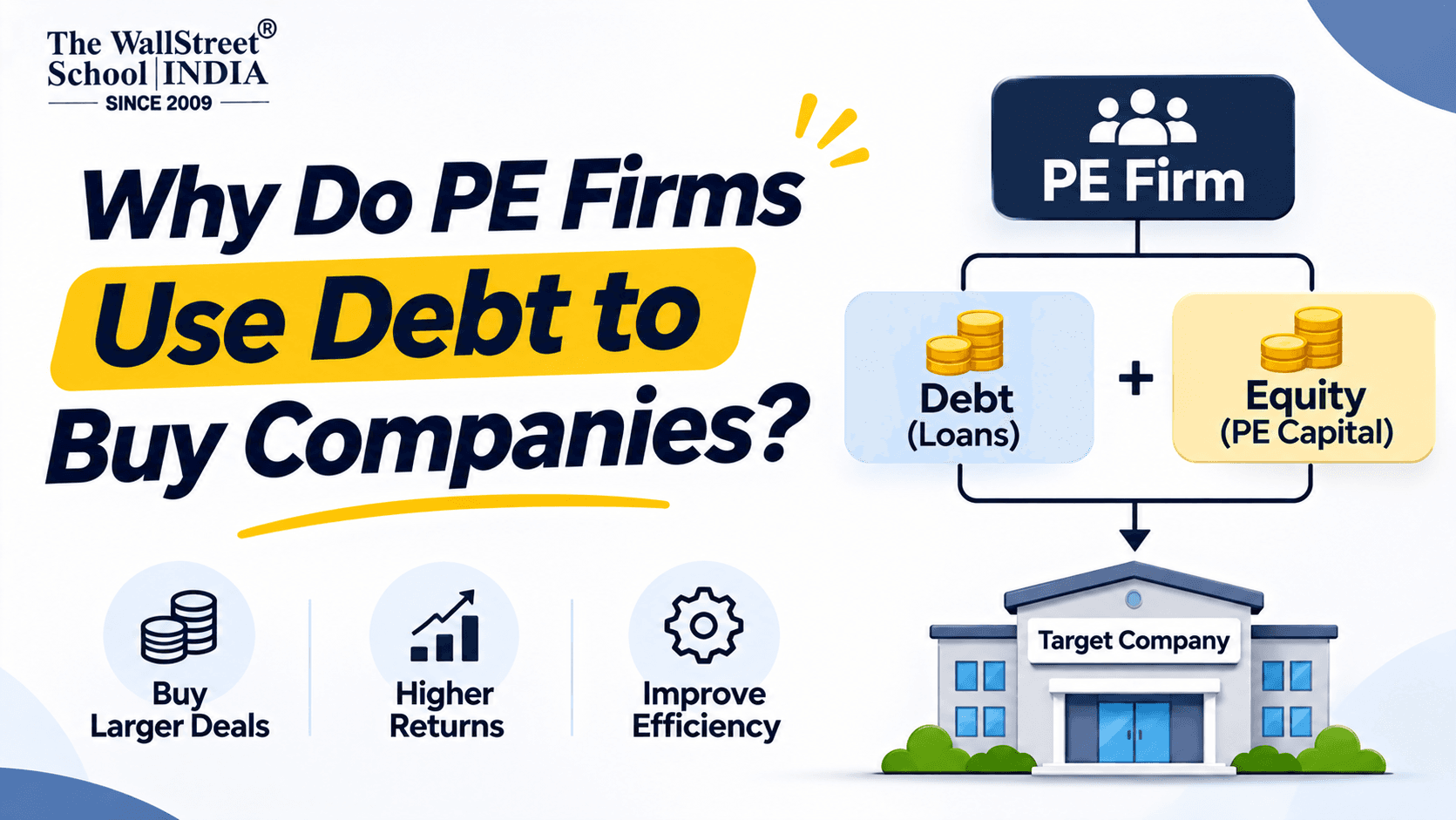
In The Sims, there's a famous cheat code that instantly hands you a pile of cash so you can build the mansion you could never afford on a starter salary. Private equity firms don't have a cheat code, but they do have the next best thing: borrowed money. Instead of paying for an entire company out of their own pockets, they bring in lenders to fund most of the bill, then use the company's own cash flow to pay it back.
That's the basic idea behind a leveraged buyout, and it raises two questions every finance student eventually asks. Why do PE firms lean on debt so heavily? And how do you keep track of where all that money comes from and where it goes? The second answer is a tidy little table called sources and uses. Let's tackle both, with one worked example and no jargon hangover.
The Big Question: Why Use Debt at All?
If you've got billions to invest, why not just pay cash? There are four good reasons, and they explain nearly every LBO financing decision.
1. Debt Amplifies Returns
This is the headline reason. Imagine buying an asset for $100 that later sells for $130.
All equity: You invest $100 and make $30, a 30% return.
With 60% debt: You invest $40 and borrow $60. You still make $30, but now on just $40 of your own money, a 75% return (before interest costs).
Same asset, same gain, dramatically different result for the investor. Think of it as the Pac-Man effect: a little power-up lets you gobble up much more than you could on your own. That's the core appeal of debt in LBO deals.
2. Interest Is Tax-Deductible
Interest payments generally reduce a company's taxable profit, creating what's called a tax shield. If a company pays $20 million in interest and faces a 25% tax rate, that deduction can save roughly $5 million in taxes. Dividends to equity holders don't get this treatment. Debt is simply cheaper, after tax, than equity.
3. It Frees Up Capital for More Deals
A firm that puts $400 million of its own cash into one company can only do one deal. A firm that puts in $185 million can spread the rest across other investments. It's the Eras Tour logic: nobody wants to buy one ticket when the same budget could get you into multiple shows.
4. Debt Creates Discipline
Regular interest and principal payments force management to focus on cash generation. There's less room for lazy spending when a lender expects a payment on schedule. Many sponsors see this pressure as a feature, not a bug.
The Catch: Debt Cuts Both Ways
Borrowing isn't free money. High debt means fixed payments regardless of how the business performs. If earnings fall short, covenants can be breached, refinancing can become hard, and in the worst cases the company can end up in distress. That's why private equity debt is typically used on stable, predictable businesses and why a careful LBO model is non-negotiable.
Like the Candy Crush player who thinks one more move will fix everything, over-leveraging works fine right up until it very much doesn't.
Enter Sources and Uses
Now to the tool that keeps this all organized. Sources and uses is simply a funding table showing:
Uses: where the money is going (what you're spending it on)
Sources: where the money is coming from (how you're paying for it)
The golden rule: total sources must equal total uses. Always. If they don't balance, something's wrong. This is the sources and uses of funds statement at the heart of every LBO.
What Goes Into the Uses Side?
Typical uses include:
Purchase of equity: what's paid to the company's shareholders
Refinancing existing debt: old loans usually get repaid when control changes
Transaction fees: advisory, legal, and due diligence costs
Financing fees: what lenders charge to arrange the debt
Cash to the balance sheet: sometimes added to ensure the business has operating cash
What Goes Into the Sources Side?
Typical sources include:
Senior debt: term loans, usually secured and the cheapest form of borrowing
Subordinated debt or notes: riskier, higher-priced debt that ranks behind senior lenders
Sponsor equity: the private equity firm's own money
Management rollover: executives reinvesting part of their proceeds to keep skin in the game
Sometimes: seller notes or existing cash on the balance sheet
A Worked LBO Sources and Uses Example
Let's put real numbers on it. Suppose a PE firm wants to buy a company with:
EBITDA: $50 million
Purchase multiple: 8x EBITDA, so enterprise value is $400 million
That $400 million breaks down as $340 million paid to shareholders plus $60 million to repay existing debt. On top of that, the deal carries $5.5 million in advisory fees and $4.5 million in financing fees (2% of the new debt).
The new debt package: $150 million senior term loan and $75 million senior notes, totaling $225 million, or 4.5x EBITDA.
Here's the sources and uses table:
Uses | $M | Sources | $M |
Purchase of equity | 340.0 | Senior term loan | 150.0 |
Refinance existing debt | 60.0 | Senior notes | 75.0 |
Advisory and transaction fees | 5.5 | Sponsor equity | 170.0 |
Financing fees | 4.5 | Management rollover | 15.0 |
Total uses | 410.0 | Total sources | 410.0 |
Notice how it balances perfectly. The equity cheque is the plug: total uses of $410 million minus $225 million of debt leaves 185 million of equity between the sponsor (170 million) and management ($15 million).
The capital structure works out to roughly 55% debt and 45% equity. That's the picture every lender, investor, and analyst looks at first.
What Happens Next?
Let's say the company grows EBITDA to $65 million over five years, and the sponsor sells at the same 8x multiple for $520 million. Assume the company's cash flow pays debt down to $115 million. Then:
Exit equity value: $520M - $115M = $405M
Return on $185M invested: about 2.2x, or roughly 17% a year
That's the payoff of the structure: a business that grew modestly, a debt load that shrank steadily and equity holders who captured the difference. These are simplified assumptions, but they show how the LBO sources and uses setup feeds directly into returns.
Why Sources and Uses Matters in an LBO Model
In a full LBO model, the sources and uses table is the starting point for everything:
It determines how much equity the sponsor must invest
It sets the opening debt balance that feeds the debt schedule
It drives interest expense and cash flow projections
It shapes the final returns (IRR and multiple of money)
Change the leverage, and the equity cheque changes, which changes the returns. That's why analysts flex this table constantly when testing deal structures. It's the Netflix recommendation engine of the model: tweak one input, and everything downstream rearranges itself.
Common Mistakes to Avoid
Beginners tend to trip over a handful of things:
Forgetting fees, which quietly inflate the uses
Not repaying existing debt, which often has to be refinanced at closing
Letting sources and uses go out of balance, a classic modeling error
Using unrealistic leverage, assuming lenders will provide more debt than the business can support
Treating equity as the leftover without checking it makes sense, since a sponsor can only invest what it's actually willing to commit
How Much Debt Is "Too Much"?
There's no universal number. Lenders look at leverage ratios (debt to EBITDA), interest coverage (EBITDA to interest), and the stability of cash flows. Stable, cash-rich businesses can support more debt. Cyclical or capital-hungry ones can't. Market conditions matter too: when credit is cheap and plentiful, deals tend to get more leveraged, and when it tightens, equity cheques grow.
Where TWSS Comes In
Reading about sources and uses is a good start. Building one correctly inside a live LBO model, then explaining the logic in an interview, is where candidates separate themselves. This is where The WallStreet School adds real value. Its training takes learners through building LBO models from scratch, including the sources and uses table, debt schedules and returns analysis, using realistic case studies and guidance from trainers with real industry exposure. Instead of memorizing definitions, you practice the exact exercises that recruiters use in modeling tests. For anyone aiming at private equity, investment banking or corporate finance, that hands-on repetition is what turns concepts into skills.
The Takeaway
PE firms use debt because it magnifies returns, creates a tax shield, preserves capital for other deals, and keeps management disciplined. The sources and uses table is how they keep the whole thing honest, showing exactly what's being paid for and exactly who's paying. Get comfortable with that table, and the rest of the LBO model starts to make sense.
Just remember the Sims lesson: a pile of borrowed cash builds an impressive mansion, but someone still has to pay the bills. In a leveraged buyout, that someone is the company, and the model had better show it can.
FAQs
1. Why do private equity firms use debt to buy companies?
Debt boosts returns on the equity invested, offers a tax shield because interest is deductible, and lets firms spread capital across more deals. It also adds discipline by requiring regular payments from the company's cash flow.
2. What is a sources and uses table in an LBO?
It's a funding table that lists where the money for a deal comes from (debt, sponsor equity, rollover) and where it goes (purchase price, debt refinancing, fees). Total sources must always equal total uses.
3. How much debt do PE firms typically use in an LBO?
It varies by industry, company stability, and credit market conditions, but debt often makes up roughly half or more of the total funding. Lenders look at ratios like debt to EBITDA and interest coverage to decide how much is reasonable.
4. What types of debt are used in a leveraged buyout?
Common types include senior term loans, senior or high-yield notes, and subordinated or mezzanine debt. Senior debt is cheaper and ranks first for repayment, while junior debt costs more because it carries greater risk.
5. What are the risks of using debt in an LBO?
High debt creates fixed payment obligations that can strain the company if earnings fall, leading to covenant breaches or financial distress. That's why LBOs usually target stable, cash-generative businesses.
Interested in Learning Finance Professionally?
Our courses take you from fundamentals to expert level — with live mentors and placement support.
Explore Our Courses