What is an LBO? Leveraged Buyout Explained With a Simple Example
Picture a game of Monopoly where you don't have enough cash to buy Park Place, so you borrow most of the money from the bank, buy it anyway, collect the rent every lap, and use that rent to pay the bank back. By the end of the game, you own a prime property while barely having spent your own cash. Sounds sneaky. It's also, in spirit, exactly how an LBO works.
If you've been hearing the term thrown around in finance interviews, deal news or that one cousin's dinner-table flex, this blog will make it click. We'll cover the LBO meaning, walk through a clean leveraged buyout example with actual numbers, and finish with why this deal structure keeps showing up in every serious finance conversation.
LBO Meaning: The Plain English Version
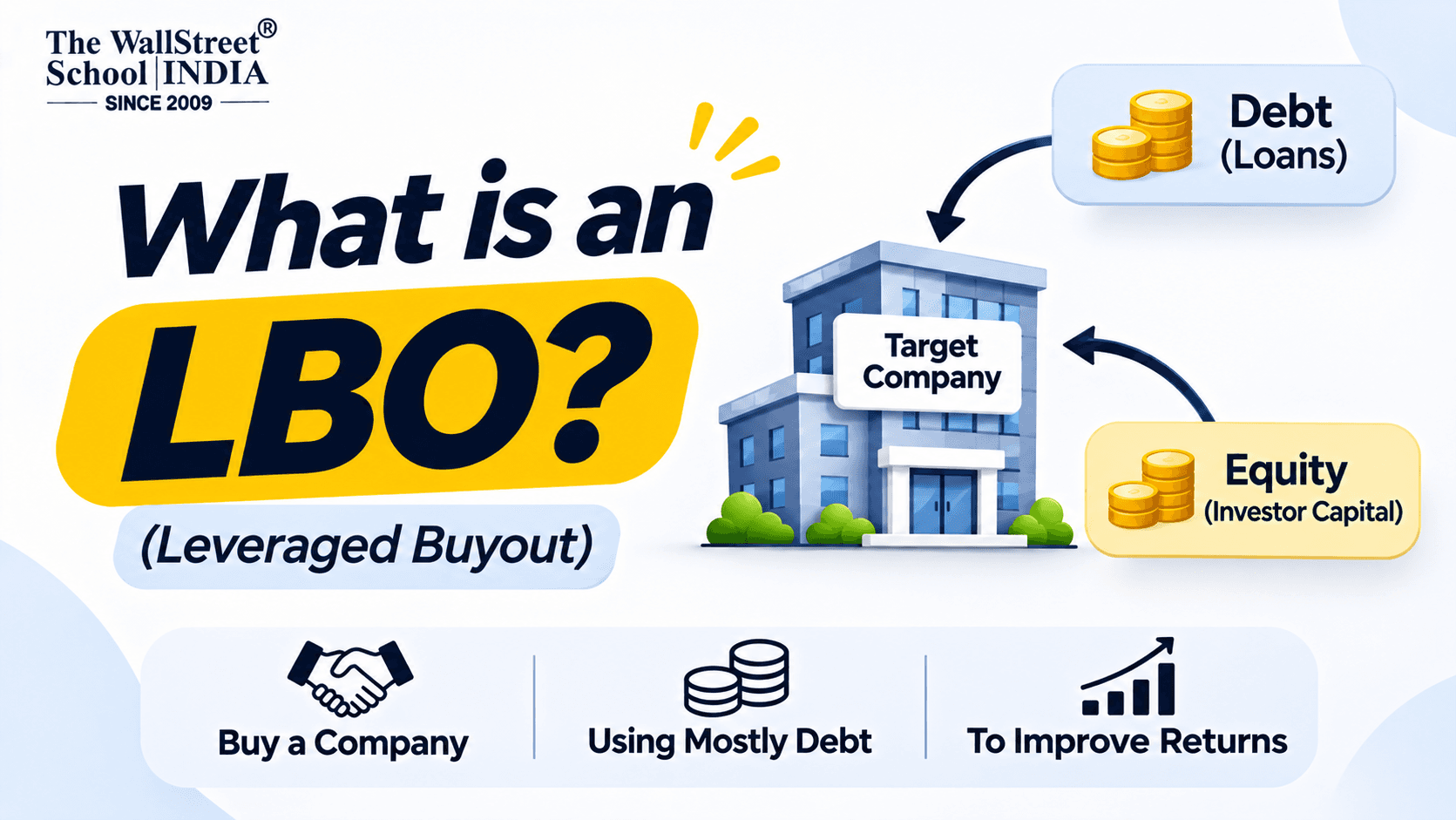
LBO stands for leveraged buyout. It's a way of acquiring a company where a large chunk of the purchase price is funded by borrowed money (debt) and only a smaller part comes from the buyer's own cash (equity). The company being bought typically becomes the one responsible for repaying that debt, using its own cash flows.
So the LBO meaning boils down to three ideas:
Buy a company using mostly borrowed money
Use the company's own earnings to pay down that debt over time
Sell the company later at a higher value and keep the profit
The buyer is usually a private equity firm, and the whole thing is built around one goal: turning a smaller equity cheque into a much bigger payout.
The House Analogy (Because Everything Makes More Sense With a House)
Think about buying a rental flat. You put down 30% of the price and take a home loan for the rest. Tenants pay rent, and that rent covers your EMI. Years later, you sell the flat for more than you paid, repay the remaining loan, and pocket the difference.
You didn't need the full price upfront and the property effectively paid for itself. A leveraged buyout is this exact idea, just applied to an entire company instead of a flat, and with much bigger numbers.
Why Use So Much Debt?
Here's the key insight, and the reason bankers love this topic: debt amplifies returns. When you borrow cheaply and the asset grows in value, your own money earns far more than it would if you'd paid everything in cash. It's the Toy Story logic of "to infinity and beyond," except the beyond comes from leverage rather than a space suit.
The flip side? If the company stumbles, that same debt amplifies losses too. That's why lenders and sponsors only back LBOs for businesses with stable, predictable cash flows.
A Simple LBO Example With Real Numbers
Time for the part you came for. Let's walk through a clean LBO example, using round figures so the math stays easy.
The setup: A private equity firm wants to buy a steady, profitable company called "SnackCo."
SnackCo's yearly EBITDA (a proxy for operating cash profit): $20 million
Purchase price: 5x EBITDA = $100 million
How the buyer pays for it:
Debt (borrowed): $60 million
Equity (the firm's own money): $40 million
The plan: Hold SnackCo for five years, improve operations, use its cash flow to repay debt, then sell.
Year 5: What Happens
Over five years, the business grows. Suppose:
EBITDA rises from $20 million to $30 million
Cash generated by the business is used to repay $30 million of the debt, leaving $30 million still owed
The firm sells SnackCo at the same 5x multiple: 5 x $30 million = $150 million
The Payout
Here's the sale math:
Item | Amount |
Sale price (enterprise value) | $150 million |
Less: remaining debt | $30 million |
Equity value to the buyer | $120 million |
The firm put in $40 million and gets back $120 million. That's a 3.0x return on its money over five years, which works out to an annual return (IRR) of roughly 25%.
The Magic Moment: Compare It to Paying All Cash
Now imagine the firm had paid the full $100 million in cash with no debt. At sale, they'd receive $150 million, a 1.5x return, or roughly 8% a year.
Scenario | Money Invested | Money Returned | Multiple | Approx. Annual Return |
With debt (LBO) | $40 million | $120 million | 3.0x | - 25% |
All cash | $100 million | $150 million | 1.5x | - 8% |
Same company, same growth, same sale price. The only difference is leverage, and it more than tripled the annual return. That, right there, is why this structure exists. This leveraged buyout example shows the whole trick in one table.
Where Did the Extra Value Come From?
Worth pausing here, because it's a favorite interview question. In the LBO example above, returns came from three sources:
Debt paydown: The company's cash flow reduced what was owed, so more of the sale price flowed to equity.
Earnings growth: EBITDA grew from $20 million to $30 million, lifting the company's value.
Leverage effect: Using debt meant a smaller equity cheque produced a bigger percentage gain.
Real deals can also benefit from multiple expansion (selling at a higher multiple than you bought), but conservative models often assume the exit multiple stays the same, as we did here.
What Makes a Good LBO Candidate?
Not every company is a fit. Sponsors typically look for businesses with:
Stable, predictable cash flows so debt payments are safe
Strong market position that protects earnings
Low capital needs, leaving more cash for debt paydown
Room for improvement, such as cost savings or growth levers
A clear exit route, like a sale or public listing
A volatile startup burning cash is a terrible candidate. A dependable snack-maker with loyal customers? Much better.
The Risks Nobody Puts on the Poster
Like Kevin McCallister setting traps in Home Alone, an LBO only works if every piece holds together. Things that can go wrong:
Earnings fall short, making debt hard to service
Interest rates rise, increasing borrowing costs
Economic downturn hits the business just when debt is heaviest
Overpaying at entry, leaving no margin for error
When it goes wrong, it can go very wrong, and some famous deals have ended in bankruptcy. That risk is exactly why the discipline of building a careful financial model matters so much.
A Famous Real-World Reference
If you want the dramatic version, look up the 1989 buyout of RJR Nabisco, one of the most talked-about deals in finance history, immortalized in the book and film Barbarians at the Gate. It's a vivid reminder that LBOs combine spreadsheets with serious boardroom drama.
Why LBOs Matter for Your Finance Career
If you're aiming for investment banking, private equity, or corporate finance, the LBO model is a rite of passage. Interviewers regularly ask candidates to walk through one, sometimes even build a simple version on the spot ("paper LBO"). Understanding the logic, not just memorizing steps, is what separates strong candidates from average ones.
A typical LBO model includes:
Purchase price and financing structure (debt vs equity)
Projected income statement and cash flows
Debt schedule showing repayments over time
Exit assumptions and returns analysis (IRR and multiple of money)
Learning LBO Modeling the Right Way
Reading an explainer like this gets you the concept. Building the model yourself is what makes it stick. That's where practical training earns its place, and where The WallStreet School really shines. The WallStreet School teaches financial modeling through hands-on, live case studies, including full LBO builds where you create the debt schedule, project the cash flows, and calculate returns from a blank spreadsheet. Instead of memorizing definitions, you practice the same exercises recruiters throw at candidates, with mentors who've worked on real deals guiding you. If you want to walk into an interview able to explain an LBO and build one without panicking, structured training like TWSS's is a seriously smart way to get there.
The Takeaway
An LBO is simply buying a company with mostly borrowed money, letting the company's own cash flow repay that debt, and selling later for a profit. Our SnackCo example showed how a $40 million equity cheque became $120 million thanks to growth, debt paydown and leverage, while the all-cash version barely made a third of that annual return.
It's clever, powerful and a little bit dangerous, which is exactly why finance people can't stop talking about it. Now you can join the conversation and maybe even win the dinner-table debate.
FAQs
1. What is an LBO in simple terms?
An LBO, or leveraged buyout, is when a company is bought using mostly borrowed money, with the acquired company's cash flows used to repay the debt. The buyer then sells the company later, aiming for a profit on a small equity investment.
2. How does a leveraged buyout work?
A buyer, usually a private equity firm, funds a purchase with a mix of debt and equity. The company's earnings pay down the debt over several years, after which the firm sells the business and keeps what's left after repaying remaining debt.
3. Can you give a simple LBO example?
Yes: a firm buys a company for $100 million using $60 million of debt and $40 million of equity. After five years of growth and debt repayment, it sells for $150 million, repays $30 million of remaining debt, and receives $120 million, a 3x return on its equity.
4. Why do private equity firms use LBOs?
Debt magnifies returns on the equity invested, so a smaller upfront cheque can produce a much larger percentage gain. Firms also use the target company's own cash flow to repay the debt rather than their own money.
5. What are the risks of an LBO?
High debt makes the company vulnerable if earnings fall, interest rates rise, or the economy weakens. Overpaying at purchase can also leave little room for error, and some LBOs have ended in bankruptcy.
Interested in Learning Finance Professionally?
Our courses take you from fundamentals to expert level — with live mentors and placement support.
Explore Our Courses